
14 Oct 2026
Château Pontet-Canet: The Fifth Growth with Super Second Ambitions
How a historic Pauillac estate challenged Bordeaux conventions, embraced biodynamic viticulture and earned a reputation that extends far beyond its 1855 classification.
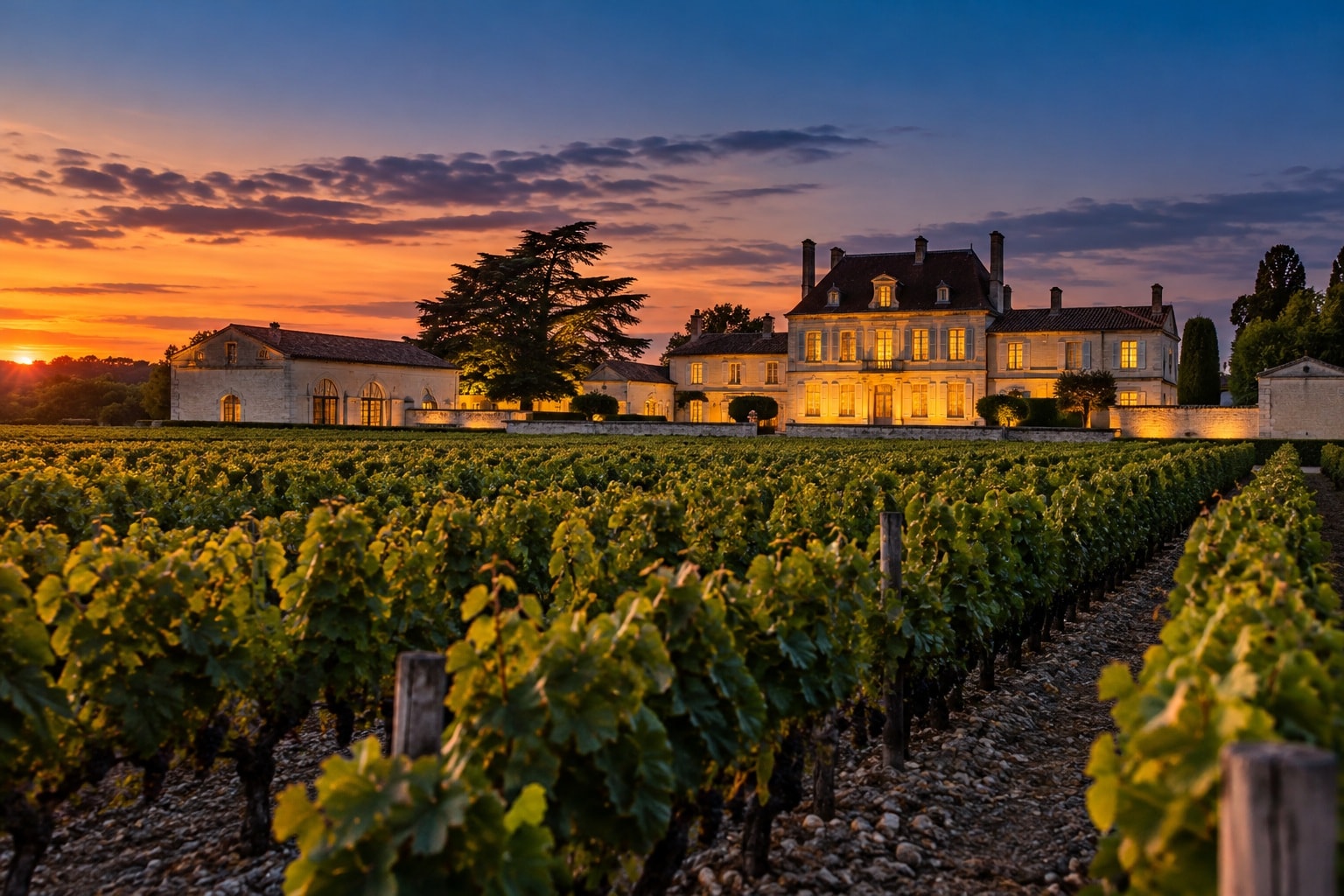
A Fifth Growth That Refused to Be Defined by Its Ranking
In Bordeaux, few distinctions carry as much historical weight as the Classification of 1855. For more than 170 years, the celebrated hierarchy of First, Second, Third, Fourth and Fifth Growths has influenced the reputation and commercial standing of the Médoc's most prestigious estates.
Yet classification and contemporary quality do not always tell the same story.
Among the most compelling examples is Château Pontet-Canet, a Fifth Growth from Pauillac whose modern reputation has challenged traditional expectations of its position in the hierarchy.
Situated close to some of Bordeaux's most celebrated vineyards, Pontet-Canet has become known for its distinctive approach to viticulture, its commitment to expressing individual vineyard parcels and its ability to produce wines of remarkable concentration, precision and ageing potential.
Its transformation raises an intriguing question: can a château officially classified as a Fifth Growth produce wines that belong in the company of Bordeaux's most prestigious estates?
For many enthusiasts, Pontet-Canet demonstrates why the answer cannot be found in classification alone.
The Meaning of Fifth Growth in Bordeaux
To understand Pontet-Canet's reputation, it helps to understand what its classification actually represents.
The Bordeaux Classification of 1855 was established for the Exposition Universelle in Paris. It organised leading Médoc estates into five categories, largely reflecting their established commercial reputations and historical market prices.
Pontet-Canet was included among the Cinquièmes Crus, or Fifth Growths.
The classification remains an important reference point today, but it is not an annual assessment of quality. An estate's position does not automatically change when its wines improve, nor does a higher classification guarantee that every vintage will outperform wines from lower-ranked properties.
This distinction matters because Bordeaux has evolved considerably since 1855.
Vineyard management, winemaking techniques, selection standards and knowledge of individual terroirs have advanced dramatically. Some estates have undergone particularly ambitious transformations, earning reputations that differ substantially from their historical rankings.
The informal expression Super Second is sometimes used for wines whose quality or reputation is considered comparable with leading classified growths, despite their official position.
It is not a recognised classification, and there is no definitive list of estates entitled to the description.
Nevertheless, Pontet-Canet's modern achievements have made it a natural subject in discussions about Bordeaux properties that perform beyond their historical rank.
Three Centuries of History in Pauillac
Pontet-Canet's origins reach back to the early eighteenth century, when Jean-François de Pontet began assembling vineyard holdings in the northern Médoc.
The estate subsequently passed through the hands of the Cruse family, who acquired it in 1865 and invested in its development.
A particularly significant chapter began in 1975, when Guy Tesseron purchased the property.
The Tesseron family, already established in the Cognac business, recognised the potential of Pontet-Canet's vineyards and began a long-term programme of improvement.
In 1994, Alfred Tesseron assumed responsibility for managing the estate.
His approach would ultimately reshape Pontet-Canet's identity.
Rather than relying exclusively on established Bordeaux practices, Alfred became increasingly interested in understanding the relationship between soil, vine health and the character of the finished wine.
The objective was not simply to produce more powerful wines. It was to achieve a clearer expression of the vineyard itself.
Justine Tesseron joined the family enterprise in 2015 and has continued its development, building on the foundations established during her father's tenure.
Across approximately three centuries, Pontet-Canet has belonged to only three families — a remarkable degree of continuity for a major Médoc estate.
An Exceptional Position in the Heart of Pauillac
Pauillac occupies a distinguished position on Bordeaux's Left Bank.
The appellation is home to three of the five First Growths of the 1855 classification: Château Lafite Rothschild, Château Latour and Château Mouton Rothschild.
Pontet-Canet's vineyards lie in this prestigious landscape, with Lafite and Mouton among its celebrated neighbours.
The estate covers approximately 81 hectares, divided into around one hundred vineyard parcels.
Its soils are not uniform.
The central plateau consists largely of deep Garonne gravel over limestone, providing the drainage and relatively low fertility that favour Cabernet Sauvignon.
Other parcels contain greater proportions of clay and limestone, creating conditions particularly suitable for Merlot.
This diversity allows the estate to work with several complementary expressions of its terroir.
Cabernet Sauvignon provides much of the wine's structure, aromatic definition and capacity for ageing. Merlot contributes texture and fruit character, while smaller proportions of Cabernet Franc and Petit Verdot can add further complexity.
The exact blend varies by vintage.
Some of the estate's older vines date from the late 1940s, and the vineyard's average vine age is approximately 50 years.
For Pontet-Canet, understanding these individual parcels has become central to its philosophy.
The ambition is not to impose one uniform style across the property, but to preserve the distinctions that make each part of the vineyard valuable.
The Biodynamic Revolution
Perhaps no decision has contributed more to Pontet-Canet's modern identity than its transition towards organic and biodynamic viticulture.
The process began in 2004, when the estate converted an initial 14 hectares to biodynamic farming.
Following the results of this experiment, the decision was taken in 2005 to extend the approach across the vineyard.
In 2010, Pontet-Canet achieved both organic and biodynamic certification, becoming the first Médoc classified growth to obtain this double certification across its entire vineyard.
The transition represented far more than a change in vineyard treatments.
It required a fundamental reassessment of how the estate managed its soils, vines and agricultural environment.
Working with the Vineyard Rather Than Against It
Biodynamic viticulture is based on an approach to agriculture that considers the vineyard as an interconnected living system.
At Pontet-Canet, this philosophy has encouraged greater attention to soil condition, biodiversity and the natural development of the vines.
The estate has progressively reduced its reliance on heavy machinery in certain vineyard operations.
Since 2008, workhorses have been introduced to cultivate selected parcels, helping to limit soil compaction.
Today, Percheron horses work a substantial proportion of the vineyard.
The estate has also adopted techniques such as manually interweaving vine shoots rather than routinely trimming the canopy.
These decisions are labour-intensive, but they reflect Pontet-Canet's emphasis on observing and responding to the needs of individual vines.
It is important to distinguish the estate's documented agricultural practices from broader claims about biodynamics.
Although Pontet-Canet attributes improvements in wine character to its approach, the specific contribution of biodynamic methods cannot be isolated from other changes in vineyard management, selection and winemaking.
What is beyond doubt is the scale and consistency of the estate's commitment.
A Different Philosophy in the Cellar
Pontet-Canet's approach does not end when the grapes are harvested.
The same emphasis on preserving vineyard character extends into the winery.
Grapes are harvested by hand, and individual parcels are assessed with close attention to their maturity and characteristics.
Fermentation and extraction are managed with the objective of retaining the fruit's natural expression rather than pursuing concentration for its own sake.
The estate has also explored alternatives to conventional oak maturation.
Alongside traditional barrels, Pontet-Canet uses concrete amphorae, allowing part of the wine to mature without the same aromatic contribution associated with new oak.
The intention is to balance structure, texture and freshness while avoiding unnecessary interference with the wine's identity.
This does not mean that oak has disappeared from Pontet-Canet.
Instead, different maturation vessels provide the winemaking team with additional possibilities when assembling the final wine.
The resulting style combines the classical architecture of Pauillac with an individual interpretation of the appellation.
What Does Château Pontet-Canet Taste Like?
Although every vintage has its own personality, several characteristics are commonly associated with Pontet-Canet.
The wines often display concentrated blackcurrant and dark berry fruit, accompanied by notes of cedar, graphite, spice and, with maturity, more complex earthy and savoury aromas.
Their structure is typically substantial, reflecting the importance of Cabernet Sauvignon and the character of Pauillac's gravel soils.
Yet Pontet-Canet's reputation is not based on power alone.
In successful vintages, the wines can combine impressive concentration with finely integrated tannins, freshness and considerable persistence.
This balance is particularly important for collectors and enthusiasts interested in long-term cellaring.
A wine with generous fruit but insufficient structure may develop differently from one possessing the acidity, tannins and concentration required for extended maturation.
Pontet-Canet's finest vintages have demonstrated the ability to combine these elements convincingly.
However, tasting character and ageing potential depend on the individual year, storage conditions and bottle history.
There is no single drinking window that accurately describes every vintage.
The Vintages That Changed Its Reputation
Certain vintages have played a particularly important role in establishing Pontet-Canet's modern standing.
2005 – A Landmark Bordeaux Vintage
The 2005 growing season produced highly regarded wines across much of Bordeaux.
For Pontet-Canet, the vintage represents an important stage in the estate's modern development, combining the structure associated with Pauillac with the increasingly precise vineyard work introduced during the preceding years.
It remains a useful reference point for understanding the château's evolution.
2009 – Richness and Remarkable Depth
The 2009 vintage is associated with generous fruit, concentration and a notably expressive character.
Pontet-Canet's own tasting description highlights blackcurrant, blackberry, graphite and aromatic complexity, supported by finely structured tannins.
It is a vintage that demonstrates the estate's capacity to produce a powerful yet carefully balanced wine.
2010 – A Defining Achievement
For many observers, 2010 stands among Pontet-Canet's most important modern vintages.
It was also the first vintage produced under the estate's full organic and biodynamic certification.
The wine is recognised for its concentration, freshness, firm structure and exceptional persistence.
The château describes an aromatic profile involving blackcurrant, cedar and menthol, with considerable depth and length.
The combination of vintage conditions, vineyard management and winemaking made 2010 an important milestone in Pontet-Canet's development.
2016 – Precision and Classical Balance
The 2016 Bordeaux vintage is widely admired for combining ripe fruit with freshness and structural definition.
At Pontet-Canet, it provides an interesting contrast to the richer character often associated with 2009.
For enthusiasts comparing vintages, this difference illustrates why choosing a wine involves more than simply identifying a highly regarded year.
Individual preferences for concentration, elegance, maturity and structure remain important.
Why Vintage Comparison Matters
Even within a single estate, the experience offered by different years can vary substantially.
A mature Pontet-Canet may display tertiary aromas and softened tannins, while a younger vintage may emphasise primary fruit, freshness and a more pronounced structure.
Understanding these differences helps explain why prices for the same château can vary considerably between vintages.
The year on the label is therefore not a minor detail.
It is an essential part of the wine's identity.
Is Pontet-Canet a Super Second?
This is where the estate's story becomes particularly interesting.
Officially, Château Pontet-Canet remains a Fifth Growth.
That classification has not changed.
However, its modern reputation demonstrates that the 1855 hierarchy cannot fully describe the quality of every wine produced in contemporary Bordeaux.
Pontet-Canet has earned considerable critical recognition, particularly for several vintages produced during the twenty-first century.
Its position among Bordeaux's leading estates is supported by its distinctive terroir, sustained investment in vineyard management and the quality achieved in successful years.
Whether it deserves the informal description Super Second is ultimately a matter of judgement.
The term is not an official award, and comparisons between estates must account for vintage variation, stylistic preferences and individual tasting assessments.
What makes Pontet-Canet compelling is not the possibility of assigning it a different unofficial rank.
It is the fact that its achievements encourage wine enthusiasts to look beyond the label's historical classification.
Understanding the Value of Pontet-Canet
Prestige and price are closely connected in Bordeaux, but they are not identical to quality.
The most famous estates command prices influenced by centuries of reputation, international demand, scarcity and their position within the fine wine market.
Pontet-Canet occupies an interesting place in this landscape.
Its Fifth Growth classification contrasts with the reputation of its strongest vintages, creating an opportunity for enthusiasts to evaluate the wine on its individual merits rather than its historical ranking.
That does not mean Pontet-Canet is always inexpensive or necessarily better value than every higher-classified estate.
Prices change according to vintage, availability, merchant, bottle condition and market demand.
A fair comparison should therefore consider the precise vintage and format, together with the wine's provenance and storage history.
For older bottles in particular, the lowest advertised price is not always the most meaningful measure of value.
The quality of the wine and the condition of the individual bottle remain fundamental considerations.
A Bordeaux Estate That Continues to Challenge Expectations
Château Pontet-Canet illustrates how a historic estate can develop a contemporary identity without abandoning the foundations of its heritage.
Its vineyards have occupied an exceptional position in Pauillac for centuries.
Its official classification remains unchanged.
Yet its modern reputation has been shaped by a willingness to reconsider established practices, invest in vineyard health and pursue a distinctive expression of terroir.
The estate's evolution under the Tesseron family has made it one of Bordeaux's most frequently discussed examples of ambition beyond classification.
For wine enthusiasts, Pontet-Canet offers something particularly rewarding: an opportunity to explore the relationship between history, terroir, viticulture, vintage and market value through the story of a single château.
Its greatest achievement may not be challenging the meaning of Fifth Growth, but demonstrating how much more there is to a great Bordeaux wine than its classification.
Fler inlägg
30 Oct 2026
Burgundy vs Bordeaux
Burgundy and Bordeaux have shaped the world of fine wine for centuries, yet their traditions are fundamentally different. From Burgundy’s vineyard-focused classifications and single-variety wines to Bordeaux’s celebrated estates and blending traditions, discover what distinguishes these two historic French wine regions.
23 Oct 2026
Does Wine Vintage Really Matter? A Guide to Understanding Great Years
The year printed on a wine label can influence its character, reputation and price. But understanding what makes a vintage exceptional requires looking beyond the number.
14 Oct 2026
Bordeaux Wine Classifications Explained: From First Growths to Super Seconds
Discover how Bordeaux's historic wine classifications work, why some celebrated estates remain unclassified, and what the rankings really mean for quality, prestige and price.