
14 Oct 2026
Bordeaux Wine Classifications Explained: From First Growths to Super Seconds
Discover how Bordeaux's historic wine classifications work, why some celebrated estates remain unclassified, and what the rankings really mean for quality, prestige and price.
Why Bordeaux Classifications Still Matter
Few wine regions are as closely associated with prestige and hierarchy as Bordeaux.
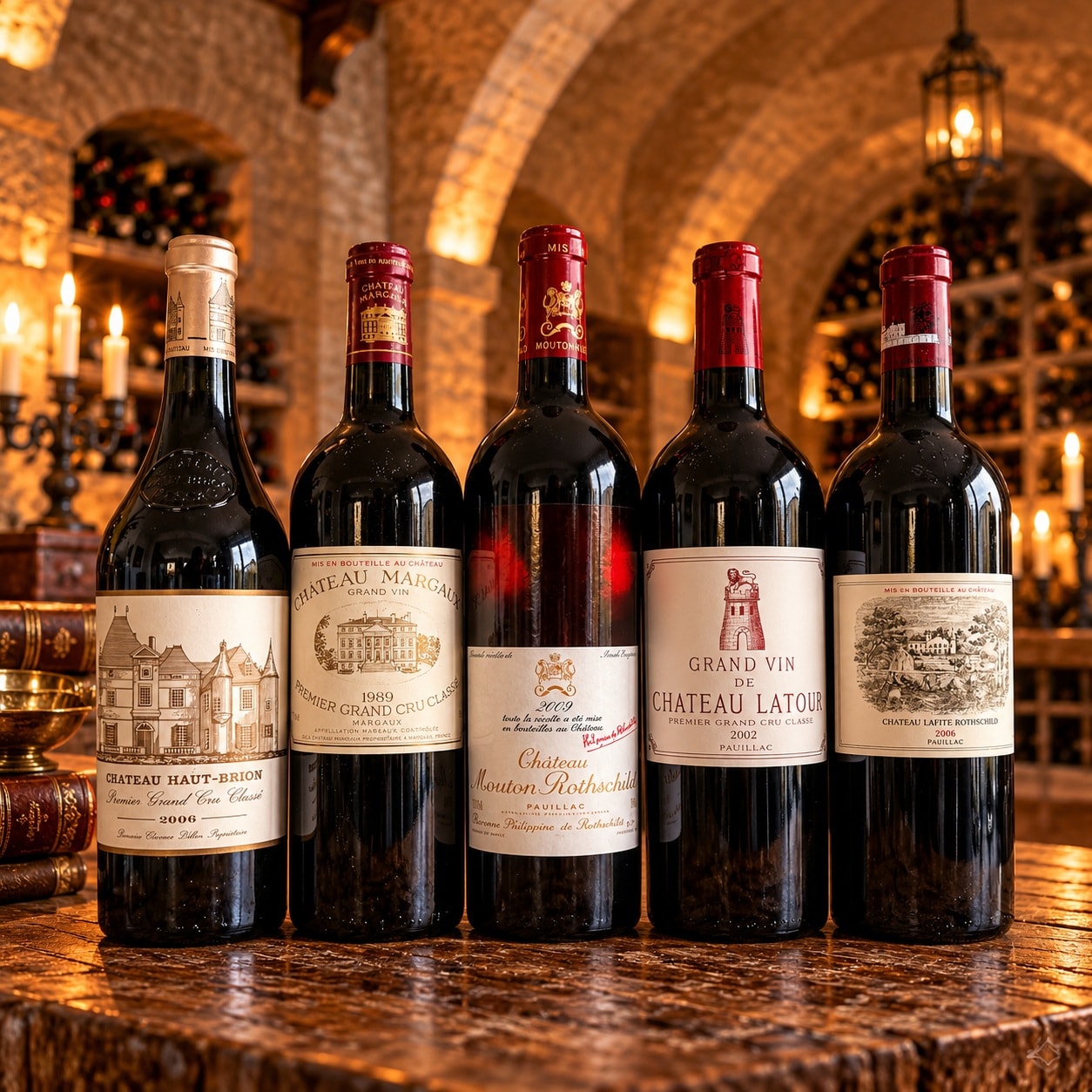
Names such as Château Lafite Rothschild, Château Margaux, Château Latour and Château Haut-Brion have become internationally recognised symbols of fine wine. Their reputations are closely connected to one of the most influential events in wine history: the Bordeaux Classification of 1855.
Yet Bordeaux's classification system is more complicated than many wine enthusiasts initially realise.
Not every prestigious estate belongs to the famous 1855 hierarchy. Some of the world's most sought-after Bordeaux wines come from properties that were never included in it.
Others have earned reputations that arguably exceed their historical classification.
And while the term First Growth carries considerable authority, it does not necessarily mean that every wine produced by a First Growth will outperform every wine from a lower-ranked château.
Understanding Bordeaux classifications therefore requires more than memorising a list of famous names.
It means understanding how the different systems originated, which regions they cover and what they can — and cannot — tell us about the wine in the bottle.
For collectors, enthusiasts and anyone comparing Bordeaux vintages, this knowledge provides valuable context when evaluating both quality and price.
The Bordeaux Classification of 1855
The most famous Bordeaux classification was created for the Exposition Universelle held in Paris in 1855.
Emperor Napoleon III wanted Bordeaux's leading wines presented to an international audience.
The Bordeaux Chamber of Commerce asked local wine brokers to organise the region's most prestigious estates into a hierarchy.
Rather than conducting a modern blind tasting competition, the brokers relied largely on established commercial reputations and the prices wines commanded in the market.
The resulting classification divided leading red wine estates into five categories, known as Crus Classés.
These became the First, Second, Third, Fourth and Fifth Growths.
Although the classification is often described as covering the Médoc, one important exception was included: Château Haut-Brion, located in Graves.
The hierarchy has remained remarkably stable.
Its most significant change came in 1973, when Château Mouton Rothschild was promoted from Second Growth to First Growth.
The continued influence of this nineteenth-century ranking is extraordinary.
More than 170 years later, the classification still plays an important role in how Bordeaux wines are perceived, collected and valued.
The Five First Growths of Bordeaux
At the summit of the 1855 classification stand five estates.
ChâteauAppellationClassification
Château Lafite Rothschild
Pauillac
First Growth
Château Latour
Pauillac
First Growth
Château Margaux
Margaux
First Growth
Château Haut-Brion
Pessac-Léognan
First Growth
Château Mouton Rothschild
Pauillac
First Growth
Four estates originally occupied the highest category in 1855.
Château Mouton Rothschild joined them following its promotion in 1973.
The First Growths represent some of Bordeaux's most historically prestigious properties, combining exceptional vineyard sites with generations of reputation and international demand.
However, their wines are not identical.
Lafite Rothschild is often associated with elegance, aromatic refinement and precision.
Latour is celebrated for its structure, concentration and remarkable capacity for ageing.
Margaux is frequently admired for its perfume, finesse and textural elegance.
Haut-Brion is recognised for its distinctive aromatic complexity, structure and character.
Mouton Rothschild is often associated with richness, intensity and expressive Cabernet Sauvignon fruit.
These descriptions are broad stylistic tendencies rather than guarantees. Individual vintages can vary considerably.
For enthusiasts, the differences between the estates are often as interesting as their shared classification.
Second Growths: Some of Bordeaux's Greatest Names
The Second Growth category includes several estates with exceptional reputations.
Among the best known are:
- Château Léoville Las Cases
- Château Pichon Longueville Baron
- Château Pichon Longueville Comtesse de Lalande
- Château Cos d'Estournel
- Château Montrose
- Château Ducru-Beaucaillou
- Château Gruaud Larose
- Château Brane-Cantenac
These estates occupy some of the most distinguished vineyard sites in the Médoc.
Several have produced vintages that are widely considered comparable in quality with wines from the First Growths.
Château Léoville Las Cases, for example, has long been recognised for producing structured, age-worthy Saint-Julien wines.
Château Montrose is similarly admired for the concentration and longevity of its finest Saint-Estèphe vintages.
Meanwhile, the two Pichon estates in Pauillac demonstrate how neighbouring properties can develop distinct stylistic identities.
Their historical classification provides a useful starting point, but the individual château, vintage and wine style remain essential considerations.
Third, Fourth and Fifth Growths
The remaining categories contain a diverse collection of important Bordeaux estates.
Although they sit below the First and Second Growths in the historical hierarchy, many have established formidable modern reputations.
Third Growths
Notable examples include Château Palmer, Château Calon Ségur and Château Giscours.
Château Palmer is particularly interesting because its contemporary reputation frequently places it among the most admired wines of Margaux.
Its official classification remains Third Growth.
Fourth Growths
The Fourth Growth category includes estates such as Château Beychevelle, Château Talbot and Château Branaire-Ducru.
These properties demonstrate the diversity of styles and terroirs found within the Médoc.
Fifth Growths
The Fifth Growth category includes several estates whose modern reputations extend well beyond what their historical position might suggest.
Examples include Château Pontet-Canet, Château Lynch-Bages, Château Grand-Puy-Lacoste and Château Clerc Milon.
Pontet-Canet has attracted particular attention for its commitment to biodynamic viticulture and its achievements in highly regarded vintages.
Lynch-Bages has similarly developed an international reputation for powerful, structured Pauillac wines.
Their success illustrates an important principle:
A château's classification describes its historical position in the 1855 hierarchy, not a fixed ceiling on the quality it can achieve today.
What Does Super Second Mean?
The expression Super Second is one of the most interesting — and sometimes misunderstood — terms in Bordeaux.
It is not an official classification.
There is no regulatory authority responsible for awarding the designation, and no universally accepted list of qualifying estates.
Instead, the term is used informally to describe certain properties whose quality, reputation or market standing is considered comparable with wines from a higher historical category.
Traditionally, the expression has been associated with outstanding Second Growth estates that approach First Growth quality or prestige.
Château Léoville Las Cases, Château Cos d'Estournel and Château Montrose are frequently discussed in this context.
The expression is also sometimes used more broadly when discussing lower-classified estates whose modern achievements appear to exceed their historical ranking.
Château Palmer, Château Lynch-Bages and Château Pontet-Canet are examples of properties that may feature in these wider discussions.
However, describing an estate as a Super Second should never be confused with an official promotion.
Pontet-Canet remains a Fifth Growth.
Palmer remains a Third Growth.
And the great Second Growths retain their original classifications.
The value of the term lies in encouraging enthusiasts to consider contemporary quality alongside historical prestige.
Its limitation is that the meaning can vary depending on who uses it.
Why Some Great Bordeaux Wines Are Not Classified in 1855
One of the most common misconceptions about Bordeaux is that every prestigious estate belongs to the 1855 classification.
In reality, the famous hierarchy primarily concerns red wines from the Médoc, together with Château Haut-Brion.
It does not provide a comprehensive ranking of Bordeaux as a whole.
Some of the region's most celebrated wines come from Saint-Émilion and Pomerol on the Right Bank.
Others originate in Graves and Pessac-Léognan.
These areas have their own histories and, in some cases, separate classification systems.
Understanding these distinctions is essential when comparing Bordeaux estates.
Saint-Émilion: A Classification That Can Change
Unlike the 1855 classification, the Saint-Émilion classification was designed to be periodically revised.
First introduced in 1955, it recognises selected estates within the Saint-Émilion Grand Cru appellation.
The system includes two principal levels:
Premier Grand Cru Classé, with the highest-ranking estates designated Premier Grand Cru Classé A, and Grand Cru Classé.
The distinction between Saint-Émilion Grand Cru and Saint-Émilion Grand Cru Classé is important.
Saint-Émilion Grand Cru is an appellation designation.
Saint-Émilion Grand Cru Classé is a classification awarded to qualifying estates.
The two are not interchangeable.
The 2022 Saint-Émilion Classification
The classification published in 2022 recognised 85 estates.
Two received the highest designation, Premier Grand Cru Classé A:
- Château Figeac
- Château Pavie
A further 12 estates were classified Premier Grand Cru Classé B, while 71 received Grand Cru Classé status.
Several internationally renowned properties, including Château Cheval Blanc, Château Ausone and Château Angélus, were not included in the 2022 classification after withdrawing from the process.
Their absence does not mean their wines suddenly became less prestigious or less capable of achieving exceptional quality.
It demonstrates that classification status and international reputation are related, but distinct, concepts.
Saint-Émilion provides a particularly clear example of how classification systems can evolve — and how their authority can also become a subject of debate.
Pomerol: Great Wines Without an Official Classification
Pomerol offers an even more striking contrast.
Despite producing some of the world's most expensive and sought-after Bordeaux wines, the appellation has no official château classification.
Its leading estates have established their reputations through vineyard quality, winemaking, historical performance and market demand.
The most famous example is Château Pétrus.
Other highly regarded properties include Château Le Pin, Château Lafleur, Vieux Château Certan and Château La Conseillante.
These estates do not need a formal classification to command international recognition.
Pomerol demonstrates that a wine's prestige can develop independently of an official hierarchy.
It also illustrates why comparing Bordeaux wines solely through classification can be misleading.
An unclassified Pomerol may be considerably more expensive than a classified Médoc growth.
The absence of a classification tells us very little about its potential quality or market value.
Graves and Pessac-Léognan: A Different Classification
The Graves classification was established in stages during the 1950s, with the definitive list completed in 1959.
Unlike the Médoc's five-tier hierarchy, the Graves system recognises selected estates without dividing them into First, Second or Third Growth categories.
Properties may be classified for red wine, white wine or both.
The classification includes renowned estates such as Château Haut-Bailly, Château Smith Haut Lafitte, Domaine de Chevalier and Château Pape Clément.
Château Haut-Brion occupies a particularly unusual position.
It is both a First Growth in the 1855 classification for red Bordeaux and a classified growth of Graves.
This overlap reflects the estate's exceptional historical standing.
Today, the most celebrated classified Graves estates are situated within the Pessac-Léognan appellation, established in 1987.
The region is particularly interesting because it produces distinguished dry white wines alongside its famous reds.
Sauternes and Barsac: The Sweet Wine Classification of 1855
The 1855 classification also included the great sweet wines of Sauternes and Barsac.
These were ranked separately from the Médoc's red wines.
At the summit stands Château d'Yquem, which received the unique designation Premier Cru Supérieur.
Below it are the Premier Cru and Deuxième Cru categories.
Notable classified estates include Château Suduiraut, Château Rieussec, Château Climens and Château Coutet.
The existence of this separate hierarchy is another reminder that the expression Bordeaux Classification of 1855 encompasses more than the famous five red wine First Growths.
It also reflects the historical importance of Bordeaux's great sweet wines.
Does a Higher Classification Mean Better Wine?
Not necessarily.
Classification is an important part of Bordeaux's history, but it should not be interpreted as an objective prediction of the quality of every bottle.
Several factors influence the character and performance of an individual wine.
Terroir
Soil composition, drainage, vineyard exposure and local climate all influence how grapes ripen and develop.
Even neighbouring estates can produce wines with noticeably different characteristics.
Vintage Conditions
Weather varies from year to year.
Temperature, rainfall, sunshine and conditions during harvest can significantly influence concentration, freshness, tannin structure and ageing potential.
A highly successful vintage from a lower-classified estate may provide a more rewarding experience than a less successful year from a more prestigious property.
Vineyard and Winemaking Decisions
The quality of vineyard management, harvest timing, fruit selection, extraction and maturation all influence the finished wine.
These practices have changed considerably since the nineteenth century.
Bottle Age and Provenance
Fine wine evolves after bottling.
Storage temperature, humidity, handling and the condition of the cork can affect how an individual bottle develops.
For mature Bordeaux, provenance may be particularly important.
Consequently, classification should be viewed as one piece of information within a much broader assessment.
How Classification Influences Bordeaux Wine Prices
The relationship between classification and price is complex.
Historical prestige contributes to demand, particularly among collectors and international buyers.
First Growth estates often command substantial premiums because of their reputations, established markets and limited production relative to global demand.
However, classification is only one factor.
Vintage quality, critic assessments, bottle condition, availability and changing market sentiment can all influence prices.
Some lower-classified estates have experienced significant increases in reputation and demand following improvements in quality.
Others may offer attractive opportunities for enthusiasts who value drinking experience more highly than historical status.
The key is to compare like with like.
A Château Pontet-Canet 2010 and a Château Pontet-Canet 2017 are not interchangeable simply because they come from the same producer.
Similarly, a mature bottle with documented storage history should not automatically be considered equivalent to one with uncertain provenance.
For meaningful price comparisons, the exact producer, wine, vintage and bottle format must be identified.
How to Use Bordeaux Classifications When Choosing Wine
The most useful approach is to treat classification as a guide to historical reputation rather than a final judgement of quality.
A First Growth designation tells us something important about an estate's longstanding prestige.
A Second Growth classification places a property within a distinguished historical group.
A Fifth Growth ranking identifies its position in the original hierarchy, but does not prevent it from producing outstanding modern wines.
Meanwhile, the absence of an 1855 classification does not diminish the achievements of Saint-Émilion, Pomerol or other Bordeaux appellations.
For enthusiasts exploring Bordeaux, the most rewarding discoveries often come from comparing estates, vintages and styles rather than following classification alone.
The historical hierarchy provides context.
The wine itself provides the experience.
Beyond the Classification
The Bordeaux classification systems remain among the most influential institutions in the world of fine wine.
They preserve an extraordinary connection between nineteenth-century commercial history and the modern international wine market.
Yet their continued relevance depends on understanding their limitations.
The Classification of 1855 captures a particular historical moment.
Saint-Émilion's periodically revised system offers a different approach.
Pomerol demonstrates that exceptional reputations can flourish without formal classification.
And estates such as Château Pontet-Canet show how contemporary achievement can challenge expectations created by historical rankings.
For anyone exploring Bordeaux, the lesson is clear:
Classification helps explain a wine's history and reputation. Understanding its terroir, producer and vintage helps explain the wine itself.
Fler inlägg
30 Oct 2026
Burgundy vs Bordeaux
Burgundy and Bordeaux have shaped the world of fine wine for centuries, yet their traditions are fundamentally different. From Burgundy’s vineyard-focused classifications and single-variety wines to Bordeaux’s celebrated estates and blending traditions, discover what distinguishes these two historic French wine regions.
23 Oct 2026
Does Wine Vintage Really Matter? A Guide to Understanding Great Years
The year printed on a wine label can influence its character, reputation and price. But understanding what makes a vintage exceptional requires looking beyond the number.
14 Oct 2026
Château Pontet-Canet: The Fifth Growth with Super Second Ambitions
How a historic Pauillac estate challenged Bordeaux conventions, embraced biodynamic viticulture and earned a reputation that extends far beyond its 1855 classification.