
13 Nov 2026
Bordeaux Second Wines: The Great Misconception
Not every Bordeaux wine produced alongside a famous Grand Vin is a conventional second wine. From Clos du Marquis and Alter Ego de Palmer to Les Forts de Latour and Le Petit Mouton, discover how vineyard origins, selection and winemaking philosophy shape some of Bordeaux's most misunderstood wines.
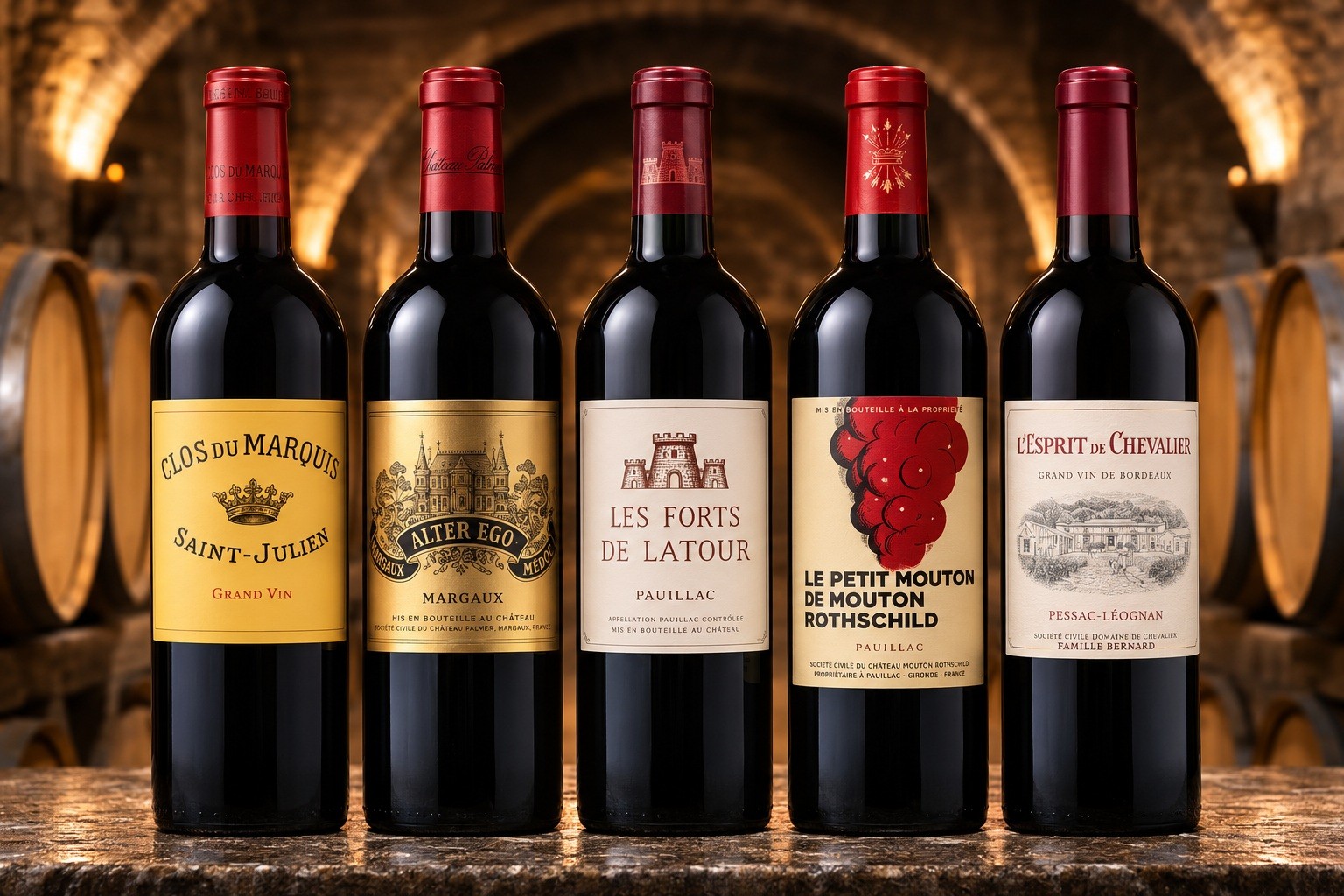
The Great Second Wine Misconception
Why Some of Bordeaux’s Most Interesting Wines Are Not Second Wines at All
In Bordeaux, the difference between a Grand Vin and a second wine appears straightforward. Look more closely, however, and a far more interesting story emerges – one involving historic vineyards, independent identities and competing interpretations of what a second wine should be.
For many wine enthusiasts, the concept of a second wine seems simple.
A prestigious Bordeaux château produces its celebrated Grand Vin. Grapes or wine lots that do not meet the estate's requirements for the principal bottling are used to create a second label.
The second wine is generally less expensive, often approachable earlier, and offers an opportunity to explore the character of a famous property without purchasing its flagship wine.
That description is broadly accurate for many estates.
But it is far from universal.
Some wines that are routinely discussed alongside Bordeaux second wines have separate vineyard histories, distinctive production objectives or identities deliberately established outside the traditional Grand Vin hierarchy.
Others are genuine second wines yet possess vineyard resources and production philosophies that make them considerably more complex than the expression second wine might suggest.
Few examples illustrate these distinctions better than Clos du Marquis, Alter Ego de Palmer, Les Forts de Latour, Le Petit Mouton de Mouton Rothschild and L’Esprit de Chevalier.
Together, they reveal why understanding Bordeaux requires looking beyond the label.
What Is a Bordeaux Second Wine?
The term second wine, or second vin, generally describes a wine produced by an estate alongside its principal bottling.
The Grand Vin represents the selection intended to express the producer's highest ambitions for a particular vintage.
The second wine provides an additional expression of the estate's production.
Traditionally, this may involve grapes from younger vines, particular vineyard parcels or wine lots that do not fit the final composition of the Grand Vin.
However, the precise approach varies between producers.
The Role of Selection
Selection is central to the production of fine Bordeaux.
Different parcels may produce grapes with different levels of ripeness, concentration, acidity and tannic structure.
Even within the same vineyard, individual vines can behave differently because of their age, exposure and growing conditions.
The winemaking team must evaluate these differences before deciding how the final wines will be assembled.
At some estates, this process results in two clearly differentiated wines.
At others, the relationship is more complex.
A Second Wine Is Not Necessarily Inferior Wine
The word second can create a misleading impression.
It describes a position within a producer's wine hierarchy, not an independently defined quality category.
A second wine may benefit from the same vineyard management, harvesting standards, winemaking facilities and technical expertise as the Grand Vin.
Its selection may emphasise different structural characteristics or a style intended to be appreciated earlier.
The distinction is therefore not simply between good grapes and bad grapes.
It concerns how a producer chooses to express the characteristics of its vineyard.
Three Questions Worth Asking
When evaluating a Bordeaux wine associated with a famous estate, three questions are particularly useful:
1. Where do the grapes originate?
Are they drawn from the same vineyard resources as the Grand Vin, from younger vines, or from separately identified parcels?
2. How is the wine selected?
Is it primarily assembled from lots not chosen for the Grand Vin, or does the estate establish a different objective before harvest?
3. How does the producer define the wine?
Does the château explicitly describe it as a second wine, or as a distinct expression with its own identity?
The answers can reveal important differences between wines that might otherwise appear to occupy the same category.
Clos du Marquis – The Wine That Challenges the Definition
Saint-Julien, Bordeaux
Clos du Marquis is one of the clearest examples of why the conventional understanding of Bordeaux second wines can be misleading.
Produced by Domaines Delon, the family organisation responsible for Château Léoville Las Cases, Clos du Marquis has frequently been associated with the estate's celebrated Grand Vin.
The relationship is understandable.
Both wines originate in Saint-Julien, share the same ownership and benefit from the expertise of the same producer.
Yet their vineyard identities are fundamentally different.
A History Beginning in 1902
Clos du Marquis was established in 1902.
Its name was inspired by the Petit Clos adjoining the Château de Léoville, historically associated with the Marquis de Las Cases.
From its origins, the wine was connected with vineyard land distinct from the principal historic holdings of Léoville Las Cases.
The vineyards used for Clos du Marquis lie farther west, within the Saint-Julien appellation.
Their location places them among some of the Médoc's most celebrated classified properties.
This is not merely a difference in selection between two labels.
It is a distinction rooted in vineyard geography and history.
A Separate Terroir
The vineyards associated with Clos du Marquis possess their own geological characteristics.
Gravel-rich soils, varied underlying formations and the climatic conditions of northern Saint-Julien contribute to the development of the grapes.
Cabernet Sauvignon plays an important role in the wine's structure, supported by Merlot and other traditional Bordeaux varieties according to the vintage.
The resulting style is associated with dark-fruit concentration, tannic definition and the capacity for bottle ageing.
These characteristics are not simply an attempt to reproduce Château Léoville Las Cases at a lower price.
Clos du Marquis is intended to express the identity of its own vineyard resources.
The Most Convincing Evidence
Perhaps the clearest indication of its independent position is that Clos du Marquis has its own second wine.
La Petite Marquise was introduced to provide a separate selection from the Clos du Marquis vineyard holdings.
The relationship is therefore distinct:
- Château Léoville Las Cases has its own Grand Vin and second wine.
- Clos du Marquis is a separate wine with its own vineyard identity.
- La Petite Marquise is the second wine of Clos du Marquis.
The second wine of Château Léoville Las Cases is Le Petit Lion du Marquis de Las Cases, not Clos du Marquis.
This distinction matters when interpreting the wine's history, classification and relationship with the estate.
What Clos du Marquis Teaches Us
Clos du Marquis demonstrates that shared ownership and production expertise do not necessarily make one wine the second wine of another.
A separate vineyard identity can be sufficiently important to establish a wine as an independent expression.
Its reputation must therefore be understood on its own terms.
Alter Ego de Palmer – Two Interpretations of One Terroir
Margaux, Bordeaux
If Clos du Marquis challenges the conventional second-wine definition through vineyard history, Alter Ego de Palmer approaches the question from another direction.
Château Palmer is one of Margaux's most celebrated estates.
Its Grand Vin is associated with depth, aromatic complexity, refined tannins and considerable ageing potential.
Alter Ego de Palmer shares the estate's origins but was developed to express a different interpretation of its terroir.
The Introduction of Alter Ego
Alter Ego was introduced with the 1998 vintage.
Rather than presenting the wine simply as a secondary selection, Château Palmer developed it as another expression of the estate.
The distinction lies particularly in the producer's intentions.
Palmer seeks a particular combination of concentration, depth and structure for its Grand Vin.
Alter Ego places greater emphasis on suppleness, aromatic expression and approachability during the wine's earlier years.
Both wines are produced with considerable attention to detail.
Their stylistic differences are deliberate.
A Different Approach Begins in the Vineyard
At Château Palmer, the distinction between the wines is not necessarily postponed until the final blending process.
The estate evaluates the potential of its vineyard parcels throughout the growing season.
Harvest decisions take account of the characteristics sought for each wine.
For Alter Ego, the estate emphasises aromatic and technological maturity in pursuit of fruit expression and supple texture.
The resulting approach influences how the wine develops from vineyard to cellar.
Merlot and the Character of Alter Ego
Merlot frequently plays an important role in Alter Ego.
Depending on the vintage, it can contribute ripe fruit, rounded texture and supple tannins.
Cabernet Sauvignon provides complementary structure and freshness.
Petit Verdot may also contribute to the blend.
The proportions vary between vintages.
The wine is often associated with dark cherry, plum, floral aromas and a silky palate.
These characteristics should not be interpreted as evidence that Alter Ego is simply a lighter or less concentrated version of Palmer.
The estate's objective is a different balance.
Independent Identity Without Separate Ownership
Alter Ego illustrates an important distinction from Clos du Marquis.
Its identity is not primarily based on an entirely separate historic vineyard.
Instead, it represents a deliberately different interpretation of the Château Palmer estate.
The producer describes Palmer and Alter Ego as two distinct expressions of the same terroir.
This makes Alter Ego a particularly interesting example of how Bordeaux estates can move beyond a simple hierarchy of first and second wines.
What Alter Ego Teaches Us
Two wines can share the same estate and terroir while being created with different stylistic intentions.
The distinction between them may begin before fermentation, through vineyard observation and harvest decisions.
Understanding the producer's philosophy is therefore essential.
Les Forts de Latour – A Second Wine with Its Own Vineyard Complexity
Pauillac, Bordeaux
Les Forts de Latour presents a different perspective.
Unlike Clos du Marquis, it is recognised as the second wine of Château Latour.
Yet its production illustrates why even genuine second wines should not automatically be understood as simple collections of rejected Grand Vin barrels.
An Established Identity
The name Les Forts de Latour first appeared on the wine's label in 1966.
Over subsequent decades, Château Latour developed its production and selection standards.
Today, Les Forts de Latour occupies an important position within the estate's range.
Its identity reflects both vineyard provenance and the producer's approach to blending.
Three Sources of Grapes
According to Château Latour, Les Forts de Latour can draw on three broad sources.
The first consists of vines situated around the edge of the historic Enclos.
The second comprises selected parcels that may be considered for the Grand Vin but are ultimately incorporated into Les Forts de Latour following assessment.
The third includes vineyard parcels outside the Enclos, within Pauillac.
These external holdings have their own histories and geological characteristics.
Some have belonged to the estate for more than a century.
Others were acquired more recently.
The result is a wine whose composition can reflect several distinct vineyard environments.
More Than a Secondary Selection
The production of Les Forts de Latour involves the same meticulous attention to vineyard management and winemaking that characterises Château Latour.
The estate identifies differences in vineyard origins and oak maturation as important distinctions between its wines.
Les Forts de Latour also generally contains a higher proportion of Merlot than the Grand Vin.
These factors influence its texture, aromatic character and development.
Why It Remains a Second Wine
Despite its substantial vineyard identity, Les Forts de Latour remains Château Latour's second wine.
This is an important distinction.
A wine does not cease to be a second wine merely because some of its grapes originate from dedicated or geographically separate parcels.
The producer's established hierarchy, selection philosophy and identification of the wine all matter.
What Les Forts de Latour Teaches Us
A second wine can possess complex vineyard origins, significant ageing potential and an identity developed over decades.
The term second wine does not describe a single production method.
It describes a relationship within the estate's wine range.
Le Petit Mouton – The Classical Second Wine, Refined
Pauillac, Bordeaux
Le Petit Mouton de Mouton Rothschild offers a more traditional example of the second-wine concept.
Produced by Château Mouton Rothschild, one of Bordeaux's five Premier Cru Classé estates, it is explicitly identified by the producer as its second wine.
Its production is closely connected with the selection standards applied to the Grand Vin.
A Modern Beginning
The first vintage was 1993.
That wine appeared under the name Le Second Vin de Mouton Rothschild.
From the 1994 vintage, it adopted the name Le Petit Mouton de Mouton Rothschild.
The name has a personal connection with Baroness Philippine de Rothschild, whose residence within the estate was known as Petit Mouton.
Its label draws inspiration from artwork by Jean Carlu, whose association with Mouton Rothschild forms part of the château's distinctive artistic history.
Younger Vines, Exceptional Terroir
Le Petit Mouton is produced particularly from selected younger vines within the Mouton Rothschild vineyard.
These vines benefit from the same prestigious Pauillac terroir as the estate's principal wine.
The grapes are harvested and vinified with considerable care.
However, the final selection differs from that of Château Mouton Rothschild.
The Grand Vin is assembled from the components considered most suitable for the estate's principal expression.
Le Petit Mouton provides another interpretation of the vineyard.
The Importance of the Selection Process
The relationship between Le Petit Mouton and Mouton Rothschild demonstrates how rigorous selection can shape two different wines.
The Grand Vin reflects the estate's most demanding selection criteria.
The second wine is also carefully assembled rather than treated as an automatic destination for everything not included in the first.
This distinction is important.
The quality of a second wine depends on the characteristics of the selected material and the decisions made throughout production.
A Separate Drinking Experience
Le Petit Mouton generally offers a different balance of structure, fruit expression and approachability from the Grand Vin.
Nevertheless, its style varies between vintages.
Its relationship with Château Mouton Rothschild should not lead to the assumption that every vintage will develop in the same way or offer an identical drinking experience.
What Le Petit Mouton Teaches Us
A traditional second wine can be an exceptionally carefully produced wine in its own right.
Its position within the estate hierarchy does not diminish the importance of its vineyard origins or production standards.
L’Esprit de Chevalier – Selection as a Philosophy
Pessac-Léognan, Bordeaux
L’Esprit de Chevalier provides another valuable example of the traditional second-wine model.
Produced by Domaine de Chevalier in Pessac-Léognan, it reflects an estate philosophy built around careful vineyard management, selective harvesting and precise blending.
The Origins of L’Esprit
Domaine de Chevalier introduced L’Esprit de Chevalier in 1989.
The estate describes its second wine as an expression of its selective approach.
Younger vines contribute to its production, alongside wine lots that do not possess precisely the structure or characteristics sought for the Grand Vin.
The objective is not simply to produce a less expensive wine.
It is to preserve the intended identity of the principal wine while creating another expression of the estate.
A Distinction Between Red and White
Domaine de Chevalier is particularly interesting because it produces both red and dry white wines.
L’Esprit de Chevalier exists in both categories.
The red wine is principally based on Cabernet Sauvignon and Merlot, with other Bordeaux varieties potentially contributing according to the vintage.
Its style is generally associated with dark fruit, balanced structure and an ability to be appreciated earlier than the Grand Vin.
The white wine, based on Sauvignon Blanc and Sémillon, is produced through the estate's approach to barrel fermentation and individual barrel selection.
Its character emphasises freshness, fruit expression and texture.
Two Wines, Two Selection Processes
The red and white versions share the same producer but should not be treated as interchangeable expressions.
Different grape varieties require different harvesting and winemaking decisions.
For the white wine, individual barrel assessment is particularly important.
For the red wine, vineyard selection and blending contribute to the final balance of structure and elegance.
Both demonstrate how the second-wine concept can be adapted to different wine styles within the same estate.
What L’Esprit de Chevalier Teaches Us
A second wine is not necessarily defined by a single technical formula.
Its production can involve different selection methods depending on grape variety, vineyard conditions and the characteristics sought by the estate.
The defining feature is the producer's deliberate creation of a separate wine within its established hierarchy.
Five Wines, Three Different Philosophies
The examples reveal three broad approaches to wine identity in Bordeaux.
1. Independent Vineyard Identity
Clos du Marquis
The wine originates from historically distinct vineyard resources and has its own second wine.
Its relationship with Château Léoville Las Cases is based on common ownership and production expertise rather than a conventional Grand Vin–second wine hierarchy.
2. Deliberately Different Stylistic Identity
Alter Ego de Palmer
The wine shares Château Palmer's terroir but is conceived as another interpretation of the estate.
Its selection and production emphasise a different balance of maturity, fruit expression and texture.
3. Traditional Second Wines with Distinct Selection Philosophies
Les Forts de Latour, Le Petit Mouton and L’Esprit de Chevalier
All three are explicitly associated with the second-wine category.
Yet their vineyard origins, grape selection and production methods differ considerably.
Les Forts de Latour draws on several vineyard sources.
Le Petit Mouton is closely associated with selected younger vines and rigorous Grand Vin selection.
L’Esprit de Chevalier reflects a broader estate philosophy involving young vines, individual wine lots and separate red and white selections.
The common term second wine therefore conceals significant differences.
Does a Second Wine Offer Better Value?
The question of value is one of the most interesting aspects of Bordeaux second wines.
A bottle associated with a prestigious château may cost substantially less than its Grand Vin.
That difference can make the wine attractive to collectors and enthusiasts.
However, a lower price does not automatically mean better value.
Reputation and Pricing
The price of a Bordeaux wine reflects several influences.
These include producer reputation, vintage, demand, availability, ageing potential and market conditions.
Association with a famous estate may itself contribute to the price of a second wine.
The relationship between price and quality is therefore not always straightforward.
Different Wines, Different Experiences
A Grand Vin may offer greater concentration, structural depth or long-term ageing potential.
A second wine may emphasise fruit expression and earlier approachability.
An independent wine such as Clos du Marquis may offer a different terroir expression altogether.
These are different experiences rather than interchangeable versions of the same product.
Vintage Matters
The relationship between two wines from the same producer can change considerably between vintages.
Weather conditions influence grape maturity, selection and blending.
An unusually successful vintage of a second wine may offer a particularly compelling combination of quality and price.
Conversely, a celebrated vintage may attract significant demand and higher prices across an estate's entire range.
Evaluating value therefore requires more than comparing the labels.
The Importance of Comparing Like with Like
When comparing prices, it is essential to distinguish between:
- The exact wine.
- The producer.
- The vintage.
- The bottle format.
- The retailer's available offer.
Clos du Marquis and Le Petit Lion are not alternative names for the same wine.
Neither are Château Palmer and Alter Ego de Palmer.
The distinction matters both for understanding what is in the bottle and for making meaningful price comparisons.
Classification – Another Source of Confusion
Bordeaux's historic classification systems can create further misunderstandings.
Château Léoville Las Cases is classified as a Deuxième Grand Cru Classé under the 1855 classification.
Château Palmer is a Troisième Grand Cru Classé.
Château Latour and Château Mouton Rothschild are Premiers Crus Classés.
Domaine de Chevalier is included among the classified growths of Graves.
However, these classifications should not automatically be transferred to every wine produced by the same estate.
Clos du Marquis is not independently classified as a Deuxième Grand Cru Classé.
Alter Ego de Palmer does not possess its own Troisième Grand Cru Classé classification.
Likewise, Les Forts de Latour and Le Petit Mouton should not be described as independently classified First Growths.
The association with a classified producer is significant.
But the identity of the wine must remain precise.
For enthusiasts exploring Bordeaux, this distinction is particularly important when interpreting labels, retailer descriptions and historical references.
Why Bordeaux's Second Wines Deserve a Closer Look
The most interesting conclusion is not that some second wines are better than others.
It is that the category itself contains a remarkable diversity of ideas.
Clos du Marquis demonstrates the importance of independent vineyard history.
Alter Ego de Palmer illustrates how one estate can deliberately create two different stylistic interpretations of its terroir.
Les Forts de Latour shows that a genuine second wine can have substantial vineyard complexity.
Le Petit Mouton reveals the role of rigorous selection within one of Bordeaux's most celebrated properties.
L’Esprit de Chevalier demonstrates how the concept can extend across both red and white winemaking.
Together, these wines challenge the assumption that Bordeaux operates according to a simple hierarchy in which every alternative label represents a lesser version of a famous Grand Vin.
The reality is considerably more nuanced.
The Question That Matters Most
When exploring a wine associated with a prestigious Bordeaux estate, the most useful question is not simply:
Is this the second wine?
It is:
What is this wine intended to express?
The answer may lie in a separate vineyard, a particular selection of grapes, a distinctive winemaking philosophy or a different interpretation of the same terroir.
Understanding that answer reveals considerably more about the wine than its position within a producer's range.
Explore Bordeaux Beyond the Grand Vin
Bordeaux offers an extraordinary diversity of wines beyond its most celebrated labels.
Some are traditional second wines.
Others are independent expressions from historic vineyards or deliberately different interpretations of an estate's terroir.
Their individual identities deserve to be understood rather than reduced to a single category.
On Sipfind, explore wines such as Clos du Marquis, Alter Ego de Palmer, Les Forts de Latour, Le Petit Mouton and L’Esprit de Chevalier.
Discover their producers, appellations and individual vintages, and compare available offers from European wine retailers.
Because understanding the wine is just as important as recognising the name on the label.
Fler inlägg
23 Nov 2026
Champagne vs the World: What Makes the King of Sparkling Wine So Special?
From the chalk hills of northern France to the vineyards of England, Italy and Spain, the world of sparkling wine is far more diverse than its most famous name suggests. But how did Champagne become the ultimate symbol of celebration, luxury and exceptional winemaking?
6 Nov 2026
Single Malt Scotch Whisky: Regions, Casks and the Pursuit of Character
Discover what defines single malt Scotch whisky, from Scotland's distinctive whisky regions and traditional distillation methods to the influence of oak casks, maturation and the craftsmanship behind the world's finest single malts.
30 Oct 2026
Burgundy vs Bordeaux
Burgundy and Bordeaux have shaped the world of fine wine for centuries, yet their traditions are fundamentally different. From Burgundy’s vineyard-focused classifications and single-variety wines to Bordeaux’s celebrated estates and blending traditions, discover what distinguishes these two historic French wine regions.