
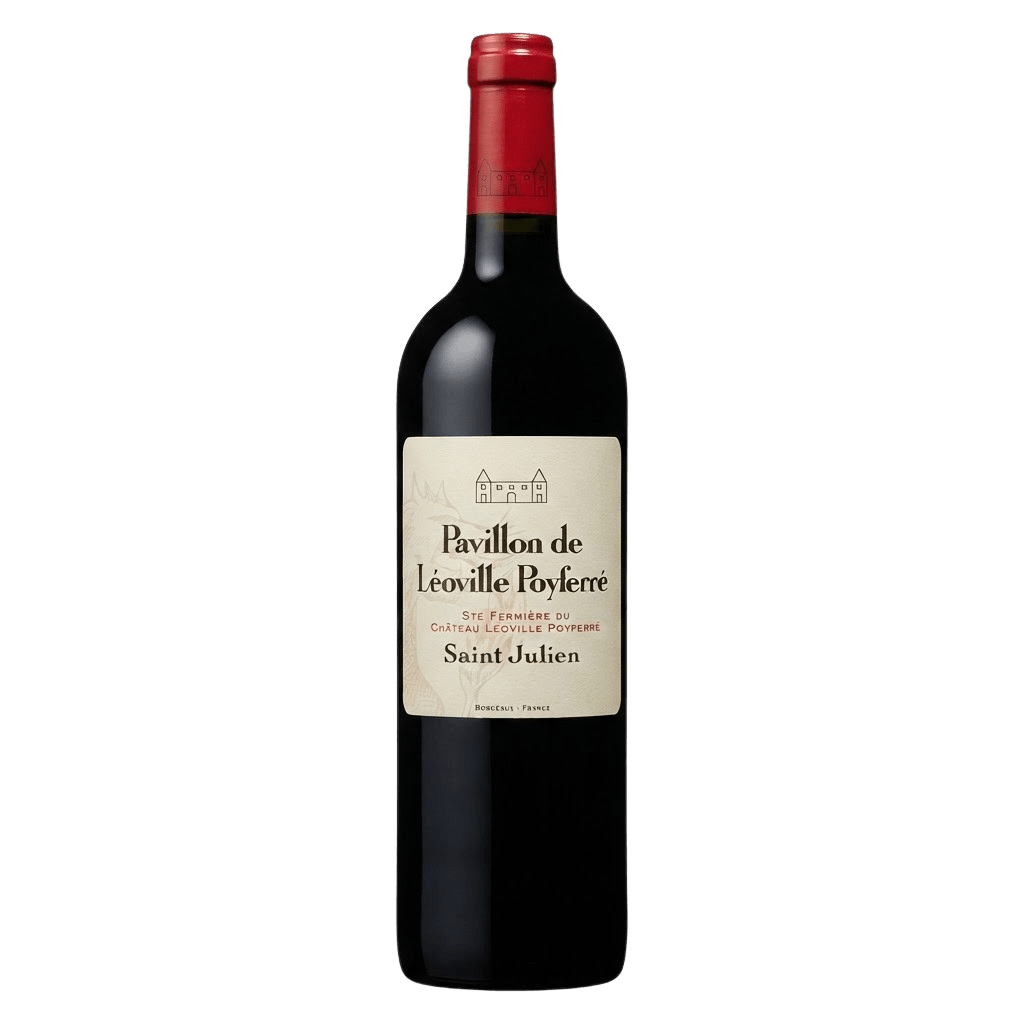
Château Lèoville Poyerré
Pavillon de Léoville Poyferré
2010
A Second Growth Saint-Julien combining Cabernet Sauvignon depth, generous dark fruit, refined tannins and the elegance and ageing potential of classic Left Bank Bordeaux.
Country
France
Region
Bordeaux - Saint-Julien
More information
Producer
Château Léoville Poyferré – A Second Growth of Saint-Julien
Château Léoville Poyferré is a prestigious wine estate in Saint-Julien on Bordeaux's Left Bank. Classified as a Deuxième Grand Cru Classé in 1855, it is one of the three historic Léoville properties that emerged from the division of a once extensive Médoc vineyard.
Owned by the Cuvelier family since 1920, the estate combines centuries of viticultural heritage with precise vineyard management and contemporary winemaking techniques. Its wines are recognised for their generous fruit, aromatic depth, supple tannins and balance, bringing together the richness of ripe Cabernet Sauvignon with the elegance and structure associated with Saint-Julien.
Quick Facts
AttributeDetails
Producer
Château Léoville Poyferré
Location
Saint-Julien-Beychevelle, Médoc, Bordeaux, France
Appellation
Saint-Julien AOC
Classification
Deuxième Grand Cru Classé, 1855
Ownership
Cuvelier family, since 1920
Principal Grape
Cabernet Sauvignon
History and Identity
From the Historic Léoville Estate to a Second Growth
The origins of Château Léoville Poyferré can be traced to 1638, when Jean de Moytié owned vineyards on the gravel ridge known as Mont-Moytié.
During the eighteenth century, the property developed into the extensive Léoville estate, which became one of the most highly regarded vineyards of the Médoc.
Following successive inheritances and divisions during the nineteenth century, the original Léoville property was separated into three estates:
Château Léoville Las Cases, Château Léoville Barton and Château Léoville Poyferré.
Château Léoville Poyferré emerged as a distinct property in 1840, when Baron Jean-Marie de Poyferré added his name to the estate.
In 1855, the château was included among the Second Growths in the official Bordeaux classification, establishing its recognised position within the hierarchy of the Médoc.
A major change followed in 1920, when the Cuvelier family acquired Château Léoville Poyferré together with Château Moulin Riche.
The estate subsequently underwent significant vineyard development and modernisation, particularly under Didier Cuvelier, who assumed responsibility in 1979.
Today, the property is managed by Sara Lecompte Cuvelier, representing the fourth generation of the family.
Estate, Vineyards and Terroir
The Gravel Terraces of Saint-Julien
Château Léoville Poyferré is situated in Saint-Julien, one of the Médoc's most celebrated Cabernet Sauvignon appellations.
The estate's vineyards extend across approximately 80 hectares within Saint-Julien, including the distinct 20-hectare Château Moulin Riche vineyard.
The principal terroirs consist of ancient gravel terraces over sandy-clay subsoils.
These gravel deposits, formed through the geological history of the Gironde, provide the drainage and heat retention particularly suited to Cabernet Sauvignon.
The estate identifies several distinct soil environments, including black earth, sandy gravel, sand, rich gravel and black gravel.
Each contributes different characteristics to the grapes:
- Gravel: Drainage, heat retention and favourable ripening conditions for Cabernet Sauvignon.
- Clay: Water retention and support during periods of summer drought.
- Sand: Well-drained conditions that influence ripening and vine development.
- Mixed gravel and clay: A combination of warmth, water regulation and structural diversity.
This mosaic of soils allows the estate to cultivate different grape varieties according to the characteristics of individual vineyard parcels.
The result is a broad palette of components available for blending, contributing to the depth and complexity of the estate's wines.
Grape Varieties
Cabernet Sauvignon at the Heart of the Estate
Cabernet Sauvignon dominates the vineyards of Château Léoville Poyferré.
The producer's published vineyard composition is:
Grape VarietyVineyard Plantings
Cabernet Sauvignon
63%
Merlot
25%
Petit Verdot
7%
Cabernet Franc
5%
These percentages describe vineyard plantings, not the blend of every vintage.
Cabernet Sauvignon provides the structural foundation of the wines, contributing dark-fruit concentration, tannins and ageing potential.
Merlot introduces generosity, supple texture and fruit richness.
Petit Verdot can contribute colour, spice and additional structure, while Cabernet Franc provides aromatic complexity and freshness.
The final composition of Château Léoville Poyferré changes according to vintage conditions and the selection of individual vineyard parcels.
For Sipfind, exact blend percentages must therefore be stored on the corresponding vintage pages.
Viticulture and Sustainability
Preserving the Balance of the Vineyard
Château Léoville Poyferré places considerable emphasis on maintaining the ecological balance of its vineyards.
The estate combines traditional vineyard observation with modern techniques adapted to individual soil types and growing conditions.
Vineyard work includes canopy management, selective leaf removal, shoot thinning and crop regulation when required.
Cover crops are used to support soil structure and biological activity, while vineyard practices are adjusted to preserve the health of the vines and encourage balanced ripening.
The estate joined Bordeaux's Environmental Management System in 2016 and has held High Environmental Value certification, Level 3, since the 2017 vintage.
This approach reflects a commitment to maintaining vineyard biodiversity and soil health while preserving the quality and individuality of the estate's terroirs.
Winemaking and Maturation
Precision from Vineyard to Cellar
Winemaking at Château Léoville Poyferré is based on detailed selection and separate vinification of individual vineyard parcels.
Grapes are harvested by hand and transported in crates to preserve their condition.
After arrival at the winery, they undergo successive sorting procedures, including manual selection and optical sorting.
Vinification takes place in temperature-controlled stainless steel tanks, allowing different grape varieties and vineyard parcels to be fermented separately.
The estate uses 57 temperature-controlled tanks, including 27 double-walled vessels that permit pre-fermentation cold maceration.
Extraction is carefully managed to develop colour, aromatic concentration and tannin structure while preserving fruit purity.
Following fermentation, the wines undergo maturation in French oak barrels.
The estate describes an ageing period of approximately 18 months, with barrel selection adapted to the character of the wines.
Blending brings together the different vineyard components to achieve the balance of fruit, structure and elegance associated with Château Léoville Poyferré.
Exact barrel proportions, alcohol levels and blend compositions remain vintage-specific.
Style and Identity
Richness, Precision and Saint-Julien Elegance
Château Léoville Poyferré is known for a particularly generous interpretation of Saint-Julien.
The wines combine ripe dark-fruit character with aromatic complexity, supple tannins and the structural definition of Cabernet Sauvignon.
Compared with some more restrained expressions of the appellation, Léoville Poyferré often displays a rounded texture and a relatively approachable character in youth.
Nevertheless, its underlying tannin structure, freshness and concentration provide the foundation for long-term bottle development.
The estate's stylistic identity can be summarised as:
Cabernet Sauvignon → concentrated dark fruit → aromatic complexity → supple tannins → freshness → structural precision → ageing potential.
Individual vintages may display different proportions of floral, mineral, spice and savoury characteristics, but the relationship between generosity and balance remains central to the estate's identity.
Wine Portfolio
Château Léoville Poyferré
The Grand Vin – Deuxième Grand Cru Classé, 1855
The flagship wine of the estate is a Cabernet Sauvignon-led Saint-Julien blend.
Produced from selected vineyard parcels, it combines concentrated fruit, aromatic depth, refined tannins and considerable ageing potential.
It represents the estate's most complete expression of its gravel-based terroirs.
Pavillon de Léoville Poyferré
The Second Wine
Pavillon de Léoville Poyferré is the estate's second wine.
Produced from selected parcels, including younger vines, it offers a more immediately accessible interpretation of the Léoville Poyferré style.
The wine emphasises fruit expression, freshness and supple structure.
Château Moulin Riche
A Distinct Saint-Julien Wine
Château Moulin Riche is produced from a separate, approximately 20-hectare vineyard situated in the northwestern part of Saint-Julien.
Although owned and managed by the same family, it has its own vineyard identity and terroir.
Its wines are characterised by generous fruit, freshness and balanced structure.
For Sipfind, Château Moulin Riche must be treated as a separate wine identity rather than as another second wine of Léoville Poyferré.
Explore Château Léoville Poyferré Wines
Discover Château Léoville Poyferré, Pavillon de Léoville Poyferré and Château Moulin Riche. Compare vintages, critic scores, availability and current prices from trusted wine merchants.
Country
Region
Bordeaux - Saint-Julien
Saint-Julien is one of the most respected wine appellations in the Médoc and has earned a distinguished reputation for producing some of Bordeaux's most refined and balanced wines. Located between Pauillac and Margaux along the left bank of the Gironde estuary, the appellation combines exceptional terroir with centuries of winemaking tradition. Despite being one of the smallest communal appellations in the Médoc, Saint-Julien boasts an extraordinary concentration of classified growth estates.
The appellation benefits from deep gravel soils mixed with clay and sand, providing excellent drainage while retaining sufficient moisture for the vines. This terroir creates ideal conditions for Cabernet Sauvignon, which dominates most blends, supported by Merlot, Cabernet Franc and Petit Verdot. The maritime influence from the Gironde moderates temperatures, allowing for slow, even ripening that contributes to the appellation's signature balance and refinement.
Saint-Julien is home to eleven classified growths from the 1855 Classification, including five distinguished Second Growths: Château Léoville Las Cases, Château Léoville Poyferré, Château Léoville Barton, Château Ducru-Beaucaillou and Château Gruaud-Larose. These estates produce wines renowned for their harmonious structure, combining concentration and power with remarkable elegance and finesse. The consistent quality across the appellation has made Saint-Julien a benchmark for classic Médoc winemaking.
Discover Saint-Julien wines, compare prices from trusted merchants across Europe and find the best offers with Sipfind.
Grapes
Cabernet Sauvignon is one of the world’s most important and widely planted red wine grapes, renowned for its powerful structure, concentrated fruit and exceptional ageing potential. Originating in Bordeaux, France, the variety has become a defining grape of fine wine regions around the world, particularly Napa Valley, Tuscany, Chile, Australia and South Africa.
Classic Cabernet Sauvignon combines flavours and aromas of blackcurrant, cassis, blackberry and dark cherry with characteristic notes of cedar, graphite, tobacco and herbs. Naturally high tannins and fresh acidity provide structure and longevity, while maturation in oak can add layers of spice, vanilla and toast. Its character varies significantly with climate, soil and winemaking, ranging from elegant and savoury to rich, powerful and intensely concentrated.
In Bordeaux, Cabernet Sauvignon is particularly associated with the Left Bank, where it forms the foundation of many prestigious blends alongside Merlot, Cabernet Franc and other permitted varieties. In Napa Valley, it has become the region’s signature red grape, producing some of the world’s most sought-after Cabernet Sauvignon wines.
Cabernet Sauvignon’s ability to express terroir while retaining its distinctive structure and character has made it a global benchmark for premium red wine. Whether produced as the dominant variety in a blend or as a varietal wine, the finest examples combine concentration, complexity and the capacity to develop gracefully over decades
Merlot is one of the world’s most important red wine grapes, celebrated for its generous fruit, supple texture and ability to produce wines ranging from approachable and elegant to exceptionally complex and long-lived. Originating in Bordeaux, France, Merlot is particularly associated with the Right Bank, where it forms the foundation of many of the prestigious wines of Pomerol and Saint-Émilion.
Merlot typically expresses flavours and aromas of plum, black cherry, blackberry and red fruits, often developing notes of chocolate, tobacco, cedar, herbs and earthy complexity with maturation. Its naturally rounded texture and generally softer tannin profile distinguish it from Cabernet Sauvignon, although the finest examples can possess considerable structure, freshness and ageing potential.
In Pomerol, Merlot reaches some of its most celebrated expressions, particularly on the appellation’s clay-rich soils, producing wines of remarkable concentration, texture and complexity. In Saint-Émilion, it is commonly blended with Cabernet Franc and, to a lesser extent, Cabernet Sauvignon, creating wines that combine ripe fruit with structure, aromatic complexity and longevity.
Beyond Bordeaux, Merlot is widely cultivated in Italy, California, Washington State, Chile and other major wine regions. It can be produced as a varietal wine or used as a central component of blends, where its fruit and texture complement more structured grape varieties.
From the great Merlot-based wines of Bordeaux’s Right Bank to leading expressions around the world, Merlot’s combination of rich fruit, refined texture and capacity to express terroir has established it as one of the defining varieties of fine red wine.
History and Style
Pavillon de Léoville Poyferré – The Second Wine of a Saint-Julien Second Growth
Pavillon de Léoville Poyferré is the second wine of Château Léoville Poyferré, one of the historic Second Growth estates of Saint-Julien in Bordeaux's Médoc.
Produced from selected vineyard parcels belonging to the estate, Pavillon shares the gravel-based terroir and winemaking philosophy of its classified Grand Vin while offering a more immediately accessible expression of Saint-Julien.
Cabernet Sauvignon and Merlot form the principal foundation of the wine, complemented by other traditional Bordeaux varieties according to vintage conditions.
Its identity centres on ripe fruit, aromatic freshness, supple tannins and balanced structure, combining the generosity associated with Léoville Poyferré with the elegance of Left Bank Bordeaux.
Quick Facts
AttributeDetails
Producer
Château Léoville Poyferré
Wine
Pavillon de Léoville Poyferré
Category
Red Bordeaux / Second Wine
Appellation
Saint-Julien AOC
Region
Médoc, Bordeaux, France
Principal Grapes
Cabernet Sauvignon and Merlot
History and Identity
The Second Wine of Château Léoville Poyferré
The history of Pavillon de Léoville Poyferré is closely connected to Château Léoville Poyferré, whose origins lie in the extensive Léoville vineyards established during the seventeenth century.
Following the division of the original Léoville property during the nineteenth century, Château Léoville Poyferré emerged as a separate estate in 1840.
The château was classified as a Deuxième Grand Cru Classé in 1855, establishing its position among the leading estates of the Médoc.
The Cuvelier family acquired the property in 1920 and subsequently introduced important developments in vineyard management, selection and winemaking.
Pavillon de Léoville Poyferré forms part of the estate's approach to producing wines with distinct stylistic identities from its vineyard holdings.
As the second wine, Pavillon is selected to express the character of Saint-Julien and the estate's terroir in a style that is generally more accessible in youth than the Grand Vin.
Its position within the estate is clearly defined:
Château Léoville Poyferré – Grand Vin
Pavillon de Léoville Poyferré – Second Wine
Pavillon should not be confused with Château Moulin Riche, a separate Saint-Julien wine produced from its own vineyard holdings under the same family ownership.
Vineyards and Terroir
The Gravel Soils of Saint-Julien
Pavillon de Léoville Poyferré originates from the vineyard environment of Château Léoville Poyferré in Saint-Julien, one of the Médoc's most important Cabernet Sauvignon appellations.
The estate's vineyards are situated on ancient gravel terraces formed by the geological history of the Gironde.
These soils provide excellent drainage and retain warmth, creating favourable growing conditions for Cabernet Sauvignon.
Beneath the gravel, varying proportions of sand and clay influence water availability and vine development.
The diversity of soil types allows different grape varieties to develop distinct characteristics across the estate.
Cabernet Sauvignon contributes concentration, structure and dark-fruit character, while Merlot provides breadth, suppleness and ripe fruit.
Cabernet Franc and Petit Verdot may contribute additional aromatic and structural complexity depending on the vintage.
The selection of vineyard parcels for Pavillon is determined by the quality and character of the harvested fruit.
Rather than being permanently associated with one fixed group of parcels, the wine represents a selection from the estate's broader vineyard resources.
This approach allows Pavillon to maintain its stylistic identity while reflecting the conditions of each growing season.
Viticulture and Vineyard Selection
From Vineyard Management to Second-Wine Selection
Pavillon de Léoville Poyferré benefits from the same vineyard management philosophy applied throughout Château Léoville Poyferré.
Individual parcels are monitored during the growing season, with viticultural practices adapted to vine development, soil characteristics and weather conditions.
Canopy management, crop regulation and selective vineyard operations help maintain balanced ripening.
Harvest decisions are based on fruit maturity, aromatic development and tannin quality.
Following harvest, grapes undergo sorting and selection before vinification.
The estate evaluates individual vineyard lots to determine their suitability for the different wines.
For Pavillon, the objective is to select components that combine fruit expression, freshness and balanced tannins.
This does not necessarily mean that the wine is produced exclusively from younger vines.
The final selection depends on the character and quality of individual lots, making it important to avoid permanently assigning specific vineyard ages or parcels to the master wine.
Grape Varieties and Blend
Cabernet Sauvignon and Merlot in Balance
Pavillon de Léoville Poyferré is produced from traditional Bordeaux grape varieties, principally Cabernet Sauvignon and Merlot.
Cabernet Sauvignon contributes structure, aromatic definition and the dark-fruit character associated with Saint-Julien.
Merlot provides additional fruit richness, roundness and a supple mid-palate.
Cabernet Franc and Petit Verdot may be included in certain vintages, contributing aromatic complexity, spice and structural depth.
The precise proportions of the grape varieties are determined by vintage conditions and the estate's selection process.
The balance between Cabernet Sauvignon and Merlot can therefore vary considerably from one release to another.
For Sipfind, the permanent wine identity should be represented as:
Saint-Julien red Bordeaux blend, principally Cabernet Sauvignon and Merlot.
Exact percentages must be attached to the relevant vintage.
This prevents SCI from incorrectly presenting the composition of one particular release as the permanent blend of Pavillon de Léoville Poyferré.
Winemaking and Maturation
An Accessible Expression of Saint-Julien
Pavillon de Léoville Poyferré is produced using the estate's approach to careful selection and controlled vinification.
Following harvest and sorting, grapes are fermented in temperature-controlled vessels.
Separate vinification of selected lots allows the winemaking team to assess their individual characteristics before blending.
Extraction is managed to develop colour, fruit concentration and tannin structure while preserving balance.
For Pavillon, the emphasis is on achieving a harmonious relationship between fruit, freshness and supple texture.
Following fermentation, the wine undergoes maturation in oak barrels.
Oak ageing contributes to structural integration and aromatic development, although the precise barrel regime varies according to vintage conditions.
The proportion of new oak, maturation period and final blend should therefore be recorded on individual vintage pages.
The resulting wine reflects the character of Château Léoville Poyferré while generally offering a softer and more immediately approachable expression than the Grand Vin.
Style and Tasting Profile
Generous Fruit, Supple Tannins and Saint-Julien Elegance
Pavillon de Léoville Poyferré combines the fruit concentration associated with Cabernet Sauvignon and Merlot with the freshness and structural definition of Saint-Julien.
Its aromatic profile generally centres on ripe red and dark fruits, complemented by subtle spice and savoury complexity.
Depending on the vintage, the wine may display blackcurrant, plum, blackberry, cedar and floral notes.
These descriptors should be understood as representative characteristics rather than permanent tasting notes for every release.
The wine's texture is particularly important to its identity.
Compared with the Grand Vin, Pavillon is generally intended to offer greater suppleness and accessibility in youth.
Cabernet Sauvignon provides structural definition, while Merlot contributes a rounded texture and fruit generosity.
The resulting style combines ripe fruit, polished tannins and balanced freshness.
Its permanent stylistic identity can be summarised as:
Cabernet Sauvignon structure → Merlot richness → ripe fruit → aromatic freshness → supple tannins → balanced Saint-Julien character.
Ageing and Serving
Approachable Young, with Potential for Development
Pavillon de Léoville Poyferré is generally designed to be approachable earlier than the estate's Grand Vin.
Its supple tannin structure and fruit-driven profile can make it enjoyable during its relatively youthful stages.
Nevertheless, stronger vintages may possess sufficient concentration, freshness and structure to develop additional complexity through bottle ageing.
The appropriate drinking window depends on the individual vintage.
As the wine matures, primary fruit characteristics may develop towards more complex aromas of cedar, tobacco and earthy notes.
Young vintages may benefit from decanting, while mature bottles should be handled according to their condition.
Sipfind should therefore maintain vintage-specific drinking windows and serving recommendations rather than assigning one universal ageing period to the master wine.
Explore Pavillon de Léoville Poyferré on Sipfind
Compare vintages, critic scores, availability and current prices for Pavillon de Léoville Poyferré from trusted wine merchants.