
Pavillon de Léoville Poyferré
2022
67EUR
incl. VAT
A historic Second Growth estate in Saint-Julien, producing Cabernet Sauvignon-led Bordeaux wines distinguished by generous fruit, refined tannins, elegance and ageing potential.
Château Léoville Poyferré is a prestigious wine estate in Saint-Julien on Bordeaux's Left Bank. Classified as a Deuxième Grand Cru Classé in 1855, it is one of the three historic Léoville properties that emerged from the division of a once extensive Médoc vineyard.
Owned by the Cuvelier family since 1920, the estate combines centuries of viticultural heritage with precise vineyard management and contemporary winemaking techniques. Its wines are recognised for their generous fruit, aromatic depth, supple tannins and balance, bringing together the richness of ripe Cabernet Sauvignon with the elegance and structure associated with Saint-Julien.
AttributeDetails
Producer
Château Léoville Poyferré
Location
Saint-Julien-Beychevelle, Médoc, Bordeaux, France
Appellation
Saint-Julien AOC
Classification
Deuxième Grand Cru Classé, 1855
Ownership
Cuvelier family, since 1920
Principal Grape
Cabernet Sauvignon
The origins of Château Léoville Poyferré can be traced to 1638, when Jean de Moytié owned vineyards on the gravel ridge known as Mont-Moytié.
During the eighteenth century, the property developed into the extensive Léoville estate, which became one of the most highly regarded vineyards of the Médoc.
Following successive inheritances and divisions during the nineteenth century, the original Léoville property was separated into three estates:
Château Léoville Las Cases, Château Léoville Barton and Château Léoville Poyferré.
Château Léoville Poyferré emerged as a distinct property in 1840, when Baron Jean-Marie de Poyferré added his name to the estate.
In 1855, the château was included among the Second Growths in the official Bordeaux classification, establishing its recognised position within the hierarchy of the Médoc.
A major change followed in 1920, when the Cuvelier family acquired Château Léoville Poyferré together with Château Moulin Riche.
The estate subsequently underwent significant vineyard development and modernisation, particularly under Didier Cuvelier, who assumed responsibility in 1979.
Today, the property is managed by Sara Lecompte Cuvelier, representing the fourth generation of the family.
Château Léoville Poyferré is situated in Saint-Julien, one of the Médoc's most celebrated Cabernet Sauvignon appellations.
The estate's vineyards extend across approximately 80 hectares within Saint-Julien, including the distinct 20-hectare Château Moulin Riche vineyard.
The principal terroirs consist of ancient gravel terraces over sandy-clay subsoils.
These gravel deposits, formed through the geological history of the Gironde, provide the drainage and heat retention particularly suited to Cabernet Sauvignon.
The estate identifies several distinct soil environments, including black earth, sandy gravel, sand, rich gravel and black gravel.
Each contributes different characteristics to the grapes:
This mosaic of soils allows the estate to cultivate different grape varieties according to the characteristics of individual vineyard parcels.
The result is a broad palette of components available for blending, contributing to the depth and complexity of the estate's wines.
Cabernet Sauvignon dominates the vineyards of Château Léoville Poyferré.
The producer's published vineyard composition is:
Grape VarietyVineyard Plantings
Cabernet Sauvignon
63%
Merlot
25%
Petit Verdot
7%
Cabernet Franc
5%
These percentages describe vineyard plantings, not the blend of every vintage.
Cabernet Sauvignon provides the structural foundation of the wines, contributing dark-fruit concentration, tannins and ageing potential.
Merlot introduces generosity, supple texture and fruit richness.
Petit Verdot can contribute colour, spice and additional structure, while Cabernet Franc provides aromatic complexity and freshness.
The final composition of Château Léoville Poyferré changes according to vintage conditions and the selection of individual vineyard parcels.
For Sipfind, exact blend percentages must therefore be stored on the corresponding vintage pages.
Château Léoville Poyferré places considerable emphasis on maintaining the ecological balance of its vineyards.
The estate combines traditional vineyard observation with modern techniques adapted to individual soil types and growing conditions.
Vineyard work includes canopy management, selective leaf removal, shoot thinning and crop regulation when required.
Cover crops are used to support soil structure and biological activity, while vineyard practices are adjusted to preserve the health of the vines and encourage balanced ripening.
The estate joined Bordeaux's Environmental Management System in 2016 and has held High Environmental Value certification, Level 3, since the 2017 vintage.
This approach reflects a commitment to maintaining vineyard biodiversity and soil health while preserving the quality and individuality of the estate's terroirs.
Winemaking at Château Léoville Poyferré is based on detailed selection and separate vinification of individual vineyard parcels.
Grapes are harvested by hand and transported in crates to preserve their condition.
After arrival at the winery, they undergo successive sorting procedures, including manual selection and optical sorting.
Vinification takes place in temperature-controlled stainless steel tanks, allowing different grape varieties and vineyard parcels to be fermented separately.
The estate uses 57 temperature-controlled tanks, including 27 double-walled vessels that permit pre-fermentation cold maceration.
Extraction is carefully managed to develop colour, aromatic concentration and tannin structure while preserving fruit purity.
Following fermentation, the wines undergo maturation in French oak barrels.
The estate describes an ageing period of approximately 18 months, with barrel selection adapted to the character of the wines.
Blending brings together the different vineyard components to achieve the balance of fruit, structure and elegance associated with Château Léoville Poyferré.
Exact barrel proportions, alcohol levels and blend compositions remain vintage-specific.
Château Léoville Poyferré is known for a particularly generous interpretation of Saint-Julien.
The wines combine ripe dark-fruit character with aromatic complexity, supple tannins and the structural definition of Cabernet Sauvignon.
Compared with some more restrained expressions of the appellation, Léoville Poyferré often displays a rounded texture and a relatively approachable character in youth.
Nevertheless, its underlying tannin structure, freshness and concentration provide the foundation for long-term bottle development.
The estate's stylistic identity can be summarised as:
Cabernet Sauvignon → concentrated dark fruit → aromatic complexity → supple tannins → freshness → structural precision → ageing potential.
Individual vintages may display different proportions of floral, mineral, spice and savoury characteristics, but the relationship between generosity and balance remains central to the estate's identity.
The Grand Vin – Deuxième Grand Cru Classé, 1855
The flagship wine of the estate is a Cabernet Sauvignon-led Saint-Julien blend.
Produced from selected vineyard parcels, it combines concentrated fruit, aromatic depth, refined tannins and considerable ageing potential.
It represents the estate's most complete expression of its gravel-based terroirs.
The Second Wine
Pavillon de Léoville Poyferré is the estate's second wine.
Produced from selected parcels, including younger vines, it offers a more immediately accessible interpretation of the Léoville Poyferré style.
The wine emphasises fruit expression, freshness and supple structure.
A Distinct Saint-Julien Wine
Château Moulin Riche is produced from a separate, approximately 20-hectare vineyard situated in the northwestern part of Saint-Julien.
Although owned and managed by the same family, it has its own vineyard identity and terroir.
Its wines are characterised by generous fruit, freshness and balanced structure.
For Sipfind, Château Moulin Riche must be treated as a separate wine identity rather than as another second wine of Léoville Poyferré.
Discover Château Léoville Poyferré, Pavillon de Léoville Poyferré and Château Moulin Riche. Compare vintages, critic scores, availability and current prices from trusted wine merchants.
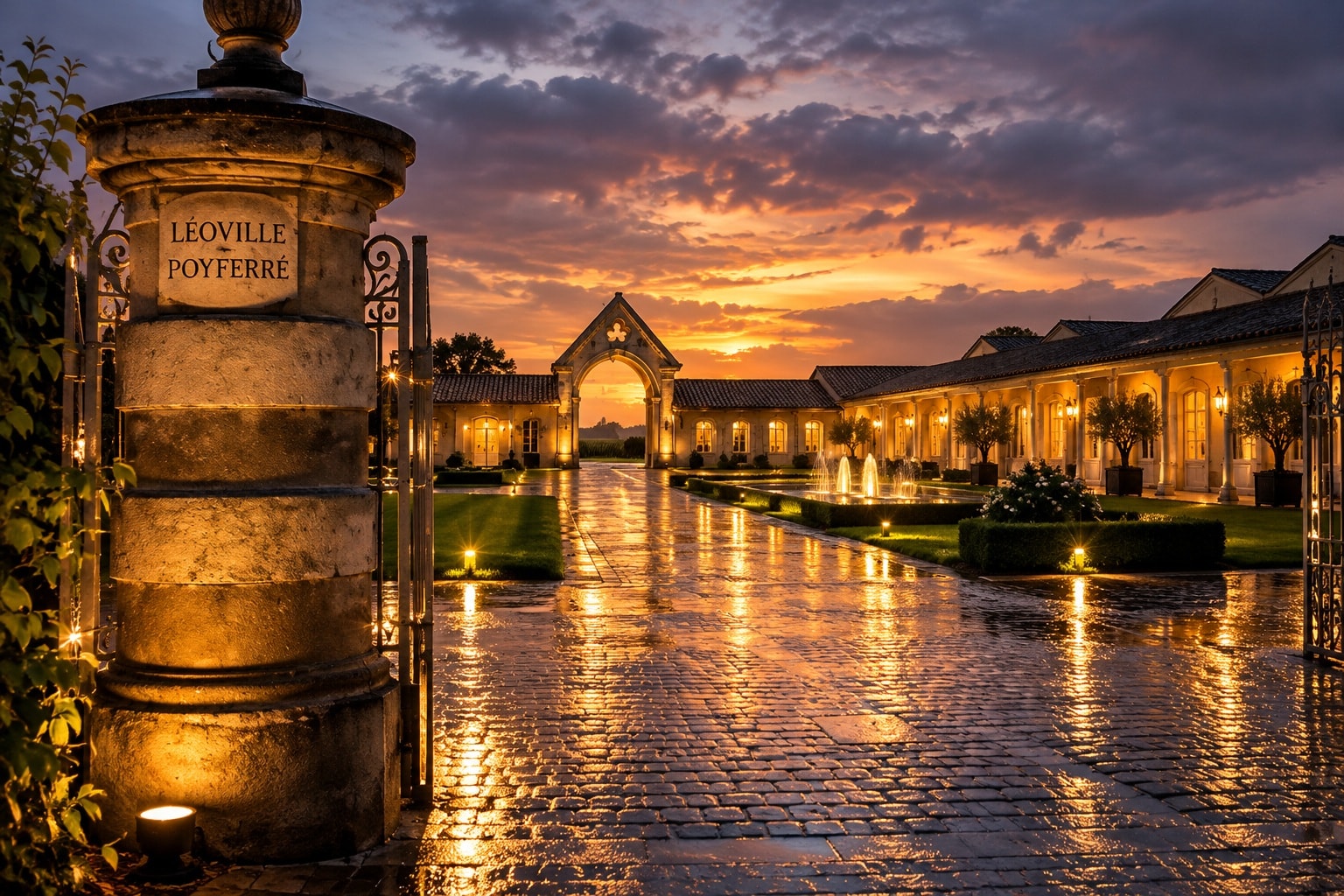
Products from Château Lèoville Poyerré: 2 pcs.
Bottle Hero
Chateaunet
Philipson Wine ApS