
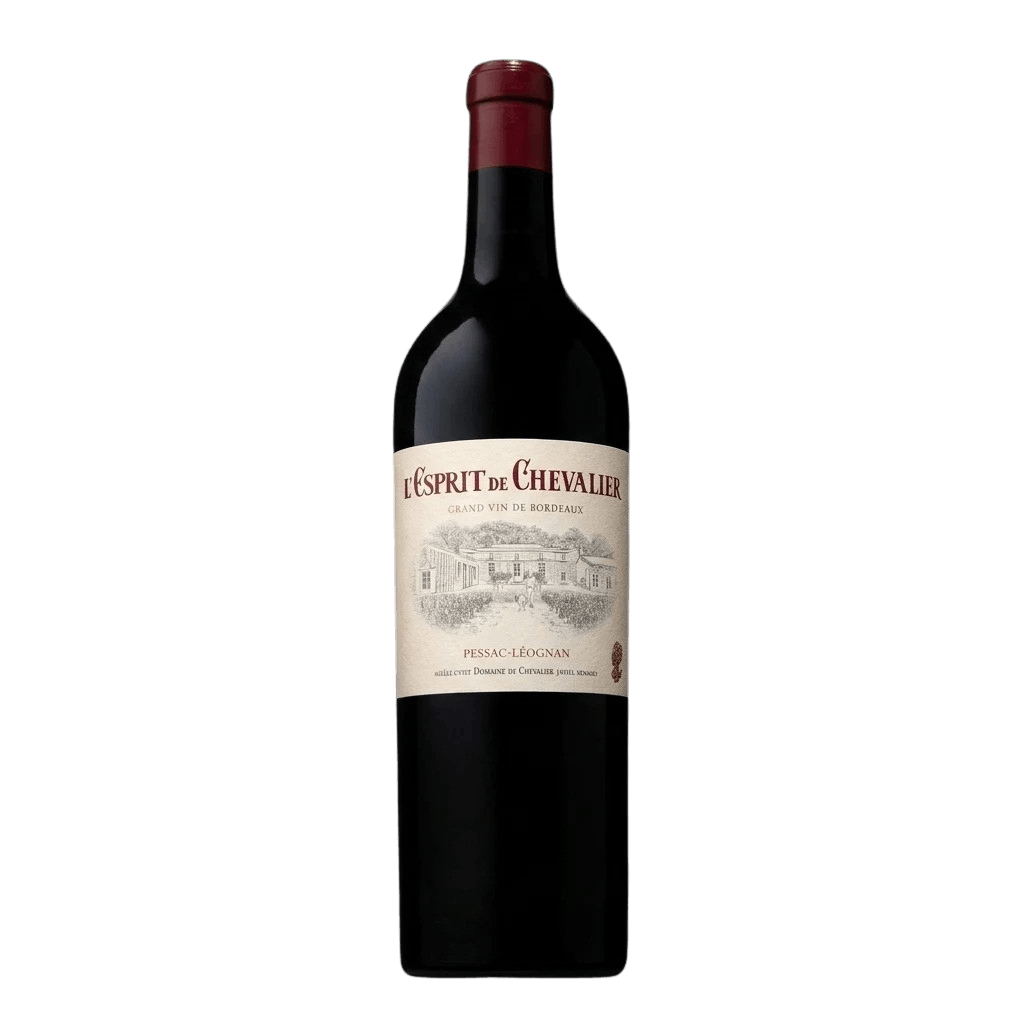
Domaine de Chevalier
L'Esprit de Chevalier Rouge
2020
From 39 EUR from 2 retailers
L’Esprit de Chevalier Rouge is the second red wine of Domaine de Chevalier, a classified Graves estate in Pessac-Léognan, Bordeaux. Introduced in 1989, it combines Cabernet Sauvignon-led structure with supple tannins, expressive dark fruit and the distinctive gravel-soil character of its historic Left Bank origins.
Country
France
Region
Bordeaux - Pessac-Leognan
Number of retailers: 2
bordeauxwines.se
Sweden
L'Esprit de Chevalier Rouge
2020
You save up to 1 EUR, where 1 EUR is the difference between the highest price and the lowest price
Gassås Wine
Sweden
L'Esprit de Chevalier Rouge
2020
Scoring
More information
Producer
Domaine de Chevalier
Domaine de Chevalier is a historic wine estate in Léognan, within Bordeaux's Pessac-Léognan appellation. Unlike many Bordeaux properties, it retains the designation Domaine rather than Château, reflecting an identity closely connected to its land, forest and long-established agricultural environment.
The estate is surrounded by woodland, creating an unusually isolated vineyard ecosystem within Pessac-Léognan. Domaine de Chevalier produces both red and white wines, with Cabernet Sauvignon forming the foundation of the red vineyard and Sauvignon Blanc dominating the white plantings. The property has belonged to the Bernard family since 1983 and is managed by Olivier Bernard and his team.
Quick Facts
- Producer: Domaine de Chevalier
- Location: Léognan, Bordeaux, France
- Appellation: Pessac-Léognan
- Classification: Grand Cru Classé de Graves
- Owner: Bernard family
- Principal varieties: Cabernet Sauvignon and Merlot for red; Sauvignon Blanc and Sémillon for white
History and Identity
The origins of Chevalier are old, with the name Chivaley appearing in the estate's historical narrative from around 1650. The property is also represented on Pierre de Belleyme's map of the region in 1783. Its development as a significant wine estate, however, accelerated during the second half of the nineteenth century.
A decisive moment came in 1865, when Arnaud and Jean Ricard acquired the domaine. The Ricard family's stewardship established much of the modern identity of Chevalier.
Under Claude Ricard, Domaine de Chevalier entered the Graves Classification in 1953.
In 1983, the Bernard family acquired the estate. Olivier Bernard subsequently oversaw substantial investment in the vineyards and cellars, including expansion of the vineyard and redevelopment of the winemaking facilities.
Despite this modernisation, continuity remains fundamental to the domaine's philosophy: preserving the character of its terroir rather than imposing a predetermined wine style upon each vintage.
Estate, Vineyards and Terroir
One of Domaine de Chevalier's defining characteristics is its location within a large forested environment.
The woodland surrounding the vineyard influences its microclimate and supports biodiversity, while the estate's relative isolation creates a distinctive ecosystem. The domaine specifically identifies the interaction between vineyard and forest as a major natural advantage.
The property covers approximately 100 hectares, of which the producer currently describes around 70 hectares as planted with vines, including approximately 60 hectares of red vines and 7 hectares of white vines.
The soils are poor and complex, with gravel playing a central role. Official technical material describes gravel over clay-gravel subsoil.
The current vineyard plantings are given by the domaine as:
Red vineyard plantings
- 65% Cabernet Sauvignon
- 30% Merlot
- 3% Petit Verdot
- 2% Cabernet Franc
White vineyard plantings
- 70% Sauvignon Blanc
- 30% Sémillon
These percentages describe vineyard plantings — not the blend of Domaine de Chevalier Rouge or Blanc.
That distinction is critical for SCI.
Viticulture
Domaine de Chevalier emphasises detailed observation of individual parcels and vines.
Planting density is approximately 10,000 vines per hectare, significantly increasing competition between vines and forming an important part of the estate's approach to fruit concentration and maturity.
The surrounding forest is equally important. Beyond its climatic influence, it provides habitat for beneficial fauna and contributes to biodiversity around the vineyard.
The domaine states that herbicides and chemical fertilisers have historically been avoided and describes an ongoing ecological approach to vineyard management. Soil drainage, vine density, parcel observation and matching grape varieties to individual terroirs form central parts of the viticultural strategy.
The underlying philosophy is therefore not simply organic or environmental positioning, but:
Forest ecosystem → soil health → high-density vineyard → individual parcel observation → balanced fruit.
Production and Winemaking
Domaine de Chevalier deliberately adapts winemaking to the characteristics of each vintage rather than pursuing maximum extraction or a predetermined style.
For the reds, the winery uses concrete, wooden and stainless-steel vats of varying capacities, allowing individual parcels, grape varieties and vine ages to be handled separately.
The domaine explicitly describes its extraction philosophy as moderate. Fermentation is carefully temperature controlled, with remontage and, where appropriate, traditional pigeage. Maceration generally lasts around 15–25 days, depending on the structure of the wine. Malolactic fermentation can then take place in new barrels.
Final blending takes place relatively early, typically in January, with the objective of integrating tannins while preserving the natural density, depth, complexity, finesse and balance of the terroir. Depending on the vintage, only around 40–65% of total red vineyard production may be selected for the Grand Vin.
White wine production follows a different philosophy. Grapes are harvested through successive passes through the vineyard, selecting fruit as individual bunches reach maturity. The domaine says a parcel may be picked repeatedly over two to three weeks.
Exact barrel proportions, maturation periods and technical parameters belong to the individual wine and vintage entities.
Style and Identity
Domaine de Chevalier's identity is built around balance rather than power.
For its red wines, the producer's philosophy combines density and depth with complexity, finesse and elegance, while deliberately avoiding excessive extraction.
The whites form an equally important part of the domaine's identity. Sauvignon Blanc provides freshness and aromatic definition, while Sémillon contributes texture and depth. The small scale of the white vineyard reflects the demanding selection and vinification required by the domaine's approach.
For SCI, I would lock the producer DNA as:
Forest → gravel → precision → Cabernet / Sauvignon Blanc → balance → depth → freshness → finesse → longevity.
That captures something genuinely distinctive about Domaine de Chevalier rather than giving it a generic Pessac-Léognan description.
Portfolio
The core portfolio is centred on two Grand Vins:
Domaine de Chevalier Rouge
Pessac-Léognan red wine based principally on Cabernet Sauvignon and Merlot.
Domaine de Chevalier Blanc
Pessac-Léognan dry white based principally on Sauvignon Blanc and Sémillon.
These need to exist as separate bottle entities within Sipfind because their vineyards, blends, vinification, maturation, tasting profiles and vintages differ substantially.
The producer entity therefore sits above them:
Domaine de Chevalier
→ Domaine de Chevalier Rouge
→ Domaine de Chevalier Blanc
→ Individual vintages
The Bernard family's involvement with other Bordeaux properties should not cause those estates to be treated as Domaine de Chevalier wines. The domaine's official site separately identifies properties including Domaine de la Solitude, Château Lespault-Martillac and Clos des Lunes.
Explore Domaine de Chevalier Wines
Discover Domaine de Chevalier Rouge and Blanc. Compare vintages, critic scores, availability and current prices from trusted wine merchants.
Country
Region
Bordeaux - Pessac-Leognan
Pessac-Léognan is an AOC/AOP wine appellation in northern Graves, immediately south and south-west of the city of Bordeaux, France. Recognised as a separate appellation in 1987, it produces both red and dry white wines across ten communes. Its gravel-dominated terroir is home to all 14 estates in the current Graves Great Growth classification, including Château Haut-Brion, which also appears in the 1855 Bordeaux Classification.
Pessac-Léognan occupies the northern part of the Graves wine area. Its vineyards extend across Cadaujac, Canéjan, Gradignan, Léognan, Martillac, Mérignac, Pessac, Saint-Médard-d’Eyrans, Talence and Villenave-d’Ornon.
The appellation’s soils combine river pebbles, fine gravel, flint, sand and limestone-rich clay. Ancient gravel deposits form gently undulating outcrops with effective natural drainage. The nearby Garonne, the city of Bordeaux and the Landes Forest also influence local growing conditions.
Red Pessac-Léognan is principally associated with Cabernet Sauvignon and Merlot. Cabernet Franc, Malbec and Petit Verdot may also contribute to the blend.
The appellation’s red wines are generally structured and complex, combining ripe fruit with firm but polished tannins. Their balance, concentration and capacity for bottle ageing vary by estate, vineyard site and vintage.
Pessac-Léognan also produces dry white Bordeaux from Sauvignon Blanc, Sauvignon Gris, Sémillon and Muscadelle. These wines can combine citrus and white-fruit character with freshness, texture and mineral or gently toasted notes.
The exact blend and ageing approach differ between producers. Sauvignon commonly contributes freshness and aromatic definition, while Sémillon can add breadth and texture.
All 14 estates in the current Graves Great Growth classification are situated within Pessac-Léognan. Estates may be classified for their red wine, their dry white wine or both.
Château Haut-Brion has a unique position: it belongs to the Graves classification and is also a Premier Grand Cru Classé in the 1855 Bordeaux Classification. Other recognised estates in the appellation include Château La Mission Haut-Brion, Domaine de Chevalier, Château Haut-Bailly, Château Pape Clément and Château Smith Haut Lafitte.
Compare prices for Pessac-Léognan wines across retailers on Sipfind. Explore red and dry white wines by estate, vintage, bottle size and available offer.
Grapes
Cabernet Sauvignon is one of the world’s most important and widely planted red wine grapes, renowned for its powerful structure, concentrated fruit and exceptional ageing potential. Originating in Bordeaux, France, the variety has become a defining grape of fine wine regions around the world, particularly Napa Valley, Tuscany, Chile, Australia and South Africa.
Classic Cabernet Sauvignon combines flavours and aromas of blackcurrant, cassis, blackberry and dark cherry with characteristic notes of cedar, graphite, tobacco and herbs. Naturally high tannins and fresh acidity provide structure and longevity, while maturation in oak can add layers of spice, vanilla and toast. Its character varies significantly with climate, soil and winemaking, ranging from elegant and savoury to rich, powerful and intensely concentrated.
In Bordeaux, Cabernet Sauvignon is particularly associated with the Left Bank, where it forms the foundation of many prestigious blends alongside Merlot, Cabernet Franc and other permitted varieties. In Napa Valley, it has become the region’s signature red grape, producing some of the world’s most sought-after Cabernet Sauvignon wines.
Cabernet Sauvignon’s ability to express terroir while retaining its distinctive structure and character has made it a global benchmark for premium red wine. Whether produced as the dominant variety in a blend or as a varietal wine, the finest examples combine concentration, complexity and the capacity to develop gracefully over decades
Merlot is one of the world’s most important red wine grapes, celebrated for its generous fruit, supple texture and ability to produce wines ranging from approachable and elegant to exceptionally complex and long-lived. Originating in Bordeaux, France, Merlot is particularly associated with the Right Bank, where it forms the foundation of many of the prestigious wines of Pomerol and Saint-Émilion.
Merlot typically expresses flavours and aromas of plum, black cherry, blackberry and red fruits, often developing notes of chocolate, tobacco, cedar, herbs and earthy complexity with maturation. Its naturally rounded texture and generally softer tannin profile distinguish it from Cabernet Sauvignon, although the finest examples can possess considerable structure, freshness and ageing potential.
In Pomerol, Merlot reaches some of its most celebrated expressions, particularly on the appellation’s clay-rich soils, producing wines of remarkable concentration, texture and complexity. In Saint-Émilion, it is commonly blended with Cabernet Franc and, to a lesser extent, Cabernet Sauvignon, creating wines that combine ripe fruit with structure, aromatic complexity and longevity.
Beyond Bordeaux, Merlot is widely cultivated in Italy, California, Washington State, Chile and other major wine regions. It can be produced as a varietal wine or used as a central component of blends, where its fruit and texture complement more structured grape varieties.
From the great Merlot-based wines of Bordeaux’s Right Bank to leading expressions around the world, Merlot’s combination of rich fruit, refined texture and capacity to express terroir has established it as one of the defining varieties of fine red wine.
Petit Verdot is a powerful red wine grape from south-west France, best known as a small but distinctive component of the classic red blends of Bordeaux. Its deeply coloured wines, firm tannins and concentrated aromatics allow even modest proportions to add structure, freshness and intensity alongside Cabernet Sauvignon, Merlot and Cabernet Franc.
On Bordeaux’s Left Bank, Petit Verdot is particularly associated with the gravel soils of the Médoc, including appellations such as Margaux, Saint-Julien, Pauillac and Saint-Estèphe. The variety buds relatively early but ripens late, making complete maturation challenging in cooler vintages. When fully ripe, it can retain vibrant acidity while developing considerable colour, tannin and aromatic complexity.
Typical expressions show blackberry, black cherry, blueberry and plum, accompanied by violet, liquorice, pepper, cocoa and other dark spices. In Bordeaux blends, Petit Verdot is generally used in limited quantities to reinforce colour, tannic structure and aromatic depth. Its combination of acidity and tannin can also contribute significantly to a wine’s ageing potential.
Beyond Bordeaux, warmer and more reliable growing conditions have allowed Petit Verdot to achieve greater ripeness and a more prominent role. Producers in California, Australia, Spain and South America increasingly use the variety in both Bordeaux-style blends and varietal wines. These expressions are often full-bodied and deeply coloured, with ripe dark fruit, floral character, spice and powerful tannins.
From its historic role in the Médoc to its expanding presence as a varietal wine, Petit Verdot is defined by colour, structure, freshness and aromatic intensity. Once regarded primarily as a supporting grape, it is increasingly recognised as a distinctive variety capable of producing serious, age-worthy wines in its own right.
History and Style
L’Esprit de Chevalier Rouge – The Second Wine of Domaine de Chevalier
L’Esprit de Chevalier Rouge is the second red wine of Domaine de Chevalier, a historic estate situated in Léognan, within Bordeaux's Pessac-Léognan appellation. Introduced in 1989, the wine reflects the estate's approach to vineyard selection, precise vinification and careful blending, offering a distinct interpretation of the terroir behind its classified Grand Vin.
Domaine de Chevalier is particularly associated with its gravel soils, its woodland surroundings and the production of both red and white Bordeaux wines. The estate has belonged to the Bernard family since 1983, with Olivier Bernard playing a central role in its modern development.
L’Esprit de Chevalier Rouge is produced primarily from younger vines and selected wine lots that do not form part of the Grand Vin. These components are assessed and blended to create a wine with its own balance of fruit, structure and texture.
Although it shares the same estate, vineyard philosophy and technical expertise as Domaine de Chevalier Rouge, L’Esprit is a separate wine. Its identity is associated with expressive fruit, refined tannins and an earlier approachability than the Grand Vin, while retaining the capacity to develop with bottle age in suitable vintages.
Wine at a Glance
- Wine: L’Esprit de Chevalier Rouge
- Producer: Domaine de Chevalier
- Country: France
- Region: Bordeaux
- Appellation: Pessac-Léognan AOC
- Historical Wine Region: Graves
- Wine Type: Dry Red Bordeaux
- Wine Category: Second Wine
- First Vintage: 1989
- Principal Grape Varieties: Cabernet Sauvignon and Merlot
- Additional Varieties: Petit Verdot and potentially Cabernet Franc, depending on the vintage
- Soils: Gravel over clay-gravel subsoil
- Harvest: Careful selection and sorting of grapes
- Vinification: Stainless steel, concrete and wooden fermentation vessels
- Maturation: Approximately 14 months in oak barrels, according to the estate's technical documentation
- Bottle Format: 750 ml
- Vintage: Individual harvest years
Domaine de Chevalier – A Historic Estate in Graves
Domaine de Chevalier occupies a distinctive position within Bordeaux.
Located in Léognan, south of the city of Bordeaux, the estate lies within the Pessac-Léognan appellation, an area historically associated with the wines of Graves.
The property has a long history and appears on the eighteenth-century map produced by Pierre de Belleyme, geographer to Louis XVI.
Unlike many Bordeaux properties traditionally known as châteaux, Domaine de Chevalier has retained the designation Domaine.
The estate is recognised for producing both red and white wines, with its principal wines included among the classified growths of Graves.
In 1983, the Bernard family acquired the property.
Under Olivier Bernard's direction, the estate continued developing its vineyard management, grape selection and winemaking facilities.
The introduction of L’Esprit de Chevalier in 1989 formed part of this development.
By creating a separate second wine, the estate could apply more selective blending decisions to its Grand Vin while giving other suitable vineyard components a distinct identity.
Today, L’Esprit de Chevalier Rouge remains an integral part of the estate's red wine production.
The Origins of L’Esprit de Chevalier
The creation of L’Esprit de Chevalier was closely connected with vineyard renewal and the planting of younger vines.
From the mid-1980s, new vineyard plantings contributed fruit that required a different approach to selection.
Rather than incorporating every suitable parcel into the Grand Vin, the estate established a separate wine.
L’Esprit de Chevalier was introduced in 1989.
Its selection is principally based on two sources:
- Fruit from younger vines that have not yet reached the maturity sought for the Grand Vin.
- Selected fermentation batches that do not fully match the Grand Vin's intended structure and precision.
This distinction is important.
L’Esprit is not simply the result of using one particular vineyard parcel or a fixed grape blend.
Its composition reflects the estate's annual assessment of individual vineyard components and wines.
The objective is to preserve the identity of Domaine de Chevalier while creating a separate expression with its own balance and texture.
Pessac-Léognan – The Terroir Behind the Wine
L’Esprit de Chevalier Rouge originates in Pessac-Léognan, the northern part of the historic Graves wine region.
The appellation was established in 1987 and includes vineyards south of Bordeaux.
Its landscape is characterised by gravel deposits, varied subsoils and extensive areas of woodland.
These features distinguish Pessac-Léognan from other Bordeaux appellations.
The gravel formations are particularly important to the cultivation of Cabernet Sauvignon.
Gravelly soils generally allow water to drain more readily than heavier clay soils, although their behaviour depends on the underlying geological layers.
At Domaine de Chevalier, the estate identifies gravel soils over a clay-gravel subsoil.
This combination influences water availability and vine development throughout the growing season.
The Influence of Gravel
Gravel contributes to the physical environment in which the vines grow.
Its characteristics include:
- Drainage that can limit prolonged water saturation.
- A soil structure suited to Cabernet Sauvignon.
- Thermal properties that influence vineyard conditions.
- Variation in water availability according to subsoil composition.
The resulting wines reflect the interaction between these soils, the grape varieties and the conditions of each vintage.
Clay-Gravel Subsoil
Beneath the gravel, the estate identifies a clay-gravel subsoil.
Clay can retain moisture differently from the gravel above it.
This creates a more complex environment for vine roots.
The relationship between surface drainage and deeper water availability is particularly relevant during warm or dry growing seasons.
The Woodland Environment
Domaine de Chevalier is also distinguished by its surrounding woodland.
The estate's setting contributes to its geographical identity within Pessac-Léognan.
The combination of gravel soils, forest surroundings and maritime climatic influences forms the broader environment in which L’Esprit de Chevalier Rouge is produced.
Grape Varieties – The Structure of a Left Bank Bordeaux Blend
L’Esprit de Chevalier Rouge is principally based on Cabernet Sauvignon and Merlot.
Petit Verdot is also used in documented vintages.
Cabernet Franc is planted at the estate, although its inclusion in L’Esprit should only be stated when confirmed for a particular vintage.
The final blend changes according to the harvest.
Cabernet Sauvignon – Structure and Aromatic Definition
Cabernet Sauvignon is central to the identity of the estate's red wines.
The variety is particularly suited to the gravelly soils of Pessac-Léognan.
It can contribute:
- Blackcurrant and dark-berry aromas.
- Firm but refined tannins.
- Freshness and structural definition.
- Cedar and savoury characteristics.
- Potential for bottle development.
Cabernet Sauvignon is generally a later-ripening variety, making vineyard management and harvest timing particularly important.
Merlot – Fruit and Texture
Merlot provides an important complement to Cabernet Sauvignon.
Its characteristics may include:
- Plum and ripe cherry aromas.
- Rounded fruit expression.
- Supple tannins.
- Greater mid-palate volume.
- A softer textural impression.
The proportion of Merlot varies between vintages and influences the balance of the finished wine.
Petit Verdot – Additional Complexity
Petit Verdot may contribute additional colour, structure and aromatic intensity.
Depending on ripeness and the growing season, it can introduce spicy or floral characteristics.
Its inclusion is determined through the estate's annual blending decisions.
Cabernet Franc – A Vintage-Dependent Component
Cabernet Franc forms part of Domaine de Chevalier's red vineyard plantings.
The variety can contribute aromatic freshness and floral or herbal characteristics.
However, it should not automatically be included in the technical composition of L’Esprit de Chevalier Rouge unless confirmed by the relevant vintage documentation.
Why the Blend Changes
The estate does not follow one permanent formula for L’Esprit de Chevalier Rouge.
The proportions depend on:
- Growing-season conditions.
- Grape maturity.
- Vineyard selection.
- The characteristics of individual fermentation batches.
- The requirements of the Grand Vin.
- The final blending assessment.
This flexibility is central to the wine's identity.
Vineyard Management and Grape Selection
Domaine de Chevalier applies detailed vineyard observation and grape selection to its red wine production.
Because the property contains different grape varieties and vine ages, the fruit does not develop uniformly.
The vineyard team monitors maturity and grape condition before harvesting.
The estate's technical documentation describes a careful sorting process.
Key Selection Stages
- Vineyard assessment: Monitoring grape development and ripeness.
- Initial selection: Identifying suitable fruit during harvesting.
- Manual bunch sorting: Removing unsuitable grape material.
- Destemming: Separating berries from stems.
- Optical sorting: Assessing berries using specialised equipment.
- Density-based sorting: Further selection according to berry characteristics.
- Separate vinification: Preserving the identity of selected batches.
These procedures help the estate control the quality and characteristics of the fruit entering fermentation.
The final allocation of individual wine lots is determined through subsequent evaluation and blending.
Vinification – Combining Tradition and Technical Precision
L’Esprit de Chevalier Rouge benefits from the estate's approach to controlled vinification.
The technical documentation identifies several types of fermentation vessels:
- Stainless steel vats.
- Concrete vats, including tulip-shaped vessels.
- Wooden vats.
Different vessels allow the winemaking team to adapt fermentation to the characteristics of individual batches.
Fermentation
During alcoholic fermentation, grape sugars are converted into alcohol.
For red wines, contact between juice and grape skins contributes colour, tannins and flavour compounds.
The duration and management of this contact influence the finished wine.
The estate evaluates the characteristics of individual batches when making extraction decisions.
Temperature Control
Fermentation temperature affects yeast activity and the extraction of compounds from grape skins.
Controlled fermentation allows the winemaking team to manage these processes according to the fruit's characteristics.
Separate Wine Lots
Individual batches can be assessed independently before blending.
This is particularly important for a second wine.
The selection is not determined solely by grape variety or vineyard location.
The finished characteristics of the wines also influence their allocation.
Blending – Defining the Identity of L’Esprit
Blending is one of the most important stages in the production of L’Esprit de Chevalier Rouge.
The estate evaluates the individual wines produced from its vineyard selections.
Each component is assessed for its fruit character, tannin structure, freshness, texture and overall balance.
The Grand Vin is assembled from components selected to express the estate's principal wine.
Other suitable components are considered for L’Esprit de Chevalier.
The second wine therefore reflects the same terroir and winemaking philosophy, but through a different selection.
The Role of the Main Varieties
Cabernet Sauvignon contributes structure and aromatic definition.
Merlot can provide fruit expression and a supple texture.
Petit Verdot may add further complexity.
The proportions vary according to the vintage.
For example, the estate's technical sheets record the following blends:
- 2017: 70% Cabernet Sauvignon, 25% Merlot and 5% Petit Verdot.
- 2022: 60% Cabernet Sauvignon, 35% Merlot and 5% Petit Verdot.
- 2024: 60% Cabernet Sauvignon, 35% Merlot and 5% Petit Verdot.
These figures illustrate the wine's Cabernet Sauvignon-led character without establishing a permanent blend.
Each vintage must be documented individually.
Oak Maturation – Developing Texture and Balance
Following vinification and blending, L’Esprit de Chevalier Rouge undergoes maturation in oak barrels.
The estate's recent technical documentation specifies approximately 14 months of barrel ageing.
Oak maturation allows the wine's components to develop before bottling.
During this period, gradual oxygen exchange can influence tannin evolution and texture.
Oak may also contribute subtle aromatic characteristics.
These can include:
- Cedar.
- Toast.
- Sweet spice.
- Savoury complexity.
The extent of these influences depends on barrel selection, the proportion of new oak and the duration of maturation.
Specific new-oak percentages should not be assumed without documentation for the relevant vintage.
The objective is to support the wine's fruit and structure while maintaining the estate's characteristic finesse.
Style and Tasting Profile
L’Esprit de Chevalier Rouge is associated with the balance between fruit, structure and elegance characteristic of Domaine de Chevalier.
The producer describes its second wine as sharing the aromatic identity of the Grand Vin while generally being approachable at a younger age.
The precise profile varies between vintages.
Appearance
Younger examples generally display a deep ruby-red colour.
The intensity depends on the grape composition and growing season.
With maturity, the colour may develop more garnet tones.
Aromatic Profile
Depending on vintage and bottle age, the wine may display:
- Blackcurrant.
- Blackberry.
- Red cherry.
- Plum.
- Liquorice.
- Subtle spice.
- Cedar.
- Earthy or woodland notes.
These characteristics are consistent with the estate's descriptions of documented vintages.
They should not be interpreted as identical tasting notes for every release.
Palate
The wine is generally associated with:
- Concentrated but expressive fruit.
- A supple texture.
- Refined tannins.
- Freshness.
- Balanced structure.
- A persistent, fruit-led finish.
The relationship between Cabernet Sauvignon's structure and Merlot's texture is central to its style.
The Character of Graves
Red wines from Pessac-Léognan can display a distinctive combination of fruit, savoury complexity and freshness.
L’Esprit de Chevalier Rouge reflects this regional identity through its gravel-soil origins and the estate's approach to selection and blending.
Ageing Potential – Earlier Approachability with Vintage Variation
L’Esprit de Chevalier Rouge is generally intended to be approachable earlier than Domaine de Chevalier Rouge.
However, earlier approachability does not mean that the wine lacks ageing potential.
The producer's descriptions of individual vintages indicate that suitable releases can develop additional complexity over several years.
The ageing potential depends on:
- Vintage conditions.
- Cabernet Sauvignon proportion.
- Fruit concentration.
- Tannin structure.
- Acidity.
- Maturation.
- Storage conditions.
Younger bottles may emphasise fresh fruit and primary aromas.
With bottle age, some vintages may develop additional savoury characteristics.
These can include cedar, tobacco, dried herbs and earthy notes.
A single drinking window should not be applied to all vintages.
Serving and Food Pairing
The wine's combination of fruit, freshness and refined structure makes it suitable for a range of savoury dishes.
Pairing choices should take account of the vintage and maturity of the bottle.
Roast Lamb
Roast lamb with herbs can complement the wine's tannins and dark-fruit characteristics.
Beef
Roasted or grilled beef provides a suitable match for its structure.
Duck
Duck breast can work well with the wine's fruit expression and savoury complexity.
Mushrooms
Mushroom-based dishes may complement more mature examples displaying earthy notes.
Mature Cheeses
Selected firm cheeses can provide a complementary balance of texture and flavour.
Serving Recommendations
- Serving Temperature: Approximately 16–18°C.
- Glassware: Bordeaux-style red wine glass.
- Decanting: According to vintage and maturity.
- Storage: Cool, dark conditions with a stable temperature.
- Drinking Window: Vintage-specific.
L’Esprit de Chevalier Rouge and Domaine de Chevalier Rouge
Both wines originate from the same estate, but they represent different selections.
Domaine de Chevalier Rouge – The Grand Vin
Domaine de Chevalier Rouge is the estate's principal classified red wine.
Its selection is intended to express the depth, structure and ageing potential of the property's terroir.
L’Esprit de Chevalier Rouge – The Second Wine
L’Esprit is produced primarily from younger vines and selected wine lots not included in the Grand Vin.
It shares the estate's approach to vineyard management, vinification and blending.
Its style generally emphasises expressive fruit, supple tannins and earlier approachability.
Two Distinct Product Identities
The wines must be treated as separate products.
L’Esprit de Chevalier Rouge should not be matched with Domaine de Chevalier Rouge in wine price comparisons.
The producer also makes a white wine named L’Esprit de Chevalier Blanc.
The red and white wines are distinct products and must not be combined.
Understanding Vintage Variation
Every vintage of L’Esprit de Chevalier Rouge reflects a different growing season.
Temperature, rainfall, harvest timing and grape maturity influence the characteristics of the fruit.
The estate responds through vineyard selection, sorting, fermentation and blending.
Although Cabernet Sauvignon generally forms the largest component, the precise blend is not fixed.
Alcohol levels, maturation details and tasting profiles also vary.
For this reason, the permanent product page should describe the wine's identity and production philosophy.
Individual vintage pages should contain the verified technical information for each harvest.
Discover L’Esprit de Chevalier Rouge on Sipfind
Explore L’Esprit de Chevalier Rouge, the second red wine of Domaine de Chevalier in Pessac-Léognan, Bordeaux.
Discover its gravel-soil origins, Cabernet Sauvignon-led blends and the characteristics of individual vintages.
Compare available offers from European wine retailers on Sipfind, with wine identity, vintage and bottle format clearly distinguished.