
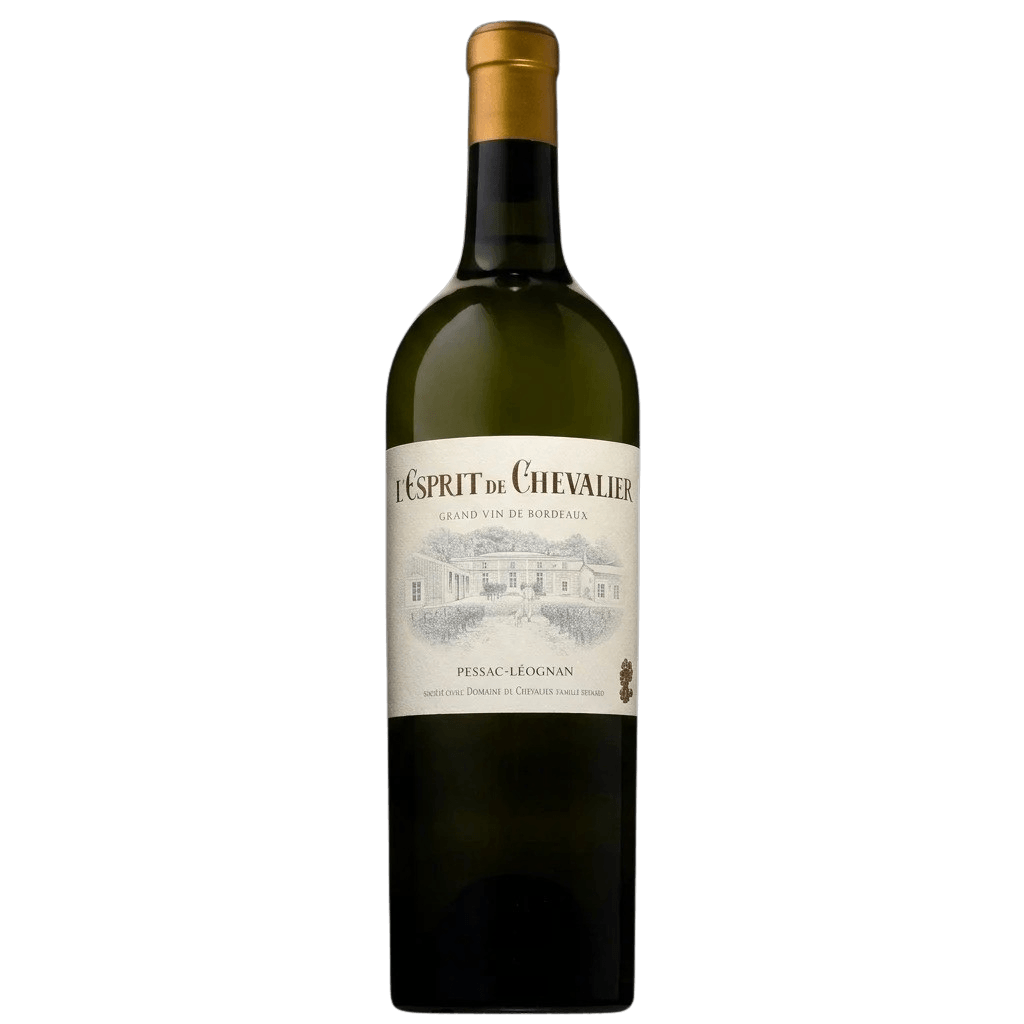
Domaine de Chevalier
L'Esprit de Chevalier Blanc
2022
From 45 EUR from 2 retailers
L’Esprit de Chevalier Blanc is the second white wine of Domaine de Chevalier in Pessac-Léognan, Bordeaux. Blending Sauvignon Blanc and Sémillon from gravel-rich vineyards, it combines citrus and white-fruit aromas with floral complexity, freshness and a refined texture. Barrel fermentation and careful selection contribute to its distinctive balance of richness and precision.
Country
France
Region
Bordeaux - Pessac-Leognan
Number of retailers: 2
bordeauxwines.se
Sweden
L'Esprit de Chevalier Blanc
2022
Gassås Wine
Sweden
L'Esprit de Chevalier Blanc
2022
Scoring
More information
Producer
Domaine de Chevalier
Domaine de Chevalier is a historic wine estate in Léognan, within Bordeaux's Pessac-Léognan appellation. Unlike many Bordeaux properties, it retains the designation Domaine rather than Château, reflecting an identity closely connected to its land, forest and long-established agricultural environment.
The estate is surrounded by woodland, creating an unusually isolated vineyard ecosystem within Pessac-Léognan. Domaine de Chevalier produces both red and white wines, with Cabernet Sauvignon forming the foundation of the red vineyard and Sauvignon Blanc dominating the white plantings. The property has belonged to the Bernard family since 1983 and is managed by Olivier Bernard and his team.
Quick Facts
- Producer: Domaine de Chevalier
- Location: Léognan, Bordeaux, France
- Appellation: Pessac-Léognan
- Classification: Grand Cru Classé de Graves
- Owner: Bernard family
- Principal varieties: Cabernet Sauvignon and Merlot for red; Sauvignon Blanc and Sémillon for white
History and Identity
The origins of Chevalier are old, with the name Chivaley appearing in the estate's historical narrative from around 1650. The property is also represented on Pierre de Belleyme's map of the region in 1783. Its development as a significant wine estate, however, accelerated during the second half of the nineteenth century.
A decisive moment came in 1865, when Arnaud and Jean Ricard acquired the domaine. The Ricard family's stewardship established much of the modern identity of Chevalier.
Under Claude Ricard, Domaine de Chevalier entered the Graves Classification in 1953.
In 1983, the Bernard family acquired the estate. Olivier Bernard subsequently oversaw substantial investment in the vineyards and cellars, including expansion of the vineyard and redevelopment of the winemaking facilities.
Despite this modernisation, continuity remains fundamental to the domaine's philosophy: preserving the character of its terroir rather than imposing a predetermined wine style upon each vintage.
Estate, Vineyards and Terroir
One of Domaine de Chevalier's defining characteristics is its location within a large forested environment.
The woodland surrounding the vineyard influences its microclimate and supports biodiversity, while the estate's relative isolation creates a distinctive ecosystem. The domaine specifically identifies the interaction between vineyard and forest as a major natural advantage.
The property covers approximately 100 hectares, of which the producer currently describes around 70 hectares as planted with vines, including approximately 60 hectares of red vines and 7 hectares of white vines.
The soils are poor and complex, with gravel playing a central role. Official technical material describes gravel over clay-gravel subsoil.
The current vineyard plantings are given by the domaine as:
Red vineyard plantings
- 65% Cabernet Sauvignon
- 30% Merlot
- 3% Petit Verdot
- 2% Cabernet Franc
White vineyard plantings
- 70% Sauvignon Blanc
- 30% Sémillon
These percentages describe vineyard plantings — not the blend of Domaine de Chevalier Rouge or Blanc.
That distinction is critical for SCI.
Viticulture
Domaine de Chevalier emphasises detailed observation of individual parcels and vines.
Planting density is approximately 10,000 vines per hectare, significantly increasing competition between vines and forming an important part of the estate's approach to fruit concentration and maturity.
The surrounding forest is equally important. Beyond its climatic influence, it provides habitat for beneficial fauna and contributes to biodiversity around the vineyard.
The domaine states that herbicides and chemical fertilisers have historically been avoided and describes an ongoing ecological approach to vineyard management. Soil drainage, vine density, parcel observation and matching grape varieties to individual terroirs form central parts of the viticultural strategy.
The underlying philosophy is therefore not simply organic or environmental positioning, but:
Forest ecosystem → soil health → high-density vineyard → individual parcel observation → balanced fruit.
Production and Winemaking
Domaine de Chevalier deliberately adapts winemaking to the characteristics of each vintage rather than pursuing maximum extraction or a predetermined style.
For the reds, the winery uses concrete, wooden and stainless-steel vats of varying capacities, allowing individual parcels, grape varieties and vine ages to be handled separately.
The domaine explicitly describes its extraction philosophy as moderate. Fermentation is carefully temperature controlled, with remontage and, where appropriate, traditional pigeage. Maceration generally lasts around 15–25 days, depending on the structure of the wine. Malolactic fermentation can then take place in new barrels.
Final blending takes place relatively early, typically in January, with the objective of integrating tannins while preserving the natural density, depth, complexity, finesse and balance of the terroir. Depending on the vintage, only around 40–65% of total red vineyard production may be selected for the Grand Vin.
White wine production follows a different philosophy. Grapes are harvested through successive passes through the vineyard, selecting fruit as individual bunches reach maturity. The domaine says a parcel may be picked repeatedly over two to three weeks.
Exact barrel proportions, maturation periods and technical parameters belong to the individual wine and vintage entities.
Style and Identity
Domaine de Chevalier's identity is built around balance rather than power.
For its red wines, the producer's philosophy combines density and depth with complexity, finesse and elegance, while deliberately avoiding excessive extraction.
The whites form an equally important part of the domaine's identity. Sauvignon Blanc provides freshness and aromatic definition, while Sémillon contributes texture and depth. The small scale of the white vineyard reflects the demanding selection and vinification required by the domaine's approach.
For SCI, I would lock the producer DNA as:
Forest → gravel → precision → Cabernet / Sauvignon Blanc → balance → depth → freshness → finesse → longevity.
That captures something genuinely distinctive about Domaine de Chevalier rather than giving it a generic Pessac-Léognan description.
Portfolio
The core portfolio is centred on two Grand Vins:
Domaine de Chevalier Rouge
Pessac-Léognan red wine based principally on Cabernet Sauvignon and Merlot.
Domaine de Chevalier Blanc
Pessac-Léognan dry white based principally on Sauvignon Blanc and Sémillon.
These need to exist as separate bottle entities within Sipfind because their vineyards, blends, vinification, maturation, tasting profiles and vintages differ substantially.
The producer entity therefore sits above them:
Domaine de Chevalier
→ Domaine de Chevalier Rouge
→ Domaine de Chevalier Blanc
→ Individual vintages
The Bernard family's involvement with other Bordeaux properties should not cause those estates to be treated as Domaine de Chevalier wines. The domaine's official site separately identifies properties including Domaine de la Solitude, Château Lespault-Martillac and Clos des Lunes.
Explore Domaine de Chevalier Wines
Discover Domaine de Chevalier Rouge and Blanc. Compare vintages, critic scores, availability and current prices from trusted wine merchants.
Country
Region
Bordeaux - Pessac-Leognan
Pessac-Léognan is an AOC/AOP wine appellation in northern Graves, immediately south and south-west of the city of Bordeaux, France. Recognised as a separate appellation in 1987, it produces both red and dry white wines across ten communes. Its gravel-dominated terroir is home to all 14 estates in the current Graves Great Growth classification, including Château Haut-Brion, which also appears in the 1855 Bordeaux Classification.
Pessac-Léognan occupies the northern part of the Graves wine area. Its vineyards extend across Cadaujac, Canéjan, Gradignan, Léognan, Martillac, Mérignac, Pessac, Saint-Médard-d’Eyrans, Talence and Villenave-d’Ornon.
The appellation’s soils combine river pebbles, fine gravel, flint, sand and limestone-rich clay. Ancient gravel deposits form gently undulating outcrops with effective natural drainage. The nearby Garonne, the city of Bordeaux and the Landes Forest also influence local growing conditions.
Red Pessac-Léognan is principally associated with Cabernet Sauvignon and Merlot. Cabernet Franc, Malbec and Petit Verdot may also contribute to the blend.
The appellation’s red wines are generally structured and complex, combining ripe fruit with firm but polished tannins. Their balance, concentration and capacity for bottle ageing vary by estate, vineyard site and vintage.
Pessac-Léognan also produces dry white Bordeaux from Sauvignon Blanc, Sauvignon Gris, Sémillon and Muscadelle. These wines can combine citrus and white-fruit character with freshness, texture and mineral or gently toasted notes.
The exact blend and ageing approach differ between producers. Sauvignon commonly contributes freshness and aromatic definition, while Sémillon can add breadth and texture.
All 14 estates in the current Graves Great Growth classification are situated within Pessac-Léognan. Estates may be classified for their red wine, their dry white wine or both.
Château Haut-Brion has a unique position: it belongs to the Graves classification and is also a Premier Grand Cru Classé in the 1855 Bordeaux Classification. Other recognised estates in the appellation include Château La Mission Haut-Brion, Domaine de Chevalier, Château Haut-Bailly, Château Pape Clément and Château Smith Haut Lafitte.
Compare prices for Pessac-Léognan wines across retailers on Sipfind. Explore red and dry white wines by estate, vintage, bottle size and available offer.
Grapes
Sauvignon Blanc is one of the world’s most widely recognised white wine grapes, celebrated for its vibrant acidity, expressive aromatics and remarkable ability to reflect climate and terroir. Originating in France, the variety is historically associated with the Loire Valley and Bordeaux, while today it produces distinctive wines across many of the world’s leading wine regions.
In the Loire Valley, Sauvignon Blanc reaches some of its most celebrated expressions in Sancerre and Pouilly-Fumé. These wines are typically dry, precise and refreshing, showing flavours and aromas of citrus, green apple, gooseberry and white flowers, often accompanied by herbal and mineral notes. Differences in soil, vineyard location and winemaking can produce styles ranging from delicate and elegant to concentrated and age-worthy.
In Bordeaux, Sauvignon Blanc traditionally plays a different role. It is frequently blended with Sémillon, and sometimes Muscadelle, to produce both dry white Bordeaux and the renowned sweet wines of Sauternes and Barsac. Sauvignon Blanc contributes acidity, freshness and aromatic lift, complementing the richness and texture of Sémillon.
Beyond France, Sauvignon Blanc has become particularly important in New Zealand, where Marlborough established an internationally recognised style characterised by intense citrus, passion fruit, gooseberry and herbaceous aromas. Important expressions are also produced in California, Chile, South Africa, Australia and Italy, demonstrating the variety’s ability to develop distinctive personalities across different climates and soils.
Whether expressed as a mineral-driven Loire wine, a structured Bordeaux blend or an intensely aromatic New World Sauvignon Blanc, the grape’s combination of freshness, aromatic clarity and terroir expression has established it as one of the defining varieties of modern white wine.
Sémillon is a white wine grape originating in Bordeaux, where it is central to both dry white blends and botrytised sweet wines. Its generous texture, affinity with noble rot and ability to develop considerable complexity through bottle ageing have established Sémillon as one of the most versatile white varieties in fine wine, with benchmark expressions found in Bordeaux and Australia’s Hunter Valley.
Quick Grape Facts
- Grape Type: White wine grape
- Origin: Bordeaux, France
- Key Regions: Sauternes, Barsac, Graves, Pessac-Léognan and Hunter Valley
- Primary Styles: Dry white wines, botrytised sweet wines and white blends
- Common Blending Partners: Sauvignon Blanc and Muscadelle
- Typical Aromas: Lemon, green apple, pear, beeswax, honey, apricot, toast and nuts
- Structure: Generally medium to full-bodied, with acidity and concentration varying according to climate, harvest timing and wine style
- Botrytis Susceptibility: High, supported by the grape’s relatively thin skins
- Ageing Potential: High in leading Sauternes, Barsac and Hunter Valley expressions
- Canonical Name: Sémillon
- Alias: Semillon
- Historical Labels: Hunter River Riesling, Shepherd’s Riesling, Hock, White Burgundy and Chablis
Regional Expressions and Wine Styles
In Sauternes and Barsac, Sémillon’s thin skins make it particularly receptive to Botrytis cinerea, or noble rot. Botrytis concentrates the grapes’ sugars, acidity and flavours, producing richly textured sweet wines with notes of honey, beeswax, apricot, candied citrus and saffron. Sauvignon Blanc commonly contributes freshness and aromatic lift, while Muscadelle may add floral complexity. In the dry white wines of Graves and Pessac-Léognan, Sémillon brings body, depth and ageing potential to blends with Sauvignon Blanc, developing waxy, toasted and nutty complexity as the wines mature.
In Australia’s Hunter Valley, Sémillon is typically harvested early at relatively low sugar levels and fermented in stainless steel with little or no oak influence. Young wines can appear light-bodied, restrained and citrus-driven, yet the finest examples evolve over decades to show lemon curd, toast, lanolin, honey and nuts. Sémillon is also produced as a varietal wine in the Barossa Valley and blended with Sauvignon Blanc in Margaret River. Historical Australian labels such as Hunter River Riesling do not indicate a relationship with Riesling and should be treated as former naming conventions rather than separate grapes or modern synonyms.
Explore Sémillon Wines on Sipfind
Explore Sémillon wines, regions and current offers from selected wine retailers on Sipfind.
History and Style
L’Esprit de Chevalier Blanc – A Distinct Expression of White Pessac-Léognan
L’Esprit de Chevalier Blanc is the second dry white wine of Domaine de Chevalier, a historic estate situated in Léognan, within Bordeaux's Pessac-Léognan appellation. Produced from Sauvignon Blanc and Sémillon, the wine reflects the estate's approach to selective harvesting, barrel fermentation and the careful assessment of individual wine lots.
Domaine de Chevalier is recognised for both its red and white wines, with its principal wines included among the classified growths of Graves. Its white vineyards occupy gravel soils over a clay-gravel subsoil, providing the growing environment for two complementary grape varieties.
L’Esprit de Chevalier Blanc shares the origins and winemaking philosophy of the estate's Grand Vin, Domaine de Chevalier Blanc, but is produced through a separate selection. Its identity is associated with expressive fruit, freshness, aromatic purity and a textured palate.
The estate describes its second white wine as rich, lively and complex, with a more open character that allows it to be appreciated earlier than the Grand Vin.
The precise balance of fruit, acidity, texture and oak influence varies between vintages, reflecting the growing season and the characteristics of the selected barrels.
Wine at a Glance
- Wine: L’Esprit de Chevalier Blanc
- Producer: Domaine de Chevalier
- Country: France
- Region: Bordeaux
- Historical Wine Region: Graves
- Appellation: Pessac-Léognan AOC
- Wine Category: Second White Wine
- Wine Style: Dry White Bordeaux
- Grape Varieties: Sauvignon Blanc and Sémillon
- Vineyard Soils: Gravel over clay-gravel subsoil
- Harvesting: Manual, in small crates
- Harvest Selection: Multiple passes according to grape maturity
- Vinification: Fermentation in oak barrels
- Maturation: Approximately nine months in barrel for recent vintages
- Bottle Size: 750 ml
- Vintage: Identified by individual harvest year
Domaine de Chevalier – A Historic Estate in Graves
Domaine de Chevalier is situated in Léognan, south of the city of Bordeaux, within the historic Graves wine region.
The property has a long-established history and appears on the eighteenth-century map produced by Pierre de Belleyme, geographer to Louis XVI.
Unlike many Bordeaux estates traditionally known as châteaux, the property has retained the name Domaine de Chevalier.
The estate is particularly notable for producing both red and white wines of recognised historical standing.
In 1983, Domaine de Chevalier was acquired by the Bernard family.
Under Olivier Bernard's direction, the property continued developing its approach to vineyard management, grape selection and winemaking.
The estate's second wine, L’Esprit de Chevalier, was introduced as part of a more selective approach to the production of its principal wines.
This development was closely connected with vineyard renewal and the planting of younger vines.
The second wine provides a separate expression of the estate's terroir while maintaining its emphasis on balance, precision and elegance.
The Origins of L’Esprit de Chevalier Blanc
The identity of L’Esprit de Chevalier Blanc is closely connected with the estate's approach to selection.
Domaine de Chevalier produces its principal white wine from carefully selected vineyard and barrel components.
The estate's white winemaking process allows individual batches to be followed throughout fermentation and maturation.
This is particularly important because barrel selection plays a central role in determining the final wines.
L’Esprit de Chevalier Blanc is assembled from suitable components that are not selected for Domaine de Chevalier Blanc.
The resulting wine is not simply a diluted version of the Grand Vin.
It has its own balance of fruit expression, texture and freshness.
The Philosophy Behind the Second Wine
The estate's approach is based on several principles:
- Selective harvesting: Grapes are picked according to their maturity.
- Individual vinification: Separate batches retain their identity during fermentation.
- Barrel assessment: Individual barrels are evaluated before blending.
- Stylistic distinction: The Grand Vin and second wine are assembled separately.
- Vintage expression: The final selection reflects the characteristics of each harvest.
The estate associates L’Esprit de Chevalier Blanc with a lively and expressive character, combining richness with freshness and aromatic precision.
Pessac-Léognan – The Home of White Graves
L’Esprit de Chevalier Blanc originates in Pessac-Léognan, an appellation situated in the northern part of the historic Graves region.
Established as a separate appellation in 1987, Pessac-Léognan is recognised for both red and dry white Bordeaux wines.
Its landscape is characterised by gravel deposits, varied subsoils and extensive woodland.
The region benefits from a maritime climate influenced by the Atlantic Ocean.
These conditions provide a distinctive environment for Sauvignon Blanc and Sémillon.
The Character of White Pessac-Léognan
The appellation's dry white wines are traditionally based on Sauvignon Blanc and Sémillon.
The two varieties contribute complementary characteristics.
Sauvignon Blanc is associated with freshness, citrus aromas and aromatic definition.
Sémillon can contribute texture, fruit concentration and additional complexity.
Together, they form the basis of a white Bordeaux style that can combine freshness with substantial palate weight.
The precise expression depends on vineyard conditions, grape proportions, fermentation and maturation.
At Domaine de Chevalier, barrel fermentation and careful selection are central to this interpretation.
The Terroir of Domaine de Chevalier
The estate's white vineyards occupy approximately seven hectares within the wider property.
The soils are principally characterised by gravel over a clay-gravel subsoil.
This geological combination is an important part of the estate's identity.
Gravel Soils
Gravel is one of the defining features of the Graves region.
Its physical characteristics influence drainage, soil temperature and the availability of water to the vines.
The gravel deposits at Domaine de Chevalier provide a growing environment for Sauvignon Blanc and Sémillon.
The behaviour of the vines depends not only on the surface gravel but also on the composition of the underlying soil.
Clay-Gravel Subsoil
Beneath the gravel lies a subsoil containing clay and gravel.
Clay retains water differently from gravel.
This creates a more complex environment for vine roots and can influence the availability of moisture during the growing season.
The relationship between surface drainage and deeper water reserves is particularly relevant during warm or dry periods.
The Influence of the Surrounding Woodland
Domaine de Chevalier is distinguished by its woodland setting.
The surrounding forest forms part of the property's geographical identity.
Together with the estate's gravel soils and the maritime climate of Bordeaux, this environment shapes the conditions in which the grapes develop.
Terroir and Wine Character
The wine's character cannot be attributed to soil alone.
It reflects the interaction between:
- Soil composition and drainage.
- Water availability.
- Seasonal temperatures and rainfall.
- Grape variety.
- Vine age and vineyard management.
- Harvest timing.
- Vinification and maturation.
These factors contribute to the individual expression of each vintage.
Sauvignon Blanc – Freshness and Aromatic Precision
Sauvignon Blanc is the principal grape variety in the estate's white vineyards.
The variety is particularly important to the aromatic identity of L’Esprit de Chevalier Blanc.
Depending on ripeness and growing conditions, Sauvignon Blanc can contribute:
- Lemon and grapefruit aromas.
- White peach and other orchard fruits.
- Floral characteristics.
- Herbal complexity.
- Fresh acidity.
- Aromatic definition.
- A focused palate.
The precise expression depends on the vintage and the estate's winemaking decisions.
The Importance of Harvest Timing
Sauvignon Blanc can change significantly as it ripens.
Harvesting decisions influence the balance between acidity, aromatic development and fruit concentration.
Domaine de Chevalier therefore monitors grape maturity closely.
The estate may harvest its white vineyards in several successive passes.
This allows the team to select grapes according to their development rather than relying on a single harvest date.
Sauvignon Blanc and Barrel Fermentation
At Domaine de Chevalier, Sauvignon Blanc is fermented in oak barrels as part of the estate's white winemaking approach.
Barrel fermentation can influence texture, aromatic integration and the development of the wine.
The intention is not simply to create pronounced oak flavours.
Instead, the process forms part of the estate's approach to complexity, balance and the expression of individual vineyard components.
Sémillon – Texture, Richness and Balance
Sémillon is the second principal grape variety used in L’Esprit de Chevalier Blanc.
It plays an important role in the traditional white wines of Bordeaux.
Sémillon can contribute characteristics associated with:
- Ripe pear and white peach.
- Subtle citrus notes.
- A rounded texture.
- Palate weight.
- Fruit concentration.
- Additional aromatic complexity with maturity.
Its role is particularly relevant to the balance between richness and freshness.
Complementing Sauvignon Blanc
Sauvignon Blanc and Sémillon offer different characteristics.
Sauvignon Blanc generally contributes aromatic intensity and acidity.
Sémillon can provide greater texture and a rounded palate.
Their combination allows the estate to produce a wine with both freshness and substance.
The proportions are determined according to the characteristics of the vintage.
A Vintage-Dependent Blend
The estate's white vineyards are described as being planted predominantly with Sauvignon Blanc, alongside Sémillon.
However, vineyard planting proportions should not be confused with the final blend of an individual vintage.
For example, the documented 2020 blend contained 60% Sauvignon Blanc and 40% Sémillon.
The 2024 blend contained 70% Sauvignon Blanc and 30% Sémillon.
These differences demonstrate the importance of maintaining separate technical information for each vintage.
Vineyard Management – Selection Before Harvest
Domaine de Chevalier places considerable emphasis on the condition and maturity of its grapes.
The white vineyards are harvested manually.
Grapes are collected into small crates to limit damage during handling and transport.
The estate's technical documentation describes harvesting in three to five successive passes, depending on the progress of ripening.
Why Multiple Harvest Passes Matter
Grapes do not necessarily ripen uniformly.
Differences may occur because of:
- Grape variety.
- Vineyard location.
- Soil characteristics.
- Vine development.
- Exposure.
- Seasonal weather conditions.
By harvesting in successive passes, the estate can respond to these variations.
Key Harvesting Practices
1. Vineyard Observation
The team monitors grape development and maturity.
2. Selection of Harvest Dates
Harvesting is organised according to the characteristics of individual vineyard areas.
3. Manual Collection
Grapes are picked by hand.
4. Small-Crate Transport
The harvested fruit is transported carefully to the winery.
5. Separate Handling
Selected batches retain their identity during the early stages of winemaking.
This process supports the estate's approach to precise vinification and blending.
Pressing – Preserving the Character of the Fruit
Following harvest, the white grapes are transferred to the winery for pressing.
Domaine de Chevalier employs a gentle approach to pressing.
The estate uses pneumatic pressing equipment to extract juice while limiting unnecessary damage to grape material.
Gentle Pressing
The pressure applied during pressing influences the composition of the extracted juice.
Different press fractions can display different characteristics.
The estate therefore treats the pressing process as an important stage of selection.
Separate Juice Fractions
Individual juice fractions can be handled separately.
This allows the winemaking team to assess their characteristics before deciding how they will be used.
The Importance of Precision
For a wine based on Sauvignon Blanc and Sémillon, preserving the balance between fruit expression, acidity and texture is particularly important.
Pressing decisions influence the material entering fermentation.
The estate's approach is designed to maintain control over this process.
Cold Settling – Preparing the Must for Fermentation
After pressing, the grape juice undergoes settling.
This process allows suspended particles to separate from the liquid.
At Domaine de Chevalier, the estate employs traditional cold settling.
The temperature is controlled to support the clarification process.
The Role of Settling
Settling helps the winemaking team manage the composition of the must before fermentation.
However, complete removal of every suspended particle is not necessarily the objective.
The estate's broader winemaking philosophy recognises that selected fine solids can influence fermentation and the development of texture.
The precise decisions depend on the quality and characteristics of the harvested fruit.
This stage forms an important link between pressing and barrel fermentation.
Barrel Fermentation – A Defining Element of the Wine
Barrel fermentation is one of the most distinctive aspects of Domaine de Chevalier's white winemaking.
Rather than relying exclusively on fermentation in stainless steel tanks, the estate ferments its white wines in oak barrels.
This approach allows individual wine lots to be handled separately.
It also provides the winemaking team with greater flexibility when assessing the characteristics of each component.
Fermentation in Oak
During alcoholic fermentation, yeast converts grape sugars into alcohol.
The fermentation vessel influences the environment in which this process takes place.
Oak barrels allow limited oxygen exchange and provide a different fermentation environment from stainless steel.
The estate considers barrel fermentation an important part of its approach to the structure and complexity of its white wines.
Why Barrel Selection Matters
Individual barrels can contain wines with different characteristics.
These differences may reflect:
- Grape variety.
- Vineyard origin.
- Harvest timing.
- Juice composition.
- Fermentation development.
- Barrel characteristics.
The winemaking team evaluates these components before determining the final blends.
This is particularly important for L’Esprit de Chevalier Blanc because the second wine is assembled through a separate selection of suitable barrels.
Maturation – Developing Texture and Integration
Following fermentation, L’Esprit de Chevalier Blanc undergoes maturation in oak barrels.
Recent technical documentation identifies a maturation period of approximately nine months.
The precise duration and barrel programme may vary between vintages.
The Purpose of Maturation
Barrel ageing allows the wine's components to develop and integrate before bottling.
During this period, the wine may undergo changes in:
- Texture.
- Aromatic complexity.
- Structural balance.
- Integration of acidity.
- Expression of fruit.
- Oak-derived characteristics.
The influence of oak depends on the proportion of new barrels, barrel age and the length of maturation.
Balance Rather Than Dominant Oak
The estate's white winemaking philosophy places emphasis on the expression of the fruit and the characteristics of the vintage.
Oak is used as part of the production process rather than simply as an aromatic addition.
L’Esprit de Chevalier Blanc is therefore best understood through the relationship between its fruit, freshness, texture and barrel development.
Specific new-oak percentages should be recorded by vintage rather than assumed to remain constant.
Blending – The Selection of Individual Barrels
Blending is central to the identity of L’Esprit de Chevalier Blanc.
The estate's barrel-fermentation approach allows individual components to be assessed separately.
The winemaking team evaluates the wines before deciding which barrels are most suitable for the Grand Vin.
Other suitable components are selected for L’Esprit de Chevalier Blanc.
The Role of Barrel Selection
Each barrel can contribute different characteristics.
Some may display greater aromatic concentration.
Others may emphasise freshness, texture or fruit expression.
The final blend is assembled to create a balanced wine.
The Distinction from the Grand Vin
Domaine de Chevalier Blanc is the estate's principal white wine.
Its selection is intended to express the characteristics sought for the Grand Vin.
L’Esprit de Chevalier Blanc is produced from a separate selection.
The estate describes its second white wine as particularly expressive and approachable in its youth.
The two wines share the same producer and terroir, but their final compositions and intended expressions differ.
Style and Tasting Profile
L’Esprit de Chevalier Blanc is associated with a combination of aromatic freshness, fruit concentration and refined texture.
Its precise characteristics depend on the vintage and bottle maturity.
Appearance
Younger examples generally display a pale straw-yellow to light golden colour.
Greenish reflections may be present.
With maturity, the colour can develop deeper golden tones.
Aromatic Profile
Depending on vintage, the wine may display:
- Lemon and grapefruit.
- White peach.
- Pear.
- Nectarine.
- White flowers.
- Subtle herbal notes.
- Almond.
- Lightly smoky or stony impressions.
These characteristics reflect the combination of Sauvignon Blanc, Sémillon and the estate's winemaking approach.
They should not be interpreted as identical tasting notes for every vintage.
Palate
The wine is generally associated with:
- Fresh acidity.
- Expressive citrus and white-fruit flavours.
- A rounded but defined texture.
- Balanced concentration.
- Floral and savoury complexity.
- A persistent finish.
The interaction between Sauvignon Blanc's freshness and Sémillon's texture is central to the wine's style.
Richness and Precision
The producer emphasises both richness and freshness in its description of L’Esprit de Chevalier Blanc.
These characteristics are not contradictory.
The wine can display substantial palate weight while retaining a lively structure.
This balance is an important part of its identity within Pessac-Léognan.
Ageing Potential – Freshness and Development
L’Esprit de Chevalier Blanc is generally intended to be approachable earlier than Domaine de Chevalier Blanc.
However, its ageing potential varies between vintages.
The combination of Sauvignon Blanc, Sémillon, acidity and barrel fermentation can provide the structure for further development in suitable years.
Factors Influencing Ageing
- Growing-season conditions.
- Grape proportions.
- Acidity.
- Fruit concentration.
- Barrel fermentation and maturation.
- Bottling conditions.
- Storage environment.
Younger bottles may emphasise citrus, fresh orchard fruit and floral aromas.
With maturity, some vintages can develop additional characteristics associated with honey, nuts, dried flowers and savoury complexity.
The rate of development depends on the individual wine.
No universal drinking window should be applied to every vintage.
Serving and Food Pairing
L’Esprit de Chevalier Blanc combines freshness with a textured palate, making it suitable for a range of dishes.
The most appropriate pairing depends on the vintage and the maturity of the bottle.
Seafood
Grilled white fish, sea bass and turbot can complement the wine's freshness and texture.
Shellfish
Scallops and selected shellfish preparations can work well with its citrus and white-fruit characteristics.
Poultry
Roast chicken and other lightly prepared poultry dishes can complement the wine's rounded palate.
Cream-Based Dishes
The wine's acidity can provide balance alongside selected cream-based sauces.
Mushrooms
Mushroom-based dishes may complement bottles displaying greater savoury complexity.
Selected Cheeses
Soft and moderately mature cheeses can provide suitable pairings depending on their intensity.
Serving Recommendations
- Serving Temperature: Approximately 10–12°C.
- Glassware: A medium-sized white wine glass.
- Decanting: Generally unnecessary for younger bottles; assess individually.
- Storage: Cool, dark conditions with a stable temperature.
- Drinking Window: Vintage-specific.
L’Esprit de Chevalier Blanc and Domaine de Chevalier Blanc
The estate produces two separately identified dry white wines.
Domaine de Chevalier Blanc – The Grand Vin
Domaine de Chevalier Blanc is the estate's principal white wine.
It represents the producer's primary selection of vineyard and barrel components.
The wine is associated with concentration, precision, complexity and ageing potential.
L’Esprit de Chevalier Blanc – The Second Wine
L’Esprit de Chevalier Blanc is assembled through a separate selection of suitable wine lots.
It shares the estate's vineyard origins and barrel-fermentation philosophy.
Its style generally emphasises expressive fruit, freshness and earlier approachability.
Two Distinct Wines
Although both wines originate from Domaine de Chevalier, they are separate products.
Their prices, blends, maturation details and ageing characteristics can differ.
L’Esprit de Chevalier Blanc must therefore be identified separately from Domaine de Chevalier Blanc.
It must also remain distinct from L’Esprit de Chevalier Rouge, the estate's second red wine.
Understanding Vintage Variation
Every vintage of L’Esprit de Chevalier Blanc reflects a different growing season.
Temperature, rainfall and harvest conditions influence the ripeness and characteristics of Sauvignon Blanc and Sémillon.
The estate responds through selective harvesting, fermentation and blending.
The final grape proportions can vary.
Alcohol levels, acidity, aromatic characteristics and maturation details may also differ.
For this reason, the permanent product page should focus on the wine's identity, terroir and established winemaking philosophy.
Precise technical information should be recorded separately for each vintage.
Discover L’Esprit de Chevalier Blanc on Sipfind
Explore L’Esprit de Chevalier Blanc, the second dry white wine of Domaine de Chevalier in Pessac-Léognan, Bordeaux.
Discover its Sauvignon Blanc and Sémillon blend, gravel-rich terroir, barrel fermentation and the characteristics of individual vintages.
Compare available offers from European wine retailers on Sipfind, with wine identity, vintage and bottle format clearly distinguished.