
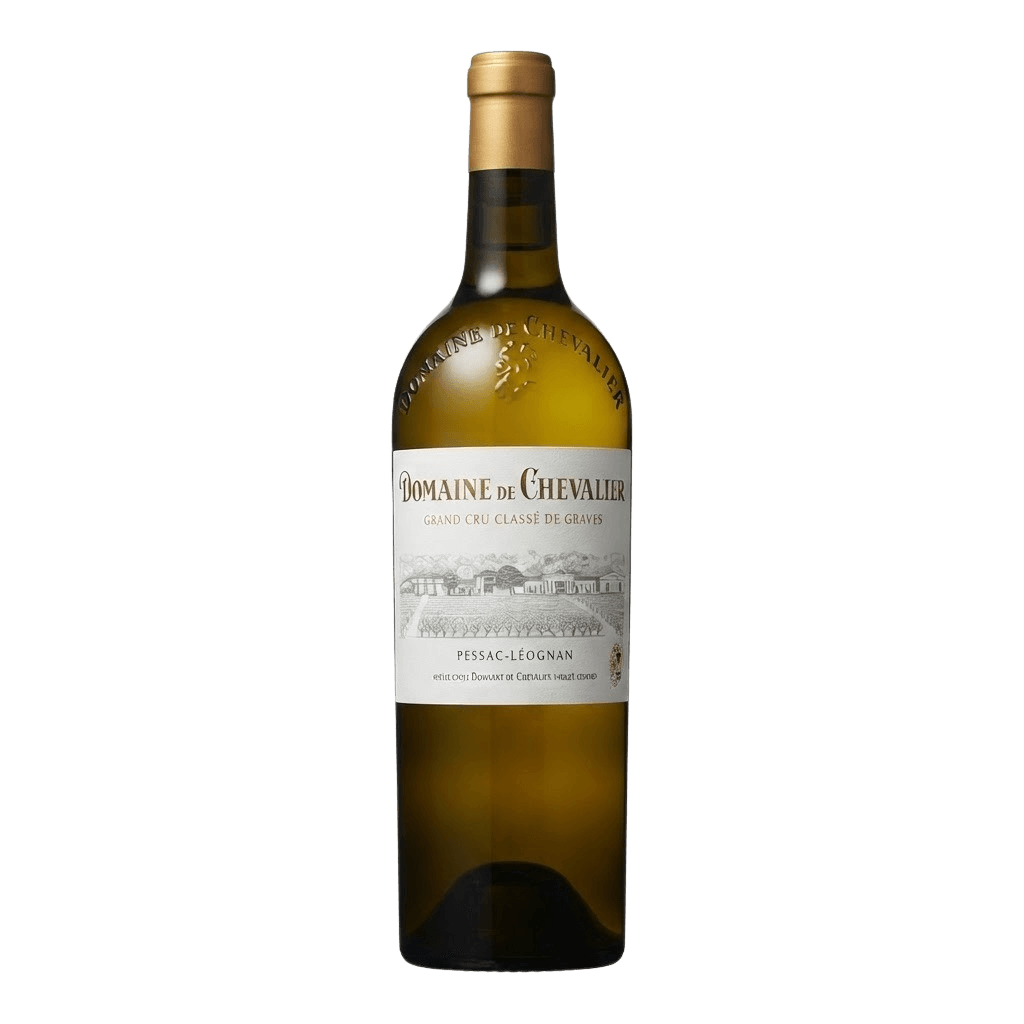
Domaine de Chevalier
Domaine de Chevalier Blanc
2021
From 119 EUR from 3 retailers
A Grand Cru Classé de Graves from Pessac-Léognan, combining Sauvignon Blanc freshness and Sémillon texture with mineral precision, complexity and long ageing potential.
Country
France
Region
Bordeaux - Pessac-Leognan
Number of retailers: 3
Chateaunet
France
Domaine de Chevalier Blanc
2021
Standard delivery 1-3 business days
bordeauxwines.se
Sweden
Domaine de Chevalier Blanc
2021
Standard delivery 1-3 business days
Gassås Wine
Sweden
Domaine de Chevalier Blanc
2021
Standard delivery 1-3 business days
You save up to 10 EUR, where 10 EUR is the difference between the highest price and the lowest price
Scoring
More information
Producer
Domaine de Chevalier
Domaine de Chevalier is a historic wine estate in Léognan, within Bordeaux's Pessac-Léognan appellation. Unlike many Bordeaux properties, it retains the designation Domaine rather than Château, reflecting an identity closely connected to its land, forest and long-established agricultural environment.
The estate is surrounded by woodland, creating an unusually isolated vineyard ecosystem within Pessac-Léognan. Domaine de Chevalier produces both red and white wines, with Cabernet Sauvignon forming the foundation of the red vineyard and Sauvignon Blanc dominating the white plantings. The property has belonged to the Bernard family since 1983 and is managed by Olivier Bernard and his team.
Quick Facts
- Producer: Domaine de Chevalier
- Location: Léognan, Bordeaux, France
- Appellation: Pessac-Léognan
- Classification: Grand Cru Classé de Graves
- Owner: Bernard family
- Principal varieties: Cabernet Sauvignon and Merlot for red; Sauvignon Blanc and Sémillon for white
History and Identity
The origins of Chevalier are old, with the name Chivaley appearing in the estate's historical narrative from around 1650. The property is also represented on Pierre de Belleyme's map of the region in 1783. Its development as a significant wine estate, however, accelerated during the second half of the nineteenth century.
A decisive moment came in 1865, when Arnaud and Jean Ricard acquired the domaine. The Ricard family's stewardship established much of the modern identity of Chevalier.
Under Claude Ricard, Domaine de Chevalier entered the Graves Classification in 1953.
In 1983, the Bernard family acquired the estate. Olivier Bernard subsequently oversaw substantial investment in the vineyards and cellars, including expansion of the vineyard and redevelopment of the winemaking facilities.
Despite this modernisation, continuity remains fundamental to the domaine's philosophy: preserving the character of its terroir rather than imposing a predetermined wine style upon each vintage.
Estate, Vineyards and Terroir
One of Domaine de Chevalier's defining characteristics is its location within a large forested environment.
The woodland surrounding the vineyard influences its microclimate and supports biodiversity, while the estate's relative isolation creates a distinctive ecosystem. The domaine specifically identifies the interaction between vineyard and forest as a major natural advantage.
The property covers approximately 100 hectares, of which the producer currently describes around 70 hectares as planted with vines, including approximately 60 hectares of red vines and 7 hectares of white vines.
The soils are poor and complex, with gravel playing a central role. Official technical material describes gravel over clay-gravel subsoil.
The current vineyard plantings are given by the domaine as:
Red vineyard plantings
- 65% Cabernet Sauvignon
- 30% Merlot
- 3% Petit Verdot
- 2% Cabernet Franc
White vineyard plantings
- 70% Sauvignon Blanc
- 30% Sémillon
These percentages describe vineyard plantings — not the blend of Domaine de Chevalier Rouge or Blanc.
That distinction is critical for SCI.
Viticulture
Domaine de Chevalier emphasises detailed observation of individual parcels and vines.
Planting density is approximately 10,000 vines per hectare, significantly increasing competition between vines and forming an important part of the estate's approach to fruit concentration and maturity.
The surrounding forest is equally important. Beyond its climatic influence, it provides habitat for beneficial fauna and contributes to biodiversity around the vineyard.
The domaine states that herbicides and chemical fertilisers have historically been avoided and describes an ongoing ecological approach to vineyard management. Soil drainage, vine density, parcel observation and matching grape varieties to individual terroirs form central parts of the viticultural strategy.
The underlying philosophy is therefore not simply organic or environmental positioning, but:
Forest ecosystem → soil health → high-density vineyard → individual parcel observation → balanced fruit.
Production and Winemaking
Domaine de Chevalier deliberately adapts winemaking to the characteristics of each vintage rather than pursuing maximum extraction or a predetermined style.
For the reds, the winery uses concrete, wooden and stainless-steel vats of varying capacities, allowing individual parcels, grape varieties and vine ages to be handled separately.
The domaine explicitly describes its extraction philosophy as moderate. Fermentation is carefully temperature controlled, with remontage and, where appropriate, traditional pigeage. Maceration generally lasts around 15–25 days, depending on the structure of the wine. Malolactic fermentation can then take place in new barrels.
Final blending takes place relatively early, typically in January, with the objective of integrating tannins while preserving the natural density, depth, complexity, finesse and balance of the terroir. Depending on the vintage, only around 40–65% of total red vineyard production may be selected for the Grand Vin.
White wine production follows a different philosophy. Grapes are harvested through successive passes through the vineyard, selecting fruit as individual bunches reach maturity. The domaine says a parcel may be picked repeatedly over two to three weeks.
Exact barrel proportions, maturation periods and technical parameters belong to the individual wine and vintage entities.
Style and Identity
Domaine de Chevalier's identity is built around balance rather than power.
For its red wines, the producer's philosophy combines density and depth with complexity, finesse and elegance, while deliberately avoiding excessive extraction.
The whites form an equally important part of the domaine's identity. Sauvignon Blanc provides freshness and aromatic definition, while Sémillon contributes texture and depth. The small scale of the white vineyard reflects the demanding selection and vinification required by the domaine's approach.
For SCI, I would lock the producer DNA as:
Forest → gravel → precision → Cabernet / Sauvignon Blanc → balance → depth → freshness → finesse → longevity.
That captures something genuinely distinctive about Domaine de Chevalier rather than giving it a generic Pessac-Léognan description.
Portfolio
The core portfolio is centred on two Grand Vins:
Domaine de Chevalier Rouge
Pessac-Léognan red wine based principally on Cabernet Sauvignon and Merlot.
Domaine de Chevalier Blanc
Pessac-Léognan dry white based principally on Sauvignon Blanc and Sémillon.
These need to exist as separate bottle entities within Sipfind because their vineyards, blends, vinification, maturation, tasting profiles and vintages differ substantially.
The producer entity therefore sits above them:
Domaine de Chevalier
→ Domaine de Chevalier Rouge
→ Domaine de Chevalier Blanc
→ Individual vintages
The Bernard family's involvement with other Bordeaux properties should not cause those estates to be treated as Domaine de Chevalier wines. The domaine's official site separately identifies properties including Domaine de la Solitude, Château Lespault-Martillac and Clos des Lunes.
Explore Domaine de Chevalier Wines
Discover Domaine de Chevalier Rouge and Blanc. Compare vintages, critic scores, availability and current prices from trusted wine merchants.
Country
Region
Bordeaux - Pessac-Leognan
Pessac-Léognan is an AOC/AOP wine appellation in northern Graves, immediately south and south-west of the city of Bordeaux, France. Recognised as a separate appellation in 1987, it produces both red and dry white wines across ten communes. Its gravel-dominated terroir is home to all 14 estates in the current Graves Great Growth classification, including Château Haut-Brion, which also appears in the 1855 Bordeaux Classification.
Pessac-Léognan occupies the northern part of the Graves wine area. Its vineyards extend across Cadaujac, Canéjan, Gradignan, Léognan, Martillac, Mérignac, Pessac, Saint-Médard-d’Eyrans, Talence and Villenave-d’Ornon.
The appellation’s soils combine river pebbles, fine gravel, flint, sand and limestone-rich clay. Ancient gravel deposits form gently undulating outcrops with effective natural drainage. The nearby Garonne, the city of Bordeaux and the Landes Forest also influence local growing conditions.
Red Pessac-Léognan is principally associated with Cabernet Sauvignon and Merlot. Cabernet Franc, Malbec and Petit Verdot may also contribute to the blend.
The appellation’s red wines are generally structured and complex, combining ripe fruit with firm but polished tannins. Their balance, concentration and capacity for bottle ageing vary by estate, vineyard site and vintage.
Pessac-Léognan also produces dry white Bordeaux from Sauvignon Blanc, Sauvignon Gris, Sémillon and Muscadelle. These wines can combine citrus and white-fruit character with freshness, texture and mineral or gently toasted notes.
The exact blend and ageing approach differ between producers. Sauvignon commonly contributes freshness and aromatic definition, while Sémillon can add breadth and texture.
All 14 estates in the current Graves Great Growth classification are situated within Pessac-Léognan. Estates may be classified for their red wine, their dry white wine or both.
Château Haut-Brion has a unique position: it belongs to the Graves classification and is also a Premier Grand Cru Classé in the 1855 Bordeaux Classification. Other recognised estates in the appellation include Château La Mission Haut-Brion, Domaine de Chevalier, Château Haut-Bailly, Château Pape Clément and Château Smith Haut Lafitte.
Compare prices for Pessac-Léognan wines across retailers on Sipfind. Explore red and dry white wines by estate, vintage, bottle size and available offer.
Grapes
Cabernet Sauvignon is one of the world’s most important and widely planted red wine grapes, renowned for its powerful structure, concentrated fruit and exceptional ageing potential. Originating in Bordeaux, France, the variety has become a defining grape of fine wine regions around the world, particularly Napa Valley, Tuscany, Chile, Australia and South Africa.
Classic Cabernet Sauvignon combines flavours and aromas of blackcurrant, cassis, blackberry and dark cherry with characteristic notes of cedar, graphite, tobacco and herbs. Naturally high tannins and fresh acidity provide structure and longevity, while maturation in oak can add layers of spice, vanilla and toast. Its character varies significantly with climate, soil and winemaking, ranging from elegant and savoury to rich, powerful and intensely concentrated.
In Bordeaux, Cabernet Sauvignon is particularly associated with the Left Bank, where it forms the foundation of many prestigious blends alongside Merlot, Cabernet Franc and other permitted varieties. In Napa Valley, it has become the region’s signature red grape, producing some of the world’s most sought-after Cabernet Sauvignon wines.
Cabernet Sauvignon’s ability to express terroir while retaining its distinctive structure and character has made it a global benchmark for premium red wine. Whether produced as the dominant variety in a blend or as a varietal wine, the finest examples combine concentration, complexity and the capacity to develop gracefully over decades
Merlot is one of the world’s most important red wine grapes, celebrated for its generous fruit, supple texture and ability to produce wines ranging from approachable and elegant to exceptionally complex and long-lived. Originating in Bordeaux, France, Merlot is particularly associated with the Right Bank, where it forms the foundation of many of the prestigious wines of Pomerol and Saint-Émilion.
Merlot typically expresses flavours and aromas of plum, black cherry, blackberry and red fruits, often developing notes of chocolate, tobacco, cedar, herbs and earthy complexity with maturation. Its naturally rounded texture and generally softer tannin profile distinguish it from Cabernet Sauvignon, although the finest examples can possess considerable structure, freshness and ageing potential.
In Pomerol, Merlot reaches some of its most celebrated expressions, particularly on the appellation’s clay-rich soils, producing wines of remarkable concentration, texture and complexity. In Saint-Émilion, it is commonly blended with Cabernet Franc and, to a lesser extent, Cabernet Sauvignon, creating wines that combine ripe fruit with structure, aromatic complexity and longevity.
Beyond Bordeaux, Merlot is widely cultivated in Italy, California, Washington State, Chile and other major wine regions. It can be produced as a varietal wine or used as a central component of blends, where its fruit and texture complement more structured grape varieties.
From the great Merlot-based wines of Bordeaux’s Right Bank to leading expressions around the world, Merlot’s combination of rich fruit, refined texture and capacity to express terroir has established it as one of the defining varieties of fine red wine.
Petit Verdot is a powerful red wine grape from south-west France, best known as a small but distinctive component of the classic red blends of Bordeaux. Its deeply coloured wines, firm tannins and concentrated aromatics allow even modest proportions to add structure, freshness and intensity alongside Cabernet Sauvignon, Merlot and Cabernet Franc.
On Bordeaux’s Left Bank, Petit Verdot is particularly associated with the gravel soils of the Médoc, including appellations such as Margaux, Saint-Julien, Pauillac and Saint-Estèphe. The variety buds relatively early but ripens late, making complete maturation challenging in cooler vintages. When fully ripe, it can retain vibrant acidity while developing considerable colour, tannin and aromatic complexity.
Typical expressions show blackberry, black cherry, blueberry and plum, accompanied by violet, liquorice, pepper, cocoa and other dark spices. In Bordeaux blends, Petit Verdot is generally used in limited quantities to reinforce colour, tannic structure and aromatic depth. Its combination of acidity and tannin can also contribute significantly to a wine’s ageing potential.
Beyond Bordeaux, warmer and more reliable growing conditions have allowed Petit Verdot to achieve greater ripeness and a more prominent role. Producers in California, Australia, Spain and South America increasingly use the variety in both Bordeaux-style blends and varietal wines. These expressions are often full-bodied and deeply coloured, with ripe dark fruit, floral character, spice and powerful tannins.
From its historic role in the Médoc to its expanding presence as a varietal wine, Petit Verdot is defined by colour, structure, freshness and aromatic intensity. Once regarded primarily as a supporting grape, it is increasingly recognised as a distinctive variety capable of producing serious, age-worthy wines in its own right.
History and Style
Domaine de Chevalier Blanc
Domaine de Chevalier Blanc is the white Grand Vin of Domaine de Chevalier, the forest-surrounded estate in Léognan, within Bordeaux's Pessac-Léognan appellation.
Produced from Sauvignon Blanc and Sémillon, the wine comes from a relatively small white vineyard of approximately seven hectares. Its identity is built around rigorous selection, successive picking passes and an unusual commitment to barrel vinification, followed by extended ageing on the lees.
The result is a dry white Bordeaux in which freshness and aromatic definition are combined with texture, density and the capacity to develop over many years in bottle.
Quick Facts
- Producer: Domaine de Chevalier
- Wine: Domaine de Chevalier Blanc
- Category: White Grand Vin
- Classification: Grand Cru Classé de Graves
- Appellation: Pessac-Léognan AOC
- Principal varieties: Sauvignon Blanc and Sémillon
History and Identity
Domaine de Chevalier has produced both red and white wines as integral parts of its identity, but the white wine is produced on a considerably smaller scale.
The domaine currently reports approximately seven hectares of white vines, compared with around 60 hectares devoted to red varieties. The producer explicitly links this limited white-vineyard area to the demanding production methods used for Domaine de Chevalier Blanc.
The white Grand Vin should therefore be treated as an independent product within Sipfind rather than as a colour variation of Domaine de Chevalier Rouge.
Producer: Domaine de Chevalier
Product: Domaine de Chevalier Blanc
Colour: White
Position: Grand Vin
Classification: Grand Cru Classé de Graves
This separation is particularly important because the red and white wines use different grape varieties, harvest strategies and vinification techniques.
Vineyards and Terroir
The white vineyard lies within Domaine de Chevalier's estate in Léognan and forms part of its distinctive gravel terroir.
The domaine currently reports approximately seven hectares of white vines, planted at around 10,000 vines per hectare. Its published white vineyard composition is:
70% Sauvignon Blanc
30% Sémillon
These figures describe vineyard plantings — not the blend of every bottle or vintage.
This distinction is important because the actual Grand Vin blend can change. The official 2021 technical sheet, for example, records:
75% Sauvignon Blanc
25% Sémillon
while the 2022 technical sheet gives:
70% Sauvignon Blanc
30% Sémillon.
Therefore:
70 / 30 = current white vineyard plantings
and
Vintage → exact bottle blend.
Harvest and Selection
Harvesting the white grapes is particularly selective.
The grapes are hand-picked into small crates, and the domaine can make between three and five successive passes through the vineyard according to ripeness.
Rather than harvesting an entire parcel at once, this approach allows individual bunches to be selected as they reach the desired maturity.
This is central to the wine's identity:
Parcel → maturity → successive picking → individual lot → barrel → selection → final blend.
It also explains why the domaine considers its white-wine production method difficult to apply on a much larger scale.
Production and Maturation
The production of Domaine de Chevalier Blanc is one of its most distinctive features.
The grapes undergo slow, gentle pneumatic pressing, with different fractions treated separately. The must is transferred directly to barrels in a temperature-controlled environment for settling.
Most importantly, the domaine states that all stages of white-wine vinification take place in barrel. This is not primarily intended to create an overtly oaked style; the producer explains that barrel vinification enables extremely precise selection and preserves the identity of individual lots before blending.
Regular bâtonnage of the lees contributes texture, volume and structure while retaining freshness.
Ageing continues on increasingly fine lees through the first summer. The wine then spends a second winter in barrel before bottling, with only light filtration required.
Recent technical sheets illustrate the general élevage:
2021: 18 months in barrel, approximately one-third new oak.
2022: 16–18 months in barrel, approximately one-third new oak.
For the master product we therefore use:
Barrel fermentation → lees ageing → bâtonnage → extended barrel maturation
while exact duration and new-oak percentage remain vintage-specific.
Blend
Domaine de Chevalier Blanc is based exclusively around the partnership of:
Sauvignon Blanc · Sémillon
Sauvignon Blanc provides the dominant varietal identity and is particularly suited to the domaine's gravel terroir. Sémillon forms the complementary component, contributing additional texture and complexity.
However, there should be no fixed numerical blend on the master bottle entity.
Instead:
Master Bottle → Sauvignon Blanc + Sémillon
Vintage Entity → exact Sauvignon Blanc / Sémillon percentages
This prevents SCI from incorrectly applying the current 70/30 vineyard composition to every vintage.
Style and Tasting Profile
Domaine de Chevalier Blanc combines two characteristics that can sometimes appear contradictory in white Bordeaux: concentration and freshness.
The domaine's vintage material repeatedly emphasises freshness, finesse, aromatic intensity and balance. Its barrel-fermentation and lees-ageing methods add structure and texture without making oak the defining character of the wine.
Rather than importing individual vintage tasting notes into the master product, we should define its stable stylistic DNA as:
Gravel → Sauvignon Blanc → freshness → Sémillon → texture → mineral precision → complexity → finesse → length.
Citrus, white flowers, white peach, exotic fruit, smoke or other individual aromatic descriptors should remain attached to vintages where they are specifically documented.
Position within the Domaine de Chevalier Portfolio
The hierarchy is straightforward:
Domaine de Chevalier Rouge
→ Red Grand Vin
→ Grand Cru Classé de Graves
Domaine de Chevalier Blanc
→ White Grand Vin
→ Grand Cru Classé de Graves
L'Esprit de Chevalier Rouge
→ Second red wine
L'Esprit de Chevalier Blanc
→ Second white wine
L'Esprit de Chevalier was created in 1989 and represents a separate second-wine entity. For the white, the domaine selects barrels individually for L'Esprit, producing a wine intended to be more accessible in its youth.
Domaine de Chevalier Blanc must therefore remain completely separate from L'Esprit de Chevalier Blanc in SCI.
Ageing and Serving
Long-term bottle development is a fundamental part of Domaine de Chevalier Blanc's identity.
The domaine explicitly describes its production approach as creating white wine for ageing, with lees stirring contributing structure while preserving freshness.
Nevertheless, we should not assign one universal drinking window to all vintages.
Acidity, concentration, harvest conditions and final blend vary considerably between years.
Therefore:
Drinking window → serving temperature → decanting → ageing potential
should be attached to the individual vintage whenever reliable information is available.
Explore Domaine de Chevalier Blanc on Sipfind
Compare vintages, critic scores, availability and current prices for Domaine de Chevalier Blanc from trusted wine merchants.