
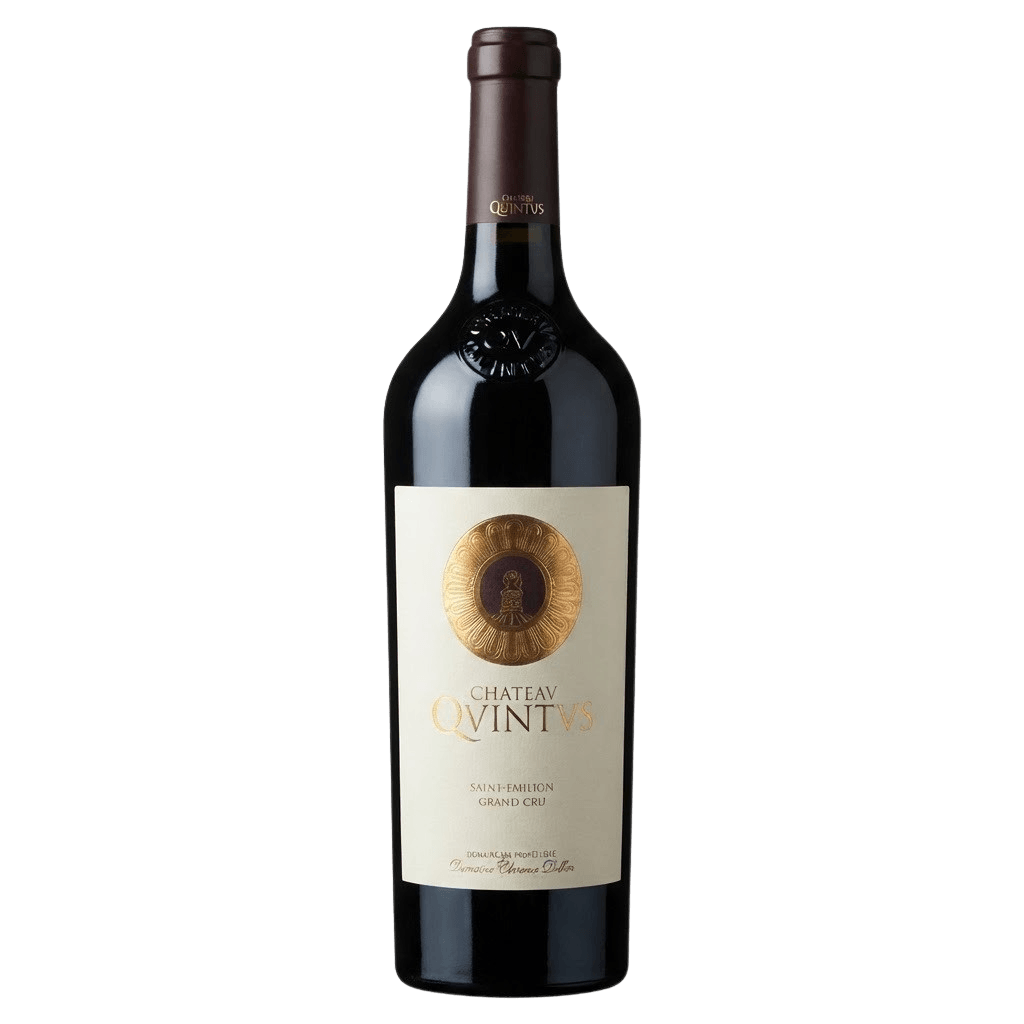
Château Quintus
Château Quintus
2018
From 166 EUR from 2 retailers
The flagship Saint-Émilion red from Domaine Clarence Dillon's Château Quintus, combining Merlot richness, Cabernet Franc freshness, refined tannins and limestone-influenced precision.
Country
France
Region
Bordeaux - Saint-Emilion
Number of retailers: 2
Philipson Wine ApS
Sweden
Château Quintus
2018
You save up to 1 EUR, where 1 EUR is the difference between the highest price and the lowest price
bordeauxwines.se
Sweden
Château Quintus
2018
More information
Producer
Château Quintus – A Contemporary Expression of Saint-Émilion
Château Quintus is a Saint-Émilion wine estate belonging to Domaine Clarence Dillon, the family-owned group responsible for Château Haut-Brion and Château La Mission Haut-Brion. Established under its present identity in 2011, Quintus brings together historic vineyards with contrasting exposures and soils to create wines that reflect the diversity of Bordeaux's Right Bank.
Situated on a limestone promontory overlooking the Dordogne valley, the estate combines Merlot and Cabernet Franc with a philosophy centred on vineyard selection, precise blending and respect for terroir. Its wines emphasise purity of fruit, freshness, textural refinement and balance, while retaining the structure required for bottle ageing.
Quick Facts
AttributeDetails
Producer
Château Quintus
Location
Saint-Émilion, Bordeaux, France
Appellation
Saint-Émilion Grand Cru
Established
2011, under its present identity
Owner
Domaine Clarence Dillon
Principal Grape Varieties
Merlot and Cabernet Franc
History and Identity
The Creation of Château Quintus
The modern history of Château Quintus began in 2011, when Domaine Clarence Dillon acquired Château Tertre Daugay, a historic Saint-Émilion property.
Under the direction of Prince Robert of Luxembourg, the estate was renamed Château Quintus and developed around the ambition of bringing together complementary vineyard terroirs under a single identity.
The name Quintus derives from the Latin word for fifth, reflecting both the property's place within the Dillon family's wine heritage and the symbolism of a fifth element representing the essence of a whole.
The estate expanded significantly in 2013 through the acquisition of neighbouring Château L'Arrosée, whose vineyards were incorporated into Quintus.
A further milestone followed in 2021 with the acquisition of Château Grand-Pontet, adding another important collection of Saint-Émilion vineyard parcels.
These acquisitions transformed Quintus into an estate combining three historic properties, each contributing its own soils, exposures and vineyard characteristics.
The result is a contemporary Bordeaux estate built upon centuries of Saint-Émilion viticultural history.
Estate, Vineyards and Terroir
A Mosaic of Saint-Émilion Terroirs
Château Quintus occupies approximately 45 hectares, including around 42 hectares of vineyards, following its expansion in 2021.
The estate's most distinctive geographical feature is its position on a limestone promontory rising approximately 62 metres above the surrounding landscape.
From this elevated position, the property overlooks the Dordogne valley and benefits from a variety of vineyard exposures.
Its principal soil types include limestone, clay and clay-limestone, with variations in depth, drainage and orientation creating different growing conditions across the estate.
Merlot and Cabernet Franc are the principal grape varieties.
Merlot contributes fruit concentration, suppleness and texture, while Cabernet Franc provides aromatic definition, freshness and structural precision.
The combination of different vineyard parcels allows the estate to select and assemble wines according to the characteristics of each growing season.
Rather than relying on one uniform vineyard profile, Quintus draws its identity from the interaction of multiple terroirs.
Viticulture and Biodiversity
Preserving the Vineyard Ecosystem
Château Quintus places considerable emphasis on biodiversity and environmental management.
The estate's landscape includes vineyards, wooded areas, hedgerows, terraces and a distinctive Mediterranean green belt.
Approximately two hectares of gardens and terraces provide habitats for insects, birds and other wildlife that contribute to the vineyard ecosystem.
The estate has introduced measures including the planting of native hedgerows, wildflower areas, nesting boxes and insect shelters.
Mechanical soil disturbance and mowing are limited where appropriate to encourage ecological diversity.
Its environmental management has been recognised through High Environmental Value certification since 2018 and ISO 14001 certification since 2019, within the collective environmental management framework for Bordeaux wine producers.
These measures form part of the estate's broader objective of maintaining healthy soils and preserving the individual character of its vineyard parcels.
Production and Winemaking
Precision Through Selection and Blending
Winemaking at Château Quintus is guided by the characteristics of each harvest and the diversity of its vineyard parcels.
Grapes are selected according to ripeness, quality and their suitability for the estate's different wines.
Parcel selection allows the winemaking team to evaluate individual components before determining the final assemblages.
The relationship between Merlot and Cabernet Franc is central to this process, with the proportions adjusted according to vintage conditions.
Fermentation and extraction are managed to preserve fruit expression while developing balanced tannins and structure.
Maturation in oak contributes to the integration and development of the wines, although the proportion of new barrels and the precise ageing regime vary between vintages.
The estate's approach prioritises harmony between fruit, structure, freshness and the mineral character associated with its limestone-influenced terroirs.
Exact grape blends, alcohol levels, harvest dates and oak maturation details belong to individual vintage pages rather than the producer's permanent profile.
Style and Identity
Elegance, Freshness and Structure
The wines of Château Quintus express a style centred on balance rather than concentration alone.
Merlot contributes generous fruit and a supple texture, while Cabernet Franc introduces freshness, aromatic lift and structural definition.
The estate's limestone and clay-limestone soils contribute to wines that combine depth with tension and precision.
Across the portfolio, the stylistic emphasis is on pure fruit, fine tannins, integrated structure and a persistent finish.
The flagship Château Quintus is designed for greater depth and ageing potential, while the estate's other wines offer different expressions of the same vineyard origins.
The resulting identity can be summarised as:
Historic Saint-Émilion terroirs → Merlot and Cabernet Franc → precise selection → harmonious blending → refined tannins → freshness → ageing potential.
Portfolio
Château Quintus
The estate's Grand Vin
Château Quintus is the flagship wine of the property.
Produced from selected vineyard parcels, it combines Merlot and Cabernet Franc in proportions determined by each vintage.
Its identity centres on fruit purity, aromatic complexity, refined tannins and the capacity to develop with bottle ageing.
Le Dragon de Quintus
The estate's second wine
Le Dragon de Quintus takes its name from the bronze dragon sculpture overlooking the estate.
Produced from the same broader collection of vineyard terroirs, it offers a more immediately approachable expression of the Quintus style.
Fresh fruit, supple texture and balanced structure are central to its identity.
Saint-Émilion de Quintus
An accessible expression of the estate
Saint-Émilion de Quintus completes the producer's current portfolio.
Made with the same attention to vineyard selection and winemaking, it emphasises freshness, generosity and approachability.
The wine provides an introduction to the character of Quintus and the wider Saint-Émilion appellation.
The producer confirms these three distinct wines in its current portfolio.
Explore Château Quintus Wines
Discover Château Quintus, Le Dragon de Quintus and Saint-Émilion de Quintus. Compare vintages, critic scores, availability and current prices from trusted wine merchants.
Country
Region
Bordeaux - Saint-Emilion
Saint-Émilion is one of the most respected wine appellations in Bordeaux and has long been recognised for producing refined, age-worthy wines of exceptional quality. Located on the Right Bank of the Dordogne River, this historic appellation combines centuries of winemaking tradition with distinctive terroir, creating elegant Merlot-dominant wines that are celebrated by collectors and enthusiasts worldwide. Established as an AOC in 1936, Saint-Émilion represents the finest expression of Right Bank winemaking.
The appellation benefits from diverse soils that define its wines. The plateau and côtes feature limestone and clay-limestone terroirs that produce structured, mineral-driven wines with remarkable ageing potential, while the lower slopes contain sandy and gravelly soils that yield softer, more approachable expressions. Merlot dominates the blend, typically complemented by Cabernet Franc and occasionally Cabernet Sauvignon, creating wines of elegance, depth and finesse.
Saint-Émilion is home to its own classification system, revised approximately every decade, which recognises Premiers Grands Crus Classés A estates such as Château Ausone and Château Cheval Blanc, alongside distinguished Premiers Grands Crus Classés B and Grands Crus Classés properties. Notable producers including Château Pavie, Château Figeac and Château Canon demonstrate the appellation's benchmark for quality and terroir expression.
Whether exploring classified estates, exceptional vintages or the appellation's rich medieval heritage, Saint-Émilion offers a distinguished introduction to Right Bank Bordeaux. Discover Saint-Émilion wines, compare prices from trusted merchants across Europe and find the best offers with Sipfind.
Grapes
Merlot is one of the world’s most important red wine grapes, celebrated for its generous fruit, supple texture and ability to produce wines ranging from approachable and elegant to exceptionally complex and long-lived. Originating in Bordeaux, France, Merlot is particularly associated with the Right Bank, where it forms the foundation of many of the prestigious wines of Pomerol and Saint-Émilion.
Merlot typically expresses flavours and aromas of plum, black cherry, blackberry and red fruits, often developing notes of chocolate, tobacco, cedar, herbs and earthy complexity with maturation. Its naturally rounded texture and generally softer tannin profile distinguish it from Cabernet Sauvignon, although the finest examples can possess considerable structure, freshness and ageing potential.
In Pomerol, Merlot reaches some of its most celebrated expressions, particularly on the appellation’s clay-rich soils, producing wines of remarkable concentration, texture and complexity. In Saint-Émilion, it is commonly blended with Cabernet Franc and, to a lesser extent, Cabernet Sauvignon, creating wines that combine ripe fruit with structure, aromatic complexity and longevity.
Beyond Bordeaux, Merlot is widely cultivated in Italy, California, Washington State, Chile and other major wine regions. It can be produced as a varietal wine or used as a central component of blends, where its fruit and texture complement more structured grape varieties.
From the great Merlot-based wines of Bordeaux’s Right Bank to leading expressions around the world, Merlot’s combination of rich fruit, refined texture and capacity to express terroir has established it as one of the defining varieties of fine red wine.
Cabernet Franc is one of France’s most historic red wine grapes, valued for its aromatic intensity, vibrant acidity and ability to express both climate and soil with remarkable clarity. It produces elegant single-varietal wines and plays an essential role in some of Bordeaux’s most distinguished blends. Earlier ripening than Cabernet Sauvignon allows Cabernet Franc to perform particularly well in cooler wine regions.
In the Loire Valley, Cabernet Franc reaches its clearest expression as a varietal wine. Typical aromas include redcurrant, raspberry, red cherry and violet, often accompanied by graphite, dried herbs, tobacco and subtle peppery notes. Naturally fresh acidity and finely structured tannins can produce approachable, fruit-driven wines as well as complex examples capable of developing for many years.
The variety is especially important in Chinon, Bourgueil and Saumur-Champigny. Chinon can range from fragrant and supple to deeply structured and age-worthy, depending on vineyard site and soil. Bourgueil often combines dark red fruit with firm structure, while Saumur-Champigny is renowned for freshness, aromatic purity and refined texture. Limestone-rich tuffeau, gravel, sand and clay all contribute to the diversity of Cabernet Franc across these Loire appellations.
In Bordeaux, Cabernet Franc is principally associated with the Right Bank, particularly Saint-Émilion and Pomerol. Usually blended with Merlot and sometimes Cabernet Sauvignon, it contributes perfume, freshness, savoury complexity and structural precision. On suitable limestone and clay terroirs, Cabernet Franc can become a dominant component of exceptionally refined and long-lived wines.
Beyond France, Cabernet Franc is cultivated in regions including Tuscany, Bolgheri, Napa Valley, Washington State, Canada, Argentina and Chile, producing styles shaped by local climate and terroir. Traditionally known as Breton in the Loire and Bouchet in parts of Bordeaux, Cabernet Franc’s combination of aromatic elegance, freshness and ageing potential establishes it as one of the world’s great red wine varieties.
History and Style
Château Quintus – The Grand Vin of a Saint-Émilion Estate
Château Quintus is the Grand Vin of the eponymous Saint-Émilion estate, owned by Domaine Clarence Dillon, the Bordeaux wine group behind Château Haut-Brion and Château La Mission Haut-Brion.
Produced from carefully selected vineyard parcels, the wine combines the generous fruit and texture of Merlot with the aromatic definition and structure of Cabernet Franc. Its identity reflects the estate's varied limestone, clay and clay-limestone soils, bringing together depth, freshness and finely integrated tannins.
Quick Facts
AttributeDetails
Producer
Château Quintus
Wine
Château Quintus
Category
Red Bordeaux / Grand Vin
Appellation
Saint-Émilion Grand Cru
Region
Bordeaux, France
Principal Grapes
Merlot and Cabernet Franc
History and Identity
The Grand Vin of Château Quintus
Château Quintus was established under its present identity in 2011, following Domaine Clarence Dillon's acquisition of the historic Château Tertre Daugay property.
The estate subsequently expanded through the integration of Château L'Arrosée in 2013 and Château Grand-Pontet in 2021. These additions brought together vineyard parcels with complementary soils, exposures and growing conditions.
The Grand Vin represents the estate's most selective expression of this combined vineyard heritage.
Rather than being defined by a single vineyard parcel, Château Quintus draws its identity from the blending of carefully chosen components across the property.
It occupies the leading position in a portfolio that also includes Dragon de Quintus and Saint-Émilion de Quintus.
The estate's expansion has progressively increased the diversity of terroirs available for selection, allowing each vintage of the Grand Vin to express a carefully assembled interpretation of Saint-Émilion.
Vineyards and Terroir
Limestone, Clay and the Diversity of Saint-Émilion
The vineyards contributing to Château Quintus are situated in Saint-Émilion on Bordeaux's Right Bank.
The estate includes an elevated limestone promontory and vineyard parcels with differing exposures, slopes and soil compositions.
Its principal terroirs comprise:
- Limestone soils, associated with freshness and structural definition.
- Clay soils, contributing to water retention and supporting ripening during dry periods.
- Clay-limestone soils, combining these characteristics across individual parcels.
Merlot and Cabernet Franc are the defining grape varieties of the Grand Vin.
Merlot provides the wine's generous fruit character, depth and supple texture. Cabernet Franc contributes aromatic lift, freshness and tannic structure.
The relative importance of individual parcels and grape varieties varies according to the conditions of each harvest.
This diversity of vineyard sources is fundamental to Château Quintus. The wine is designed to express the estate's combined terroirs rather than the characteristics of one isolated vineyard.
Viticulture and Vineyard Selection
Selecting the Best Expression of Each Harvest
Vineyard management at Château Quintus is adapted to the characteristics of individual parcels and the conditions of each growing season.
The estate places particular emphasis on monitoring grape development and assessing ripeness through vineyard observation and berry tasting.
Selection begins before harvest, with decisions about individual plots informed by their maturity, balance and aromatic potential.
The grapes are subsequently assessed to determine their suitability for the Grand Vin or the estate's other wines.
This approach allows Château Quintus to respond to variations in weather, soil conditions and ripening patterns while maintaining the identity of the flagship wine.
For example, the estate's official 2023 documentation describes detailed selection within individual plots, with different components directed towards the appropriate winery according to their potential.
The principle is consistent, but exact vineyard operations and harvest decisions remain vintage-specific.
Blend and Winemaking
Merlot and Cabernet Franc in Balance
Château Quintus is principally a blend of Merlot and Cabernet Franc.
The precise proportions are determined by the characteristics of each vintage and the selection of vineyard parcels.
Merlot provides fruit concentration, breadth and a rounded texture, while Cabernet Franc contributes aromatic complexity, freshness and structural definition.
The importance of maintaining vintage-specific blend information is illustrated by two official releases:
VintageMerlotCabernet Franc
2022
58.5%
41.5%
2023
78.3%
21.7%
The estate has also used a small proportion of Malbec in certain earlier vintages, including 2021. Consequently, the master wine should identify Merlot and Cabernet Franc as its principal grapes without treating them as an exhaustive blend for every year.
Fermentation and extraction are adapted to the quality and character of the harvested grapes.
The resulting wines undergo maturation in oak barrels, with the proportion of new oak adjusted according to vintage conditions.
For the master Château Quintus page, exact barrel percentages, alcohol levels, harvest dates and maturation periods should not be presented as permanent characteristics.
These details belong to the individual vintage profiles.
Style and Tasting Profile
Fruit Purity, Freshness and Refined Structure
Château Quintus combines the richness associated with Merlot-based Saint-Émilion wines with the aromatic freshness and structural precision of Cabernet Franc.
Its established stylistic identity centres on ripe red and dark fruit, aromatic definition, finely integrated tannins and a balanced relationship between concentration and freshness.
The estate's limestone-influenced terroirs contribute to the wine's sense of tension and mineral character, while clay-rich parcels support depth and texture.
Individual vintages may show different proportions of floral, fruit, spice and savoury characteristics.
The wine's underlying identity can nevertheless be expressed as:
Merlot richness → Cabernet Franc freshness → aromatic precision → refined tannins → mineral tension → balance → persistent finish.
The producer consistently emphasises fruit purity, subtle minerality, silky texture and ageing potential when describing Château Quintus.
Ageing and Serving
A Saint-Émilion Wine Designed for Development
Château Quintus is produced with bottle ageing in mind.
Its combination of fruit concentration, acidity and tannin structure allows the wine to develop additional aromatic complexity and textural integration over time.
The appropriate ageing period depends on the vintage.
Warmer, more concentrated years may develop differently from cooler vintages with a greater emphasis on freshness and acidity.
For this reason, Sipfind should not assign one universal drinking window to Château Quintus.
Vintage-specific critic assessments and producer recommendations should determine the ageing information displayed for individual releases.
The wine is generally suited to traditional Bordeaux serving practices, including an appropriate serving temperature and decanting when justified by the age and structure of the particular bottle.
Explore Château Quintus on Sipfind
Compare vintages, critic scores, availability and current prices for Château Quintus from trusted wine merchants.