
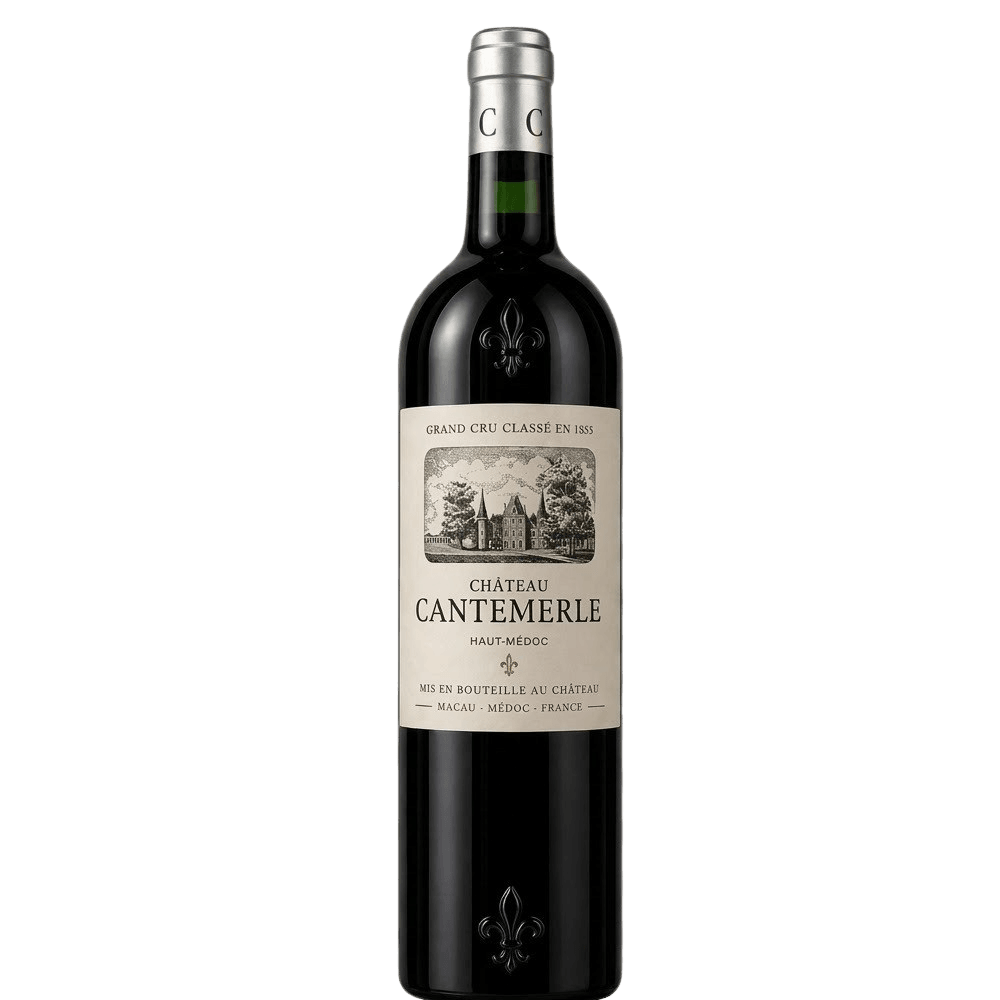
Château Cantemerle
Château Cantemerle
2001
Château Cantemerle is a distinguished Fifth Growth from Bordeaux's Haut-Médoc appellation. Combining Cabernet Sauvignon-led structure with the elegance of traditional Left Bank winemaking, this historic Grand Vin is known for its dark-fruit character, refined tannins and balanced ageing potential.
Country
France
Region
Bordeaux - Haut-Médoc
More information
Producer
Château Cantemerle – A Historic Fifth Growth of the Haut-Médoc
Château Cantemerle is one of the historic classified wine estates of Bordeaux's Haut-Médoc, situated in the commune of Macau at the southern end of the Médoc peninsula.
Recognised as a Cinquième Grand Cru Classé in the Bordeaux Classification of 1855, the estate combines a remarkable history with a distinctive approach to producing elegant, structured and age-worthy red wines.
Cantemerle's origins extend to the Middle Ages, with the earliest documented evidence of wine production dating to 1354.
Over the centuries, the property has passed through the hands of influential Bordeaux families, survived periods of economic and agricultural difficulty, and undergone substantial restoration.
Today, Château Cantemerle encompasses approximately 200 hectares of land, including 98 hectares of vineyards and extensive areas of woodland, parkland and meadows.
Its vineyards are planted on deep gravel soils, with Cabernet Sauvignon forming the foundation of the estate's wines.
The château is particularly associated with a style that favours balance, aromatic complexity and refined tannins rather than excessive concentration.
Under the ownership of Groupe SMABTP, Château Cantemerle has experienced a sustained period of investment and renewal.
Recent developments include a modern gravity-flow winery and underground barrel cellar designed to improve the precision of individual parcel vinification while reducing the estate's environmental footprint.
The result is a property where historical continuity and contemporary winemaking exist alongside one another.
The Estate at a Glance
- Producer: Château Cantemerle
- Location: Macau, Haut-Médoc, Bordeaux, France
- Classification: Cinquième Grand Cru Classé, 1855
- Historical Origins: Medieval
- First Documented Wine Production: 1354
- Ownership: Groupe SMABTP
- Managing Director: Laure Canu
- Vineyard Area: Approximately 98 hectares
- Total Estate: Approximately 200 hectares
- Principal Grape: Cabernet Sauvignon
- Other Varieties: Merlot, Petit Verdot and Cabernet Franc
- Soils: Deep siliceous gravel
- Grand Vin: Château Cantemerle
- Second Wine: Les Allées de Cantemerle
- Wine Style: Elegant, structured and aromatic red Bordeaux
- Ageing Potential: Significant in suitable vintages
The Origins of Château Cantemerle
The history of Château Cantemerle begins long before the emergence of Bordeaux's modern wine classifications.
During the Middle Ages, the property was a fortified residence positioned along important commercial routes connecting Macau with the Garonne River.
Its location gave it both strategic and economic importance.
The original fortified house was surrounded by defensive earthworks and moats, reflecting its role within the feudal landscape of medieval Aquitaine.
The First Written Evidence – 1354
The earliest documented evidence of wine production at Cantemerle dates to 1354.
Historical records describe the lord of the property paying a feudal tithe through the delivery of a barrel of clairet.
Clairet was an early style of Bordeaux wine, generally lighter in colour than many modern red wines.
The reference establishes that viticulture formed part of Cantemerle's agricultural activities during the 14th century.
It also places the property within the long history of Bordeaux's wine trade.
The Villeneuve Family
A decisive chapter began in 1579, when Jehan de Villeneuve acquired the estate.
The Villeneuve family subsequently became closely associated with Cantemerle's development.
Over generations, the property evolved from a fortified noble residence into an established agricultural and wine-producing estate.
The family expanded and reorganised its activities, placing increasing emphasis on viticulture.
During the 17th century, the château acquired much of the architectural character associated with the property today.
From Medieval Stronghold to Wine Château
The transformation of Cantemerle reflected wider developments in the Médoc.
As Bordeaux's commercial importance increased, vineyard estates became increasingly focused on producing wines for regional and international markets.
The estate's agricultural resources and proximity to transport routes helped support its development.
By the 19th century, Cantemerle had established a reputation that would eventually lead to its inclusion among Bordeaux's classified growths.
The Extraordinary Story of the 1855 Classification
Château Cantemerle occupies a particularly interesting place in the history of the Bordeaux Classification of 1855.
Its inclusion was not straightforward.
Indeed, the estate was initially omitted from the classification.
The Paris Universal Exhibition
In 1855, Emperor Napoleon III requested a classification of Bordeaux wines for the Universal Exhibition in Paris.
The Bordeaux Chamber of Commerce asked the region's wine brokers to prepare a ranking.
The brokers relied heavily on historical market prices and commercial reputation.
The resulting classification divided the leading Médoc red wines into five categories.
Why Cantemerle Was Initially Missing
Château Cantemerle had traditionally sold substantial quantities of its wine directly to buyers in the Netherlands.
Because these transactions did not consistently pass through the established Bordeaux brokerage system, the estate's historical prices were less visible in the records used to prepare the classification.
Consequently, Cantemerle was omitted from the original list published in April 1855.
The omission did not go unchallenged.
Caroline de Villeneuve's Intervention
Baroness Caroline de Villeneuve, who had managed the estate following her husband's death in 1834, challenged the decision.
She assembled historical evidence of the wine's commercial standing, including pricing records and other documentation.
Her efforts demonstrated that Cantemerle possessed the market reputation required for inclusion.
On 16 September 1855, Château Cantemerle was officially added to the classification as a Fifth Growth.
The episode remains one of the most distinctive stories associated with the historic Bordeaux ranking.
A Classification That Endured
Château Cantemerle has retained its Cinquième Grand Cru Classé status ever since.
The classification is an important part of the estate's identity, but it should be understood in its historical context.
The 1855 ranking reflected commercial standing in the mid-19th century rather than a modern annual assessment of wine quality.
For Cantemerle, the classification also represents the determination of a remarkable figure in the estate's history.
Decline, Recovery and the Modern Estate
The decades following the 1855 Classification brought significant challenges.
Like many European vineyards, Cantemerle was affected by phylloxera and fungal diseases during the late 19th century.
These crises damaged vineyard productivity and required substantial investment in replanting.
The Dubos Family
In 1892, the estate passed to Théophile-Jean Dubos.
The Dubos family continued its development through a period marked by agricultural change, economic instability and two world wars.
The difficulties of the 20th century contributed to a substantial reduction in the area under vine.
Following the Second World War, only approximately 20 hectares remained in cultivation.
Despite these challenges, the property retained its historic identity.
A Turning Point in 1981
A major change occurred in 1981 when the French mutual insurance group SMABTP acquired Château Cantemerle.
The new ownership initiated an extensive programme of restoration and investment.
Vineyards were replanted, production facilities improved and the historic buildings restored.
The vineyard area gradually expanded.
The estate ultimately returned to a scale more consistent with its historical importance.
A New Phase Under Laure Canu
Since 2021, Château Cantemerle has been managed by Laure Canu.
Her leadership has coincided with an ambitious programme of technical modernisation.
The objective has been to improve precision in vineyard and cellar operations while preserving the estate's established style.
This approach reflects an important principle: modernisation should enhance the expression of Cantemerle's terroir rather than fundamentally change its identity.
The Terroir of Château Cantemerle
Château Cantemerle is located in the southern Haut-Médoc, near the commune of Macau.
Its vineyards occupy gravel-rich land associated with the ancient geological development of the Garonne River system.
The estate's approximately 98 hectares of vines are grouped around the château.
This geographical continuity is an important feature of Cantemerle.
The Importance of Deep Gravel
The Médoc's great gravel soils were formed through successive periods of erosion and sediment deposition.
At Cantemerle, these soils contain siliceous gravel derived from ancient geological processes.
Gravel provides several advantages for growing Cabernet Sauvignon.
It generally offers good drainage, helping prevent excessive water accumulation around vine roots.
Its relatively low fertility can also moderate vine vigour.
These conditions encourage the development of smaller crops with suitable concentration when the growing season is favourable.
Heat and Ripening
Gravel absorbs and releases heat, influencing the immediate environment around the vines.
This can be particularly important for Cabernet Sauvignon, a variety that requires sufficient warmth to achieve full ripeness.
The combination of drainage, sunlight and temperature contributes to the vineyard's suitability for producing structured red Bordeaux.
A Continuous Vineyard Landscape
Cantemerle's vineyards have remained closely associated with the château and its surrounding land for generations.
This continuity provides the estate with a relatively coherent geographical identity.
Nevertheless, individual parcels differ in their precise soil composition, exposure and growing conditions.
Understanding these differences is central to modern vineyard management.
Average Vine Age
The estate reports an average vine age of approximately 40 years.
Mature vines can develop extensive root systems and respond differently to seasonal conditions from younger plantings.
However, vine age alone does not determine wine quality.
The interaction between vine health, soil, climate and vineyard management remains essential.
Cabernet Sauvignon – The Foundation of Cantemerle
Cabernet Sauvignon dominates the vineyard at Château Cantemerle.
According to the estate's current planting figures, it accounts for approximately 71% of the vineyard.
This makes Cantemerle a particularly Cabernet Sauvignon-oriented property within the Haut-Médoc.
Structure and Freshness
Cabernet Sauvignon contributes several characteristics associated with the estate's wines.
These include dark-fruit aromas, tannic structure, freshness and the capacity for extended ageing.
On the gravel soils of Cantemerle, the variety can achieve a balance between ripeness and aromatic definition.
Aromatic Expression
Depending on vintage and bottle age, Cabernet Sauvignon may contribute:
- Blackcurrant.
- Blackberry.
- Dark cherry.
- Cedar.
- Graphite-like impressions.
- Tobacco.
- Subtle herbal notes.
- Fine spice.
The exact balance varies according to growing conditions and winemaking.
The Importance of Maturity
Cabernet Sauvignon ripens relatively late.
Its development can be influenced by rainfall and temperature during the final stages of the growing season.
The timing of harvest is therefore particularly important.
The estate seeks sufficient maturity while retaining freshness and avoiding excessive extraction.
Merlot, Petit Verdot and Cabernet Franc
Although Cabernet Sauvignon forms the backbone of the vineyard, the other traditional Bordeaux varieties play important supporting roles.
The estate's reported planting composition is approximately:
- Cabernet Sauvignon: 71%
- Merlot: 18%
- Petit Verdot: 7%
- Cabernet Franc: 4%
These percentages describe vineyard plantings, not the composition of every vintage.
Merlot
Merlot contributes fruit expression and roundness.
Its generally earlier ripening can provide useful flexibility during harvest.
Depending on the vintage, it may contribute plum, cherry and softer textural characteristics.
Petit Verdot
Petit Verdot can contribute colour, structure and aromatic complexity.
Its characteristics may include dark fruit, violet and spice.
The variety requires suitable ripening conditions and is therefore used according to the quality of each harvest.
Cabernet Franc
Cabernet Franc contributes aromatic detail and freshness.
Its potential characteristics include floral notes, red fruit and subtle herbal complexity.
Although it represents a relatively small proportion of the vineyard, it can play a useful role in the final blend.
Blending at Cantemerle
The composition of Château Cantemerle changes according to the vintage.
The final blend is determined by the characteristics of the harvested grapes and the estate's selection process.
The objective is to preserve balance, structure and the distinctive elegance of the property.
Vineyard Management and Harvesting
The production of Château Cantemerle begins with careful management of the vineyard throughout the growing season.
The estate monitors vine development, soil conditions and grape maturity.
Managing Vine Growth
Pruning and canopy management influence the distribution of fruit and foliage.
These practices help regulate vine vigour and improve the conditions around the grape clusters.
The estate has traditionally used Médoc double-Guyot pruning.
Leaf removal may be undertaken according to the development of the vineyard.
Harvest Decisions
Harvest timing is determined by the maturity of individual parcels and grape varieties.
Cabernet Sauvignon, Merlot, Petit Verdot and Cabernet Franc do not necessarily reach suitable maturity at the same time.
This requires a coordinated approach to harvesting.
Sorting the Grapes
Careful grape selection helps ensure that the fruit entering the winery meets the estate's standards.
The condition of the grapes is particularly important in vintages affected by challenging weather.
The objective is to preserve fruit quality before fermentation begins.
Winemaking – Precision Without Excessive Extraction
Château Cantemerle's winemaking philosophy places particular emphasis on balance and the preservation of fruit character.
The estate seeks wines with refined tannins and aromatic clarity rather than excessive extraction.
Parcel-by-Parcel Vinification
The modern winery allows grapes from different parcels to be fermented separately.
This approach provides the winemaking team with greater flexibility.
Individual lots can be evaluated according to their aromatic character, structure and potential contribution to the final blend.
A New Gravity-Flow Winery
In 2025, Château Cantemerle introduced a substantially modernised winery.
The development included a gravity-flow system designed to reduce mechanical handling of grapes and wine.
The winery contains 114 stainless-steel fermentation vats of varying capacities.
These allow individual parcels, and in some cases smaller sections of parcels, to be vinified separately.
Gentle Extraction
The estate describes its contemporary approach as favouring gentle extraction.
Fermentation temperatures and pumping-over are adjusted according to the characteristics of each lot.
The objective is to extract colour, aroma and tannin without producing an unnecessarily aggressive structure.
This approach is consistent with Cantemerle's emphasis on elegance.
The Role of Press Wine
Press wine can contribute additional structure and complexity.
At Cantemerle, individual press-wine lots are evaluated carefully before incorporation into the final blend.
Their inclusion depends on the characteristics of the vintage and the balance sought by the winemaking team.
Maturation in French Oak
Oak maturation plays an important role in the development of Château Cantemerle.
The estate's current approach involves approximately 12 months in French oak barrels, with around 35% new oak.
These figures describe the current production approach and should not automatically be applied to historical vintages.
The Purpose of Oak Ageing
Maturation allows the wine's structural components to develop.
Controlled interaction with oxygen contributes to the gradual integration of tannins.
Oak can also introduce subtle aromatic characteristics.
These may include cedar, spice and delicate toasted notes.
Preserving Fruit and Terroir
Cantemerle does not seek to create a wine dominated by oak.
The objective is to support the structure and complexity of the wine while retaining its fruit expression.
The proportion of new barrels is therefore an important stylistic decision.
A New Underground Cellar
The estate's modernisation programme included the construction of an underground barrel cellar.
The facility benefits from naturally stable temperature conditions.
It also incorporates systems designed to reduce energy consumption.
The new cellar represents a significant investment in the long-term development of the property.
The Style of Château Cantemerle
Château Cantemerle is particularly associated with an elegant interpretation of Haut-Médoc.
Its wines combine Cabernet Sauvignon structure with aromatic refinement and a relatively restrained approach to extraction.
Appearance
Young vintages generally display a deep ruby colour.
With maturity, the colour may develop garnet and brick-red reflections.
Aromatic Profile
Depending on the vintage, the wines may display:
- Blackcurrant.
- Blackberry.
- Red cherry.
- Violet.
- Cedar.
- Tobacco.
- Graphite-like impressions.
- Subtle spice.
- Forest-floor characteristics with maturity.
Palate
The palate typically combines freshness, dark-fruit expression and defined tannins.
Merlot can contribute roundness, while Cabernet Sauvignon provides structure.
Petit Verdot and Cabernet Franc may add complexity.
Texture
One of Cantemerle's defining stylistic ambitions is the production of fine, integrated tannins.
The estate seeks a balance between concentration and elegance.
Finish
The finish may combine persistent fruit, freshness and subtle savoury characteristics.
Its length and complexity depend on the vintage and the development of the wine.
Ageing Potential
Château Cantemerle produces wines capable of developing with bottle age.
The combination of Cabernet Sauvignon, gravel terroir and carefully managed tannins contributes to this potential.
Young Vintages
Young wines may display fresh blackcurrant, dark cherry and floral aromas.
The tannins can be prominent, particularly in structured vintages.
Mature Vintages
With suitable bottle ageing, the wines may develop:
- Cedar.
- Tobacco.
- Leather.
- Dried fruit.
- Forest floor.
- Subtle earthy complexity.
These characteristics develop differently according to the vintage.
Vintage Variation
The ageing potential of Château Cantemerle should be assessed individually.
Warmer vintages may produce different structural balances from cooler growing seasons.
Harvest conditions and blending decisions also influence development.
A universal drinking window should not be applied to every vintage.
Château Cantemerle and Les Allées de Cantemerle
The estate produces two principal red wines.
Château Cantemerle – The Grand Vin
Château Cantemerle is the estate's classified Grand Vin.
It represents the selection intended to express the property's principal identity.
The blend varies according to vintage.
The wine is associated with structure, elegance and ageing potential.
Les Allées de Cantemerle – The Second Wine
Les Allées de Cantemerle is the estate's second wine.
It provides a separate expression of the vineyard and the estate's selection philosophy.
Like many Bordeaux second wines, its precise composition and characteristics depend on the vintage.
It should not be described as independently classified under the 1855 Classification.
Two Separate Wine Identities
Although both wines share the same producer, they should be treated as distinct products.
Their labels, blends, selection criteria and market positioning differ.
For accurate vintage information and price comparisons, each wine requires its own product identity.
Sustainability and the Natural Environment
Château Cantemerle is unusual in the extent of the natural landscape surrounding its vineyards.
The estate encompasses approximately 200 hectares, including nearly 100 hectares of woodland, parkland and meadows.
These areas form an important part of the property's identity.
Biodiversity
The preservation of woodland and other natural habitats contributes to the estate's environmental management.
The property seeks to maintain a balance between agricultural production and the surrounding ecosystem.
Environmental Certification
Château Cantemerle has undertaken environmental initiatives covering vineyard management, biodiversity and resource use.
In 2023, the estate received the Cultivons Demain corporate social responsibility certification associated with the Bordeaux wine sector.
Energy Efficiency
The new winery and underground cellar incorporate systems intended to reduce energy consumption.
These include geothermal technology and improved water-management systems.
The estate's approach reflects a broader commitment to combining modern wine production with environmental responsibility.
Château Cantemerle in the Context of the Haut-Médoc
The Haut-Médoc appellation contains some of Bordeaux's most historically important vineyard landscapes.
Its wines are generally based on Cabernet Sauvignon and Merlot, with other traditional varieties contributing according to the producer.
The appellation includes a wide range of properties, from smaller independent estates to internationally recognised classified growths.
The Southern Médoc
Cantemerle's location near Macau places it in the southern part of the Médoc peninsula.
The estate benefits from the gravel soils associated with this area.
Its geographical position also provides an interesting contrast with the classified properties farther north in appellations such as Saint-Julien and Pauillac.
A Distinctive Fifth Growth
Cantemerle's classification and long history give it a recognised place within Bordeaux.
However, its identity is not defined solely by the 1855 ranking.
The estate's extensive natural surroundings, historically continuous vineyard and emphasis on elegance contribute to its individual character.
Heritage and Modernisation
The relationship between tradition and technical development is central to Cantemerle's contemporary direction.
The property has invested in modern facilities while retaining the architectural and historical character of the château.
Its winemaking philosophy continues to emphasise balance, precision and the expression of its gravel terroir.
Discover Château Cantemerle on Sipfind
Château Cantemerle combines centuries of Bordeaux history with the distinctive terroir of the southern Haut-Médoc.
Its position in the 1855 Classification, extensive gravel vineyards and commitment to refined Cabernet Sauvignon-led wines make it an important producer within the Médoc.
Explore Château Cantemerle and Les Allées de Cantemerle on Sipfind.
Discover individual vintages, learn about their characteristics and compare available offers from European wine retailers.
Each wine and vintage should be evaluated according to its own identity, composition and production history.
Country
Region
Bordeaux - Haut-Médoc
Haut-Médoc – The Historic Heart of Bordeaux's Left Bank
Haut-Médoc is one of the most important wine appellations on Bordeaux's Left Bank, occupying the southern section of the Médoc peninsula between the Atlantic Ocean and the Gironde estuary.
Renowned for its gravel-rich vineyards and Cabernet Sauvignon-led red wines, the appellation combines centuries of winemaking history with a remarkable diversity of estates and terroirs.
Haut-Médoc is particularly associated with structured Bordeaux blends that balance dark-fruit concentration, freshness and tannic definition.
The region includes several estates classified in the historic Bordeaux Classification of 1855, alongside numerous independent producers whose reputations have developed outside that ranking.
Although Haut-Médoc is frequently discussed as part of the wider Médoc wine region, the Haut-Médoc AOC is a distinct appellation.
Its boundaries should not be confused with the separate communal appellations of Margaux, Saint-Julien, Pauillac, Saint-Estèphe, Moulis-en-Médoc and Listrac-Médoc.
Understanding this distinction is essential to appreciating the geographical and stylistic diversity of Bordeaux's Left Bank.
A Historic Bordeaux Wine Region
The Médoc's transformation into one of the world's most celebrated wine regions accelerated during the 17th and 18th centuries.
Dutch engineers contributed to the drainage of marshland, helping make additional areas suitable for agriculture and viticulture.
Over time, vineyard estates developed on the gravel terraces of the peninsula.
These soils proved particularly suitable for Cabernet Sauvignon, which gradually became one of the defining grape varieties of the region.
By the 19th century, the Médoc had established an international reputation for wines capable of developing considerable complexity through bottle ageing.
The Bordeaux Classification of 1855 formalised the commercial standing of many of its leading estates.
Five classified growths are situated within the present-day Haut-Médoc appellation: Château La Lagune, Château La Tour Carnet, Château Belgrave, Château Camensac and Château Cantemerle.
Their presence reflects the historical importance of the appellation, although the quality and identity of Haut-Médoc extend well beyond its classified properties.
Geography and Terroir
Haut-Médoc occupies a broad landscape of gravel terraces, gentle slopes and varied underlying soils.
The region's geology reflects successive periods of sediment deposition associated with the Garonne and Gironde river systems.
Gravel is particularly important because of its drainage characteristics and ability to absorb warmth.
These conditions can support the ripening of Cabernet Sauvignon, a relatively late-ripening grape variety.
However, Haut-Médoc is not geologically uniform.
Clay, limestone and sandy soils also occur throughout the appellation.
Their distribution influences vineyard water availability, grape development and the balance between the varieties used in the final wines.
The maritime climate moderates seasonal temperature extremes, while rainfall patterns and autumn conditions can significantly influence the character of individual vintages.
Cabernet Sauvignon and the Bordeaux Blend
Cabernet Sauvignon is central to the identity of Haut-Médoc.
It contributes dark-fruit aromas, tannic structure, freshness and the capacity for bottle ageing.
Merlot provides complementary fruit and texture, often contributing a rounder mid-palate.
Cabernet Franc, Petit Verdot, Malbec and Carménère may also form part of the traditional Bordeaux blend.
The precise proportions vary between producers and vintages.
This flexibility allows estates to adapt their wines to the characteristics of individual vineyard parcels and growing seasons.
Wine Style and Ageing Potential
Haut-Médoc wines are generally associated with blackcurrant, blackberry, dark cherry, cedar and subtle herbal or savoury characteristics.
Cabernet Sauvignon contributes structure, while Merlot can provide additional suppleness.
The finest examples balance fruit concentration with freshness and well-defined tannins.
With suitable bottle ageing, wines may develop aromas of tobacco, leather, forest floor and dried fruit.
However, Haut-Médoc encompasses a broad range of styles.
Some wines are intended for relatively early enjoyment, while more structured examples can develop over many years.
The ageing potential depends on the producer, vintage, vineyard conditions and winemaking.
Classified Growths and Independent Estates
The historic classified growths form an important part of Haut-Médoc's identity.
Château La Lagune, Château La Tour Carnet, Château Belgrave, Château Camensac and Château Cantemerle are all included in the 1855 Classification.
However, the appellation also contains highly regarded estates outside that ranking.
Château Sociando-Mallet is a notable example, recognised for structured, Cabernet Sauvignon-led wines with significant ageing potential.
Other producers contribute to the diversity of the appellation through different vineyard holdings, blending decisions and winemaking philosophies.
The distinction between classified and unclassified estates should not be interpreted as a simple measure of contemporary wine quality.
The 1855 Classification reflects historical commercial standing rather than an annual assessment.
Haut-Médoc and the Communal Appellations
The geographical Haut-Médoc contains several of Bordeaux's most celebrated communal appellations.
Margaux, Saint-Julien, Pauillac, Saint-Estèphe, Moulis-en-Médoc and Listrac-Médoc each possess their own appellation identity.
Their wines may share the broader geological and climatic characteristics of the Médoc, but they are marketed under separate appellations.
Haut-Médoc AOC therefore represents a distinct category rather than a collective label for all wines produced in the southern Médoc.
This distinction is particularly important when comparing wines, producers and vintages.
Discover Haut-Médoc on Sipfind
Haut-Médoc offers an extensive range of Cabernet Sauvignon-led Bordeaux wines, from historic classified growths to distinguished independent estates.
Its diversity of terroirs and producers provides opportunities to explore different interpretations of the traditional Left Bank blend.
Discover Haut-Médoc producers, individual wines and vintages on Sipfind.
Compare available offers from European wine retailers for the same wine, vintage and bottle format.
Grapes
History and Style
Château Cantemerle – A Historic Fifth Growth of the Haut-Médoc
Château Cantemerle is a historic Grand Cru Classé from Bordeaux's Haut-Médoc appellation, situated on the Left Bank of the Gironde estuary. Classified as a Fifth Growth in 1855, the estate produces a traditional Bordeaux blend distinguished by its balance of structure, freshness and elegance.
The Grand Vin reflects the character of the southern Médoc, where gravel-rich soils and a temperate maritime climate provide favourable conditions for Cabernet Sauvignon and other classic Bordeaux grape varieties.
A Distinctive Place in the 1855 Classification
Château Cantemerle occupies an unusual position in Bordeaux's classification history. Although initially omitted from the published 1855 list, the estate was subsequently included following representations concerning its historical market standing.
Its recognition as a Cinquième Grand Cru Classé established its place among the classified growths of the Médoc.
Today, Château Cantemerle remains an established example of the traditional Haut-Médoc style, combining Cabernet Sauvignon's structure with the complementary qualities of Merlot and other permitted varieties.
Terroir and Grape Varieties
The vineyards of Château Cantemerle are situated in the Haut-Médoc, where gravel deposits play an important role in vineyard drainage and grape ripening.
Cabernet Sauvignon forms the principal foundation of the Grand Vin, contributing blackcurrant character, freshness and tannic structure.
Merlot provides complementary fruit and texture, while Cabernet Franc and Petit Verdot may contribute aromatic detail and additional complexity.
The proportions of each variety are determined by the conditions of the growing season and the estate's blending decisions.
Winemaking and Maturation
Château Cantemerle follows the principles of traditional Bordeaux winemaking, with careful attention to fruit selection, fermentation and maturation.
The objective is to preserve the expression of the vineyard while achieving a balanced relationship between fruit, tannins and oak.
Maturation in oak barrels contributes to the wine's development, although the proportion of new oak and the length of ageing can differ between vintages.
These decisions influence the wine's texture, aromatic development and capacity for bottle ageing.
Style and Ageing Potential
Château Cantemerle is generally associated with blackcurrant, blackberry and dark cherry, complemented by cedar, subtle spice and savoury notes.
Its tannins are typically structured yet refined, supporting a style that emphasises balance rather than excessive concentration.
With suitable bottle ageing, well-stored vintages may develop more complex notes of tobacco, leather and forest floor.
The wine's drinking window depends on the vintage, storage conditions and individual preferences.
Château Cantemerle on Sipfind
Explore Château Cantemerle across individual vintages on Sipfind.
Compare available offers from European wine retailers for the same vintage and 750 ml bottle format, with each listing linked to the relevant merchant.