Tignanello
2023
144EUR
incl. VAT
Marchesi Antinori is one of Italy's oldest and most celebrated wine estates, with twenty-six generations of continuous family ownership since 1385. Based across Tuscany's most distinguished terroirs—Chianti Classico, Bolgheri and Montalcino—the House transformed Italian fine wine during the 1970s by pioneering the Super Tuscan category and introducing barrique ageing and international grape varieties to the region. Its flagship wine, Tignanello, remains a benchmark for collectors worldwide.
Marchesi Antinori represents one of the oldest continuously family-owned wine estates in the world, with twenty-six generations of unbroken stewardship since Giovanni di Piero Antinori joined Florence's Arte Fiorentina dei Vinattieri in 1385. Headquartered in Tuscany and led today by Marchese Piero Antinori alongside his three daughters—Albiera, Allegra and Alessia—the House controls prestigious vineyard holdings across Chianti Classico, Bolgheri and Montalcino. Combining respect for Tuscan winemaking tradition with groundbreaking innovation, Marchesi Antinori redefined Italian fine wine during the 1970s and established the Super Tuscan movement that would reshape perceptions of the region globally.
Quick Facts
Six Centuries of Tuscan Winemaking
The Antinori family's involvement in Florentine wine commerce began in 1385, when Giovanni di Piero Antinori enrolled in the Arte Fiorentina dei Vinattieri, the city's guild of vintners. Over the following centuries, the family established itself among Tuscany's most respected producers, acquiring vineyards throughout the region and exporting wine across Europe.
The estate's modern identity took shape under Marchese Piero Antinori, who assumed leadership in 1966 at the age of twenty-eight. Recognising both the limitations of existing Chianti regulations and the potential of Tuscany's finest terroirs, he initiated a series of winemaking experiments that would fundamentally reshape Italian wine.
The Birth of the Super Tuscan
In 1971, Marchesi Antinori released the first vintage of Tignanello, produced from Sangiovese blended with Cabernet Sauvignon and Cabernet Franc. The wine was aged in small French oak barriques rather than traditional large Slavonian casks and contained no white grapes—practices that violated Chianti Classico regulations at the time.
Unable to qualify for DOC status, Tignanello was initially labelled as simple Vino da Tavola. Its exceptional quality and international acclaim, however, demonstrated that Italy's greatest wines need not conform to restrictive appellation rules. The wine became the archetype of the Super Tuscan movement, inspiring a generation of producers to prioritise terroir expression and quality over regulatory compliance.
Solaia followed in 1978, a Cabernet Sauvignon-dominated blend from a single vineyard neighbouring Tignanello. Together, these wines established Marchesi Antinori as the defining voice of modern Tuscan winemaking.
Tuscan Terroirs from Chianti to the Coast
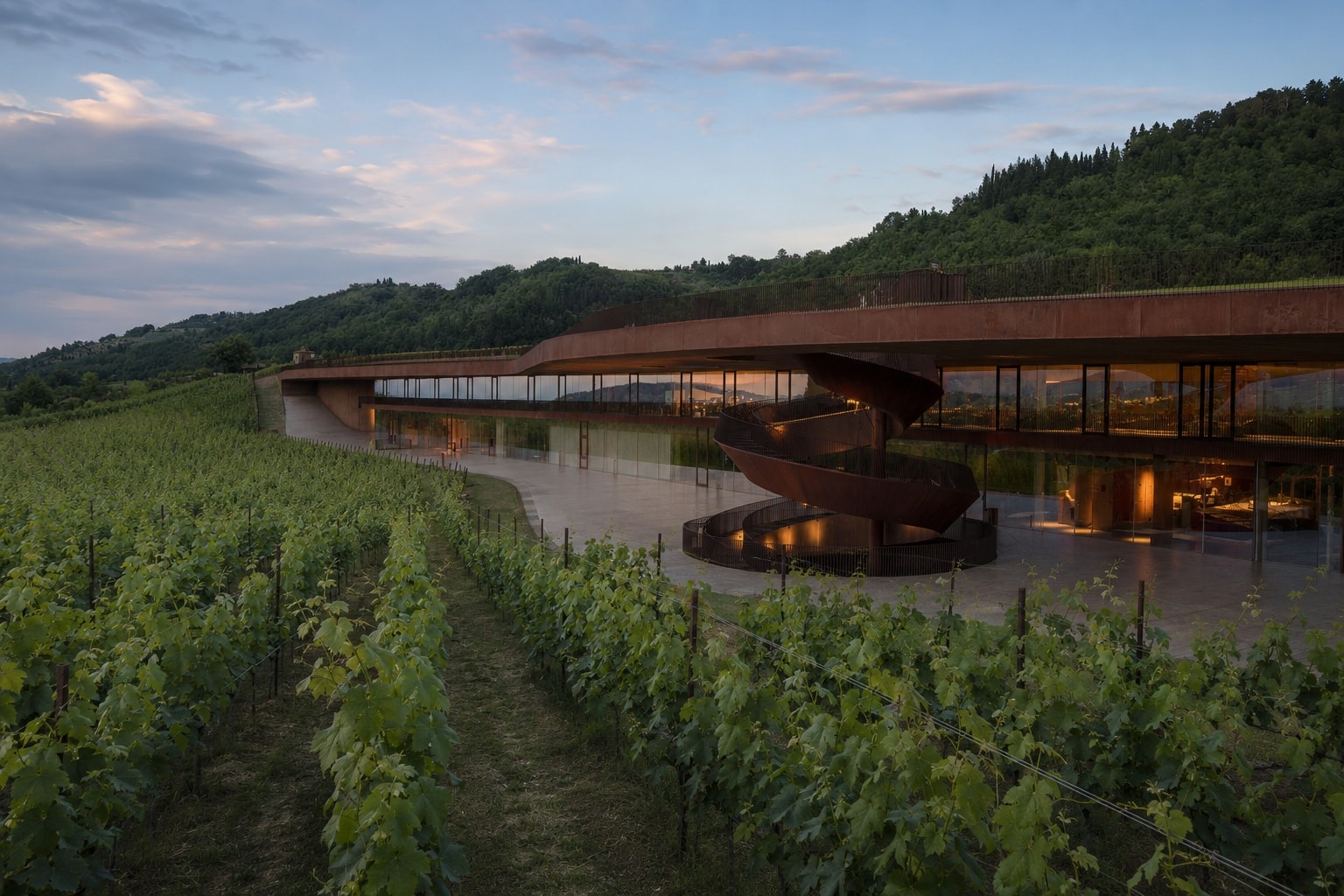
The estate's vineyard holdings span Tuscany's most distinguished wine regions. Tenuta Tignanello, covering 319 hectares in the heart of Chianti Classico between the Greve and Pesa valleys, provides the fruit for both Tignanello and Solaia as well as the estate's benchmark Pèppoli Chianti Classico. Limestone-rich galestro soils and elevations between 350 and 400 metres create ideal conditions for Sangiovese and Cabernet varieties.
In Bolgheri, the coastal estate of Guado al Tasso extends across approximately 1,000 hectares, with 320 hectares under vine. Its maritime-influenced climate and gravelly, alluvial soils suit Cabernet Sauvignon, Merlot and Cabernet Franc, producing wines of concentration and structure distinct from the inland Chianti Classico properties.
In Montalcino, the Pian delle Vigne estate focuses exclusively on Brunello di Montalcino, crafted entirely from Sangiovese Grosso. Each property reflects a commitment to site-specific viticulture and careful parcel selection, with winemaking tailored to express the distinct character of each terroir.
Precision Across the Portfolio
Vineyard work at Marchesi Antinori emphasises low yields, selective harvesting and rigorous fruit sorting. In the cellar, fermentation typically occurs in temperature-controlled stainless steel or concrete, followed by extended ageing in French oak barriques of varying sizes and toast levels depending on the wine and vintage.
The result is a collection that balances power with elegance, fruit intensity with structure, and Tuscan identity with global sophistication. Tignanello and Solaia routinely age for two decades or more, developing layered complexity while retaining freshness and precision. Estate Chianti Classico wines offer earlier accessibility but reward patience with evolving aromatic depth and tertiary character.
Across every vintage and every appellation, Marchesi Antinori remains a reference point for Italian fine wine—a House that honours six centuries of tradition while continuing to define the future of Tuscan winemaking.