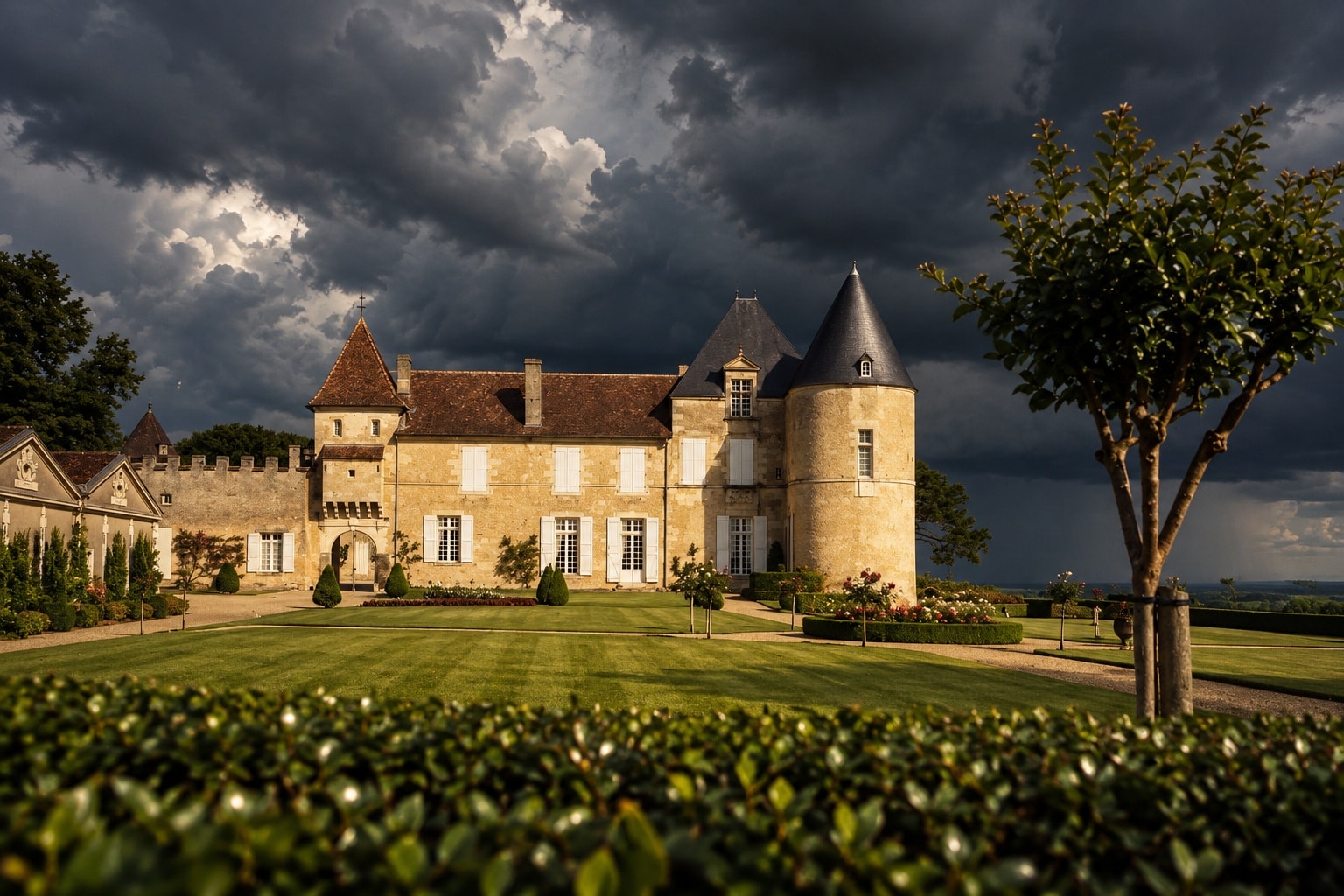
Château d’Yquem
2021
399EUR
incl. VAT
A historic Sauternes estate where singular terroir, noble rot and exacting selection create profoundly complex sweet wines with remarkable balance and longevity.
Perched on the highest hill of Sauternes in southern Bordeaux, Château d’Yquem occupies a singular position in the history of fine wine. In the 1855 Classification of Sauternes and Barsac, it was awarded the unique rank of Premier Cru Supérieur – the only estate to receive that distinction.
Yquem's identity is shaped by an unusual convergence of terroir, climate and painstaking human intervention. Its 113 hectares of vines encompass a broad mosaic of Sauternes soils, while the development of Botrytis cinerea, or noble rot, concentrates the grapes and contributes to the extraordinary aromatic complexity of its sweet wine. Selection is uncompromising, and the estate has historically chosen not to produce Château d’Yquem when a harvest fails to meet its standards.
The documented history of Yquem stretches back more than four centuries. In 1593, Jacques Sauvage, a member of a local noble family, was granted feudal tenure over Yquem. The Sauvage family subsequently built the château and assembled the vineyard parcel by parcel, becoming full owners of the property in 1711.
A defining figure in Yquem's development was Françoise-Joséphine de Sauvage d’Yquem, who married Louis-Amédée de Lur-Saluces in 1785. Widowed only a few years later, she assumed responsibility for the estate and played a central role in establishing its international reputation. Under her stewardship, a new cellar was constructed in 1826 and the demanding practice of harvesting grapes through successive selective passes was refined.
Yquem's status was formally recognised in 1855, when it became the sole estate classified Premier Cru Supérieur in the classification of Sauternes and Barsac.
The Lur-Saluces family remained closely associated with Yquem into the twentieth century. At the end of that century the estate entered a new period of ownership, with LVMH acquiring Château d’Yquem in 1999.
Château d’Yquem has 113 hectares of vines, although only around 100 hectares are normally in production at any one time. Each year, ageing vines are removed and parcels are allowed to rest before replanting; young vines then require several years before their fruit meets Yquem's standards.
The vineyard encompasses an unusually broad cross-section of Sauternes geology. Surface soils containing pebbles and coarse gravel absorb and retain warmth, while clay-rich subsoils provide important reserves of moisture.
Water management has long been critical. Numerous natural springs occur across the property, and approximately 100 kilometres of drainage have been installed since the nineteenth century to control excess water.
The vineyard is planted approximately:
These percentages describe the vineyard plantings, not the blend of an individual Château d’Yquem vintage. Sémillon contributes richness, volume and structure, while Sauvignon Blanc provides aromatic lift and finesse.
Viticulture at Yquem remains deliberately traditional and labour-intensive. The soils are cultivated rather than chemically weeded, and farm manure is applied sparingly to maintain the natural balance and relative poverty of the soils.
Severe winter pruning deliberately limits potential yields in favour of ripeness and concentration. The estate also maintains genetic diversity through massal selection, preserving vine material considered particularly well adapted to Yquem's terroir.
Above all, viticulture must create the conditions in which healthy ripe grapes can subsequently interact with Botrytis cinerea. Noble rot is fundamental to Château d’Yquem, but its development is irregular – both across the vineyard and within individual bunches – making selection during harvest essential.
Harvest at Yquem is fundamentally different from a conventional grape harvest. Rather than picking entire parcels at once, experienced teams return through the vineyard repeatedly, selecting individual grapes or bunches only when they have reached the required stage of concentration and noble rot. This succession of selective passes is central to Yquem's identity and inevitably results in very low yields.
After pressing, the must is transferred to new oak barrels for fermentation. Depending on the individual lot, fermentation may take roughly two to six weeks and stops naturally. Lots originating from individual harvest days are initially kept separate.
Selection continues long after harvest. After six to eight months, selected lots undergo preliminary blending, with barrels that fail to meet Yquem's standards excluded. The retained wine then continues its maturation, with the estate describing an additional 20 months in barrel, accompanied by regular topping, racking and further tasting-based selection before the final blend is determined.
This relentless selection means that producing Château d’Yquem is not simply a question of harvesting grapes affected by noble rot; each vintage must ultimately meet the estate's own qualitative threshold.
Château d’Yquem is defined not simply by sweetness or concentration, but by the balance between richness, acidity, aromatic complexity and texture.
Young wines can display citrus, apricot, mandarin and exotic-fruit characters alongside floral, vanilla and toasted nuances. With extended bottle age, the aromatic spectrum can develop towards dried apricot, marmalade, prune, saffron, cinnamon, liquorice and complex floral notes.
Texture is equally important. Yquem is characteristically rich and enveloping, yet its acidity, bitterness and freshness prevent the wine from becoming heavy. This tension between concentration and lift is fundamental to its ability to evolve over exceptionally long periods in bottle.
Individual vintages can nevertheless differ dramatically. Their precise blend, alcohol, residual sugar, harvest conditions and tasting profile therefore belong on Sipfind's vintage-specific Château d’Yquem pages, not on the producer page.
The estate's principal wine and the expression upon which Yquem's historic reputation rests. A botrytis-affected sweet white Sauternes produced from Sémillon and Sauvignon Blanc, with the precise composition and character determined by each vintage.
Y d’Yquem – commonly known simply as Y – is the estate's rare dry white wine, made from the same terroir and vines but harvested and vinified differently from Château d’Yquem.
Y has been produced since 1959. Its style evolved significantly from 1996, and since 2004 the estate has deliberately harvested selected Sauvignon Blanc parcels early to preserve freshness. The estate describes annual production at around 10,000 bottles, making Y a very small part of total production.
Discover Château d’Yquem and Y d’Yquem. Compare vintages, critic scores, availability and current prices from trusted wine merchants.