
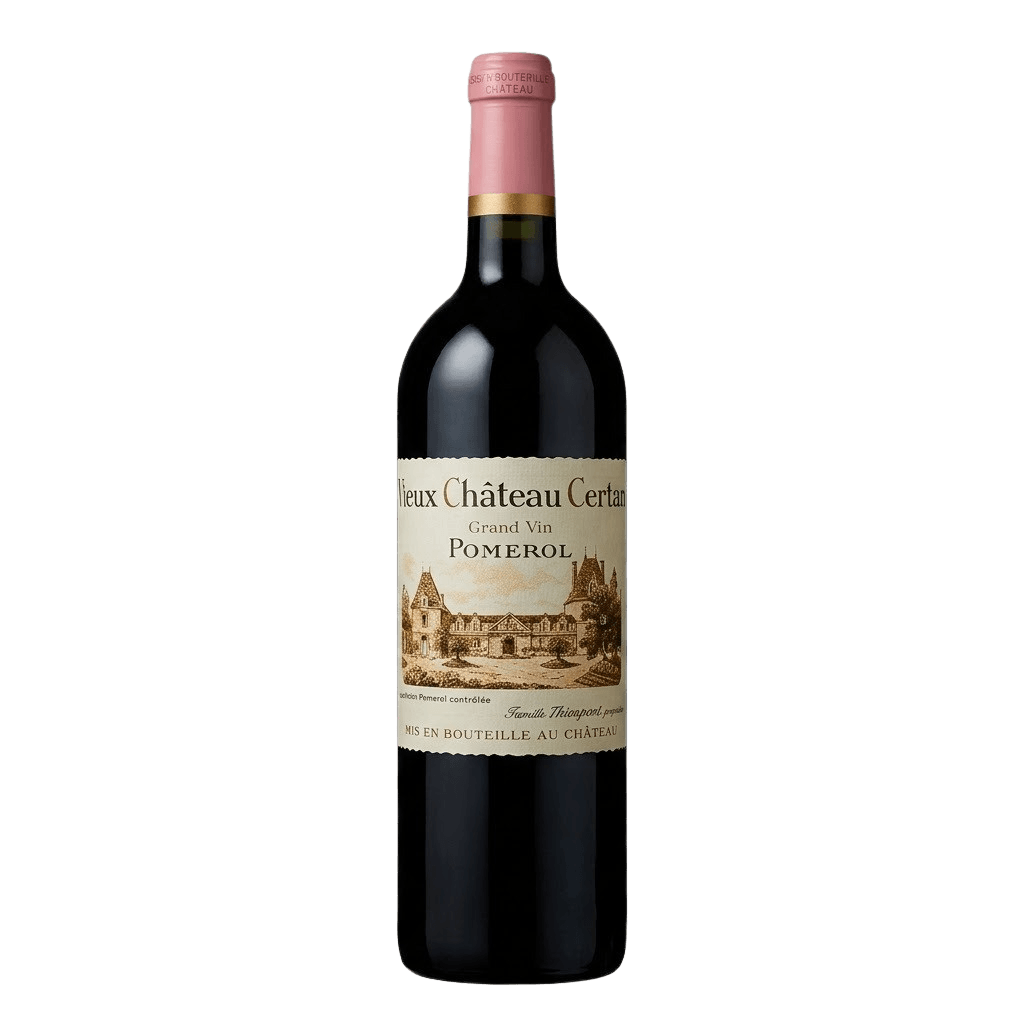
Vieux Château Certan
Vieux Château Certan
2018
From 321 EUR from 2 retailers
Vieux Château Certan represents the aristocratic heart of Pomerol, crafting flagship wines that marry Merlot's opulence with Cabernet Franc's structure. A benchmark estate combining elegance, power and remarkable ageing potential.
Country
France
Region
Bordeaux - Pomerol
Number of retailers: 2
Bottle Hero
European Union
Vieux Château Certan
2018
You save up to 76 EUR, where 76 EUR is the difference between the highest price and the lowest price
Philipson Wine ApS
Sweden
Vieux Château Certan
2018
Standard delivery 1-3 business days
More information
Producer
Vieux Château Certan is one of Pomerol's most distinguished estates, widely regarded as a peer to Château Pétrus despite the absence of an official classification system on the Right Bank. Located on the Pomerol plateau and under the stewardship of the Thienpont family since 1924, the property has maintained an unbroken reputation for quality across nearly four and a half centuries. The estate is known for its distinctive compositional approach, favouring Cabernet Franc to an extent unusual in Merlot-dominated Pomerol, and producing wines of structure, aromatic complexity and remarkable longevity.
Quick Facts
- Location: Pomerol, Bordeaux, France
- Founded: Late 16th century
- Ownership: Thienpont family since 1924
- Leadership: Alexandre Thienpont
- Estate size: Approximately 14 hectares
- Principal grapes: Merlot, Cabernet Franc, Cabernet Sauvignon
- Soils: Gravel and clay with iron-rich subsoil
- Grand Vin: Vieux Château Certan
- Second wine: La Gravette de Certan
- Style: Elegant, precise and structured with pronounced Cabernet Franc character
- Ageing potential: 20 to 40 years and beyond
- Classification: None – Pomerol has no official classification system
A Historic Estate at the Heart of Pomerol
The property was established in the late 16th century and takes its name from the Demay de Certan family, who owned the estate during the 18th century. By the 19th century, Vieux Château Certan had already become one of the most respected names in Pomerol, commanding prices comparable to the leading classified estates of the Médoc.
The Thienpont family acquired the property in 1924, beginning a period of careful stewardship that continues under Alexandre Thienpont, who has led the estate since 1985. This continuity of ownership and philosophy has allowed the estate to maintain an identity rooted in precision, balance and restraint rather than power alone.
The Plateau and Its Distinctive Soils
Vieux Château Certan occupies a privileged position on the Pomerol plateau, where its vineyards sit on a complex mix of gravel over clay. Crucially, the subsoil contains a notable iron-rich component known locally as crasse de fer, which contributes minerality, structure and a particular tension to the wines.
The estate's 14 hectares are planted to a blend that reflects the diversity of these soils. Merlot accounts for approximately 60 to 70 per cent, supported by a significant proportion of Cabernet Franc—often 25 to 30 per cent—and a smaller amount of Cabernet Sauvignon. This compositional balance sets Vieux Château Certan apart from many Pomerol neighbours, where Merlot typically dominates more completely.
A Cabernet Franc Signature
The estate's commitment to Cabernet Franc gives the Grand Vin a distinctive aromatic profile and structure. Where many Pomerols emphasise roundness and immediacy, Vieux Château Certan combines richness with floral lift, mineral complexity and refined, persistent tannins. The result is a wine that balances the generosity of Merlot with the precision and longevity associated with Cabernet Franc.
This approach requires careful viticulture and patient winemaking. Selective harvesting, gentle extraction and maturation in French oak barrels—typically around 80 per cent new wood—allow the estate to preserve clarity and site expression. The Grand Vin is built to age gracefully, developing layers of complexity, tertiary notes and a more seamless integration over two to four decades or longer.
La Gravette de Certan, the estate's second wine, is produced from younger vines and parcels that do not meet the exacting standards of the Grand Vin. It offers earlier accessibility while retaining the elegance and mineral signature characteristic of the property.
Country
Region
Bordeaux - Pomerol
Pomerol is one of the most respected wine appellations in Bordeaux and has earned international recognition for producing exceptional Merlot-based wines of extraordinary elegance and depth. Located on the Right Bank near Saint-Émilion, this small appellation combines centuries of winemaking tradition with some of the most distinctive terroir in France. Despite having no formal classification system, Pomerol commands some of the highest prices in the fine wine market and remains highly sought-after by collectors worldwide.
The appellation covers approximately 800 hectares characterised by gravel, clay and iron-rich soils known locally as crasse de fer. This unique terroir provides ideal conditions for Merlot, which typically comprises 70-90% of plantings, with Cabernet Franc playing a supporting role. The iron-oxide content in the soil contributes to the wines' distinctive mineral character, concentration and remarkable structure. Cool clay subsoils retain moisture during dry summers, allowing grapes to ripen slowly and develop exceptional complexity.
Pomerol is home to some of Bordeaux's most distinguished estates, including Pétrus, widely regarded as one of the greatest wines in the world, alongside Le Pin, Vieux Château Certan, Lafleur, Trotanoy and L'Évangile. These wines are celebrated for their velvety texture, intense dark fruit, refined tannins and outstanding ageing potential. The absence of a formal classification has allowed quality and reputation to speak for themselves, creating a distinctive culture of excellence.
Discover Pomerol wines, compare prices from trusted merchants across Europe and find the best offers with Sipfind.
Grapes
Merlot is one of the world’s most important red wine grapes, celebrated for its generous fruit, supple texture and ability to produce wines ranging from approachable and elegant to exceptionally complex and long-lived. Originating in Bordeaux, France, Merlot is particularly associated with the Right Bank, where it forms the foundation of many of the prestigious wines of Pomerol and Saint-Émilion.
Merlot typically expresses flavours and aromas of plum, black cherry, blackberry and red fruits, often developing notes of chocolate, tobacco, cedar, herbs and earthy complexity with maturation. Its naturally rounded texture and generally softer tannin profile distinguish it from Cabernet Sauvignon, although the finest examples can possess considerable structure, freshness and ageing potential.
In Pomerol, Merlot reaches some of its most celebrated expressions, particularly on the appellation’s clay-rich soils, producing wines of remarkable concentration, texture and complexity. In Saint-Émilion, it is commonly blended with Cabernet Franc and, to a lesser extent, Cabernet Sauvignon, creating wines that combine ripe fruit with structure, aromatic complexity and longevity.
Beyond Bordeaux, Merlot is widely cultivated in Italy, California, Washington State, Chile and other major wine regions. It can be produced as a varietal wine or used as a central component of blends, where its fruit and texture complement more structured grape varieties.
From the great Merlot-based wines of Bordeaux’s Right Bank to leading expressions around the world, Merlot’s combination of rich fruit, refined texture and capacity to express terroir has established it as one of the defining varieties of fine red wine.
Cabernet Franc is one of France’s most historic red wine grapes, valued for its aromatic intensity, vibrant acidity and ability to express both climate and soil with remarkable clarity. It produces elegant single-varietal wines and plays an essential role in some of Bordeaux’s most distinguished blends. Earlier ripening than Cabernet Sauvignon allows Cabernet Franc to perform particularly well in cooler wine regions.
In the Loire Valley, Cabernet Franc reaches its clearest expression as a varietal wine. Typical aromas include redcurrant, raspberry, red cherry and violet, often accompanied by graphite, dried herbs, tobacco and subtle peppery notes. Naturally fresh acidity and finely structured tannins can produce approachable, fruit-driven wines as well as complex examples capable of developing for many years.
The variety is especially important in Chinon, Bourgueil and Saumur-Champigny. Chinon can range from fragrant and supple to deeply structured and age-worthy, depending on vineyard site and soil. Bourgueil often combines dark red fruit with firm structure, while Saumur-Champigny is renowned for freshness, aromatic purity and refined texture. Limestone-rich tuffeau, gravel, sand and clay all contribute to the diversity of Cabernet Franc across these Loire appellations.
In Bordeaux, Cabernet Franc is principally associated with the Right Bank, particularly Saint-Émilion and Pomerol. Usually blended with Merlot and sometimes Cabernet Sauvignon, it contributes perfume, freshness, savoury complexity and structural precision. On suitable limestone and clay terroirs, Cabernet Franc can become a dominant component of exceptionally refined and long-lived wines.
Beyond France, Cabernet Franc is cultivated in regions including Tuscany, Bolgheri, Napa Valley, Washington State, Canada, Argentina and Chile, producing styles shaped by local climate and terroir. Traditionally known as Breton in the Loire and Bouchet in parts of Bordeaux, Cabernet Franc’s combination of aromatic elegance, freshness and ageing potential establishes it as one of the world’s great red wine varieties.
Cabernet Sauvignon is one of the world’s most important and widely planted red wine grapes, renowned for its powerful structure, concentrated fruit and exceptional ageing potential. Originating in Bordeaux, France, the variety has become a defining grape of fine wine regions around the world, particularly Napa Valley, Tuscany, Chile, Australia and South Africa.
Classic Cabernet Sauvignon combines flavours and aromas of blackcurrant, cassis, blackberry and dark cherry with characteristic notes of cedar, graphite, tobacco and herbs. Naturally high tannins and fresh acidity provide structure and longevity, while maturation in oak can add layers of spice, vanilla and toast. Its character varies significantly with climate, soil and winemaking, ranging from elegant and savoury to rich, powerful and intensely concentrated.
In Bordeaux, Cabernet Sauvignon is particularly associated with the Left Bank, where it forms the foundation of many prestigious blends alongside Merlot, Cabernet Franc and other permitted varieties. In Napa Valley, it has become the region’s signature red grape, producing some of the world’s most sought-after Cabernet Sauvignon wines.
Cabernet Sauvignon’s ability to express terroir while retaining its distinctive structure and character has made it a global benchmark for premium red wine. Whether produced as the dominant variety in a blend or as a varietal wine, the finest examples combine concentration, complexity and the capacity to develop gracefully over decades
History and Style
Vieux Château Certan stands as one of Pomerol's most historic and prestigious estates, producing a flagship Grand Vin that exemplifies the appellation's distinctive character. Unlike many Pomerol properties that rely almost exclusively on Merlot, this estate is renowned for its significant proportion of Cabernet Franc, creating wines of exceptional complexity and structure that bridge the styles of Right and Left Bank Bordeaux.
Quick Facts
- Producer: Vieux Château Certan
- Classification: Prestigious Pomerol estate (unclassified appellation)
- Region: Bordeaux
- Appellation: Pomerol
- Country: France
- Style: Full-bodied Right Bank Bordeaux with exceptional structure
- Grape Composition: Merlot-dominant blend with significant Cabernet Franc (typically 60-70% Merlot, 30-40% Cabernet Franc)
- Ageing Potential: 20-40+ years from vintage
- Alcohol (ABV): 13-14%
- Tasting Profile: Dark cherry, plum, violets, graphite, tobacco, truffle, refined tannins
- Food Pairing: Roasted lamb, duck breast, beef Wellington, game birds, aged Comté
- Serving Temperature: 16-18°C
- Bottle Status: Flagship
- Vintage: Varies by vintage (multi-vintage estate)
Vineyard, Terroir and Style
The estate's vineyards occupy some of Pomerol's finest terroir, with deep gravel over clay subsoils that provide both drainage and water retention. This geological diversity allows for the cultivation of multiple grape varieties, with the blend typically dominated by Merlot complemented by substantial Cabernet Franc and smaller amounts of Cabernet Sauvignon. The Thienpont family's meticulous viticulture and traditional winemaking approach have maintained the property's stellar reputation for generations.
History and Reputation
The flagship wine displays remarkable aromatic refinement, combining dark fruit intensity with floral notes, graphite minerality and subtle spice. On the palate, it offers a rare combination of Pomerol's characteristic richness with firm, age-worthy structure and silky tannins. The substantial Cabernet Franc component contributes herbal complexity and freshness that distinguish these wines from their more Merlot-dominant neighbours.
Vieux Château Certan represents an essential expression of Pomerol's terroir and a compelling choice for collectors seeking wines that combine immediate appeal with decades of ageing potential.