
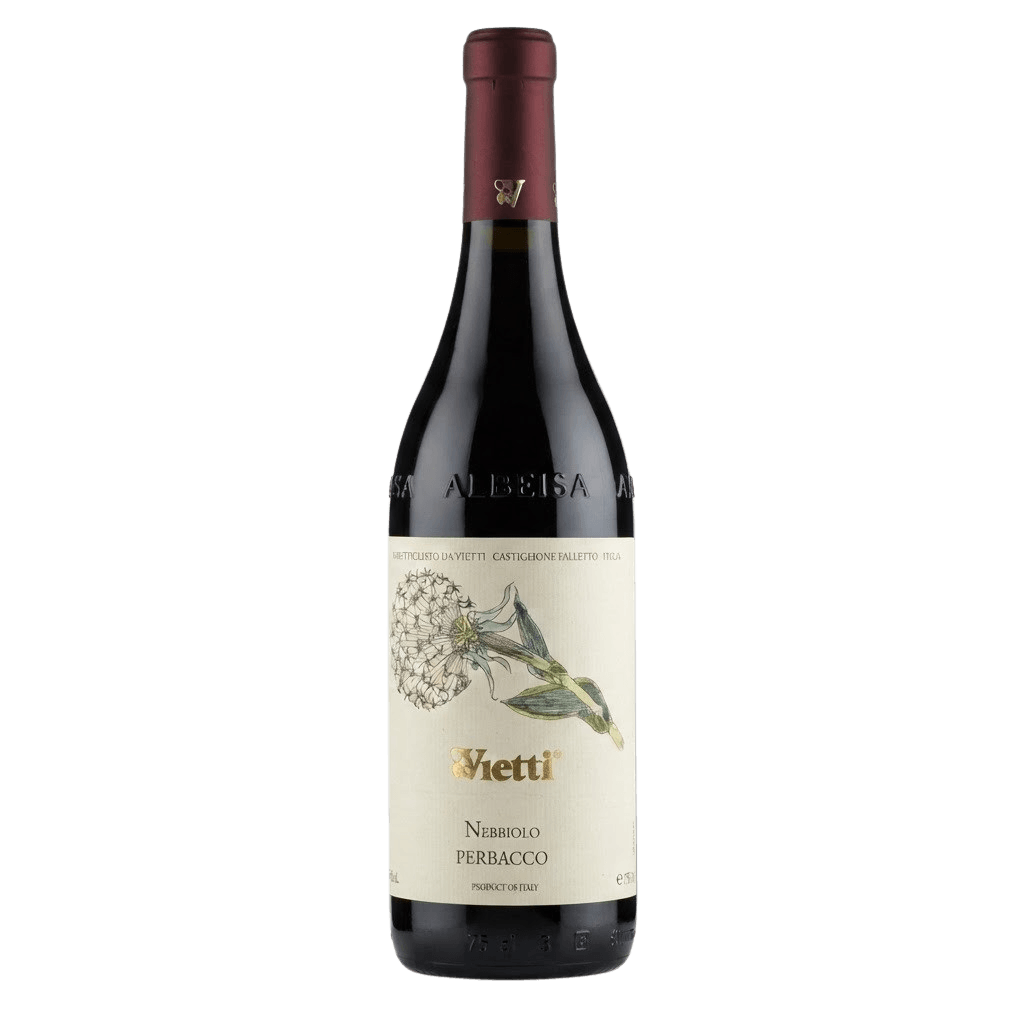
Vietti
Vietti Langhe Nebbiolo Perbacco
2022
From 22 EUR from 2 retailers
Vietti Langhe Nebbiolo Perbacco brings together selected Nebbiolo vineyards, predominantly from the Barolo and Barbaresco areas. Individually vinified and matured for approximately 18–20 months in wood, it offers expressive raspberry fruit, fresh herbal notes and elegant tannins, combining youthful intensity with ageing potential.
Country
Italy
Region
Barolo/Barbaresco - Barolo/Barbaresco
Number of retailers: 2
Chateaunet
France
Vietti Langhe Nebbiolo Perbacco
2022
Standard delivery 1-3 business days
Lobenbergs Gute Weine GmbH & Co. KG
Germany
Vietti Langhe Nebbiolo Perbacco
2022
You save up to 10 EUR, where 10 EUR is the difference between the highest price and the lowest price
Scoring
More information
Producer
Vietti is a historic and highly respected producer of Barolo DOCG and Barbaresco DOCG, celebrated for its meticulous single-vineyard interpretations of Nebbiolo. Based in Castiglione Falletto in the heart of Piedmont's Langhe hills, the estate has been under Krause family ownership since 2016, following generations of family stewardship by the Vietti and Currado families. Its wines combine aromatic refinement, structural elegance and the depth required for long-term cellaring.
Quick Facts
- Location: Castiglione Falletto, Langhe, Piedmont, Italy
- Founded: Late 19th century
- Classification: Barolo DOCG and Barbaresco DOCG
- Ownership: Krause family, since 2016
- Previous stewardship: Vietti and Currado families
- Principal grape: Nebbiolo
- Other varieties: Barbera, Arneis
- Signature wines: Barolo Rocche di Castiglione, Barolo Lazzarito, Barolo Ravera
- Soils: Calcareous marl with varying proportions of sand and clay
- Vineyards: Multiple cru holdings across Barolo and Barbaresco zones
- Style: Precise, balanced and built for extended ageing
- Winemaking: Extended maceration and maturation in large oak casks
A Pioneering Estate in Castiglione Falletto
Vietti was established in the late 19th century in Castiglione Falletto, one of Barolo's most acclaimed communes. The estate gained prominence under the leadership of Alfredo Currado, who joined the family in the 1960s and became a defining figure in modern Piedmontese winemaking. Currado was among the first producers to bottle single-vineyard Barolo and Barbaresco, emphasising the distinctive character of individual crus at a time when such precision was rare.
His commitment to site-specific expression helped establish Vietti as a benchmark for quality and clarity. In 2016, the Krause family acquired the estate, ensuring continuity of its winemaking philosophy and further investment in its vineyards and cellar.
The Crus of Barolo and Barbaresco
Vietti's identity is shaped by its holdings in some of the Langhe's most distinguished vineyard sites. In Barolo, the estate produces wines from Rocche di Castiglione, Lazzarito, Ravera, Brunate and Villero—each expressing a distinct facet of Nebbiolo shaped by soil composition, exposure and elevation.
Rocche di Castiglione, located directly above the village of Castiglione Falletto, is the estate's historic flagship vineyard. Its steep, southwest-facing slopes and compact calcareous marl soils produce a Barolo of concentration, aromatic intensity and firm structure, capable of evolving gracefully for three decades or more.
Lazzarito, situated in Serralunga d'Alba, offers a more austere and mineral-driven expression, while Ravera in Novello is recognised for its elegance and floral character. In Barbaresco, Vietti works with fruit from the Masseria cru, producing wines of refinement and balance.
Tradition and Precision in the Cellar
Vietti's winemaking approach respects the traditional methods of the region while allowing each site to speak with clarity. Extended maceration on the skins—often lasting several weeks—extracts colour, tannin and aromatic complexity without over-extraction. Fermentation and maturation take place in large Slavonian oak botti, which permit gradual oxygenation and development without imposing dominant wood character.
The result is a collection of wines that balance power with finesse, combining the savoury depth, fine-grained tannins and lifted aromatics that define great Nebbiolo. Vietti's Barolo and Barbaresco are built to reward extended cellaring, typically reaching their peak after 15 to 25 years, though the finest vintages from the estate's top crus can continue to evolve for much longer.
Beyond Nebbiolo, Vietti also produces distinguished Barbera d'Alba and Arneis, showcasing the estate's commitment to expressing the full range of Piedmont's indigenous varieties with precision and respect for origin.
Country
Region
Barolo/Barbaresco - Barolo/Barbaresco
Barolo and Barbaresco are widely regarded as Italy's most prestigious wine regions and represent the benchmark for Nebbiolo worldwide. Located in the Langhe hills of Piedmont in northwestern Italy, these neighbouring DOCG appellations combine centuries of winemaking tradition with exceptional terroir, producing some of the most sought-after and age-worthy wines in the world. Often described as the 'King and Queen of Italian wine', Barolo and Barbaresco have established Piedmont as one of the greatest fine wine regions alongside Bordeaux and Burgundy.
The regions benefit from a continental climate moderated by Alpine influences, with calcareous marl and sandstone soils that create ideal conditions for Nebbiolo. Barolo covers eleven communes including the renowned crus of Cannubi, Brunate and Bussia, producing powerful, structured wines that require extended ageing. Barbaresco, located northeast of Barolo, encompasses four communes and produces wines that are typically more approachable in their youth while retaining remarkable elegance and complexity. Both regions demonstrate extraordinary site-specific expression, with individual vineyards—known as Menzioni Geografiche Aggiuntive (MGAs)—producing distinct interpretations of Nebbiolo's signature aromas of rose, tar, cherry and truffle.
The regions are home to legendary producers including Giacomo Conterno, Bruno Giacosa, Bartolo Mascarello, Giuseppe Rinaldi, Gaja, Produttori del Barbaresco and Roagna. Together these estates represent a culture of meticulous vineyard management, respect for tradition and uncompromising quality that has made Barolo and Barbaresco among the world's most collectible wines.
Whether exploring historic vintages, renowned crus or iconic producers, Barolo and Barbaresco offer an unrivalled journey through Italy's finest wine heritage. Discover Barolo/Barbaresco wines, compare prices from trusted merchants across Europe and find the best offers with Sipfind.
Grapes
Nebbiolo is the noble red grape of Piedmont in northwestern Italy, best known as the variety behind the celebrated wines of Barolo and Barbaresco. Despite its relatively pale colour, Nebbiolo produces wines of remarkable structure, complexity and longevity, combining naturally high acidity with powerful tannins.
Classic Nebbiolo is distinguished by an expressive aromatic profile of red cherry, rose, violet and dried flowers, often developing notes of spice, herbs, leather, tobacco and truffle with age. The grape is particularly sensitive to its growing site, allowing differences in soil, altitude and exposure to create highly distinctive expressions.
Nebbiolo reaches its greatest fame in the Langhe hills, where Barolo and Barbaresco demonstrate the grape’s exceptional capacity for ageing and reflecting terroir. Beyond these renowned appellations, Nebbiolo is also cultivated across northern Piedmont and parts of Lombardy, producing styles ranging from elegant and aromatic to intensely structured.
Its combination of perfume, acidity, tannin and longevity has established Nebbiolo as one of Italy’s most important and distinctive red grape varieties.
History and Style
Vietti Langhe Nebbiolo Perbacco – A Distinctive Expression of Piedmontese Nebbiolo
Vietti Langhe Nebbiolo Perbacco is a 100% Nebbiolo red wine produced within the Langhe DOC appellation in Piedmont, northern Italy.
Its identity is closely connected to two of the region's most celebrated wine-producing areas: Barolo and Barbaresco.
According to Vietti, the grapes originate predominantly from selected vineyards within these areas, bringing together Nebbiolo grown across different sites in the Langhe.
The producer's approach is particularly distinctive.
Rather than combining all the grapes at the beginning of production, Vietti vinifies and matures the individual vineyard parcels separately.
This allows each component to develop independently before the final selection and blending process.
The relationship between Perbacco and Vietti's Barolo production is especially significant.
In the producer's technical documentation for the 2021 vintage, Vietti explains that the individual parcels are assessed to determine which lots will become Langhe Nebbiolo and which will continue their maturation for Barolo Castiglione.
This approach gives Perbacco a direct connection to the producer's wider Nebbiolo winemaking programme.
Following fermentation, the wine undergoes approximately 18–20 months of maturation in wooden barrels before the individual components are assembled in stainless steel for bottling.
Vietti describes Perbacco as a wine with aromas of raspberry, redcurrant, mint and spices, supported by round, elegant tannins and a long, refined finish.
The producer also emphasises its development over time: robust and intense in youth, becoming more complex and elegant with ageing.
These characteristics make Perbacco a distinctive expression of Langhe Nebbiolo, shaped by careful vineyard selection, separate vinification and extended maturation.
Wine at a Glance
AttributeDetails
Wine
Vietti Langhe Nebbiolo Perbacco
Producer
Vietti
Country
Italy
Region
Piedmont
Wine Region
Langhe
Appellation
Langhe DOC
Wine Type
Still Red Wine
Grape Variety
100% Nebbiolo
Vineyard Origin
Predominantly Barolo and Barbaresco areas
Vineyard Selection
Multiple selected parcels
Vinification
Individual parcels vinified separately
Alcoholic Fermentation
Approximately 3–4 weeks
Fermentation Temperature
28–32°C
Malolactic Fermentation
Stainless steel and/or barriques
Wood Maturation
Approximately 18–20 months
Ageing Vessels
Large barrels and barriques
Final Blending
Stainless-steel tanks
Aromas
Raspberry, Redcurrant, Mint, Spices
Tannins
Round and Elegant
Finish
Long and Refined
Vintage Type
Vintage
Sipfind MVP Bottle Size
750 ml
What Makes Vietti Perbacco Special?
The defining feature of Vietti Langhe Nebbiolo Perbacco is its relationship with the producer's broader Nebbiolo production.
Vietti works with selected vineyard parcels, predominantly from the Barolo and Barbaresco areas.
Each parcel is vinified and matured separately.
This individual treatment allows the producer to evaluate the characteristics and development of the different wines before making the final selection.
The 2021 technical sheet provides a particularly revealing explanation of this process.
Vietti states that the individual parcels are kept separate until the lots destined for Langhe Nebbiolo and those intended to continue ageing for Barolo Castiglione have been selected.
This is an important distinction.
Perbacco is not simply described as a young Nebbiolo made for immediate consumption.
Its production involves a structured vineyard-selection process and a substantial period of maturation in wood.
At approximately 18–20 months, the documented wood-ageing period is also an important part of the wine's identity.
The resulting wine combines the expressive fruit character of Nebbiolo with the structure and complexity associated with extended maturation.
These characteristics distinguish Perbacco from many simpler interpretations of Langhe Nebbiolo.
The Vineyards – Nebbiolo from Barolo and Barbaresco
Vietti sources the grapes for Perbacco predominantly from selected vineyards in the Barolo and Barbaresco production areas.
Both areas lie within the Langhe hills of Piedmont and are internationally recognised for their Nebbiolo wines.
The producer does not identify a fixed list of contributing vineyards in its general product description.
We should therefore not assign Perbacco to particular MGAs or municipalities without vintage-specific documentation.
What Vietti does confirm is that the wine brings together Nebbiolo from several selected vineyard sites.
Each parcel is vinified separately, allowing the producer to preserve flexibility during the selection and blending process.
This approach is especially relevant for Nebbiolo, a grape variety whose characteristics can vary considerably between growing sites.
Differences in vineyard conditions and harvest development can influence the structure and aromatic expression of the resulting wine.
By maintaining the individual parcels separately, Vietti can assess these differences before assembling the final Perbacco blend.
The wine therefore represents a considered combination of selected Nebbiolo vineyards rather than the expression of a single geographical site.
Nebbiolo – The Grape Behind Perbacco
Perbacco is produced exclusively from Nebbiolo, one of Piedmont's most important red grape varieties.
Nebbiolo is also the grape responsible for the wines of Barolo and Barbaresco.
The variety is recognised for its aromatic complexity, naturally high acidity and pronounced tannic structure.
These characteristics allow Nebbiolo to produce wines that can develop additional complexity through maturation.
For Perbacco, Vietti's official tasting description identifies a combination of fruit, herbal and spicy aromas.
Raspberry and redcurrant provide the fruit profile, while mint and spices contribute additional aromatic dimensions.
The producer describes the tannins as round and elegant.
This combination of fruit expression and structure is central to the wine's character.
Vietti also notes that Perbacco changes with ageing, developing from a robust and powerful young wine into a more complex and elegant expression.
The wine therefore illustrates both the immediate aromatic appeal and the developmental potential of Nebbiolo.
Winemaking – Separate Vinification of Individual Parcels
Vietti's winemaking process for Perbacco begins with the separate treatment of selected vineyard parcels.
According to the producer, alcoholic fermentation lasts approximately three to four weeks.
Fermentation takes place at controlled temperatures between 28°C and 32°C.
Following alcoholic fermentation, the wine undergoes malolactic fermentation in stainless-steel tanks and/or barriques.
The individual vineyard components remain separate throughout this stage.
This separation is particularly important because Vietti assesses the different lots before deciding their eventual destination.
The producer's 2021 technical documentation explains that some lots are selected for Langhe Nebbiolo Perbacco, while others continue maturation for Barolo Castiglione.
The exact selection is therefore part of the producer's vintage-specific winemaking decisions.
This method gives Perbacco a distinctive production identity.
Rather than relying on a fixed, undifferentiated blend, Vietti works with individual components that can be evaluated according to their development.
The final wine is assembled only after the separate vinification and maturation stages have been completed.
Oak Maturation – Approximately 18–20 Months
After malolactic fermentation, Perbacco continues its maturation in wooden barrels.
Vietti specifies an ageing period of approximately 18–20 months.
The producer uses both barriques and large wooden barrels.
The general technical documentation does not specify the proportion of each vessel type or the percentage of new oak.
Those details should therefore not be assumed.
The maturation process takes place while the individual vineyard components remain separate.
Only after this period are the selected wines assembled in stainless-steel tanks before bottling.
This sequence is important because it allows the producer to assess the development of each component before the final blend is determined.
The extended period in wood also distinguishes Perbacco from wines produced with a much shorter maturation process.
For Nebbiolo, time in barrel can contribute to the development and integration of the wine's structural characteristics.
Vietti's own description emphasises the resulting combination of round tannins, aromatic intensity and a refined finish.
Tasting Profile – Raspberry, Redcurrant and Fresh Herbal Notes
Vietti describes Perbacco as an expressive and structured Nebbiolo.
The producer identifies raspberry and redcurrant among its principal fruit aromas.
These are accompanied by notes of mint and spices, creating a profile that combines fruit with herbal and savoury complexity.
On the palate, the wine is characterised by round, elegant tannins.
Vietti also highlights its long and refined finish.
The producer makes an important distinction between the wine's youthful and mature character.
When young, Perbacco is described as robust, intense and powerful.
With ageing, it becomes more complex and elegant.
This development is central to the producer's interpretation of the wine.
The tasting profile should nevertheless be understood as Vietti's general description rather than an identical tasting assessment for every historical vintage.
Individual releases may differ according to harvest conditions and bottle development.
For Sipfind's vintage-specific pages, these general characteristics should be supplemented with verified information for the relevant year.
Perbacco and Vietti Barolo – An Important Connection
One of the most interesting aspects of Perbacco is its documented relationship with Vietti's Barolo production.
The producer's 2021 technical sheet explains that individual vineyard lots are assessed before being assigned to Langhe Nebbiolo Perbacco or selected to continue ageing for Barolo Castiglione.
This demonstrates that Perbacco is closely connected to Vietti's broader approach to Nebbiolo.
However, the two wines remain distinct products.
Perbacco is classified as Langhe DOC Nebbiolo.
Barolo Castiglione belongs to the Barolo DOCG appellation and follows its own production and maturation requirements.
The relationship between the wines should therefore not be interpreted as meaning that they are interchangeable.
Their official classifications, product identities and release conditions differ.
For Sipfind, they must be maintained as separate bottle entities, even where their vineyard sourcing or production processes are related.
This distinction is essential for accurate retailer matching and vintage identification.
Vintage Variation and Ageing Potential
Vietti Langhe Nebbiolo Perbacco is a vintage wine.
Each release is associated with a particular harvest year, and growing conditions can influence the character of the finished wine.
Temperature, rainfall and harvest conditions affect the development of Nebbiolo and the balance between fruit, acidity and tannins.
Vietti's general tasting description explicitly recognises that Perbacco can develop with ageing.
The producer describes the wine as powerful in youth and increasingly complex and elegant as it matures.
This indicates that bottle development is an important part of the wine's identity.
However, a universal drinking window cannot be established from the general technical description alone.
Individual vintages should be evaluated separately.
For example, Vietti has published a dedicated retrospective of the 2017 Perbacco, describing its dark, ripe fruit, integrated tannins and balanced finish.
This illustrates why vintage-specific information is valuable.
The permanent bottle page should explain the wine's identity and production methods, while individual vintage pages should document the characteristics of each release.
Discover Vietti Langhe Nebbiolo Perbacco on Sipfind
Explore Vietti Langhe Nebbiolo Perbacco, a distinctive expression of Nebbiolo from the Langhe hills of Piedmont.
Discover how selected vineyards, separate vinification and extended wood maturation contribute to its character.
Explore available vintages and compare offers from independent European wine retailers through Sipfind.
Find the exact bottle and vintage you are looking for, with retailer prices and product information presented in one place.