
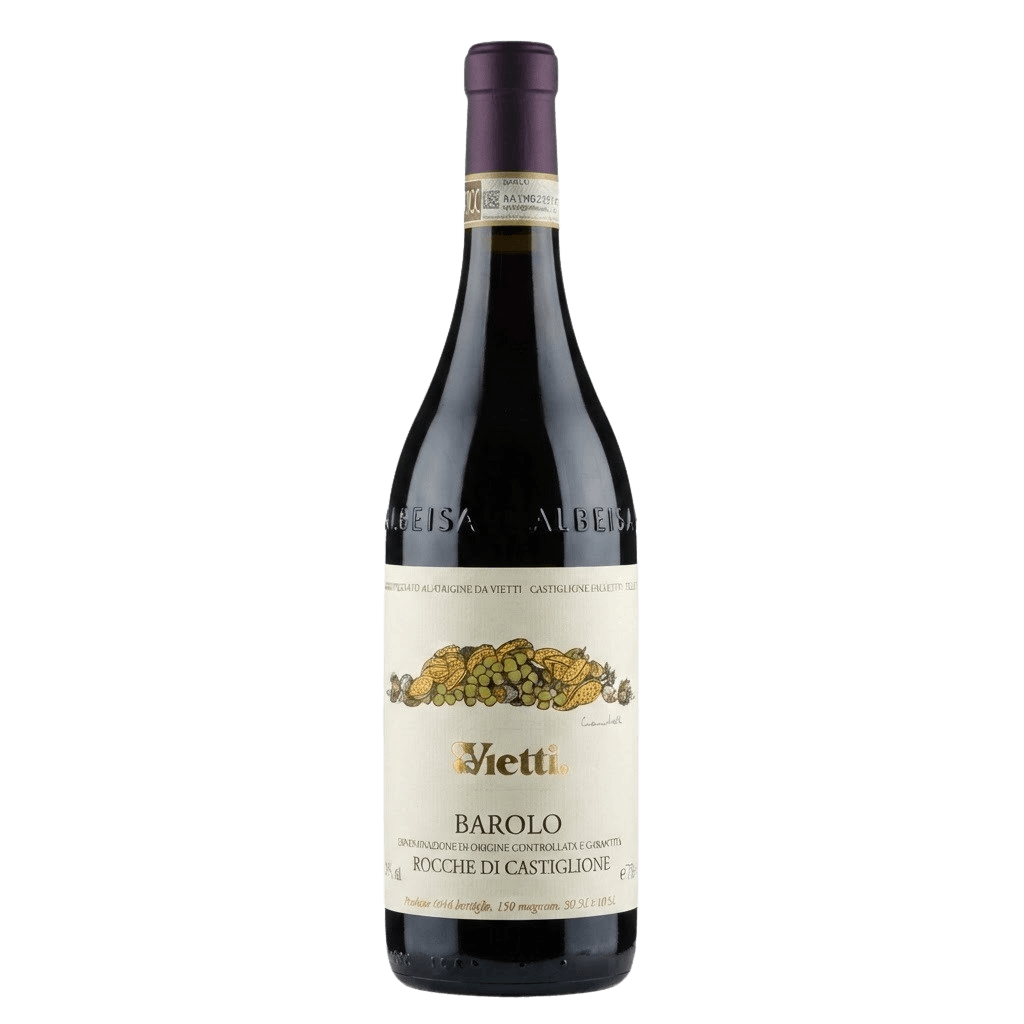
Vietti
Vietti Barolo Rocche di Castiglione
2008
Vietti Barolo Rocche di Castiglione is a distinguished single-vineyard Nebbiolo from Castiglione Falletto. Closely associated with the estate's pioneering 1961 vineyard-designated Barolo, it expresses one of the appellation's historic vineyard sites and an important chapter in the evolution of modern Barolo.
Country
Italy
Region
Barolo/Barbaresco - Barolo/Barbaresco
Scoring
More information
Producer
Vietti is a historic and highly respected producer of Barolo DOCG and Barbaresco DOCG, celebrated for its meticulous single-vineyard interpretations of Nebbiolo. Based in Castiglione Falletto in the heart of Piedmont's Langhe hills, the estate has been under Krause family ownership since 2016, following generations of family stewardship by the Vietti and Currado families. Its wines combine aromatic refinement, structural elegance and the depth required for long-term cellaring.
Quick Facts
- Location: Castiglione Falletto, Langhe, Piedmont, Italy
- Founded: Late 19th century
- Classification: Barolo DOCG and Barbaresco DOCG
- Ownership: Krause family, since 2016
- Previous stewardship: Vietti and Currado families
- Principal grape: Nebbiolo
- Other varieties: Barbera, Arneis
- Signature wines: Barolo Rocche di Castiglione, Barolo Lazzarito, Barolo Ravera
- Soils: Calcareous marl with varying proportions of sand and clay
- Vineyards: Multiple cru holdings across Barolo and Barbaresco zones
- Style: Precise, balanced and built for extended ageing
- Winemaking: Extended maceration and maturation in large oak casks
A Pioneering Estate in Castiglione Falletto
Vietti was established in the late 19th century in Castiglione Falletto, one of Barolo's most acclaimed communes. The estate gained prominence under the leadership of Alfredo Currado, who joined the family in the 1960s and became a defining figure in modern Piedmontese winemaking. Currado was among the first producers to bottle single-vineyard Barolo and Barbaresco, emphasising the distinctive character of individual crus at a time when such precision was rare.
His commitment to site-specific expression helped establish Vietti as a benchmark for quality and clarity. In 2016, the Krause family acquired the estate, ensuring continuity of its winemaking philosophy and further investment in its vineyards and cellar.
The Crus of Barolo and Barbaresco
Vietti's identity is shaped by its holdings in some of the Langhe's most distinguished vineyard sites. In Barolo, the estate produces wines from Rocche di Castiglione, Lazzarito, Ravera, Brunate and Villero—each expressing a distinct facet of Nebbiolo shaped by soil composition, exposure and elevation.
Rocche di Castiglione, located directly above the village of Castiglione Falletto, is the estate's historic flagship vineyard. Its steep, southwest-facing slopes and compact calcareous marl soils produce a Barolo of concentration, aromatic intensity and firm structure, capable of evolving gracefully for three decades or more.
Lazzarito, situated in Serralunga d'Alba, offers a more austere and mineral-driven expression, while Ravera in Novello is recognised for its elegance and floral character. In Barbaresco, Vietti works with fruit from the Masseria cru, producing wines of refinement and balance.
Tradition and Precision in the Cellar
Vietti's winemaking approach respects the traditional methods of the region while allowing each site to speak with clarity. Extended maceration on the skins—often lasting several weeks—extracts colour, tannin and aromatic complexity without over-extraction. Fermentation and maturation take place in large Slavonian oak botti, which permit gradual oxygenation and development without imposing dominant wood character.
The result is a collection of wines that balance power with finesse, combining the savoury depth, fine-grained tannins and lifted aromatics that define great Nebbiolo. Vietti's Barolo and Barbaresco are built to reward extended cellaring, typically reaching their peak after 15 to 25 years, though the finest vintages from the estate's top crus can continue to evolve for much longer.
Beyond Nebbiolo, Vietti also produces distinguished Barbera d'Alba and Arneis, showcasing the estate's commitment to expressing the full range of Piedmont's indigenous varieties with precision and respect for origin.
Country
Region
Barolo/Barbaresco - Barolo/Barbaresco
Barolo and Barbaresco are widely regarded as Italy's most prestigious wine regions and represent the benchmark for Nebbiolo worldwide. Located in the Langhe hills of Piedmont in northwestern Italy, these neighbouring DOCG appellations combine centuries of winemaking tradition with exceptional terroir, producing some of the most sought-after and age-worthy wines in the world. Often described as the 'King and Queen of Italian wine', Barolo and Barbaresco have established Piedmont as one of the greatest fine wine regions alongside Bordeaux and Burgundy.
The regions benefit from a continental climate moderated by Alpine influences, with calcareous marl and sandstone soils that create ideal conditions for Nebbiolo. Barolo covers eleven communes including the renowned crus of Cannubi, Brunate and Bussia, producing powerful, structured wines that require extended ageing. Barbaresco, located northeast of Barolo, encompasses four communes and produces wines that are typically more approachable in their youth while retaining remarkable elegance and complexity. Both regions demonstrate extraordinary site-specific expression, with individual vineyards—known as Menzioni Geografiche Aggiuntive (MGAs)—producing distinct interpretations of Nebbiolo's signature aromas of rose, tar, cherry and truffle.
The regions are home to legendary producers including Giacomo Conterno, Bruno Giacosa, Bartolo Mascarello, Giuseppe Rinaldi, Gaja, Produttori del Barbaresco and Roagna. Together these estates represent a culture of meticulous vineyard management, respect for tradition and uncompromising quality that has made Barolo and Barbaresco among the world's most collectible wines.
Whether exploring historic vintages, renowned crus or iconic producers, Barolo and Barbaresco offer an unrivalled journey through Italy's finest wine heritage. Discover Barolo/Barbaresco wines, compare prices from trusted merchants across Europe and find the best offers with Sipfind.
Grapes
Nebbiolo is the noble red grape of Piedmont in northwestern Italy, best known as the variety behind the celebrated wines of Barolo and Barbaresco. Despite its relatively pale colour, Nebbiolo produces wines of remarkable structure, complexity and longevity, combining naturally high acidity with powerful tannins.
Classic Nebbiolo is distinguished by an expressive aromatic profile of red cherry, rose, violet and dried flowers, often developing notes of spice, herbs, leather, tobacco and truffle with age. The grape is particularly sensitive to its growing site, allowing differences in soil, altitude and exposure to create highly distinctive expressions.
Nebbiolo reaches its greatest fame in the Langhe hills, where Barolo and Barbaresco demonstrate the grape’s exceptional capacity for ageing and reflecting terroir. Beyond these renowned appellations, Nebbiolo is also cultivated across northern Piedmont and parts of Lombardy, producing styles ranging from elegant and aromatic to intensely structured.
Its combination of perfume, acidity, tannin and longevity has established Nebbiolo as one of Italy’s most important and distinctive red grape varieties.
History and Style
Vietti Barolo Rocche di Castiglione – A Landmark in the History of Barolo
Vietti Barolo Rocche di Castiglione is one of the estate's most historically significant wines and an important example of single-vineyard Barolo.
Produced from Nebbiolo grown in the Rocche di Castiglione vineyard in Castiglione Falletto, it reflects the relationship between a recognised vineyard site and one of Piedmont's established wine producers.
Its significance extends beyond the quality and reputation of the vineyard itself.
In 1961, Vietti produced a vineyard-designated Barolo from Rocche di Castiglione, an important milestone in the estate's history.
At a time when Barolo was commonly associated with blending grapes from different vineyards, the decision to identify a specific vineyard helped draw attention to the individuality of particular growing sites.
This approach subsequently became an increasingly important part of Barolo's identity.
Today, the appellation is internationally recognised for its individual vineyard expressions, including wines from officially delimited geographical areas known as Menzioni Geografiche Aggiuntive, or MGAs.
Rocche di Castiglione is one of these recognised vineyard areas.
For Vietti, the wine represents a continuing connection between its historical commitment to vineyard identity and its contemporary production of site-specific Barolo.
It is therefore a wine of particular interest to enthusiasts exploring the development of Barolo, the importance of individual vineyards and the history of Vietti.
Wine at a Glance
AttributeDetails
Wine
Vietti Barolo Rocche di Castiglione
Producer
Vietti
Country
Italy
Region
Piedmont
Wine Region
Langhe
Appellation
Barolo DOCG
Municipality
Castiglione Falletto
Vineyard
Rocche di Castiglione
Vineyard Classification
Barolo MGA
Grape Variety
Nebbiolo
Wine Colour
Red
Wine Type
Still Red Wine
Vintage Type
Vintage
Historical Milestone
1961
Vineyard Exposure
Requires producer verification
Vineyard Altitude
Requires producer verification
Vine Age
Requires producer verification
Soil Composition
Requires producer verification
Fermentation
Requires producer verification
Maturation
Requires producer verification
Producer Tasting Notes
Requires producer verification
Sipfind MVP Format
750 ml
Rocche di Castiglione – A Distinguished Barolo Vineyard
Rocche di Castiglione is a recognised vineyard area in the municipality of Castiglione Falletto, one of the principal communes of the Barolo appellation.
The vineyard forms part of the complex landscape of the Langhe, where differences in altitude, exposure, geology and vineyard position contribute to the diversity of Nebbiolo wines.
Castiglione Falletto occupies a central position within the Barolo production area.
Its vineyards are associated with a range of expressions of Nebbiolo, reflecting variations in soil structure and topography.
Rocche di Castiglione has a long-established reputation as an important vineyard site.
The designation identifies a specific geographical origin rather than simply a stylistic category.
For Vietti Barolo Rocche di Castiglione, this geographical identity is fundamental.
The wine is associated with grapes grown within the recognised vineyard area, rather than being presented as a general blend from across the Barolo appellation.
However, the precise altitude, exposure, geological composition and age of Vietti's vines should be taken from the estate's technical documentation.
These details are essential for a fully verified description of the producer's particular vineyard holdings.
The Historic 1961 Vintage
The year 1961 occupies a special place in Vietti's history.
It is widely associated with the estate's early production of vineyard-designated Barolo from Rocche di Castiglione.
The decision to identify the vineyard on the wine was significant.
Historically, many Barolo producers combined Nebbiolo from different vineyards to achieve a desired balance of structure, aromatic expression and ageing potential.
By highlighting an individual vineyard, Vietti contributed to a growing appreciation of the differences between Barolo's specific growing sites.
This approach anticipated the increasing importance of vineyard identity in the region.
Today, single-vineyard Barolo has become an established category within the appellation.
Wines bearing recognised MGA names allow enthusiasts to explore differences between geographical origins.
Vietti Rocche di Castiglione therefore has a historical significance that extends beyond the individual bottle.
It represents part of the broader evolution of Barolo towards greater recognition of vineyard-specific character.
The 1961 milestone remains an important element of the wine's identity.
Nebbiolo – The Grape Behind Barolo
Vietti Barolo Rocche di Castiglione is made from Nebbiolo, the grape variety required for Barolo DOCG.
Nebbiolo is one of Italy's most distinctive red grapes.
It is particularly associated with Piedmont and the Langhe hills, where it produces wines capable of combining aromatic complexity, pronounced tannins and substantial ageing potential.
The grape is known for its relatively pale colour compared with many other structured red varieties.
Its aromatic profile can include red fruit, floral notes, spice and more complex tertiary characteristics as the wine develops.
Nebbiolo's naturally significant tannin structure and acidity contribute to the ageing potential of traditional Barolo.
However, the precise expression of these characteristics varies considerably according to vineyard origin, vintage conditions and winemaking.
For Vietti Rocche di Castiglione, the grape provides the foundation, while the vineyard and producer determine the wine's individual identity.
The Character of Castiglione Falletto
Castiglione Falletto is one of the eleven municipalities included in the Barolo production area.
Its vineyards occupy a distinctive position within the appellation.
The commune is often discussed in relation to the balance between aromatic refinement and structural intensity found in different Barolo wines.
However, such generalisations should be treated cautiously.
Individual vineyard sites can differ substantially, even within the same municipality.
Rocche di Castiglione represents a specific geographical expression of Castiglione Falletto.
Its reputation is associated with the individuality of the vineyard rather than a single characteristic shared by every wine from the commune.
For this reason, a detailed understanding of Vietti Rocche di Castiglione requires consideration of the estate's actual vineyard holdings and production methods.
Winemaking and Maturation
The production of Barolo involves the fermentation of Nebbiolo grapes followed by a period of maturation that must satisfy the appellation's regulatory requirements.
Under Barolo DOCG rules, wines must undergo a minimum ageing period of 38 months, including at least 18 months in wood, calculated according to the appellation's prescribed timetable.
These requirements provide the regulatory foundation for Barolo production.
Individual producers may choose different fermentation methods, maceration periods and maturation vessels.
Such decisions influence tannin development, aromatic expression and the wine's evolution.
For Vietti Rocche di Castiglione, the precise fermentation and maturation methods should be documented using the estate's official technical sheet.
It would be inappropriate to assign a particular fermentation duration, temperature or barrel regime without verification.
These details are especially important for a wine of this standing, where the producer's approach forms part of its individual identity.
Tasting Profile and Aromatic Development
Barolo made from Nebbiolo can display a complex aromatic range.
Typical characteristics of the variety include red cherry, raspberry, rose, violet and spice.
With bottle development, Nebbiolo wines may acquire more complex aromas associated with dried flowers, leather, tobacco and earthy notes.
The structure of Barolo is frequently characterised by significant tannins and acidity.
These elements contribute to the wine's ability to develop over time.
However, these descriptions represent general characteristics of Nebbiolo and Barolo.
They should not be presented as Vietti's official tasting notes for Rocche di Castiglione.
The producer's own description is required to identify the specific aromatic and structural characteristics of this wine.
Vintage-specific tasting assessments can then provide additional information about individual releases.
Ageing Potential and Vintage Variation
Vietti Barolo Rocche di Castiglione is a vintage wine.
Each release reflects the conditions of a particular growing season.
Temperature, rainfall and the timing of harvest can influence Nebbiolo's ripeness, tannin development and aromatic characteristics.
The resulting differences can be particularly important for single-vineyard wines.
Barolo is internationally recognised for its ageing potential, but the optimal drinking period varies between wines and vintages.
A structured vintage from a favourable growing season may develop differently from one produced under cooler or more challenging conditions.
For Sipfind, the permanent bottle page should therefore remain vintage-neutral.
Individual vintage pages can provide information about harvest conditions, professional assessments and recommended drinking windows where these are supported by reliable sources.
This ensures that general statements about Barolo's longevity are not confused with precise predictions for individual bottles.
Rocche di Castiglione Within Vietti's Barolo Collection
Vietti produces several vineyard-designated Barolo wines from recognised sites across the appellation.
These include wines associated with Brunate, Lazzarito, Ravera and other distinguished vineyard areas.
Each wine reflects a different geographical origin within the Barolo region.
Rocche di Castiglione occupies a particularly important place in this collection because of its historical association with the estate's 1961 vineyard-designated Barolo.
The wine connects Vietti's contemporary vineyard-focused production with an earlier period when identifying individual Barolo vineyards was less common.
For enthusiasts exploring Vietti's range, Rocche di Castiglione provides an important reference point.
It is both a recognised single-vineyard Barolo and a wine closely connected to the development of the estate's modern identity.
Discover Vietti Barolo Rocche di Castiglione on Sipfind
Explore Vietti Barolo Rocche di Castiglione, a historically significant single-vineyard Barolo from Castiglione Falletto.
Discover the vineyard's geographical identity, the importance of Nebbiolo and Vietti's pioneering role in the development of vineyard-designated Barolo.
Browse available vintages and compare offers from independent European wine retailers through Sipfind.
Find the exact wine and vintage you are looking for, with retailer information presented in one place.