
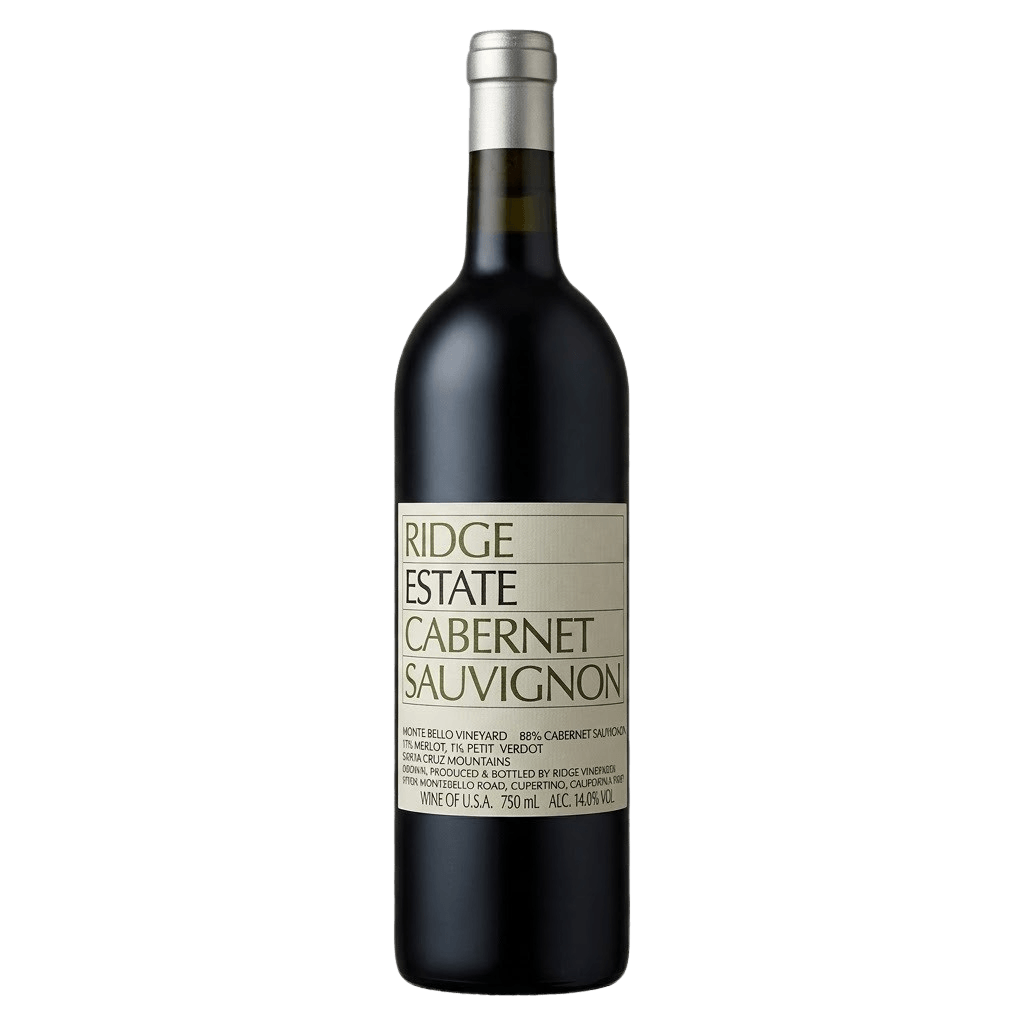
Ridge Vineyards
Ridge Vineyards Cabernet Sauvignon Estate
2016
A distinctive Cabernet Sauvignon-led red wine from the limestone-rich Monte Bello Vineyard in California's Santa Cruz Mountains, combining mountain-grown fruit, natural acidity, refined tannins and traditional American oak maturation.
Country
United States
Region
Santa Cruz Mountains
More information
Producer
Founded in 1959, Ridge Vineyards has established itself as one of California's most respected producers of terroir-driven wines, working across vineyard sites in the Santa Cruz Mountains and Sonoma County. The winery's approach centres on expressing individual vineyard character through natural fermentation, extended maceration and the use of American oak cooperage. Ridge's Monte Bello and single-vineyard Zinfandels have earned international recognition for their structure, complexity and remarkable ability to evolve gracefully over decades.
Quick Facts
- Location: Santa Cruz Mountains and Sonoma County, California, United States
- Founded: 1959
- Appellations: Santa Cruz Mountains AVA, Dry Creek Valley AVA, Alexander Valley AVA
- Ownership: Majority owned by Otsuka Pharmaceutical, management-led operations
- Principal grapes: Cabernet Sauvignon, Zinfandel, Petite Sirah, Carignane, Merlot
- Signature wine: Monte Bello
- Key single-vineyard Zinfandels: Lytton Springs, Geyserville, East Bench
- Estate holdings: Monte Bello estate in Santa Cruz Mountains, approximately 100+ acres under management
- Monte Bello vineyard elevation: 400 to 820 metres above sea level
- Soils: Monte Bello – fractured limestone; Sonoma sites – gravelly loam over mixed alluvial deposits
- Viticulture: Sustainable farming practices, dry-farmed where possible
- Style: Site-specific, structured and built for extended bottle ageing
California Wines Built for Time
Ridge Vineyards was established at a moment when California winemaking remained largely focused on volume and accessibility. From the outset, the founders adopted a different philosophy, drawing inspiration from traditional European practices and seeking out hillside vineyards capable of producing wines with concentration, balance and longevity.
This vision became reality when Ridge acquired the abandoned Monte Bello vineyard in the Santa Cruz Mountains, a steep, high-elevation site planted to Cabernet Sauvignon in the late 19th century. The 1962 vintage marked the first Monte Bello release, introducing a style that prioritised structure and ageability over immediate approachability.
The Monte Bello Estate
Monte Bello occupies a dramatic ridgetop site rising between 400 and 820 metres above sea level, approximately 80 kilometres south of San Francisco. The vineyard's fractured limestone soils, steep exposures and cool maritime influence create conditions markedly different from the warmer valley floors below.
Cabernet Sauvignon forms the foundation of Monte Bello, typically blended with Merlot, Petit Verdot and Cabernet Franc in proportions determined by each vintage. The wine's structure comes not from extraction alone but from physiological ripeness achieved slowly over an extended growing season, supported by naturally moderate yields and old-vine material.
Monte Bello has demonstrated its capacity to age for 30 years or more. The 1971 vintage famously placed fifth in the 1976 Judgment of Paris tasting and ascended to first place when the same wines were re-tasted in 2006, confirming the wine's exceptional development over time.
Historic Zinfandel Sites in Sonoma
Ridge's work in Sonoma County centres on several historic vineyard sites planted predominantly to Zinfandel, often interspersed with field-blended parcels of Petite Sirah, Carignane and Mataro. Lytton Springs, acquired in 1991, contains vines dating to 1901, while Geyserville incorporates fruit from benchland vineyards planted between the 1880s and 1930s.
These sites occupy warmer, lower-elevation terrain than Monte Bello, yet Ridge applies the same guiding principles: natural fermentation with indigenous yeasts, extended maceration on skins and maturation in air-dried American oak barrels. The resulting Zinfandels combine ripe fruit concentration with structure, acidity and a capacity to age for 10 to 20 years—unusual longevity for the variety.
East Bench, released from a specific section of the Lytton Springs vineyard, represents Ridge's most site-specific expression of old-vine Zinfandel, bottled without blending across parcels.
Minimal Intervention, Maximum Expression
Ridge's winemaking relies on allowing each vineyard to direct decisions in the cellar. Grapes are fermented in open-top tanks using naturally occurring yeasts, with punch-downs performed by hand or foot. Extended maceration—often lasting three to four weeks—extracts colour, tannin and flavour compounds slowly, without harsh extraction.
American oak, sourced primarily from Missouri and air-dried for several years, provides the framework for maturation. Ridge has worked closely with coopers to develop barrels that complement rather than dominate the fruit, contributing structure and subtle spice without masking vineyard character.
The winery labels each bottle with detailed technical information, including varietal percentages, vineyard sources, fermentation and ageing timelines, and additions made during vinification. This transparency reflects Ridge's belief that wines of origin require nothing more than careful stewardship from vineyard to bottle.
Country
Region
Santa Cruz Mountains
Santa Cruz Mountains is a respected wine region in California, spanning the rugged mountain range between the San Francisco Bay and the Pacific Ocean. Established as an AVA in 1981, the region is known for its high-elevation vineyards, diverse microclimates and exceptional growing conditions that produce wines of notable structure and refinement. The mountains create a natural barrier where cool maritime influences meet warmer inland air, resulting in one of California's most characterful terroirs.
Vineyards are planted at elevations ranging from 400 to over 2,000 feet on steep slopes with varied soils including limestone, shale and ancient seabed deposits. Pinot Noir, Chardonnay and Cabernet Sauvignon thrive in these conditions, developing concentrated fruit character, bright acidity and remarkable ageing potential. Notable producers include Ridge Vineyards, Mount Eden Vineyards, David Bruce Winery and Rhys Vineyards, each contributing distinctive expressions of mountain-grown wine that reflect the region's complex geology and cool-climate character.
Discover Santa Cruz Mountains wines, compare prices from trusted merchants across Europe and find the best offers with Sipfind.
Grapes
Cabernet Sauvignon is one of the world’s most important and widely planted red wine grapes, renowned for its powerful structure, concentrated fruit and exceptional ageing potential. Originating in Bordeaux, France, the variety has become a defining grape of fine wine regions around the world, particularly Napa Valley, Tuscany, Chile, Australia and South Africa.
Classic Cabernet Sauvignon combines flavours and aromas of blackcurrant, cassis, blackberry and dark cherry with characteristic notes of cedar, graphite, tobacco and herbs. Naturally high tannins and fresh acidity provide structure and longevity, while maturation in oak can add layers of spice, vanilla and toast. Its character varies significantly with climate, soil and winemaking, ranging from elegant and savoury to rich, powerful and intensely concentrated.
In Bordeaux, Cabernet Sauvignon is particularly associated with the Left Bank, where it forms the foundation of many prestigious blends alongside Merlot, Cabernet Franc and other permitted varieties. In Napa Valley, it has become the region’s signature red grape, producing some of the world’s most sought-after Cabernet Sauvignon wines.
Cabernet Sauvignon’s ability to express terroir while retaining its distinctive structure and character has made it a global benchmark for premium red wine. Whether produced as the dominant variety in a blend or as a varietal wine, the finest examples combine concentration, complexity and the capacity to develop gracefully over decades
Merlot is one of the world’s most important red wine grapes, celebrated for its generous fruit, supple texture and ability to produce wines ranging from approachable and elegant to exceptionally complex and long-lived. Originating in Bordeaux, France, Merlot is particularly associated with the Right Bank, where it forms the foundation of many of the prestigious wines of Pomerol and Saint-Émilion.
Merlot typically expresses flavours and aromas of plum, black cherry, blackberry and red fruits, often developing notes of chocolate, tobacco, cedar, herbs and earthy complexity with maturation. Its naturally rounded texture and generally softer tannin profile distinguish it from Cabernet Sauvignon, although the finest examples can possess considerable structure, freshness and ageing potential.
In Pomerol, Merlot reaches some of its most celebrated expressions, particularly on the appellation’s clay-rich soils, producing wines of remarkable concentration, texture and complexity. In Saint-Émilion, it is commonly blended with Cabernet Franc and, to a lesser extent, Cabernet Sauvignon, creating wines that combine ripe fruit with structure, aromatic complexity and longevity.
Beyond Bordeaux, Merlot is widely cultivated in Italy, California, Washington State, Chile and other major wine regions. It can be produced as a varietal wine or used as a central component of blends, where its fruit and texture complement more structured grape varieties.
From the great Merlot-based wines of Bordeaux’s Right Bank to leading expressions around the world, Merlot’s combination of rich fruit, refined texture and capacity to express terroir has established it as one of the defining varieties of fine red wine.
Cabernet Franc is one of France’s most historic red wine grapes, valued for its aromatic intensity, vibrant acidity and ability to express both climate and soil with remarkable clarity. It produces elegant single-varietal wines and plays an essential role in some of Bordeaux’s most distinguished blends. Earlier ripening than Cabernet Sauvignon allows Cabernet Franc to perform particularly well in cooler wine regions.
In the Loire Valley, Cabernet Franc reaches its clearest expression as a varietal wine. Typical aromas include redcurrant, raspberry, red cherry and violet, often accompanied by graphite, dried herbs, tobacco and subtle peppery notes. Naturally fresh acidity and finely structured tannins can produce approachable, fruit-driven wines as well as complex examples capable of developing for many years.
The variety is especially important in Chinon, Bourgueil and Saumur-Champigny. Chinon can range from fragrant and supple to deeply structured and age-worthy, depending on vineyard site and soil. Bourgueil often combines dark red fruit with firm structure, while Saumur-Champigny is renowned for freshness, aromatic purity and refined texture. Limestone-rich tuffeau, gravel, sand and clay all contribute to the diversity of Cabernet Franc across these Loire appellations.
In Bordeaux, Cabernet Franc is principally associated with the Right Bank, particularly Saint-Émilion and Pomerol. Usually blended with Merlot and sometimes Cabernet Sauvignon, it contributes perfume, freshness, savoury complexity and structural precision. On suitable limestone and clay terroirs, Cabernet Franc can become a dominant component of exceptionally refined and long-lived wines.
Beyond France, Cabernet Franc is cultivated in regions including Tuscany, Bolgheri, Napa Valley, Washington State, Canada, Argentina and Chile, producing styles shaped by local climate and terroir. Traditionally known as Breton in the Loire and Bouchet in parts of Bordeaux, Cabernet Franc’s combination of aromatic elegance, freshness and ageing potential establishes it as one of the world’s great red wine varieties.
Petit Verdot is a powerful red wine grape from south-west France, best known as a small but distinctive component of the classic red blends of Bordeaux. Its deeply coloured wines, firm tannins and concentrated aromatics allow even modest proportions to add structure, freshness and intensity alongside Cabernet Sauvignon, Merlot and Cabernet Franc.
On Bordeaux’s Left Bank, Petit Verdot is particularly associated with the gravel soils of the Médoc, including appellations such as Margaux, Saint-Julien, Pauillac and Saint-Estèphe. The variety buds relatively early but ripens late, making complete maturation challenging in cooler vintages. When fully ripe, it can retain vibrant acidity while developing considerable colour, tannin and aromatic complexity.
Typical expressions show blackberry, black cherry, blueberry and plum, accompanied by violet, liquorice, pepper, cocoa and other dark spices. In Bordeaux blends, Petit Verdot is generally used in limited quantities to reinforce colour, tannic structure and aromatic depth. Its combination of acidity and tannin can also contribute significantly to a wine’s ageing potential.
Beyond Bordeaux, warmer and more reliable growing conditions have allowed Petit Verdot to achieve greater ripeness and a more prominent role. Producers in California, Australia, Spain and South America increasingly use the variety in both Bordeaux-style blends and varietal wines. These expressions are often full-bodied and deeply coloured, with ripe dark fruit, floral character, spice and powerful tannins.
From its historic role in the Médoc to its expanding presence as a varietal wine, Petit Verdot is defined by colour, structure, freshness and aromatic intensity. Once regarded primarily as a supporting grape, it is increasingly recognised as a distinctive variety capable of producing serious, age-worthy wines in its own right.
History and Style
Ridge Estate Cabernet Sauvignon – The Character of California's Mountain Vineyards
High in California's Santa Cruz Mountains, overlooking the landscape between Silicon Valley and the Pacific Ocean, Monte Bello Vineyard provides the geographical foundation for Ridge Estate Cabernet Sauvignon.
Far removed from the warmer valley-floor vineyards commonly associated with Californian Cabernet Sauvignon, this mountain environment combines elevation, maritime influence and distinctive limestone-rich geology.
Ridge Estate Cabernet Sauvignon originates exclusively from grapes grown by Ridge at Monte Bello Vineyard, the same historic estate responsible for the producer's internationally recognised Monte Bello.
However, Estate Cabernet Sauvignon is not simply a different label for the flagship wine. It possesses its own identity, shaped by vineyard selection, blending decisions and a winemaking approach designed to achieve an earlier balance between fruit, acidity and tannin.
Its heritage extends back to 1978, although the present Estate Cabernet Sauvignon designation was introduced with the 2008 vintage.
The wine offers an opportunity to explore the distinctive relationship between Cabernet Sauvignon and one of California's most unusual mountain vineyard environments.
Quick Wine Facts
- Producer: Ridge Vineyards
- Wine: Ridge Estate Cabernet Sauvignon
- Country: United States
- State: California
- Region: Santa Cruz Mountains
- Appellation: Santa Cruz Mountains AVA
- Vineyard: Monte Bello Vineyard
- Wine Category: Still Red Wine
- Wine Style: Cabernet Sauvignon-led Bordeaux-style Blend
- Principal Grape Variety: Cabernet Sauvignon
- Complementary Grape Varieties: Merlot, Cabernet Franc and Petit Verdot, depending on vintage
- Grape Origin: Exclusively estate-grown
- Vineyard Elevation: Approximately 396–823 metres across Monte Bello Vineyard
- Soil Composition: Decomposed Franciscan greenstone and clay over limestone
- Climate: Cool mountain climate with Pacific maritime influence
- Viticulture: Monte Bello Vineyard fully certified organic since the 2022 harvest
- Harvest: Manual
- Alcoholic Fermentation: Indigenous yeasts
- Malolactic Fermentation: Naturally occurring bacteria
- Oak Maturation: Predominantly American oak
- Oak Maturation Period: Vintage-dependent
- Alcohol Content: Vintage-dependent
- Historical Origins: 1978
- Current Product Designation: Since the 2008 vintage
- Ageing Potential: Extended, depending on vintage and storage
- Standard Bottle Format: 750 ml
The Historical Origins of Monte Bello Vineyard
The history of Monte Bello Vineyard reaches back to the nineteenth century, when California's wine industry was developing its own identity through European grape varieties and agricultural traditions.
Early vineyard development on Monte Bello Ridge established a connection between Bordeaux grape varieties and the distinctive growing conditions of the Santa Cruz Mountains.
The mountainous landscape presented considerable challenges. Establishing vineyards required working with steep terrain, variable soil depths and growing conditions that differed significantly from those of California's warmer agricultural valleys.
Nevertheless, these conditions would eventually become central to the identity of the wines produced at Monte Bello.
The historical vineyard landscape experienced periods of development, abandonment and replanting before becoming the foundation of modern Ridge Vineyards.
Today, Estate Cabernet Sauvignon continues this association between Cabernet Sauvignon and the mountain vineyards of Monte Bello.
The Origins of Estate Cabernet Sauvignon
The historical relationship between Estate Cabernet Sauvignon and Monte Bello is essential to understanding the wine.
During the development of the Monte Bello estate, Ridge identified differences between individual vineyard parcels.
Some parcels produced wines with the concentration, tannic structure and long maturation requirements associated with the flagship Monte Bello.
Others consistently delivered wines with a different balance of fruit and structure, allowing their complexity to become accessible earlier.
Rather than incorporating every suitable parcel into the same wine, Ridge developed a separate Cabernet Sauvignon-based bottling.
The Development of a Distinct Wine
The historical development of Estate Cabernet Sauvignon includes several important stages:
- Recognition of stylistic differences between vineyard parcels.
- Introduction of a separate Cabernet-based wine in 1978.
- Development of a distinct approach to vineyard selection.
- Adjustments to extraction and blending.
- Introduction of the Estate Cabernet Sauvignon designation with the 2008 vintage.
- Continued refinement of the distinction between Estate Cabernet Sauvignon and Monte Bello.
The modern wine should therefore be understood as an individual expression of the estate rather than simply a collection of components excluded from its flagship.
Its identity is based on the suitability of selected vineyard lots for a particular style of wine.
Santa Cruz Mountains – A Distinctive Californian Wine Region
The Santa Cruz Mountains AVA occupies a mountainous area south of San Francisco, influenced by the Pacific Ocean to the west and the warmer inland landscape to the east.
Unlike many Californian wine regions defined by broad valleys, the Santa Cruz Mountains contain vineyards distributed across slopes, ridges and elevated sites.
The region's geographical diversity creates substantial differences between individual vineyards.
Defining Characteristics of the Santa Cruz Mountains
- Mountainous terrain.
- Considerable variation in vineyard elevation.
- Pacific maritime influence.
- Diverse geological formations.
- Differences in slope orientation and sunlight exposure.
- Local variations in temperature and rainfall.
- Distinct vineyard microclimates.
The region supports several important grape varieties, including Cabernet Sauvignon, Pinot Noir and Chardonnay.
However, their suitability depends heavily on the characteristics of individual vineyard sites.
Monte Bello Vineyard occupies a particularly distinctive position within this diverse geographical environment.
Monte Bello Vineyard – The Geographical Foundation
Estate Cabernet Sauvignon originates exclusively from Monte Bello Vineyard.
The estate encompasses numerous vineyard parcels distributed across different elevations and geological conditions.
These parcels do not produce identical grapes, even when planted with the same variety.
Differences in soil depth, slope, exposure and vine development can influence the characteristics of the resulting wines.
This diversity provides Ridge with the opportunity to select and combine vineyard lots according to their individual qualities.
Principal Vineyard Characteristics
- Mountain vineyard location.
- Elevations ranging from approximately 396 to 823 metres across the estate.
- Limestone-rich underlying geology.
- Franciscan greenstone and clay-influenced soils.
- Maritime climatic influence.
- Cabernet Sauvignon and other Bordeaux grape varieties.
- Multiple individually identifiable vineyard parcels.
- Estate-managed viticulture.
The elevation range describes Monte Bello Vineyard as a whole. The precise elevations of the parcels contributing to Estate Cabernet Sauvignon may vary between vintages.
Mountain Elevation and Grape Development
Elevation is an important component of Monte Bello's geographical identity.
Mountain vineyards can experience growing conditions that differ substantially from nearby lower-altitude vineyards.
Temperature, sunlight, wind exposure and soil development interact in complex ways.
Higher elevation does not automatically produce superior grapes, nor does it guarantee a cooler environment at every moment of the growing season.
However, the combination of elevation and maritime influence at Monte Bello contributes to its distinctive growing conditions.
Potential Influences of Mountain Viticulture
- Differences in daytime and night-time temperatures.
- Variations in sunlight intensity.
- Increased exposure to wind.
- Changes in the timing of grape maturation.
- Differences in soil depth and water availability.
- Variation in natural acidity.
- Differences in grape skin and tannin development.
These factors help explain why Cabernet Sauvignon grown in a mountain environment can express a different balance of fruit, freshness and structure from wines originating in warmer locations.
The Influence of the Pacific Ocean
Monte Bello Vineyard lies approximately 24 kilometres from the Pacific Ocean.
The proximity of the ocean forms an important part of the wider climatic environment of the Santa Cruz Mountains.
Maritime influence can moderate temperatures and affect the progression of the growing season.
For Cabernet Sauvignon, the relationship between fruit maturation and the retention of natural acidity is particularly important.
A relatively moderate growing environment can allow grapes to develop flavour and structural maturity without necessarily accumulating the levels of sugar associated with hotter vineyard locations.
Climatic Influences Relevant to Cabernet Sauvignon
- Moderation of extreme temperatures.
- Variations in seasonal ripening.
- Preservation of natural acidity.
- Differences in aromatic development.
- Changes in the relationship between sugar and phenolic maturity.
The influence of the Pacific is not identical across every parcel or growing season.
Nevertheless, the maritime mountain environment remains fundamental to the geographical identity of Estate Cabernet Sauvignon.
Limestone and Franciscan Greenstone – An Unusual Geological Setting
One of Monte Bello Vineyard's defining characteristics is its geological composition.
The vineyard contains soils derived from Franciscan greenstone and clay, overlying decomposing limestone.
This combination distinguishes Monte Bello from many of California's better-known Cabernet Sauvignon-producing vineyard environments.
Limestone
Limestone is a sedimentary rock composed predominantly of calcium carbonate.
In vineyard environments, limestone-derived materials can influence soil chemistry, root development and water availability.
Their effects depend on the physical structure of the soil, its depth and its interaction with other geological materials.
Franciscan Greenstone
Franciscan greenstone is associated with California's complex geological history.
Its presence reflects the geological processes that contributed to the formation of the coastal mountain ranges.
At Monte Bello, weathered greenstone forms part of the material from which vineyard soils have developed.
Clay
Clay contributes to the physical properties of the soil, including its ability to retain water and nutrients.
The proportion and distribution of clay vary across the vineyard.
Together, these geological components create a diverse environment for grapevine development.
Although Ridge associates its vineyard geology with the distinctive character of its wines, geological minerals should not be interpreted as directly transferring identifiable mineral flavours into the finished wine.
The relationship between geology and sensory expression is more complex, involving vine physiology, water availability, grape development and winemaking.
Organic Viticulture at Monte Bello
Ridge Vineyards identifies the preservation of its vineyard environment as an important part of its agricultural philosophy.
The entire Monte Bello Vineyard has been certified organic since the 2022 harvest.
This represents a significant development in the estate's long-term approach to vineyard management.
Documented Vineyard Practices
- Organic vineyard cultivation.
- Use of cover crops.
- Integrated pest management.
- Preservation of the vineyard ecosystem.
- Management adapted to individual vineyard conditions.
Cover crops can serve several agricultural purposes, including supporting soil structure, reducing erosion and providing habitats for beneficial organisms.
Integrated pest management combines observation and agricultural techniques to manage vineyard pests and disease pressure.
These approaches are particularly relevant in a mountain environment where slopes, soil depth and water availability vary considerably.
Organic certification should nevertheless be distinguished from other agricultural designations.
Estate Cabernet Sauvignon should not automatically be described as biodynamic, additive-free or certified organic wine solely because its grapes originate from an organically certified vineyard.
The precise labelling status of each vintage should be assessed individually.
Cabernet Sauvignon – The Foundation of the Wine
Cabernet Sauvignon is the principal grape variety of Ridge Estate Cabernet Sauvignon.
Its suitability for structured red wines has established it as one of the world's most important grape varieties.
The variety originated in France and is historically associated with the vineyards of Bordeaux.
Its international development has demonstrated a considerable capacity to express different climates, soils and winemaking traditions.
Characteristics Associated with Cabernet Sauvignon
- Dark-fruit aromas.
- Blackcurrant and blackberry characteristics.
- Substantial tannic structure.
- Natural acidity.
- Deep colour.
- Capacity for oak maturation.
- Potential for extended bottle development.
The expression of these characteristics depends on growing conditions and winemaking.
In the mountain environment of Monte Bello, Cabernet Sauvignon forms the structural foundation of a wine that can combine concentrated fruit with freshness and firm tannins.
Merlot – A Complementary Component
Merlot frequently contributes to the blend of Estate Cabernet Sauvignon.
Although the exact proportion varies between vintages, its inclusion reflects the flexibility available through the estate's Bordeaux grape varieties.
Merlot can contribute a different balance of fruit and structure from Cabernet Sauvignon.
Potential Contributions of Merlot
- Plum and dark-fruit characteristics.
- Mid-palate breadth.
- Textural roundness.
- Integration of tannins.
- Complementary aromatic complexity.
The influence of Merlot depends on its vineyard origin, maturity and the characteristics of the individual base wine.
Its role should not be reduced to simply softening Cabernet Sauvignon.
At Monte Bello, Merlot is an individual expression of the estate's growing environment and can contribute both structure and complexity.
Cabernet Franc – Aromatic and Structural Complexity
Cabernet Franc is another Bordeaux variety cultivated at Monte Bello.
It has historically contributed to selected vintages of Estate Cabernet Sauvignon.
Depending on the growing conditions and blending proportion, Cabernet Franc can provide additional aromatic definition and structural characteristics.
Potential Contributions of Cabernet Franc
- Red-fruit aromas.
- Floral characteristics.
- Herbal and savoury nuances.
- Freshness.
- Additional tannic definition.
- Aromatic complexity.
Its inclusion is determined through vintage-specific blending rather than a permanent formula.
Petit Verdot – Colour and Structural Definition
Petit Verdot may also contribute to Estate Cabernet Sauvignon.
The variety is traditionally used in relatively small proportions in Bordeaux-style blends.
Its characteristics can provide additional dimensions of colour, aroma and structure.
Potential Contributions of Petit Verdot
- Dark-fruit concentration.
- Deep colour.
- Floral and spice characteristics.
- Firm tannins.
- Structural persistence.
As with Cabernet Franc, its presence and proportion depend on the vintage.
Estate Cabernet Sauvignon should therefore not be described as a fixed four-variety blend.
The Art of Vineyard Selection and Blending
The diversity of Monte Bello Vineyard allows Ridge to evaluate wines originating from different parcels before determining their final destination.
This approach is central to the distinction between Estate Cabernet Sauvignon and Monte Bello.
Rather than relying exclusively on geographical boundaries, the selection process also considers the sensory and structural characteristics of individual wines.
Factors Relevant to Vineyard Lot Selection
- Fruit concentration.
- Tannic structure.
- Natural acidity.
- Aromatic complexity.
- Palate texture.
- Balance between fruit and structure.
- Expected development during maturation.
- Potential for earlier accessibility.
The objective is to construct a wine with its own stylistic identity.
Estate Cabernet Sauvignon remains a mountain-grown Cabernet Sauvignon with substantial ageing potential, but its selection and production approach generally favour earlier integration than the flagship Monte Bello.
The exact composition is determined separately for each vintage.
Harvesting – Preserving the Character of Mountain-Grown Fruit
The grapes used for Estate Cabernet Sauvignon are harvested by hand.
Manual harvesting allows vineyard workers to collect grapes from the estate's varied terrain while maintaining attention to fruit condition.
Mountain vineyards can experience considerable differences in grape development between individual parcels.
Harvest decisions therefore need to account for more than a single estate-wide measurement.
Important Harvest Considerations
- Sugar development.
- Natural acidity.
- Aromatic maturity.
- Tannin development.
- Fruit condition.
- Weather forecasts.
- Differences in parcel exposure.
- Intended wine style.
The relationship between these factors changes from one growing season to another.
Harvest dates, grape maturity measurements and yields should consequently be treated as vintage-specific information.
Indigenous Yeast Fermentation
A defining characteristic of Ridge's winemaking philosophy is its use of naturally occurring yeasts for alcoholic fermentation.
Rather than routinely relying on selected commercial yeast cultures, Ridge allows indigenous yeasts to initiate and conduct fermentation.
During alcoholic fermentation, yeasts convert grape sugars into alcohol, carbon dioxide and numerous other compounds that contribute to the development of wine.
Characteristics of Indigenous Yeast Fermentation
- Reliance on naturally occurring yeast populations.
- Potential differences in fermentation progression.
- Interaction between grape composition and microbial activity.
- Development of fermentation-derived aromas.
- Requirement for careful observation and management.
Indigenous yeast fermentation does not independently guarantee greater complexity or superior quality.
Its significance at Ridge lies in its role within a broader production philosophy that seeks to preserve the individuality of vineyard-grown fruit.
Extraction and Tannin Management
Cabernet Sauvignon naturally contains substantial quantities of phenolic compounds, particularly within its skins and seeds.
During red-wine fermentation, contact between juice and grape solids allows colour, tannins and other compounds to enter the developing wine.
The intensity and duration of this contact influence the structure of the finished wine.
For Estate Cabernet Sauvignon, Ridge has documented a production approach involving comparatively gentle extraction and earlier pressing.
This supports the wine's distinctive balance and earlier accessibility.
Important Elements of Extraction Management
- Duration of skin contact.
- Fermentation temperature.
- Frequency of pump-overs.
- Grape condition.
- Proportion of crushed and whole berries.
- Timing of pressing.
- Sensory assessment of tannin development.
These parameters are adjusted according to the characteristics of individual harvests.
The objective is not necessarily to minimise tannins, but to establish a suitable relationship between fruit concentration and structural intensity.
Natural Malolactic Fermentation
Following or alongside alcoholic fermentation, Estate Cabernet Sauvignon undergoes malolactic fermentation through naturally occurring bacteria.
During this process, malic acid is converted into lactic acid.
This transformation changes the wine's acid composition and can influence its texture and microbiological stability.
Potential Effects of Malolactic Fermentation
- Modification of perceived acidity.
- Development of a rounder palate texture.
- Changes in aromatic characteristics.
- Greater microbiological stability following completion.
The precise timing and location of malolactic fermentation can vary.
It may take place in tanks, barrels or a combination of vessels, depending on the production decisions made for the individual vintage.
American Oak – A Distinctive Ridge Tradition
Ridge Vineyards has a longstanding association with American oak maturation.
While many premium Cabernet Sauvignon producers favour French oak, American oak has become an important component of Ridge's established winemaking identity.
The sensory contribution of oak depends on more than its geographical origin.
Barrel construction, seasoning, toasting, age and maturation duration all influence its interaction with wine.
Potential Contributions of American Oak
- Vanilla nuances.
- Sweet spice.
- Toasted characteristics.
- Cedar-like aromas.
- Changes in palate texture.
- Gradual integration of tannins.
- Development of aromatic complexity.
New barrels generally contribute more extractable oak compounds than previously used barrels.
The use of both new and older barrels allows producers to manage the balance between oak-derived characteristics and the expression of the fruit.
The proportion of new oak, the precise oak origins and the duration of maturation should be assessed individually for each Estate Cabernet Sauvignon vintage.
Ridge's Traditional Winemaking Philosophy
Ridge describes its approach to wine production through an emphasis on traditional methods and restrained intervention.
This philosophy recognises that vineyard origin and growing-season conditions are fundamental to wine identity.
Nevertheless, restrained intervention does not mean the absence of winemaking decisions.
Careful monitoring, blending, fermentation management and appropriate adjustments remain important.
Elements of the Production Philosophy
- Attention to individual vineyard lots.
- Indigenous yeast fermentation.
- Naturally occurring malolactic bacteria.
- Extraction adapted to grape characteristics.
- Traditional barrel maturation.
- Ingredient transparency.
- Limited and purposeful cellar adjustments.
Ridge publishes detailed information concerning the ingredients and production methods used for individual vintages.
These disclosures allow the wine to be understood through documented practices rather than broad assumptions about natural winemaking.
Estate Cabernet Sauvignon should not automatically be described as sulphite-free, unfined, unfiltered or produced without additions.
Such specifications require confirmation for each individual vintage.
Style and Tasting Profile
Ridge Estate Cabernet Sauvignon expresses a combination of Cabernet Sauvignon-led fruit, mountain-grown structure and traditional oak maturation.
Its precise sensory profile varies according to the vintage, blending composition and stage of bottle development.
Appearance
Depending on vintage and maturity, the wine may display:
- Deep ruby colour.
- Dark garnet reflections.
- Considerable colour concentration.
- Gradual development towards garnet and brick-red tones with age.
Primary Fruit Aromas
The fruit profile may include:
- Blackcurrant.
- Blackberry.
- Dark plum.
- Black cherry.
- Ripe red berries.
Secondary Aromas
Characteristics associated with fermentation and barrel maturation may include:
- Toasted oak.
- Vanilla.
- Cedar.
- Dark chocolate.
- Sweet spices.
- Subtle smoky nuances.
Herbal and Savoury Characteristics
Individual vintages may also reveal:
- Mint.
- Fennel.
- Dried herbs.
- Earthy nuances.
- Savoury complexity.
Palate
The wine is generally associated with:
- Medium-to-full or full-bodied structure.
- Concentrated dark-fruit expression.
- Fresh natural acidity.
- Firm tannins.
- Integrated oak characteristics.
- Considerable palate persistence.
These characteristics should be interpreted as a broad stylistic framework rather than a guaranteed tasting profile for every release.
Ageing Potential – The Evolution of Mountain Cabernet Sauvignon
Estate Cabernet Sauvignon is produced to develop its complexity earlier than Ridge Monte Bello while retaining meaningful capacity for bottle maturation.
The relationship between fruit concentration, acidity, tannin and oak provides the foundation for its development.
Young bottles may display more pronounced fruit, oak and structural firmness.
With suitable cellaring, these characteristics can become increasingly integrated.
Potential Developments During Bottle Ageing
- Gradual softening of tannins.
- Greater integration of oak.
- Development of dried-fruit characteristics.
- Cedar and tobacco nuances.
- Earthy and savoury complexity.
- Changes in colour.
- Increased aromatic integration.
The progression of these characteristics depends on the individual vintage and storage history.
Ridge maintains a dedicated vintage tracker for Estate Cabernet Sauvignon, providing updated assessments of its development.
This is particularly useful because a wine's maturity cannot be determined solely by counting the years since harvest.
Factors Influencing Ageing
- Growing-season conditions.
- Grape composition.
- Natural acidity.
- Tannin concentration.
- Oak maturation.
- Bottling conditions.
- Storage temperature.
- Bottle format.
- Closure condition.
A universal drinking window should not be applied to every vintage.
Serving and Decanting
Estate Cabernet Sauvignon benefits from serving conditions that allow its fruit, structure and aromatic complexity to develop in balance.
Young vintages may benefit from exposure to air, particularly when their tannins and oak characteristics remain prominent.
Older bottles require a more individual approach.
Serving Recommendations
- Serving Temperature: Approximately 16–18°C.
- Glassware: A large Bordeaux-style red-wine glass.
- Young Vintages: Consider decanting for approximately one to two hours.
- Mature Vintages: Assess the wine before prolonged exposure to air.
- Older Bottles: Gentle decanting may assist with sediment removal.
- Storage: Cool, dark and stable conditions.
These recommendations are general editorial guidance rather than fixed producer specifications.
The condition and maturity of the individual bottle should determine the final serving approach.
Food Pairing – Complementing Structure and Freshness
The combination of Cabernet Sauvignon, natural acidity and firm tannins makes Estate Cabernet Sauvignon particularly suitable for dishes with substantial flavour and texture.
Grilled Ribeye
The richness of marbled beef can complement the wine's tannic structure and concentrated fruit.
Roast Lamb
Roast lamb with rosemary, thyme or garlic can provide a combination of savoury depth and herbal complexity.
Beef Wellington
The combination of beef, mushrooms and pastry can complement both the fruit and maturation-derived characteristics of the wine.
Venison
Venison prepared with a restrained dark-fruit or savoury sauce can provide a suitable pairing for structured Cabernet Sauvignon.
Braised Beef Short Ribs
Slow-cooked beef can complement the wine's texture and persistent dark-fruit characteristics.
Wild Mushroom Dishes
Mushroom-based preparations can provide an interesting combination with the earthy and savoury characteristics of mature vintages.
Mature Hard Cheeses
Suitable combinations may include:
- Mature Cheddar.
- Aged Comté.
- Gruyère.
- Mature Manchego.
- Parmigiano Reggiano.
The suitability of each pairing depends on preparation, seasoning and the maturity of the wine.
Estate Cabernet Sauvignon and Ridge Monte Bello
Estate Cabernet Sauvignon and Monte Bello share a fundamental geographical connection.
Both originate from the Monte Bello estate in the Santa Cruz Mountains.
However, their identities are not interchangeable.
Ridge Estate Cabernet Sauvignon
- Exclusively estate-grown grapes from Monte Bello Vineyard.
- Cabernet Sauvignon-led composition.
- Selection of vineyard lots suited to earlier accessibility.
- Extraction and blending adapted to its individual style.
- Substantial but generally earlier-developing ageing potential.
Ridge Monte Bello
- The flagship wine of the Monte Bello estate.
- Selection of vineyard lots suited to its distinctive structural identity.
- Cabernet Sauvignon-led composition.
- Emphasis on concentration, complexity and extended maturation.
- Separate commercial and historical identity.
Estate Cabernet Sauvignon should not be treated as a vintage, alternative label or bottle format of Monte Bello.
They represent separate wines originating from the same historic vineyard environment.
Estate Cabernet Sauvignon and Santa Cruz Mountains Cabernet Sauvignon
Another important distinction concerns Ridge's Santa Cruz Mountains Cabernet Sauvignon.
Historically, the Santa Cruz Mountains designation was used for the predecessor of Estate Cabernet Sauvignon.
The Estate designation was introduced with the 2008 vintage to emphasise the wine's origin in grapes grown by Ridge at Monte Bello Vineyard.
With the 2023 harvest, Ridge revived the Santa Cruz Mountains Cabernet Sauvignon label for a separate wine produced using grapes purchased from other growers within the appellation.
Estate Cabernet Sauvignon
- Exclusively estate-grown grapes.
- Monte Bello Vineyard origin.
- Current Estate designation introduced in 2008.
Santa Cruz Mountains Cabernet Sauvignon
- Reintroduced as a separate bottling with the 2023 vintage.
- Grapes sourced from independent growers.
- Santa Cruz Mountains AVA origin.
- Distinct product identity.
This distinction is particularly important when identifying bottles, comparing vintages and interpreting retailer listings.
Historical bottles carrying the Santa Cruz Mountains designation require additional attention because the meaning of the name has changed over time.
Understanding Vintage Variation
Although Estate Cabernet Sauvignon maintains a consistent geographical and stylistic identity, its technical specifications are not identical every year.
Differences in rainfall, temperatures, grape development and vineyard selection influence the composition of each release.
Vintage-Specific Characteristics
The following should be assessed individually:
- Growing-season conditions.
- Harvest dates.
- Vineyard yields.
- Selected vineyard parcels.
- Cabernet Sauvignon percentage.
- Merlot percentage.
- Cabernet Franc percentage.
- Petit Verdot percentage.
- Fermentation parameters.
- Oak origin.
- Proportion of new oak.
- Barrel maturation period.
- Alcohol content.
- Bottling date.
- Tasting profile.
- Recommended drinking window.
The permanent identity of Estate Cabernet Sauvignon remains rooted in its estate-grown fruit, Monte Bello Vineyard origin and Cabernet Sauvignon-led composition.
Each vintage provides an individual expression of that shared geographical and winemaking foundation.
Discover Ridge Estate Cabernet Sauvignon on Sipfind
Explore Ridge Estate Cabernet Sauvignon, a distinctive mountain-grown red wine from Monte Bello Vineyard in California's Santa Cruz Mountains.
Discover its limestone-rich vineyard environment, Cabernet Sauvignon-led composition, traditional fermentation methods and individual vintage characteristics.
Compare available offers from European wine retailers on Sipfind, with producer, wine, vintage and bottle format clearly identified.