
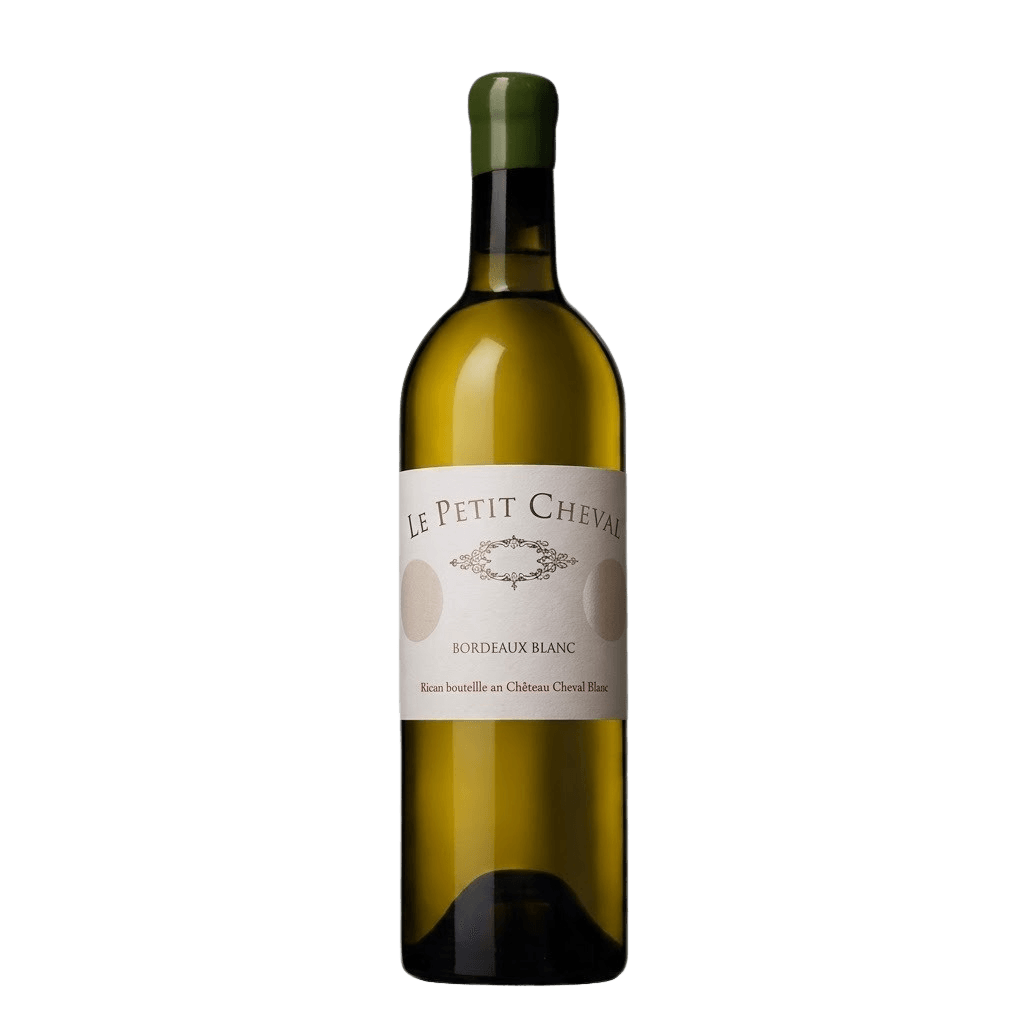
Chateau Cheval Blanc
Le Petit Cheval Bordeaux Blanc
From 134 EUR from 6 retailers
Le Petit Cheval Bordeaux Blanc is the distinctive dry white wine of Château Cheval Blanc, first released with the 2014 vintage. Produced from Sauvignon Blanc and Sémillon grown on dedicated vineyard parcels, it combines citrus and orchard-fruit expression with freshness, textural depth and carefully integrated oak. An ambitious white Bordeaux from one of Saint-Émilion's most celebrated estates.
Country
France
Region
Bordeaux - Saint-Emilion
Number of retailers: 6
Chateaunet
France
Le Petit Cheval Bordeaux Blanc
2023
Standard delivery 1-3 business days
Chateaunet
France
Le Petit Cheval Bordeaux Blanc
2022
Standard delivery 1-3 business days
Chateaunet
France
Le Petit Cheval Bordeaux Blanc
2021
Standard delivery 1-3 business days
Chateaunet
France
Le Petit Cheval Bordeaux Blanc
2019
Standard delivery 1-3 business days
Gassås Wine
Sweden
Le Petit Cheval Bordeaux Blanc
2023
You save up to 26 EUR, where 26 EUR is the difference between the highest price and the lowest price
Lobenbergs Gute Weine GmbH & Co. KG
Germany
Le Petit Cheval Bordeaux Blanc
2021
More information
Producer
Château Cheval Blanc is one of only four estates classified as Premier Grand Cru Classé A in Saint-Émilion, representing the appellation's highest distinction alongside Angélus, Ausone and Pavie. Located on the border with Pomerol, the 39-hectare estate has been under joint ownership of LVMH and Groupe Frère since 1998. Its wines are defined by an exceptional blend dominated by Merlot and Cabernet Franc, producing Bordeaux of silky elegance, layered complexity and extraordinary ageing potential.
Quick Facts
- Location: Saint-Émilion, Bordeaux, France
- Appellation: Saint-Émilion AOC
- Classification: Premier Grand Cru Classé A (Saint-Émilion Classification)
- Ownership: LVMH and Groupe Frère (joint ownership since 1998)
- Estate established: 18th century
- Estate size: 39 hectares under vine
- Principal grapes: Merlot and Cabernet Franc (with minor Cabernet Sauvignon)
- Soils: Gravel and clay, uniquely positioned on the Pomerol boundary
- Grand Vin: Château Cheval Blanc
- Second wine: Le Petit Cheval
- Style: Elegant, structured Right Bank Bordeaux with exceptional aromatics
- Ageing potential: 30 to 50+ years
A Singular Position on the Pomerol Border
Château Cheval Blanc occupies an unusual position for a Saint-Émilion estate, situated at the north-western edge of the appellation immediately adjacent to Pomerol. This location places the property on soils more closely aligned with its Pomerol neighbours than with the limestone plateau and côtes that define much of Saint-Émilion.
The estate's 39 hectares are planted across a distinctive terroir of deep gravel beds interspersed with areas of clay. This geological complexity, rare in Saint-Émilion, creates natural conditions ideally suited to both Merlot and Cabernet Franc, allowing the estate to craft a highly individual blend that diverges from the Merlot-Cabernet Sauvignon convention of most Right Bank properties.
The Dominance of Cabernet Franc
Cabernet Franc plays an unusually prominent role at Cheval Blanc, often representing between 50 and 60 per cent of the final Grand Vin depending on the vintage. This distinguishes the estate from nearly all other classified Saint-Émilion properties, where Merlot typically leads and Cabernet Sauvignon provides the supporting structure.
The gravelly sections of the vineyard allow Cabernet Franc to ripen fully and express its characteristic aromatic complexity—floral notes, refined spice and freshness—while the clay soils contribute depth, richness and textural weight through Merlot. The result is a wine that combines the elegance and perfume of Cabernet Franc with the silky generosity of Merlot, creating a signature style recognised for its exceptional balance and refinement.
This blend composition has become central to Cheval Blanc's identity and contributes directly to the wine's remarkable ability to age gracefully over several decades.
Meticulous Parcel Selection and Cellar Precision
The estate's winemaking is built around parcel-by-parcel vineyard management and selective harvesting. Each section of the vineyard is vinified separately, allowing the winemaking team to assess and blend with extraordinary precision. This approach ensures that only the most expressive lots contribute to the Grand Vin.
Maturation takes place in French oak barrels, typically 100 per cent new, for a period of 16 to 18 months. The extended élevage integrates the oak carefully into the wine's structure while preserving the aromatic purity and silky tannins that define Cheval Blanc's style.
Le Petit Cheval, introduced in 1988, is produced from younger vines and parcels that do not meet the exacting standards for the Grand Vin. It expresses the estate's distinctive terroir and blend in a more approachable, earlier-maturing form.
Legendary Vintages and Enduring Collectibility
Château Cheval Blanc has produced some of Bordeaux's most celebrated wines, with certain vintages achieving near-mythical status among collectors. The 1947, produced in an exceptionally hot year, remains one of the most renowned wines of the 20th century, while vintages such as 1982, 1998, 2009 and 2010 have reinforced the estate's position at the summit of Right Bank Bordeaux.
The Grand Vin is built for extended cellaring, typically requiring a decade or more to reveal its full complexity. With time, youthful structure and concentrated fruit evolve into extraordinary depth, tertiary complexity and a seamless harmony that can last half a century or longer. This combination of immediate elegance and profound longevity secures Cheval Blanc's reputation as one of the world's most collectible and investment-worthy wine estates.
Country
Region
Bordeaux - Saint-Emilion
Saint-Émilion is one of the most respected wine appellations in Bordeaux and has long been recognised for producing refined, age-worthy wines of exceptional quality. Located on the Right Bank of the Dordogne River, this historic appellation combines centuries of winemaking tradition with distinctive terroir, creating elegant Merlot-dominant wines that are celebrated by collectors and enthusiasts worldwide. Established as an AOC in 1936, Saint-Émilion represents the finest expression of Right Bank winemaking.
The appellation benefits from diverse soils that define its wines. The plateau and côtes feature limestone and clay-limestone terroirs that produce structured, mineral-driven wines with remarkable ageing potential, while the lower slopes contain sandy and gravelly soils that yield softer, more approachable expressions. Merlot dominates the blend, typically complemented by Cabernet Franc and occasionally Cabernet Sauvignon, creating wines of elegance, depth and finesse.
Saint-Émilion is home to its own classification system, revised approximately every decade, which recognises Premiers Grands Crus Classés A estates such as Château Ausone and Château Cheval Blanc, alongside distinguished Premiers Grands Crus Classés B and Grands Crus Classés properties. Notable producers including Château Pavie, Château Figeac and Château Canon demonstrate the appellation's benchmark for quality and terroir expression.
Whether exploring classified estates, exceptional vintages or the appellation's rich medieval heritage, Saint-Émilion offers a distinguished introduction to Right Bank Bordeaux. Discover Saint-Émilion wines, compare prices from trusted merchants across Europe and find the best offers with Sipfind.
Grapes
Sauvignon Blanc is one of the world’s most widely recognised white wine grapes, celebrated for its vibrant acidity, expressive aromatics and remarkable ability to reflect climate and terroir. Originating in France, the variety is historically associated with the Loire Valley and Bordeaux, while today it produces distinctive wines across many of the world’s leading wine regions.
In the Loire Valley, Sauvignon Blanc reaches some of its most celebrated expressions in Sancerre and Pouilly-Fumé. These wines are typically dry, precise and refreshing, showing flavours and aromas of citrus, green apple, gooseberry and white flowers, often accompanied by herbal and mineral notes. Differences in soil, vineyard location and winemaking can produce styles ranging from delicate and elegant to concentrated and age-worthy.
In Bordeaux, Sauvignon Blanc traditionally plays a different role. It is frequently blended with Sémillon, and sometimes Muscadelle, to produce both dry white Bordeaux and the renowned sweet wines of Sauternes and Barsac. Sauvignon Blanc contributes acidity, freshness and aromatic lift, complementing the richness and texture of Sémillon.
Beyond France, Sauvignon Blanc has become particularly important in New Zealand, where Marlborough established an internationally recognised style characterised by intense citrus, passion fruit, gooseberry and herbaceous aromas. Important expressions are also produced in California, Chile, South Africa, Australia and Italy, demonstrating the variety’s ability to develop distinctive personalities across different climates and soils.
Whether expressed as a mineral-driven Loire wine, a structured Bordeaux blend or an intensely aromatic New World Sauvignon Blanc, the grape’s combination of freshness, aromatic clarity and terroir expression has established it as one of the defining varieties of modern white wine.
Sémillon is a white wine grape originating in Bordeaux, where it is central to both dry white blends and botrytised sweet wines. Its generous texture, affinity with noble rot and ability to develop considerable complexity through bottle ageing have established Sémillon as one of the most versatile white varieties in fine wine, with benchmark expressions found in Bordeaux and Australia’s Hunter Valley.
Quick Grape Facts
- Grape Type: White wine grape
- Origin: Bordeaux, France
- Key Regions: Sauternes, Barsac, Graves, Pessac-Léognan and Hunter Valley
- Primary Styles: Dry white wines, botrytised sweet wines and white blends
- Common Blending Partners: Sauvignon Blanc and Muscadelle
- Typical Aromas: Lemon, green apple, pear, beeswax, honey, apricot, toast and nuts
- Structure: Generally medium to full-bodied, with acidity and concentration varying according to climate, harvest timing and wine style
- Botrytis Susceptibility: High, supported by the grape’s relatively thin skins
- Ageing Potential: High in leading Sauternes, Barsac and Hunter Valley expressions
- Canonical Name: Sémillon
- Alias: Semillon
- Historical Labels: Hunter River Riesling, Shepherd’s Riesling, Hock, White Burgundy and Chablis
Regional Expressions and Wine Styles
In Sauternes and Barsac, Sémillon’s thin skins make it particularly receptive to Botrytis cinerea, or noble rot. Botrytis concentrates the grapes’ sugars, acidity and flavours, producing richly textured sweet wines with notes of honey, beeswax, apricot, candied citrus and saffron. Sauvignon Blanc commonly contributes freshness and aromatic lift, while Muscadelle may add floral complexity. In the dry white wines of Graves and Pessac-Léognan, Sémillon brings body, depth and ageing potential to blends with Sauvignon Blanc, developing waxy, toasted and nutty complexity as the wines mature.
In Australia’s Hunter Valley, Sémillon is typically harvested early at relatively low sugar levels and fermented in stainless steel with little or no oak influence. Young wines can appear light-bodied, restrained and citrus-driven, yet the finest examples evolve over decades to show lemon curd, toast, lanolin, honey and nuts. Sémillon is also produced as a varietal wine in the Barossa Valley and blended with Sauvignon Blanc in Margaret River. Historical Australian labels such as Hunter River Riesling do not indicate a relationship with Riesling and should be treated as former naming conventions rather than separate grapes or modern synonyms.
Explore Sémillon Wines on Sipfind
Explore Sémillon wines, regions and current offers from selected wine retailers on Sipfind.
History and Style
Le Petit Cheval Bordeaux Blanc – The White Wine of Château Cheval Blanc
Le Petit Cheval Bordeaux Blanc is a distinctive dry white wine produced by Château Cheval Blanc, one of the most celebrated estates in Saint-Émilion. First commercially released with the 2014 vintage, the wine represents a separate chapter in the history of a property traditionally associated with Cabernet Franc and Merlot.
Rather than creating a white counterpart to its famous red Grand Vin through conventional selection, Château Cheval Blanc developed a dedicated white-wine project with its own vineyard resources, grape varieties and winemaking philosophy.
The result is a wine conceived around freshness, aromatic precision, depth and ageing potential.
Produced under the Bordeaux Blanc appellation, Le Petit Cheval Blanc is based on Sauvignon Blanc, complemented by Sémillon in more recent vintages. Its production involves careful vineyard management, parcel-specific harvesting, fermentation in wooden vessels and extended maturation.
The wine's identity is particularly unusual within Bordeaux. Although Château Cheval Blanc is situated in Saint-Émilion, its white wine cannot carry the Saint-Émilion appellation, which is reserved for red wines.
Le Petit Cheval Blanc therefore combines the expertise of a celebrated Right Bank producer with a distinctive interpretation of the wider Bordeaux white-wine tradition.
Wine at a Glance
- Wine: Le Petit Cheval Bordeaux Blanc
- Producer: Château Cheval Blanc
- Region: Bordeaux, France
- Appellation: Bordeaux Blanc AOC
- Wine Type: Dry White Wine
- First Commercial Vintage: 2014
- First Market Release: 2016
- Grape Varieties: Sauvignon Blanc and Sémillon
- Early Vintages: Sauvignon Blanc
- Vineyard Origins: Dedicated white-wine parcels associated with the former Château La Tour du Pin property
- Terroir: Clay, sand and varying combinations of these soils
- Winemaking: Parcel-specific vinification and fermentation in wooden vessels
- Maturation: Extended ageing, with duration determined by vintage
- Style: Citrus, orchard fruit, floral complexity, freshness and textural depth
- Classification: Not independently classified
- Bottle Format: 750 ml
- Vintage: Identified by individual harvest year
The Origins of Le Petit Cheval Blanc
The history of Le Petit Cheval Blanc begins with an ambitious decision by Château Cheval Blanc to explore the potential of white wine production.
The estate's reputation had been established through its red wines, particularly the Grand Vin Château Cheval Blanc and its second wine, Le Petit Cheval.
The white-wine project therefore represented a significant departure from the property's established production.
The Acquisition of Château La Tour du Pin
In 2006, the owners of Château Cheval Blanc acquired Château La Tour du Pin, a neighbouring property whose vineyard resources offered opportunities for further development.
Part of the land was subsequently used for the establishment of dedicated white-wine vineyards.
The project allowed the estate to explore the relationship between local soils and the traditional white Bordeaux grape varieties Sauvignon Blanc and Sémillon.
Rather than adapting existing red-wine production, the team approached the project as the creation of a new wine.
An Experimental Beginning
The first experimental white wines were produced in 2009.
Over the following years, the team evaluated the vineyard's potential and experimented with different approaches to cultivation and winemaking.
The early results did not satisfy the estate's ambitions.
Consequently, the first five experimental vintages were not commercially released.
This decision illustrates the importance placed on establishing a consistent identity before introducing the wine to the market.
The First Commercial Vintage – 2014
The 2014 vintage marked the first commercial release of Le Petit Cheval Blanc.
It was introduced to the market in 2016.
The first release was produced entirely from Sauvignon Blanc.
Subsequent vintages have demonstrated the evolution of the vineyard and the incorporation of Sémillon into the blend.
The wine has therefore developed through a combination of experimentation, vineyard maturity and an increasingly detailed understanding of its terroir.
Château Cheval Blanc – A Different Expression of a Famous Estate
Château Cheval Blanc is situated in the north-western part of Saint-Émilion, close to the boundary with Pomerol.
The estate is internationally recognised for its red wines, particularly its distinctive use of Cabernet Franc alongside Merlot.
Its vineyard contains a complex mosaic of soils, including gravel, clay and sand.
These variations contribute to the character of its red wines and form an important part of the estate's understanding of terroir.
From Red Wine Expertise to White Wine Production
Producing a fine dry white wine requires different decisions from those involved in producing a structured red Bordeaux.
White grape varieties respond differently to ripening conditions.
The preservation of acidity, aromatic freshness and fruit purity becomes particularly important.
Winemaking decisions must also account for the effects of pressing, fermentation temperature, oxygen exposure and maturation.
For Château Cheval Blanc, the white-wine project provided an opportunity to apply its experience of vineyard observation and precise selection to a different category of wine.
A Separate Wine Identity
Le Petit Cheval Blanc should not be understood as the white equivalent of the estate's red second wine.
The two wines have different vineyard origins, grape varieties and production objectives.
The red Le Petit Cheval is selected from the estate's red-wine vineyard resources.
Le Petit Cheval Blanc originates from dedicated white-wine parcels.
Their shared name reflects the producer rather than an identical relationship to the Grand Vin.
Bordeaux Blanc – A Distinct Appellation
Although Château Cheval Blanc is located in Saint-Émilion, Le Petit Cheval Blanc is produced under the Bordeaux Blanc appellation.
This distinction reflects the appellation rules governing wine production in the region.
Saint-Émilion is associated with red wines.
Dry white wines produced in the wider geographical area may instead qualify for the Bordeaux Blanc appellation when the relevant production requirements are satisfied.
The White Bordeaux Tradition
Bordeaux is internationally famous for its red blends.
However, the region also possesses a long tradition of producing dry white wines.
Sauvignon Blanc and Sémillon are the principal varieties associated with many of its most distinguished examples.
The two grapes can offer complementary characteristics.
Sauvignon Blanc contributes aromatic precision and freshness.
Sémillon can provide additional texture, breadth and complexity.
The balance between them varies according to vineyard conditions and the producer's objectives.
Beyond Traditional White-Wine Areas
Some of Bordeaux's most celebrated dry white wines originate in Pessac-Léognan and Graves.
Le Petit Cheval Blanc offers a different geographical perspective.
It demonstrates that carefully selected vineyard resources outside those established white-wine appellations can also support an ambitious dry white Bordeaux.
Its identity is therefore linked both to the traditions of the region and to the particular circumstances of its creation.
The Terroir of Le Petit Cheval Blanc
The vineyards used for Le Petit Cheval Blanc are associated with land acquired through Château La Tour du Pin.
Their soils include clay and sand, with variations between parcels.
These characteristics influence drainage, water availability and vine development.
Clay Soils
Clay can retain moisture and influence the availability of water during dry periods.
Its physical properties affect root development and the timing of grape ripening.
In suitable conditions, clay-rich soils can contribute to the development of grapes with concentration and structural balance.
Sandy Soils
Sandy soils generally possess different drainage and temperature characteristics.
Their influence depends on depth, underlying geology and the local climate.
The interaction between sand and clay creates different growing environments within the vineyard.
Understanding Individual Parcels
The estate's approach involves observing differences between vineyard parcels.
Each parcel may respond differently to temperature, rainfall and seasonal conditions.
This makes parcel-specific management important.
Harvest dates can be adjusted according to the maturity of the grapes.
The resulting wines can then be evaluated separately before blending.
The Importance of Vintage
The vineyard's characteristics are expressed differently from one year to another.
A warm, dry growing season may influence the development of fruit concentration and acidity.
Cooler conditions may favour a different aromatic profile.
Rainfall and harvest timing also affect the final balance.
Le Petit Cheval Blanc is therefore best understood through both its permanent vineyard identity and the characteristics of individual vintages.
Sauvignon Blanc – The Foundation of the Wine
Sauvignon Blanc is the principal grape variety associated with Le Petit Cheval Blanc.
The first commercially released vintage, 2014, was produced entirely from Sauvignon Blanc.
The variety is recognised for its aromatic intensity, freshness and ability to express differences in growing conditions.
Aromatic Characteristics
Depending on ripeness and winemaking, Sauvignon Blanc may contribute:
- Lemon.
- Grapefruit.
- Bergamot.
- Lime zest.
- White peach.
- Pear.
- White flowers.
- Herbal notes.
- Fresh acidity.
These characteristics vary according to the vintage.
Managing Aromatic Expression
Sauvignon Blanc can produce strongly varietal aromas.
However, Château Cheval Blanc's approach is not simply to maximise aromatic intensity.
The estate seeks a balance between fruit expression, freshness and texture.
Vineyard management and harvesting decisions are therefore important.
The Importance of Ripeness
Harvesting too early may result in excessive herbal character and pronounced acidity.
Harvesting too late can reduce freshness and alter the aromatic balance.
The objective is to identify a suitable relationship between ripeness, aromatic development and acidity.
For Le Petit Cheval Blanc, this balance is central to the wine's identity.
Sémillon – Texture and Complexity
Sémillon was incorporated into the commercial blend from the 2018 vintage.
It provides a complementary expression to Sauvignon Blanc.
The variety is particularly associated with texture, body and the ability to develop complexity through maturation.
Its Contribution to the Blend
Depending on the vintage, Sémillon may contribute:
- Pear.
- Ripe orchard fruit.
- Subtle citrus.
- Floral aromas.
- Rounded texture.
- Additional palate weight.
- Waxy characteristics with maturity.
The precise contribution depends on the grape's ripeness and the final proportion used.
A Developing Blend
The incorporation of Sémillon reflects the evolution of the white-wine project.
It allows the winemaking team to explore a broader range of textures and aromatic characteristics.
The blend is not fixed.
For example, the 2020 vintage contained 82% Sauvignon Blanc and 18% Sémillon, while the 2023 vintage contained 73% Sauvignon Blanc and 27% Sémillon.
These proportions illustrate the importance of treating each vintage separately.
Vineyard Management and Harvest
The production of Le Petit Cheval Blanc begins with detailed observation of the vineyard.
The estate monitors vine development throughout the growing season.
This includes the development of shoots, leaves, grape clusters and fruit maturity.
Canopy Management
The arrangement of leaves around the grape clusters influences sunlight exposure and airflow.
Careful canopy management can help achieve more even ripening.
The estate has described the use of selective leaf removal to influence the aromatic development of Sauvignon Blanc.
Harvest Timing
White-wine harvesting requires particular attention to acidity and aromatic maturity.
The timing of harvest can have a significant influence on the finished wine.
Different parcels may therefore be harvested separately.
Selection of Grapes
The condition of the fruit is assessed before pressing.
Careful selection helps preserve the quality of the must.
This is particularly important when the producer seeks a wine combining freshness, aromatic purity and substantial texture.
Vinification – Precision and Restraint
Le Petit Cheval Blanc is produced through a carefully managed white-wine vinification process.
The estate has developed methods intended to preserve fruit purity while creating a wine with depth and structure.
Pressing
Following harvest, the grapes are pressed to extract their juice.
The management of pressing influences the composition of the must.
Gentle extraction helps control the transfer of compounds from grape skins and other solid material.
Clarification
The must undergoes clarification before fermentation.
The objective is to achieve a suitable balance between clarity and the retention of compounds that contribute to fermentation and texture.
Fermentation in Wooden Vessels
Château Cheval Blanc uses wooden vessels of different sizes for fermentation.
These have included demi-muids, larger barrels and wooden vats.
The choice of vessel influences the relationship between the wine, oxygen and oak.
The use of larger containers can allow maturation in wood without necessarily creating a strongly oak-dominated aromatic profile.
Fermentation Management
Fermentation converts grape sugars into alcohol.
Temperature, yeast activity and the characteristics of the must influence the finished wine.
The estate's approach is intended to preserve the aromatic character of the grapes while supporting the development of texture.
Extended Maturation – A Defining Characteristic
One of the most distinctive aspects of Le Petit Cheval Blanc is its extended maturation.
The wine spends a substantial period ageing before bottling.
The precise duration depends on the vintage.
For example, the 2020 and 2023 vintages underwent approximately 18 months of maturation.
The 2022 vintage was matured for approximately 20 months.
Why Extended Ageing Matters
Maturation influences the integration of the wine's components.
Over time, the relationship between acidity, fruit, texture and aromatic complexity can develop.
Wooden vessels also allow controlled interaction with oxygen.
The extent of this interaction depends on the size and characteristics of the container.
Texture Without Excessive Oak
The estate's objective is not to produce a wine dominated by vanilla or toasted oak aromas.
Instead, maturation is used to support the wine's structural development.
Larger wooden vessels can contribute to this approach.
Lees and Texture
Contact with fine lees can influence the texture and complexity of white wine.
The estate adjusts its lees-management practices according to the development of the wine.
These decisions contribute to the balance between freshness and palate weight.
Bottling
After maturation, the wine is prepared for bottling.
The timing and technical procedures depend on the vintage.
The objective is to preserve the wine's balance and stability while allowing for further development in bottle.
Wine Style and Tasting Profile
Le Petit Cheval Blanc is associated with an elegant combination of aromatic precision, freshness and textural depth.
Its style differs from simple, early-drinking Sauvignon Blanc.
The wine's extended maturation and blending philosophy contribute to a more layered expression.
Appearance
Young vintages generally display a pale yellow colour, sometimes with green reflections.
With maturity, the colour may develop deeper golden tones.
Aromatic Profile
Depending on vintage and bottle age, the wine may display:
- Lemon zest.
- Grapefruit.
- Bergamot.
- Pear.
- White peach.
- Yellow orchard fruit.
- White flowers.
- Lime blossom.
- Subtle herbal notes.
- Beeswax.
- Delicate brioche characteristics.
- Mineral-like impressions.
These descriptors reflect characteristics found in the producer's vintage tasting notes and should not be interpreted as identical across all years.
Palate
The palate generally combines freshness with a rounded and substantial texture.
Sauvignon Blanc contributes aromatic definition and acidity.
Sémillon can add breadth and complexity.
Extended maturation supports the integration of these elements.
The Finish
The finish may display citrus freshness, subtle bitterness and a persistent savoury or mineral-like impression.
The balance varies according to the vintage.
Ageing Potential
Le Petit Cheval Blanc was conceived as a white wine capable of developing with bottle age.
This ambition distinguishes it from many dry white wines intended primarily for immediate consumption.
The Role of Acidity
Acidity contributes to freshness and can support the wine's development.
However, acidity alone does not determine ageing potential.
Fruit concentration, structure, winemaking and storage conditions also matter.
Development in Bottle
Young bottles may emphasise citrus, orchard fruit and floral aromas.
With maturity, suitable vintages may develop greater complexity.
Possible characteristics include:
- Honeyed notes.
- Beeswax.
- Dried citrus.
- Toasted bread.
- Subtle nutty aromas.
- More integrated texture.
These are potential developments rather than guaranteed characteristics.
Vintage-Specific Drinking Windows
The ageing potential of Le Petit Cheval Blanc should be assessed separately for each vintage.
The wine's structure and maturation can vary.
No universal drinking window should be applied across the entire range.
Serving Le Petit Cheval Blanc
Serving temperature and glassware can influence the perception of the wine.
Temperature
A serving temperature of approximately 10–12°C provides a useful starting point.
More mature or structurally complex bottles may benefit from a slightly higher temperature.
Excessive chilling can suppress aromatic expression.
Glassware
A medium-sized white-wine glass with sufficient bowl volume allows the wine's aromas to develop.
A glass designed for complex white Burgundy may also be suitable.
Decanting
Young vintages may benefit from some aeration.
However, decanting should be considered according to the wine's age and condition.
Older bottles should be handled carefully.
Storage
For long-term storage, bottles should be kept in a cool, dark environment with a stable temperature.
Avoid excessive heat and rapid temperature changes.
Food Pairing
Le Petit Cheval Blanc offers considerable flexibility at the table.
Its combination of acidity, fruit and texture makes it suitable for a range of dishes.
Seafood
Lobster, crab and scallops can complement the wine's freshness and texture.
Fish
Roasted turbot, sole and other delicately flavoured fish can provide particularly suitable pairings.
Poultry
Roast chicken with a light cream sauce can work well with the wine's rounded palate.
Vegetable Dishes
Asparagus, fennel and selected vegetable preparations may complement its aromatic character.
Cheese
Soft cheeses and selected goat's cheeses can provide interesting combinations.
The ideal pairing depends on the vintage and the preparation of the dish.
Le Petit Cheval Blanc and Le Petit Cheval – Two Different Wines
The similarity between the names can create confusion.
However, the two wines are fundamentally different.
Le Petit Cheval – Red
Le Petit Cheval is Château Cheval Blanc's red second wine.
It was first produced in 1988.
Its grapes originate from the estate's red-wine vineyard resources.
The wine is based on traditional Saint-Émilion red grape varieties, particularly Cabernet Franc and Merlot.
Le Petit Cheval Blanc – White
Le Petit Cheval Blanc is a separate dry white wine.
Its first commercially released vintage was 2014.
It originates from dedicated white-wine vineyards and is produced from Sauvignon Blanc and Sémillon.
Its appellation is Bordeaux Blanc.
Why the Distinction Matters
The wines should never be grouped under a single product identity.
They differ in:
- Colour.
- Grape varieties.
- Vineyard origins.
- Appellation.
- Production history.
- Winemaking.
- Tasting profile.
- Ageing characteristics.
The shared name reflects their association with Château Cheval Blanc.
It does not make them different colours of the same wine.
Understanding Vintage Variation
Every vintage of Le Petit Cheval Blanc reflects the conditions of its growing season.
Temperature, rainfall and harvest timing influence the development of Sauvignon Blanc and Sémillon.
The final blend can vary significantly.
Maturation periods may also differ.
Early Vintages
The first commercial vintages were produced entirely from Sauvignon Blanc.
These wines reflect the early development of the project.
Later Vintages
From 2018, Sémillon became part of the blend.
The introduction of the variety provided an additional component for texture and complexity.
Technical Information
The following details should always be associated with a specific vintage:
- Grape percentages.
- Alcohol content.
- Harvest dates.
- Maturation duration.
- Production volume.
- Bottling date.
- Drinking window.
- Tasting notes.
The permanent product page should remain focused on the wine's established identity.
Discover Le Petit Cheval Bordeaux Blanc on Sipfind
Le Petit Cheval Bordeaux Blanc represents an unusual and carefully developed expression of white Bordeaux from Château Cheval Blanc.
Its history, dedicated vineyard origins and distinctive approach to maturation give it an identity separate from the estate's celebrated red wines.
Explore the available vintages of Le Petit Cheval Blanc on Sipfind.
Discover their individual characteristics and compare offers from European wine retailers for the same vintage and bottle format.