
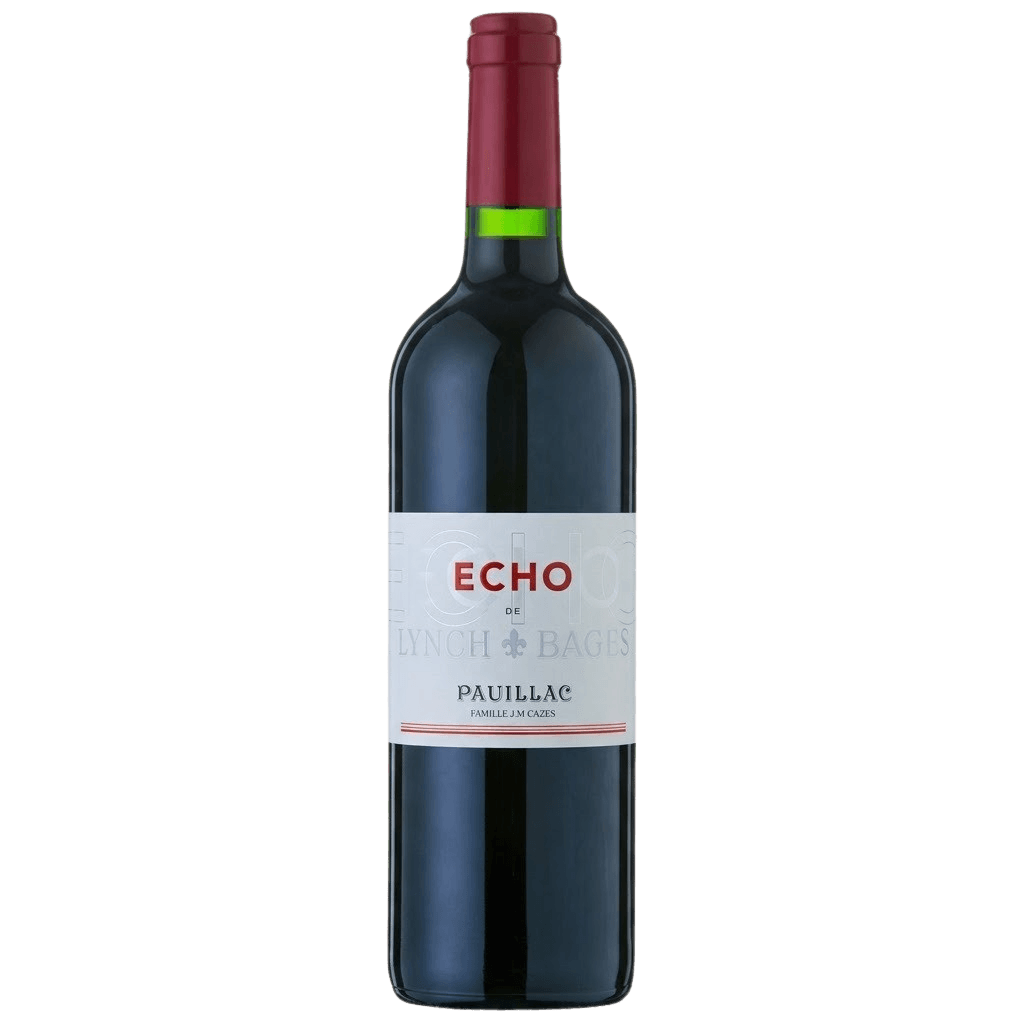
Château Lynch-Bages
Echo de Lynch-Bages
2010
Echo de Lynch-Bages is the second wine of Château Lynch-Bages, one of Pauillac's most celebrated Fifth Growth estates, offering an approachable expression of the estate's powerful, fruit-driven Cabernet Sauvignon style with excellent value.
Country
France
Region
Bordeaux - Pauillac
More information
Producer
Château Lynch-Bages is a Fifth Growth (Cinquième Cru Classé) estate in Pauillac whose wines have consistently performed well beyond their official 1855 classification ranking. Under the stewardship of the Cazes family since 1939, the château occupies a privileged position on the Bages plateau, where deep gravel soils and proximity to the Gironde estuary shape wines of remarkable power, generosity and longevity. Lynch-Bages has built an international reputation for producing Cabernet-dominant reds that combine immediate opulence with the structure to age gracefully for thirty years or more.
Quick Facts
- Location: Bages plateau, Pauillac, Bordeaux, France
- Classification: Cinquième Cru Classé – Fifth Growth, 1855
- Ownership: Cazes family since 1939
- Leadership: Jean-Charles Cazes, followed by Jean-Michel Cazes; currently managed by the fourth generation
- Estate history: Named after Irish merchant Thomas Lynch in the 18th century; property combined with the Bages terroir
- Vineyard area: Approximately 100 hectares
- Principal grapes: Cabernet Sauvignon (approximately 73%), Merlot (15%), Cabernet Franc (10%), Petit Verdot (2%)
- Soils: Deep Günzian gravel over clay and limestone subsoil
- Grand Vin: Château Lynch-Bages
- Second wine: Echo de Lynch-Bages
- Style: Powerful, richly textured Pauillac with opulent fruit and refined tannins
- Ageing potential: 20–30+ years
The Plateau of Bages
The estate's name reflects both its heritage and its place. Lynch refers to Thomas Lynch, an Irish merchant who acquired the property in the mid-18th century, while Bages identifies the gently elevated plateau southwest of the town of Pauillac where the vineyards lie. Following the French Revolution, the estate passed through several hands before Jean-Charles Cazes acquired it in 1939, establishing the family stewardship that continues today.
Under Jean-Michel Cazes, who led the property from 1973 until 2006, Lynch-Bages underwent significant modernisation while maintaining respect for traditional methods. The estate's reputation grew steadily throughout the late 20th century, cementing its status as one of Bordeaux's most reliable and sought-after châteaux.
Gravel, Drainage and the Gironde
The vineyards of Lynch-Bages occupy approximately 100 hectares on the Bages plateau, where deep beds of Günzian gravel provide excellent drainage and encourage the vines to root deeply. These well-drained soils are particularly suited to Cabernet Sauvignon, which accounts for roughly 73 per cent of plantings and forms the backbone of the estate's Grand Vin.
The Gironde estuary lies just over a kilometre to the east, moderating temperatures and reducing the risk of spring frost and extreme summer heat. This maritime influence supports slow, even ripening and helps preserve freshness and aromatic complexity in the fruit.
Merlot, Cabernet Franc and a small proportion of Petit Verdot complete the blend, contributing roundness, floral lift and additional structural refinement.
Opulence, Structure and Time
Château Lynch-Bages is recognised for a style that balances power with elegance. The Grand Vin typically offers concentrated dark fruit, cassis, graphite and subtle spice, supported by refined tannins and a long, persistent finish. While approachable in its youth, the wine reveals greater depth and complexity with extended cellaring—often showing beautifully after two or three decades.
Vinification takes place in temperature-controlled stainless steel and concrete vats, with gentle extraction designed to preserve purity and balance. Maturation occurs in French oak barrels, approximately 60 to 75 per cent of which are new depending on the vintage, allowing the wine to develop texture and aromatic nuance without overwhelming the fruit.
Echo de Lynch-Bages, the estate's second wine, reflects the same commitment to terroir and quality. It offers earlier accessibility while retaining the château's characteristic richness and structure.
A Benchmark for Pauillac
Lynch-Bages has become one of the most recognisable names in Pauillac, valued by collectors and enthusiasts alike for its consistency, generosity and ability to reward patience. Its wines appear regularly on lists of the finest Bordeaux and remain sought-after across markets worldwide.
The estate's combination of privileged terroir, meticulous vineyard management and thoughtful cellar work continues to produce wines that honour both the heritage of the 1855 Classification and the evolving standards of modern Bordeaux.
Country
Region
Bordeaux - Pauillac
Pauillac is one of the most respected appellations in Bordeaux and the only commune in the Médoc to contain three of the five First Growth estates from the historic 1855 Classification. Located on the Left Bank of the Gironde estuary in the Haut-Médoc, Pauillac combines centuries of winemaking heritage with exceptional terroir, producing powerful, structured wines that rank among the most collectible Bordeaux bottles. The appellation represents the pinnacle of Cabernet Sauvignon expression in the Médoc.
The appellation benefits from deep gravel beds mixed with sand and clay, providing excellent drainage and ideal conditions for Cabernet Sauvignon, which typically dominates blends alongside Merlot, Cabernet Franc and Petit Verdot. The moderating influence of the Gironde estuary protects vines from frost while extending the growing season, allowing grapes to achieve optimal ripeness. These geological and climatic factors contribute to wines of remarkable concentration, balance and longevity.
Pauillac is home to Château Lafite Rothschild, Château Latour and Château Mouton Rothschild, three of the world's most celebrated wine estates. Beyond the First Growths, the appellation includes distinguished producers such as Château Pichon-Longueville, Château Pichon Longueville Comtesse de Lalande and Château Lynch-Bages. Pauillac wines are renowned for their firm tannins, cassis and blackcurrant character, cedar notes and exceptional ageing potential, often reaching their peak after decades in the cellar.
Discover Pauillac wines, compare prices from trusted merchants across Europe and find the best offers with Sipfind.
Grapes
Cabernet Sauvignon is one of the world’s most important and widely planted red wine grapes, renowned for its powerful structure, concentrated fruit and exceptional ageing potential. Originating in Bordeaux, France, the variety has become a defining grape of fine wine regions around the world, particularly Napa Valley, Tuscany, Chile, Australia and South Africa.
Classic Cabernet Sauvignon combines flavours and aromas of blackcurrant, cassis, blackberry and dark cherry with characteristic notes of cedar, graphite, tobacco and herbs. Naturally high tannins and fresh acidity provide structure and longevity, while maturation in oak can add layers of spice, vanilla and toast. Its character varies significantly with climate, soil and winemaking, ranging from elegant and savoury to rich, powerful and intensely concentrated.
In Bordeaux, Cabernet Sauvignon is particularly associated with the Left Bank, where it forms the foundation of many prestigious blends alongside Merlot, Cabernet Franc and other permitted varieties. In Napa Valley, it has become the region’s signature red grape, producing some of the world’s most sought-after Cabernet Sauvignon wines.
Cabernet Sauvignon’s ability to express terroir while retaining its distinctive structure and character has made it a global benchmark for premium red wine. Whether produced as the dominant variety in a blend or as a varietal wine, the finest examples combine concentration, complexity and the capacity to develop gracefully over decades
Merlot is one of the world’s most important red wine grapes, celebrated for its generous fruit, supple texture and ability to produce wines ranging from approachable and elegant to exceptionally complex and long-lived. Originating in Bordeaux, France, Merlot is particularly associated with the Right Bank, where it forms the foundation of many of the prestigious wines of Pomerol and Saint-Émilion.
Merlot typically expresses flavours and aromas of plum, black cherry, blackberry and red fruits, often developing notes of chocolate, tobacco, cedar, herbs and earthy complexity with maturation. Its naturally rounded texture and generally softer tannin profile distinguish it from Cabernet Sauvignon, although the finest examples can possess considerable structure, freshness and ageing potential.
In Pomerol, Merlot reaches some of its most celebrated expressions, particularly on the appellation’s clay-rich soils, producing wines of remarkable concentration, texture and complexity. In Saint-Émilion, it is commonly blended with Cabernet Franc and, to a lesser extent, Cabernet Sauvignon, creating wines that combine ripe fruit with structure, aromatic complexity and longevity.
Beyond Bordeaux, Merlot is widely cultivated in Italy, California, Washington State, Chile and other major wine regions. It can be produced as a varietal wine or used as a central component of blends, where its fruit and texture complement more structured grape varieties.
From the great Merlot-based wines of Bordeaux’s Right Bank to leading expressions around the world, Merlot’s combination of rich fruit, refined texture and capacity to express terroir has established it as one of the defining varieties of fine red wine.
Cabernet Franc is one of France’s most historic red wine grapes, valued for its aromatic intensity, vibrant acidity and ability to express both climate and soil with remarkable clarity. It produces elegant single-varietal wines and plays an essential role in some of Bordeaux’s most distinguished blends. Earlier ripening than Cabernet Sauvignon allows Cabernet Franc to perform particularly well in cooler wine regions.
In the Loire Valley, Cabernet Franc reaches its clearest expression as a varietal wine. Typical aromas include redcurrant, raspberry, red cherry and violet, often accompanied by graphite, dried herbs, tobacco and subtle peppery notes. Naturally fresh acidity and finely structured tannins can produce approachable, fruit-driven wines as well as complex examples capable of developing for many years.
The variety is especially important in Chinon, Bourgueil and Saumur-Champigny. Chinon can range from fragrant and supple to deeply structured and age-worthy, depending on vineyard site and soil. Bourgueil often combines dark red fruit with firm structure, while Saumur-Champigny is renowned for freshness, aromatic purity and refined texture. Limestone-rich tuffeau, gravel, sand and clay all contribute to the diversity of Cabernet Franc across these Loire appellations.
In Bordeaux, Cabernet Franc is principally associated with the Right Bank, particularly Saint-Émilion and Pomerol. Usually blended with Merlot and sometimes Cabernet Sauvignon, it contributes perfume, freshness, savoury complexity and structural precision. On suitable limestone and clay terroirs, Cabernet Franc can become a dominant component of exceptionally refined and long-lived wines.
Beyond France, Cabernet Franc is cultivated in regions including Tuscany, Bolgheri, Napa Valley, Washington State, Canada, Argentina and Chile, producing styles shaped by local climate and terroir. Traditionally known as Breton in the Loire and Bouchet in parts of Bordeaux, Cabernet Franc’s combination of aromatic elegance, freshness and ageing potential establishes it as one of the world’s great red wine varieties.
History and Style
Echo de Lynch-Bages is the second wine of Château Lynch-Bages, a Fifth Growth (Cinquième Grand Cru Classé) estate that has long been considered one of Pauillac's most consistent and sought-after producers. This second label offers wine enthusiasts an accessible entry point to the estate's renowned style, crafted from younger vines and parcels not selected for the flagship Grand Vin.
Quick Facts
- Producer: Château Lynch-Bages
- Classification: Second wine of Fifth Growth (Cinquième Grand Cru Classé 1855)
- Region: Bordeaux
- Appellation: Pauillac
- Country: France
- Style: Full-bodied Left Bank Bordeaux
- Grape Composition: Cabernet Sauvignon-dominant blend, typically with Merlot, Cabernet Franc, and Petit Verdot (exact proportions vary by vintage)
- Ageing Potential: 8-15 years from vintage
- Alcohol (ABV): 13-14%
- Tasting Profile: Blackcurrant, cassis, dark berries, cedar, tobacco, graphite, firm tannins
- Food Pairing: Grilled lamb, roasted beef, duck confit, aged hard cheeses
- Serving Temperature: 16-18°C
- Bottle Status: Second Wine
- Vintage: Vintage (varies by release)
Vineyard, Terroir and Style
Château Lynch-Bages has been owned by the Cazes family since 1939 and sits on the Bages plateau in Pauillac, benefiting from deep gravel soils that provide excellent drainage and encourage vine stress. The estate's 100 hectares of vineyards are planted predominantly to Cabernet Sauvignon, with supporting roles for Merlot, Cabernet Franc, and Petit Verdot. The terroir produces wines of remarkable concentration and structure, with the signature power and elegance that define Pauillac.
History and Reputation
Echo de Lynch-Bages captures the estate's characteristic style with ripe blackcurrant, cassis, and dark berry fruit complemented by notes of cedar, tobacco, and graphite. The wine displays classic Left Bank structure with firm but approachable tannins, making it more accessible in its youth than the Grand Vin while retaining genuine ageing potential. Matured in French oak barrels, it offers generous fruit expression balanced by subtle oak influence and mineral complexity.
This second wine represents exceptional value for those seeking authentic Pauillac character without the investment required for classified growth flagships, appealing to both developing collectors and experienced enthusiasts looking for earlier-drinking Left Bank Bordeaux with pedigree.