
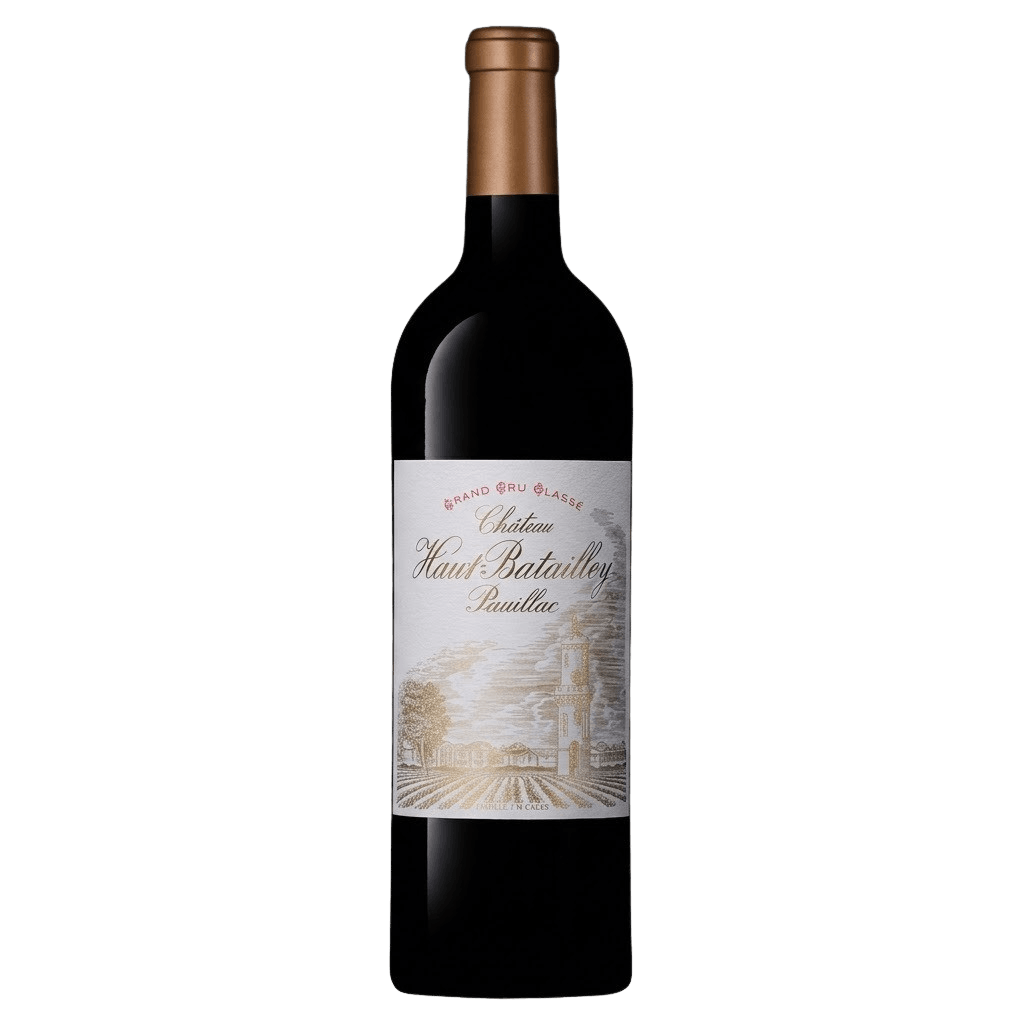
Chateau Haut-Batailley
Chateau Haut-Batailley
2014
From 55 EUR from 1 retailers
Château Haut-Batailley represents the refined elegance of Pauillac's Fifth Growth estates, producing Cabernet Sauvignon-dominant Grand Vin with classic Left Bank structure and approachable sophistication.
Country
France
Region
Bordeaux - Pauillac
Number of retailers: 1
Chateaunet
France
Chateau Haut-Batailley
2014
Standard delivery 1-3 business days
More information
Producer
Château Haut-Batailley is a Fifth Growth estate in Pauillac, classified as a Cinquième Cru Classé in the 1855 Classification. Located in one of Bordeaux's most celebrated appellations and owned by the Cazes family since 2017, the property comprises 22 hectares of vineyard on the Left Bank. The estate is recognised for producing Cabernet Sauvignon-led wines that combine classic Pauillac structure with elegance, refinement and long cellaring potential.
Quick Facts
- Location: Pauillac, Médoc, Bordeaux, France
- Classification: Cinquième Cru Classé – Fifth Growth, 1855
- Ownership: Cazes family, since 2017
- Previous ownership: Borie family for over half a century
- Estate size: 22 hectares of vineyard
- Principal grapes: Cabernet Sauvignon, Merlot, Cabernet Franc
- Soils: Deep Günzian gravel over clay and limestone subsoil
- Grand Vin: Château Haut-Batailley
- Style: Medium-bodied, elegant Pauillac with structure and finesse
- Viticulture: Sustainable vineyard management
- Ageing potential: 15 to 25 years
A Divided Legacy
Château Haut-Batailley shares its origins with the larger Château Batailley, once a single estate recognised in the 1855 Classification. In 1942, the property was divided between the heirs of its owners, creating two independent classified growths. Haut-Batailley was managed by the Borie family for more than five decades, during which it earned a reputation for consistent quality and restrained elegance.
In 2017, the Cazes family, proprietors of the renowned Château Lynch-Bages, acquired Haut-Batailley and initiated a programme of investment aimed at modernising facilities while preserving the estate's traditional character and terroir-driven philosophy.
Gravels of the Plateau de Bages
The vineyard is situated on the Plateau de Bages, a gravelly rise south of the town of Pauillac. This historic sector is known for deep beds of Günzian gravel deposited over clay and limestone subsoil during the Quaternary period. The free-draining gravel encourages vine stress and concentrated fruit, while the clay beneath provides water reserves during dry vintages.
Cabernet Sauvignon dominates the vineyard, occupying approximately 65 percent of plantings and giving the estate its characteristic structure and aromatic depth. Merlot adds roundness and approachability, while Cabernet Franc contributes aromatic lift and complexity.
Refinement in Bottle
Haut-Batailley is known for a style that favours finesse over power. The Grand Vin typically displays dark fruit, graphite and cedar notes, supported by fine-grained tannins and a core of freshness that encourages graceful development over time.
Following the Cazes family's acquisition, winemaking has been refined with greater parcel selection, the introduction of optical sorting and the use of temperature-controlled concrete vats alongside traditional oak fermentation vessels. French oak barriques, typically renewed by 50 to 60 percent each year, allow the wine to mature without overwhelming its inherent elegance.
The result is a Pauillac that respects the estate's classified growth heritage while expressing a modern clarity and balance—wines built to reward both early appreciation and patient cellaring.
Country
Region
Bordeaux - Pauillac
Pauillac is one of the most respected appellations in Bordeaux and the only commune in the Médoc to contain three of the five First Growth estates from the historic 1855 Classification. Located on the Left Bank of the Gironde estuary in the Haut-Médoc, Pauillac combines centuries of winemaking heritage with exceptional terroir, producing powerful, structured wines that rank among the most collectible Bordeaux bottles. The appellation represents the pinnacle of Cabernet Sauvignon expression in the Médoc.
The appellation benefits from deep gravel beds mixed with sand and clay, providing excellent drainage and ideal conditions for Cabernet Sauvignon, which typically dominates blends alongside Merlot, Cabernet Franc and Petit Verdot. The moderating influence of the Gironde estuary protects vines from frost while extending the growing season, allowing grapes to achieve optimal ripeness. These geological and climatic factors contribute to wines of remarkable concentration, balance and longevity.
Pauillac is home to Château Lafite Rothschild, Château Latour and Château Mouton Rothschild, three of the world's most celebrated wine estates. Beyond the First Growths, the appellation includes distinguished producers such as Château Pichon-Longueville, Château Pichon Longueville Comtesse de Lalande and Château Lynch-Bages. Pauillac wines are renowned for their firm tannins, cassis and blackcurrant character, cedar notes and exceptional ageing potential, often reaching their peak after decades in the cellar.
Discover Pauillac wines, compare prices from trusted merchants across Europe and find the best offers with Sipfind.
Grapes
Cabernet Sauvignon is one of the world’s most important and widely planted red wine grapes, renowned for its powerful structure, concentrated fruit and exceptional ageing potential. Originating in Bordeaux, France, the variety has become a defining grape of fine wine regions around the world, particularly Napa Valley, Tuscany, Chile, Australia and South Africa.
Classic Cabernet Sauvignon combines flavours and aromas of blackcurrant, cassis, blackberry and dark cherry with characteristic notes of cedar, graphite, tobacco and herbs. Naturally high tannins and fresh acidity provide structure and longevity, while maturation in oak can add layers of spice, vanilla and toast. Its character varies significantly with climate, soil and winemaking, ranging from elegant and savoury to rich, powerful and intensely concentrated.
In Bordeaux, Cabernet Sauvignon is particularly associated with the Left Bank, where it forms the foundation of many prestigious blends alongside Merlot, Cabernet Franc and other permitted varieties. In Napa Valley, it has become the region’s signature red grape, producing some of the world’s most sought-after Cabernet Sauvignon wines.
Cabernet Sauvignon’s ability to express terroir while retaining its distinctive structure and character has made it a global benchmark for premium red wine. Whether produced as the dominant variety in a blend or as a varietal wine, the finest examples combine concentration, complexity and the capacity to develop gracefully over decades
Merlot is one of the world’s most important red wine grapes, celebrated for its generous fruit, supple texture and ability to produce wines ranging from approachable and elegant to exceptionally complex and long-lived. Originating in Bordeaux, France, Merlot is particularly associated with the Right Bank, where it forms the foundation of many of the prestigious wines of Pomerol and Saint-Émilion.
Merlot typically expresses flavours and aromas of plum, black cherry, blackberry and red fruits, often developing notes of chocolate, tobacco, cedar, herbs and earthy complexity with maturation. Its naturally rounded texture and generally softer tannin profile distinguish it from Cabernet Sauvignon, although the finest examples can possess considerable structure, freshness and ageing potential.
In Pomerol, Merlot reaches some of its most celebrated expressions, particularly on the appellation’s clay-rich soils, producing wines of remarkable concentration, texture and complexity. In Saint-Émilion, it is commonly blended with Cabernet Franc and, to a lesser extent, Cabernet Sauvignon, creating wines that combine ripe fruit with structure, aromatic complexity and longevity.
Beyond Bordeaux, Merlot is widely cultivated in Italy, California, Washington State, Chile and other major wine regions. It can be produced as a varietal wine or used as a central component of blends, where its fruit and texture complement more structured grape varieties.
From the great Merlot-based wines of Bordeaux’s Right Bank to leading expressions around the world, Merlot’s combination of rich fruit, refined texture and capacity to express terroir has established it as one of the defining varieties of fine red wine.
History and Style
Château Haut-Batailley is the flagship Grand Vin of Château Haut-Batailley, a Fifth Growth (Cinquième Cru Classé) estate in Bordeaux's prestigious Pauillac appellation. This Cabernet Sauvignon-dominant wine embodies the elegant, refined expression of Pauillac's inland plateau terroirs, offering classic Left Bank structure with fine-grained tannins and excellent ageing potential.
Quick Facts
- Producer: Château Haut-Batailley
- Classification: Cinquième Cru Classé (Fifth Growth, 1855)
- Region: Bordeaux
- Appellation: Pauillac
- Country: France
- Style: Medium to full-bodied Left Bank Bordeaux
- Grape Composition: Cabernet Sauvignon-dominant blend (typically 65-75%), with Merlot and Cabernet Franc
- Ageing Potential: 15-25 years from vintage
- Alcohol (ABV): 13-14%
- Tasting Profile: Blackcurrant, cassis, cedar, graphite, tobacco, fine tannins
- Food Pairing: Roast lamb, beef, duck, game meats, aged hard cheeses
- Serving Temperature: 16-18°C
- Bottle Status: Flagship
- Consumer Profile: Bordeaux collectors, fine-wine enthusiasts seeking classified growth quality, wine investors
Vineyard, Terroir and Style
The estate benefits from deep gravelly soils on gently elevated terroir in southern Pauillac, neighbouring illustrious properties like Château Batailley and Grand-Puy-Lacoste. These well-drained Günzian gravel beds provide ideal conditions for Cabernet Sauvignon, which typically forms the majority of the blend alongside Merlot and Cabernet Franc. The vineyard's position allows for optimal ripening while maintaining the freshness and structure that define fine Pauillac.
History and Reputation
The wine showcases classic Pauillac characteristics: ripe blackcurrant and cassis, supported by cedar, graphite, and subtle tobacco notes. Medium to full-bodied with fine tannins, Château Haut-Batailley offers approachable elegance in its youth while developing complexity over 15-25 years. Matured in French oak barrels, the wine balances fruit purity with refined oak integration, making it both cellar-worthy and accessible compared to its more powerful First Growth neighbours.
Compare prices across premium retailers and discover why this Fifth Growth continues to earn praise for delivering exceptional Pauillac character and remarkable value within the classified growth hierarchy.