
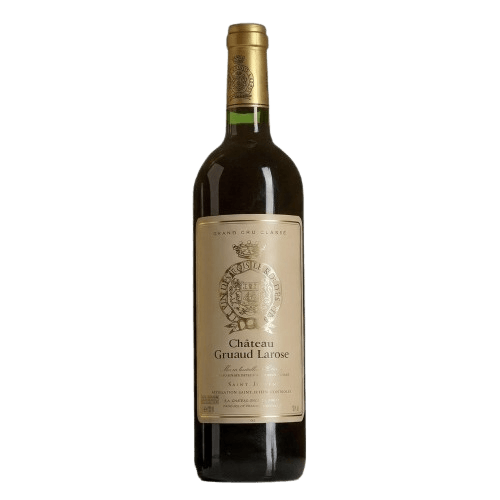
Château Gruaud Larose
Château Gruaud Larose
2010
From 137 EUR from 3 retailers
Château Gruaud Larose produces a flagship Grand Vin from its Deuxième Grand Cru Classé estate in Saint-Julien, delivering classic Left Bank Bordeaux with structured elegance and renowned ageing potential.
Country
France
Region
Bordeaux - Saint-Julien
Number of retailers: 3
Bottle Hero
European Union
Château Gruaud Larose
2010
You save up to 64 EUR, where 64 EUR is the difference between the highest price and the lowest price
bordeauxwines.se
Sweden
Château Gruaud Larose
2010
Standard delivery 1-3 business days
Lobenbergs Gute Weine GmbH & Co. KG
Germany
Château Gruaud Larose
2010
Standard delivery 1-3 business days
More information
Producer
Château Gruaud Larose is one of the most distinguished Second Growths classified in 1855, with a reputation for producing robust, long-lived wines that exemplify the character of Saint-Julien. Located in the centre of the appellation and owned by the Merlaut family, the estate has maintained consistent quality across generations. Its Grand Vin is recognised for remarkable concentration, structured tannins and the ability to evolve gracefully over decades.
Quick Facts
- Location: Beychevelle, Saint-Julien, Bordeaux, France
- Classification: Deuxième Cru Classé – Second Growth, 1855
- Estate history: Dates to the early 18th century
- Current ownership: Merlaut family, since 1997
- Estate size: Approximately 82 hectares of contiguous vineyards
- Principal grapes: Cabernet Sauvignon, Merlot, Cabernet Franc, Petit Verdot
- Soils: Deep Gunzian gravel beds over clay and sand
- Grand Vin: Château Gruaud Larose
- Second wine: Sarget de Gruaud Larose
- Style: Powerful, structured and age-worthy
- Production: Traditional Médocain winemaking with extended barrel maturation
The Wines of the King
The estate's name and reputation were established by Joseph Stanislas Gruaud, an abbot and influential figure who acquired the property in 1757. Under his stewardship, the vineyard expanded significantly and its wines gained recognition at the highest levels, earning the title "the wine of kings, the king of wines" during the 18th century.
Following Gruaud's death in 1778, the estate passed to his heirs and was eventually divided between two branches of the family. The property was reunited in 1935 under a single ownership, restoring the estate's historic unity and allowing it to build on its classified status with renewed focus and ambition.
A Single Expanse of Gravel
The estate's 82 hectares form one of the largest contiguous vineyard holdings in Saint-Julien. This single, unbroken expanse sits on a plateau of deep Gunzian gravel, the oldest and most prized geological formation in the Médoc, laid down during the Quaternary period.
The gravel beds provide exceptional drainage and heat retention, encouraging gradual ripening and concentration in Cabernet Sauvignon, which typically represents around 60 to 65 per cent of the blend. Merlot, Cabernet Franc and small quantities of Petit Verdot complete the composition, contributing roundness, complexity and aromatic depth.
The vineyard's proximity to the Gironde estuary moderates temperature extremes and protects against spring frost, creating conditions suited to producing wines of power and structure without sacrificing balance or freshness.
Depth Built to Last
Gruaud Larose is made in a deliberately traditional style. Fermentation occurs in temperature-controlled stainless steel and concrete vats, with extraction managed to preserve structure and intensity. The Grand Vin is matured in French oak barrels for 18 to 24 months, with a proportion of new oak that varies according to vintage character.
The result is a wine distinguished by dense black fruit, graphite, tobacco and dark spice, supported by firm, fine-grained tannins and remarkable length. In youth, Château Gruaud Larose can appear compact and muscular. With cellaring, it develops tertiary complexity, aromatic refinement and a more seamless integration of fruit, oak and acidity.
Sarget de Gruaud Larose, produced from younger vines and selected parcels, offers earlier approachability while retaining the estate's signature depth and structure. It provides an accessible introduction to the house style and the character of Saint-Julien's gravel terroirs.
Country
Region
Bordeaux - Saint-Julien
Saint-Julien is one of the most respected wine appellations in the Médoc and has earned a distinguished reputation for producing some of Bordeaux's most refined and balanced wines. Located between Pauillac and Margaux along the left bank of the Gironde estuary, the appellation combines exceptional terroir with centuries of winemaking tradition. Despite being one of the smallest communal appellations in the Médoc, Saint-Julien boasts an extraordinary concentration of classified growth estates.
The appellation benefits from deep gravel soils mixed with clay and sand, providing excellent drainage while retaining sufficient moisture for the vines. This terroir creates ideal conditions for Cabernet Sauvignon, which dominates most blends, supported by Merlot, Cabernet Franc and Petit Verdot. The maritime influence from the Gironde moderates temperatures, allowing for slow, even ripening that contributes to the appellation's signature balance and refinement.
Saint-Julien is home to eleven classified growths from the 1855 Classification, including five distinguished Second Growths: Château Léoville Las Cases, Château Léoville Poyferré, Château Léoville Barton, Château Ducru-Beaucaillou and Château Gruaud-Larose. These estates produce wines renowned for their harmonious structure, combining concentration and power with remarkable elegance and finesse. The consistent quality across the appellation has made Saint-Julien a benchmark for classic Médoc winemaking.
Discover Saint-Julien wines, compare prices from trusted merchants across Europe and find the best offers with Sipfind.
Grapes
Cabernet Sauvignon is one of the world’s most important and widely planted red wine grapes, renowned for its powerful structure, concentrated fruit and exceptional ageing potential. Originating in Bordeaux, France, the variety has become a defining grape of fine wine regions around the world, particularly Napa Valley, Tuscany, Chile, Australia and South Africa.
Classic Cabernet Sauvignon combines flavours and aromas of blackcurrant, cassis, blackberry and dark cherry with characteristic notes of cedar, graphite, tobacco and herbs. Naturally high tannins and fresh acidity provide structure and longevity, while maturation in oak can add layers of spice, vanilla and toast. Its character varies significantly with climate, soil and winemaking, ranging from elegant and savoury to rich, powerful and intensely concentrated.
In Bordeaux, Cabernet Sauvignon is particularly associated with the Left Bank, where it forms the foundation of many prestigious blends alongside Merlot, Cabernet Franc and other permitted varieties. In Napa Valley, it has become the region’s signature red grape, producing some of the world’s most sought-after Cabernet Sauvignon wines.
Cabernet Sauvignon’s ability to express terroir while retaining its distinctive structure and character has made it a global benchmark for premium red wine. Whether produced as the dominant variety in a blend or as a varietal wine, the finest examples combine concentration, complexity and the capacity to develop gracefully over decades
Merlot is one of the world’s most important red wine grapes, celebrated for its generous fruit, supple texture and ability to produce wines ranging from approachable and elegant to exceptionally complex and long-lived. Originating in Bordeaux, France, Merlot is particularly associated with the Right Bank, where it forms the foundation of many of the prestigious wines of Pomerol and Saint-Émilion.
Merlot typically expresses flavours and aromas of plum, black cherry, blackberry and red fruits, often developing notes of chocolate, tobacco, cedar, herbs and earthy complexity with maturation. Its naturally rounded texture and generally softer tannin profile distinguish it from Cabernet Sauvignon, although the finest examples can possess considerable structure, freshness and ageing potential.
In Pomerol, Merlot reaches some of its most celebrated expressions, particularly on the appellation’s clay-rich soils, producing wines of remarkable concentration, texture and complexity. In Saint-Émilion, it is commonly blended with Cabernet Franc and, to a lesser extent, Cabernet Sauvignon, creating wines that combine ripe fruit with structure, aromatic complexity and longevity.
Beyond Bordeaux, Merlot is widely cultivated in Italy, California, Washington State, Chile and other major wine regions. It can be produced as a varietal wine or used as a central component of blends, where its fruit and texture complement more structured grape varieties.
From the great Merlot-based wines of Bordeaux’s Right Bank to leading expressions around the world, Merlot’s combination of rich fruit, refined texture and capacity to express terroir has established it as one of the defining varieties of fine red wine.
Cabernet Franc is one of France’s most historic red wine grapes, valued for its aromatic intensity, vibrant acidity and ability to express both climate and soil with remarkable clarity. It produces elegant single-varietal wines and plays an essential role in some of Bordeaux’s most distinguished blends. Earlier ripening than Cabernet Sauvignon allows Cabernet Franc to perform particularly well in cooler wine regions.
In the Loire Valley, Cabernet Franc reaches its clearest expression as a varietal wine. Typical aromas include redcurrant, raspberry, red cherry and violet, often accompanied by graphite, dried herbs, tobacco and subtle peppery notes. Naturally fresh acidity and finely structured tannins can produce approachable, fruit-driven wines as well as complex examples capable of developing for many years.
The variety is especially important in Chinon, Bourgueil and Saumur-Champigny. Chinon can range from fragrant and supple to deeply structured and age-worthy, depending on vineyard site and soil. Bourgueil often combines dark red fruit with firm structure, while Saumur-Champigny is renowned for freshness, aromatic purity and refined texture. Limestone-rich tuffeau, gravel, sand and clay all contribute to the diversity of Cabernet Franc across these Loire appellations.
In Bordeaux, Cabernet Franc is principally associated with the Right Bank, particularly Saint-Émilion and Pomerol. Usually blended with Merlot and sometimes Cabernet Sauvignon, it contributes perfume, freshness, savoury complexity and structural precision. On suitable limestone and clay terroirs, Cabernet Franc can become a dominant component of exceptionally refined and long-lived wines.
Beyond France, Cabernet Franc is cultivated in regions including Tuscany, Bolgheri, Napa Valley, Washington State, Canada, Argentina and Chile, producing styles shaped by local climate and terroir. Traditionally known as Breton in the Loire and Bouchet in parts of Bordeaux, Cabernet Franc’s combination of aromatic elegance, freshness and ageing potential establishes it as one of the world’s great red wine varieties.
History and Style
Château Gruaud Larose is the flagship Grand Vin of Château Gruaud Larose, a Deuxième Grand Cru Classé estate in Bordeaux's prestigious Saint-Julien appellation. This Cabernet Sauvignon-dominant blend exemplifies the structured elegance and long ageing potential that defines Left Bank Bordeaux, earning a reputation as one of Saint-Julien's most consistent producers.
Quick Facts
- Producer: Château Gruaud Larose
- Classification: Deuxième Grand Cru Classé (1855)
- Region: Bordeaux
- Appellation: Saint-Julien
- Country: France
- Style: Full-bodied Left Bank Bordeaux
- Grape Composition: Cabernet Sauvignon-dominant blend (typically 60-70% Cabernet Sauvignon, with Merlot, Cabernet Franc, and Petit Verdot)
- Ageing Potential: 15-30+ years from vintage
- Alcohol (ABV): 13-14%
- Tasting Profile: Blackcurrant, cedar, graphite, dark cherry, tobacco, vanilla, structured tannins
- Food Pairing: Roast lamb, beef Wellington, game meats, aged hard cheeses, duck confit
- Serving Temperature: 16-18°C
- Bottle Status: Flagship
- Vintage: Varies by vintage (multi-vintage product)
Vineyard, Terroir and Style
The estate's 82-hectare vineyard benefits from exceptional terroir on deep Günzian gravel beds, providing optimal drainage and stress conditions for concentrated fruit development. The classic Saint-Julien position between Pauillac and Margaux allows Gruaud Larose to combine the power of the former with the finesse of the latter. Meticulous vineyard management and selective harvesting ensure only the finest parcels contribute to the flagship wine, with lesser lots declassified to the estate's second wine, Sarget de Gruaud Larose.
History and Reputation
The wine typically showcases blackcurrant, cedar, and graphite notes characteristic of Cabernet-led Saint-Julien, supported by structured tannins and natural acidity that promise decades of evolution. Oak maturation in French barriques adds layers of spice and vanilla while preserving the wine's elegant fruit core.
For collectors and fine-wine enthusiasts seeking benchmark Saint-Julien with proven track record and cellar-worthiness, Château Gruaud Larose delivers consistent quality across vintages. Compare prices on Sipfind to discover competitive offers on this distinguished Deuxième Cru Classé.