
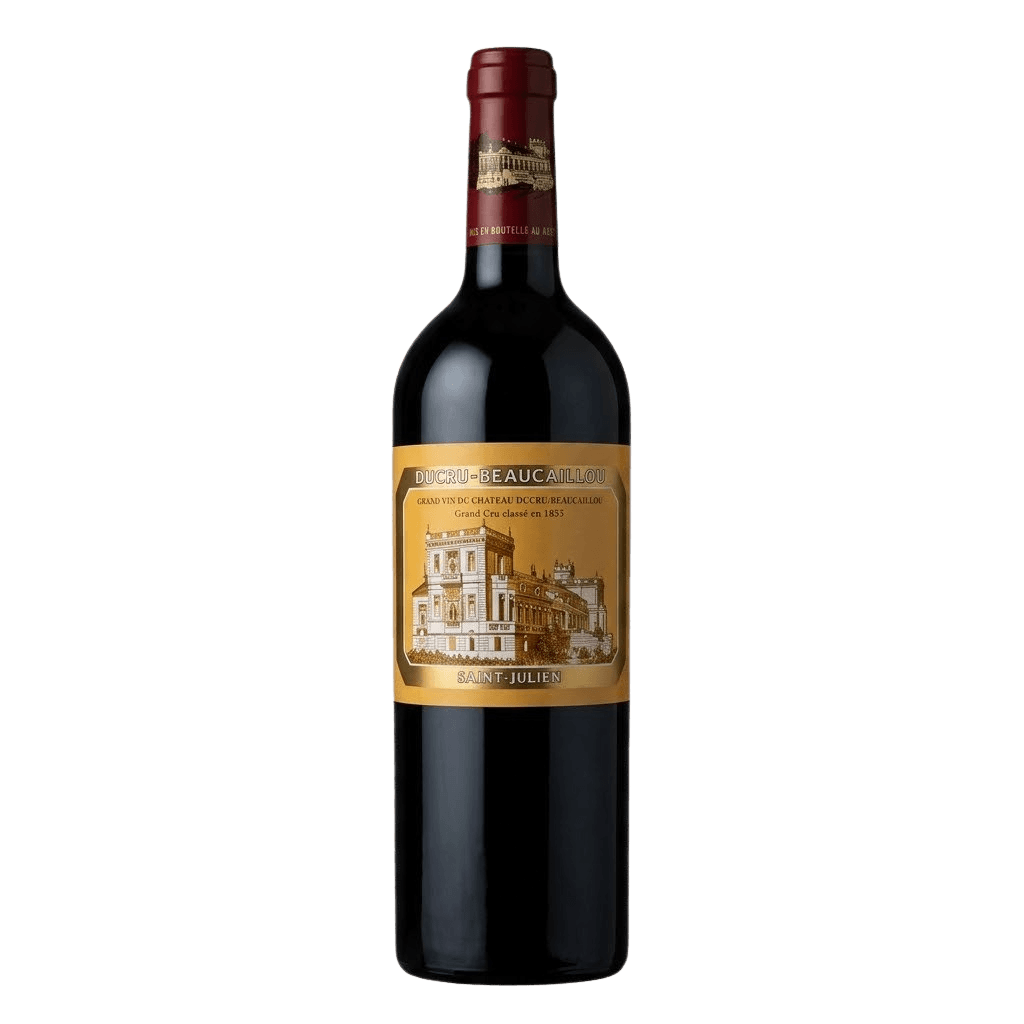
Château Ducru-Beaucaillou
Château Ducru-Beaucaillou
2013
Château Ducru-Beaucaillou represents the pinnacle of Saint-Julien winemaking, a Second Growth estate producing Cabernet Sauvignon-led wines celebrated for their balance, refinement and remarkable ageing potential across decades.
Country
France
Region
Bordeaux - Saint-Julien
More information
Producer
Château Ducru-Beaucaillou is a Deuxième Cru Classé estate in the Saint-Julien appellation, classified in the landmark 1855 Bordeaux Classification and recognised as one of the Left Bank's most distinguished properties. The estate has remained under the stewardship of the Borie family for generations, preserving a commitment to terroir-driven winemaking and meticulous vineyard management. Its Grand Vin combines concentration and refinement in a style that balances structure with extraordinary finesse.
Quick Facts
- Location: Saint-Julien-Beychevelle, Saint-Julien, Bordeaux, France
- Classification: Deuxième Cru Classé – Second Growth, 1855
- Ownership: Borie family
- Estate size: 75 hectares of vineyards
- Principal grapes: Cabernet Sauvignon, Merlot, Cabernet Franc, Petit Verdot
- Soils: Deep Quaternary gravel over clay and limestone
- Position: Elevated plateau overlooking the Gironde estuary
- Grand Vin: Château Ducru-Beaucaillou
- Second wine: La Croix de Beaucaillou
- Style: Elegant, structured and built for extended ageing
- Ageing potential: 25 to 40 years or more
- Investment grade: Internationally recognised
The Name and the Stones
The estate's distinctive name derives from two sources. "Ducru" refers to the Ducru family, who owned the property in the late 18th century and established its reputation as one of the Médoc's finest vineyards. "Beaucaillou" translates as "beautiful pebbles", a direct reference to the large, polished gravel stones that define the estate's terroir.
These smooth stones, deposited by the Garonne and Dordogne rivers over millennia, form a deep, well-draining layer across the vineyard. They absorb heat during the day and release it gradually at night, creating ideal conditions for slow, even ripening and contributing to the structure and aromatic complexity of the wine.
A Privileged Position Above the Estuary
Château Ducru-Beaucaillou's 75 hectares occupy an elevated plateau directly overlooking the Gironde estuary, positioned among the finest vineyard land in Saint-Julien. The proximity to the water moderates temperature extremes, reducing the risk of spring frost and extending the ripening period into autumn.
The estate's gravel soils vary in depth and composition across different parcels, with underlying clay and limestone adding complexity and moisture retention. Cabernet Sauvignon thrives in these conditions, forming the backbone of the Grand Vin and typically representing the majority of the blend. Merlot provides mid-palate depth and roundness, while smaller proportions of Cabernet Franc and Petit Verdot add aromatic lift and structural refinement.
Vineyard work follows traditional principles adapted to each parcel's characteristics. Planting density, canopy management and selective harvesting all serve to express the site's natural balance and precision.
The Grand Vin and its Expression
The Grand Vin of Château Ducru-Beaucaillou is vinified parcel by parcel, allowing each component to be understood and assessed individually before blending. Maturation takes place in French oak barrels, with the proportion of new wood calibrated vintage by vintage to complement rather than dominate the wine's expression.
What emerges is a Cabernet-led Saint-Julien distinguished by its harmony. The wine combines dark fruit concentration, graphite minerality and fine-grained tannins with freshness, aromatic precision and remarkable length. It is built neither for immediate consumption nor for excessive power, but for gradual evolution over decades.
Across vintages spanning multiple generations, Château Ducru-Beaucaillou has earned a reputation as a benchmark of balance in Bordeaux—a wine that reflects the elegance of Saint-Julien and the depth of one of the appellation's most privileged terroirs.
Country
Region
Bordeaux - Saint-Julien
Saint-Julien is one of the most respected wine appellations in the Médoc and has earned a distinguished reputation for producing some of Bordeaux's most refined and balanced wines. Located between Pauillac and Margaux along the left bank of the Gironde estuary, the appellation combines exceptional terroir with centuries of winemaking tradition. Despite being one of the smallest communal appellations in the Médoc, Saint-Julien boasts an extraordinary concentration of classified growth estates.
The appellation benefits from deep gravel soils mixed with clay and sand, providing excellent drainage while retaining sufficient moisture for the vines. This terroir creates ideal conditions for Cabernet Sauvignon, which dominates most blends, supported by Merlot, Cabernet Franc and Petit Verdot. The maritime influence from the Gironde moderates temperatures, allowing for slow, even ripening that contributes to the appellation's signature balance and refinement.
Saint-Julien is home to eleven classified growths from the 1855 Classification, including five distinguished Second Growths: Château Léoville Las Cases, Château Léoville Poyferré, Château Léoville Barton, Château Ducru-Beaucaillou and Château Gruaud-Larose. These estates produce wines renowned for their harmonious structure, combining concentration and power with remarkable elegance and finesse. The consistent quality across the appellation has made Saint-Julien a benchmark for classic Médoc winemaking.
Discover Saint-Julien wines, compare prices from trusted merchants across Europe and find the best offers with Sipfind.
Grapes
Cabernet Sauvignon is one of the world’s most important and widely planted red wine grapes, renowned for its powerful structure, concentrated fruit and exceptional ageing potential. Originating in Bordeaux, France, the variety has become a defining grape of fine wine regions around the world, particularly Napa Valley, Tuscany, Chile, Australia and South Africa.
Classic Cabernet Sauvignon combines flavours and aromas of blackcurrant, cassis, blackberry and dark cherry with characteristic notes of cedar, graphite, tobacco and herbs. Naturally high tannins and fresh acidity provide structure and longevity, while maturation in oak can add layers of spice, vanilla and toast. Its character varies significantly with climate, soil and winemaking, ranging from elegant and savoury to rich, powerful and intensely concentrated.
In Bordeaux, Cabernet Sauvignon is particularly associated with the Left Bank, where it forms the foundation of many prestigious blends alongside Merlot, Cabernet Franc and other permitted varieties. In Napa Valley, it has become the region’s signature red grape, producing some of the world’s most sought-after Cabernet Sauvignon wines.
Cabernet Sauvignon’s ability to express terroir while retaining its distinctive structure and character has made it a global benchmark for premium red wine. Whether produced as the dominant variety in a blend or as a varietal wine, the finest examples combine concentration, complexity and the capacity to develop gracefully over decades
Merlot is one of the world’s most important red wine grapes, celebrated for its generous fruit, supple texture and ability to produce wines ranging from approachable and elegant to exceptionally complex and long-lived. Originating in Bordeaux, France, Merlot is particularly associated with the Right Bank, where it forms the foundation of many of the prestigious wines of Pomerol and Saint-Émilion.
Merlot typically expresses flavours and aromas of plum, black cherry, blackberry and red fruits, often developing notes of chocolate, tobacco, cedar, herbs and earthy complexity with maturation. Its naturally rounded texture and generally softer tannin profile distinguish it from Cabernet Sauvignon, although the finest examples can possess considerable structure, freshness and ageing potential.
In Pomerol, Merlot reaches some of its most celebrated expressions, particularly on the appellation’s clay-rich soils, producing wines of remarkable concentration, texture and complexity. In Saint-Émilion, it is commonly blended with Cabernet Franc and, to a lesser extent, Cabernet Sauvignon, creating wines that combine ripe fruit with structure, aromatic complexity and longevity.
Beyond Bordeaux, Merlot is widely cultivated in Italy, California, Washington State, Chile and other major wine regions. It can be produced as a varietal wine or used as a central component of blends, where its fruit and texture complement more structured grape varieties.
From the great Merlot-based wines of Bordeaux’s Right Bank to leading expressions around the world, Merlot’s combination of rich fruit, refined texture and capacity to express terroir has established it as one of the defining varieties of fine red wine.
History and Style
Château Ducru-Beaucaillou stands as one of Saint-Julien's most revered estates, a Deuxième Cru Classé property whose flagship Grand Vin has earned international acclaim for its consistent quality and exceptional longevity. The estate's name derives from its distinctive large stones (beaux cailloux) that cover the vineyard terroir, contributing to the wine's unique character and drainage properties.
Quick Facts
- Producer: Château Ducru-Beaucaillou
- Classification: Deuxième Cru Classé (1855)
- Region: Bordeaux
- Appellation: Saint-Julien
- Country: France
- Style: Full-bodied Left Bank Bordeaux
- Grape Composition: Cabernet Sauvignon-dominant blend (typically 70-85%), Merlot, Cabernet Franc
- Ageing Potential: 25-40+ years from vintage
- Alcohol (ABV): 13-14%
- Tasting Profile: Blackcurrant, cedar, graphite, tobacco, dark fruit, fine tannins
- Food Pairing: Roast lamb, beef, game, duck, aged hard cheeses
- Serving Temperature: 16-18°C
- Bottle Status: Flagship
- Consumer Profile: Collectors, fine wine enthusiasts, Bordeaux connoisseurs, fine dining
Vineyard, Terroir and Style
Situated along the Gironde estuary with prime riverside parcels, the château benefits from exceptional gravelly soils that impart remarkable structure and finesse. The estate's meticulous viticulture and traditional winemaking approach ensure each vintage expresses the classical Saint-Julien profile: power balanced with elegance, concentration tempered by freshness. The flagship wine is typically Cabernet Sauvignon-dominant, complemented by Merlot and smaller proportions of Cabernet Franc, creating a harmonious blend that evolves magnificently over time.
History and Reputation
The wine displays quintessential Left Bank character with notes of blackcurrant, cedar, graphite and tobacco, supported by refined tannins and vibrant acidity. Extended barrel ageing in French oak develops complexity while preserving the terroir's signature purity. Vintages consistently demonstrate 25-40+ years of cellaring potential, rewarding patience with extraordinary depth and nuance.
For collectors and Bordeaux enthusiasts seeking benchmark Saint-Julien, Château Ducru-Beaucaillou represents an essential reference point. Compare prices across global merchants on Sipfind to secure this legendary estate's wines for your cellar.