
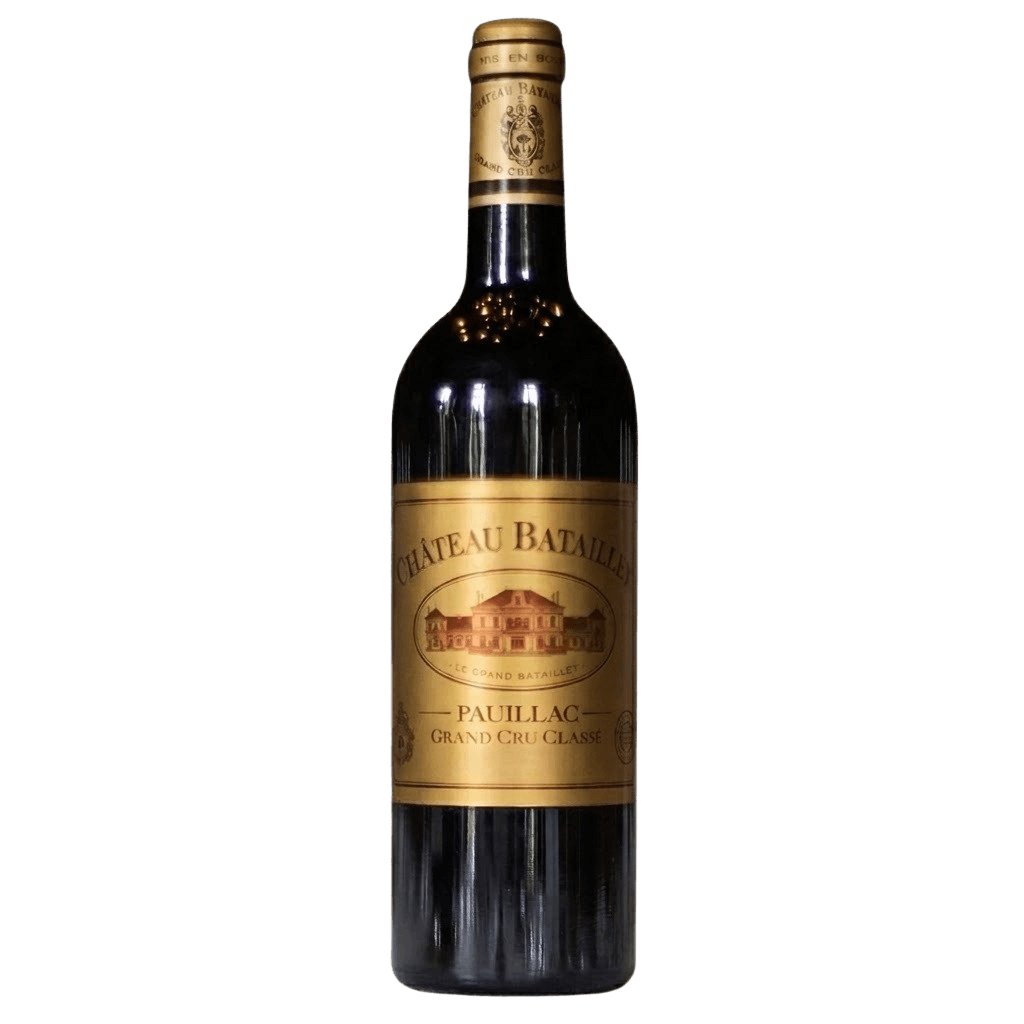
Château Batailley
Château Batailley
2007
Château Batailley represents distinguished Fifth Growth Pauillac, crafted by a historic estate known for producing Cabernet Sauvignon-led wines that balance traditional Left Bank structure with approachability and excellent ageing potential.
Country
France
Region
Bordeaux - Pauillac
More information
Producer
Château Batailley is a Fifth Growth (Cinquième Cru Classé) estate in the Pauillac appellation, classified in the 1855 Bordeaux hierarchy. Owned by the Castéja family since 1942, the property comprises 57 hectares of deep gravel vineyards that consistently produce Cabernet Sauvignon-based wines of notable structure and cellaring potential. Batailley has maintained a reputation for delivering classic Left Bank character with reliability and balance across vintages.
Quick Facts
- Location: Pauillac, Médoc, Bordeaux, France
- Classification: Cinquième Cru Classé – Fifth Growth, 1855
- Ownership: Castéja family, since 1942
- Estate origin: Established in the 18th century
- Vineyard area: 57 hectares
- Principal grapes: Cabernet Sauvignon (approximately 70%), Merlot, Cabernet Franc, Petit Verdot
- Soils: Deep Quaternary gravel over gravel-sand substrates
- Grand Vin: Château Batailley
- Style: Structured, approachable Pauillac with balanced fruit and refined tannins
- Typical ageing potential: 15 to 25 years
An Estate Born from Division
The name Batailley is believed to reference a battle fought on the site during the Hundred Years' War. The estate itself was formed in the 18th century and gained prominence during the 19th century as one of the Médoc's respected properties. In 1855, it was classified as a Fifth Growth.
In 1942, the Castéja family acquired Batailley and has maintained ownership through successive generations. The family's involvement in Bordeaux extends across multiple estates, providing depth of experience and continuity in managing the property's vineyards and winemaking approach.
Gravel Soils and Cabernet Dominance
Batailley's vineyards lie on the plateau south of Pauillac, where deep gravel soils provide excellent drainage and encourage the development of concentrated, well-structured fruit. These soils, characteristic of the appellation's finest sites, are particularly well suited to Cabernet Sauvignon, which forms around 70% of the estate's plantings.
Merlot provides roundness and balance, while smaller proportions of Cabernet Franc and Petit Verdot add aromatic complexity and structural detail. The vineyard's maturity and consistent management allow Batailley to produce wines that reflect Pauillac's classic identity: blackcurrant, cedar, graphite and tobacco, supported by firm but refined tannins.
Tradition, Balance and Longevity
Winemaking at Batailley follows traditional methods, with fermentation in temperature-controlled tanks and maturation in French oak barrels. The approach prioritises balance over extraction, resulting in wines that combine structure with accessibility and reveal greater complexity with bottle age.
Château Batailley consistently demonstrates the ability to age gracefully. Across two decades or more, its wines develop layers of dried fruit, leather, tobacco and earthy complexity while retaining freshness and definition. The estate represents a reliable and approachable expression of classified Pauillac, offering collectors entry to the appellation's structured, age-worthy style without sacrificing typicity or finesse.
Country
Region
Bordeaux - Pauillac
Pauillac is one of the most respected appellations in Bordeaux and the only commune in the Médoc to contain three of the five First Growth estates from the historic 1855 Classification. Located on the Left Bank of the Gironde estuary in the Haut-Médoc, Pauillac combines centuries of winemaking heritage with exceptional terroir, producing powerful, structured wines that rank among the most collectible Bordeaux bottles. The appellation represents the pinnacle of Cabernet Sauvignon expression in the Médoc.
The appellation benefits from deep gravel beds mixed with sand and clay, providing excellent drainage and ideal conditions for Cabernet Sauvignon, which typically dominates blends alongside Merlot, Cabernet Franc and Petit Verdot. The moderating influence of the Gironde estuary protects vines from frost while extending the growing season, allowing grapes to achieve optimal ripeness. These geological and climatic factors contribute to wines of remarkable concentration, balance and longevity.
Pauillac is home to Château Lafite Rothschild, Château Latour and Château Mouton Rothschild, three of the world's most celebrated wine estates. Beyond the First Growths, the appellation includes distinguished producers such as Château Pichon-Longueville, Château Pichon Longueville Comtesse de Lalande and Château Lynch-Bages. Pauillac wines are renowned for their firm tannins, cassis and blackcurrant character, cedar notes and exceptional ageing potential, often reaching their peak after decades in the cellar.
Discover Pauillac wines, compare prices from trusted merchants across Europe and find the best offers with Sipfind.
Grapes
Cabernet Sauvignon is one of the world’s most important and widely planted red wine grapes, renowned for its powerful structure, concentrated fruit and exceptional ageing potential. Originating in Bordeaux, France, the variety has become a defining grape of fine wine regions around the world, particularly Napa Valley, Tuscany, Chile, Australia and South Africa.
Classic Cabernet Sauvignon combines flavours and aromas of blackcurrant, cassis, blackberry and dark cherry with characteristic notes of cedar, graphite, tobacco and herbs. Naturally high tannins and fresh acidity provide structure and longevity, while maturation in oak can add layers of spice, vanilla and toast. Its character varies significantly with climate, soil and winemaking, ranging from elegant and savoury to rich, powerful and intensely concentrated.
In Bordeaux, Cabernet Sauvignon is particularly associated with the Left Bank, where it forms the foundation of many prestigious blends alongside Merlot, Cabernet Franc and other permitted varieties. In Napa Valley, it has become the region’s signature red grape, producing some of the world’s most sought-after Cabernet Sauvignon wines.
Cabernet Sauvignon’s ability to express terroir while retaining its distinctive structure and character has made it a global benchmark for premium red wine. Whether produced as the dominant variety in a blend or as a varietal wine, the finest examples combine concentration, complexity and the capacity to develop gracefully over decades
Merlot is one of the world’s most important red wine grapes, celebrated for its generous fruit, supple texture and ability to produce wines ranging from approachable and elegant to exceptionally complex and long-lived. Originating in Bordeaux, France, Merlot is particularly associated with the Right Bank, where it forms the foundation of many of the prestigious wines of Pomerol and Saint-Émilion.
Merlot typically expresses flavours and aromas of plum, black cherry, blackberry and red fruits, often developing notes of chocolate, tobacco, cedar, herbs and earthy complexity with maturation. Its naturally rounded texture and generally softer tannin profile distinguish it from Cabernet Sauvignon, although the finest examples can possess considerable structure, freshness and ageing potential.
In Pomerol, Merlot reaches some of its most celebrated expressions, particularly on the appellation’s clay-rich soils, producing wines of remarkable concentration, texture and complexity. In Saint-Émilion, it is commonly blended with Cabernet Franc and, to a lesser extent, Cabernet Sauvignon, creating wines that combine ripe fruit with structure, aromatic complexity and longevity.
Beyond Bordeaux, Merlot is widely cultivated in Italy, California, Washington State, Chile and other major wine regions. It can be produced as a varietal wine or used as a central component of blends, where its fruit and texture complement more structured grape varieties.
From the great Merlot-based wines of Bordeaux’s Right Bank to leading expressions around the world, Merlot’s combination of rich fruit, refined texture and capacity to express terroir has established it as one of the defining varieties of fine red wine.
Cabernet Franc is one of France’s most historic red wine grapes, valued for its aromatic intensity, vibrant acidity and ability to express both climate and soil with remarkable clarity. It produces elegant single-varietal wines and plays an essential role in some of Bordeaux’s most distinguished blends. Earlier ripening than Cabernet Sauvignon allows Cabernet Franc to perform particularly well in cooler wine regions.
In the Loire Valley, Cabernet Franc reaches its clearest expression as a varietal wine. Typical aromas include redcurrant, raspberry, red cherry and violet, often accompanied by graphite, dried herbs, tobacco and subtle peppery notes. Naturally fresh acidity and finely structured tannins can produce approachable, fruit-driven wines as well as complex examples capable of developing for many years.
The variety is especially important in Chinon, Bourgueil and Saumur-Champigny. Chinon can range from fragrant and supple to deeply structured and age-worthy, depending on vineyard site and soil. Bourgueil often combines dark red fruit with firm structure, while Saumur-Champigny is renowned for freshness, aromatic purity and refined texture. Limestone-rich tuffeau, gravel, sand and clay all contribute to the diversity of Cabernet Franc across these Loire appellations.
In Bordeaux, Cabernet Franc is principally associated with the Right Bank, particularly Saint-Émilion and Pomerol. Usually blended with Merlot and sometimes Cabernet Sauvignon, it contributes perfume, freshness, savoury complexity and structural precision. On suitable limestone and clay terroirs, Cabernet Franc can become a dominant component of exceptionally refined and long-lived wines.
Beyond France, Cabernet Franc is cultivated in regions including Tuscany, Bolgheri, Napa Valley, Washington State, Canada, Argentina and Chile, producing styles shaped by local climate and terroir. Traditionally known as Breton in the Loire and Bouchet in parts of Bordeaux, Cabernet Franc’s combination of aromatic elegance, freshness and ageing potential establishes it as one of the world’s great red wine varieties.
Petit Verdot is a powerful red wine grape from south-west France, best known as a small but distinctive component of the classic red blends of Bordeaux. Its deeply coloured wines, firm tannins and concentrated aromatics allow even modest proportions to add structure, freshness and intensity alongside Cabernet Sauvignon, Merlot and Cabernet Franc.
On Bordeaux’s Left Bank, Petit Verdot is particularly associated with the gravel soils of the Médoc, including appellations such as Margaux, Saint-Julien, Pauillac and Saint-Estèphe. The variety buds relatively early but ripens late, making complete maturation challenging in cooler vintages. When fully ripe, it can retain vibrant acidity while developing considerable colour, tannin and aromatic complexity.
Typical expressions show blackberry, black cherry, blueberry and plum, accompanied by violet, liquorice, pepper, cocoa and other dark spices. In Bordeaux blends, Petit Verdot is generally used in limited quantities to reinforce colour, tannic structure and aromatic depth. Its combination of acidity and tannin can also contribute significantly to a wine’s ageing potential.
Beyond Bordeaux, warmer and more reliable growing conditions have allowed Petit Verdot to achieve greater ripeness and a more prominent role. Producers in California, Australia, Spain and South America increasingly use the variety in both Bordeaux-style blends and varietal wines. These expressions are often full-bodied and deeply coloured, with ripe dark fruit, floral character, spice and powerful tannins.
From its historic role in the Médoc to its expanding presence as a varietal wine, Petit Verdot is defined by colour, structure, freshness and aromatic intensity. Once regarded primarily as a supporting grape, it is increasingly recognised as a distinctive variety capable of producing serious, age-worthy wines in its own right.
History and Style
Château Batailley is the flagship Grand Vin of Château Batailley, a respected Fifth Growth (Cinquième Grand Cru Classé) estate in Bordeaux's prestigious Pauillac appellation. Classified in the renowned 1855 Classification, this wine embodies the classic Left Bank style with Cabernet Sauvignon-dominant blends that showcase the gravelly terroir of Pauillac while offering compelling value within the classified growth hierarchy.
Quick Facts
- Producer: Château Batailley
- Classification: Cinquième Grand Cru Classé (Fifth Growth, 1855)
- Region: Bordeaux
- Appellation: Pauillac
- Country: France
- Style: Full-bodied Left Bank Bordeaux
- Grape Composition: Cabernet Sauvignon-dominant blend (typically 70-75% Cabernet Sauvignon, with Merlot, Cabernet Franc, and Petit Verdot)
- Ageing Potential: 15-25 years from vintage
- Alcohol (ABV): 13-14%
- Tasting Profile: Blackcurrant, cedar, graphite, tobacco, dark fruit, firm tannins
- Food Pairing: Roasted lamb, grilled beef, venison, game birds, aged hard cheeses
- Serving Temperature: 16-18°C
- Bottle Status: Flagship
- Vintage: Varies by vintage
Vineyard, Terroir and Style
The estate's vineyards benefit from Pauillac's optimal gravelly soil composition and proximity to the Gironde estuary, which provides crucial temperature moderation. This terroir allows Cabernet Sauvignon to achieve full phenolic ripeness while retaining the structure and elegance that define great Pauillac wines. The property has been meticulously managed to preserve traditional winemaking practices while incorporating modern precision viticulture, ensuring consistent quality across vintages.
History and Reputation
Château Batailley typically presents a deep ruby colour with aromatic layers of blackcurrant, cedar, graphite, and subtle tobacco notes. On the palate, the wine demonstrates firm yet refined tannins, balanced acidity, and the characteristic power and depth expected from Pauillac, with a long, structured finish. The wines are aged in French oak barrels, developing complexity while maintaining varietal purity.
This flagship offering appeals to collectors and enthusiasts seeking authentic classified growth Pauillac with proven ageing potential. Compare prices across premium wine retailers on Sipfind to find the best value for this distinguished Fifth Growth.