
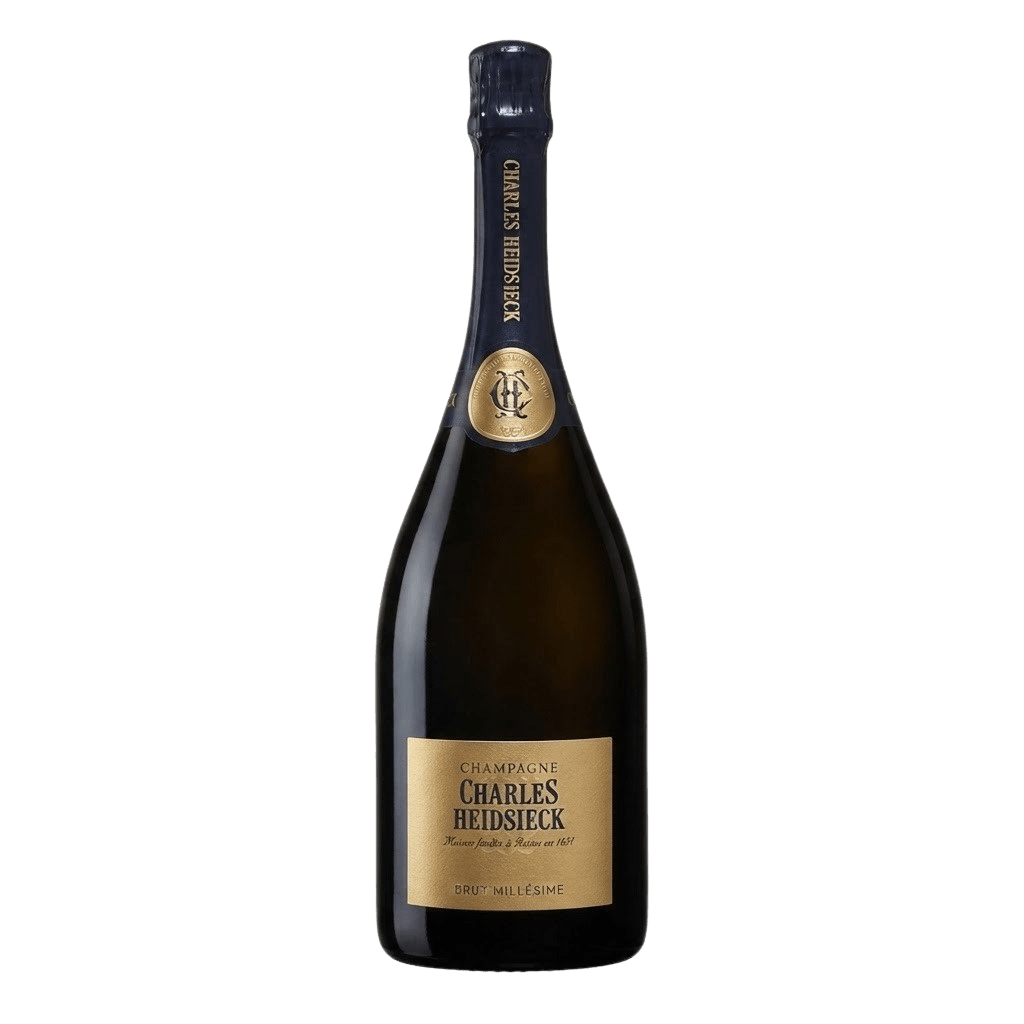
Champagne Charles Heidsieck
Charles Heidsieck Brut Millésimé
2012
Charles Heidsieck Brut Millésimé is a vintage Champagne made from Pinot Noir and Chardonnay grown in selected Champagne vineyards. Produced only in chosen years, it reflects the character of a single harvest and develops additional complexity through extended maturation in the historic chalk cellars beneath Reims.
Country
France
Region
Champagne
More information
Producer
Charles Heidsieck – The Art of Time in Champagne
Founded in Reims in 1851, Charles Heidsieck is one of Champagne's historic houses, distinguished by its adventurous founder, exceptional reserve wines and a philosophy that places time at the centre of winemaking.
While many Champagne houses are recognised for their vineyard heritage or celebrated prestige cuvées, Charles Heidsieck has developed a particularly distinctive identity through the art of blending and prolonged maturation.
Its Champagnes are characterised by a combination of freshness, depth and a generous, often creamy texture. These qualities are closely connected to the house's extensive collection of reserve wines and the remarkable chalk cellars beneath Reims, where bottles mature in carefully controlled conditions.
The story begins with Charles-Camille Heidsieck, an ambitious entrepreneur who established his own Champagne house at just 29 years old.
His determination to build an international reputation took him far beyond France, earning him the nickname Champagne Charlie and establishing a legacy that continues to shape the house today.
More than 175 years after its foundation, Charles Heidsieck remains closely associated with the pursuit of complexity, elegance and the transformative influence of time.
Producer at a Glance
AttributeDetails
Producer
Charles Heidsieck
Founded
1851
Founder
Charles-Camille Heidsieck
Location
Reims, Champagne
Country
France
Appellation
Champagne AOC
Principal Grapes
Chardonnay, Pinot Noir, Meunier
Historic Cellars
Gallo-Roman chalk crayères
Cellars Acquired
1867
Cellar Depth
Approximately 30 metres
Cellar Galleries
More than 8 kilometres
UNESCO Recognition
2015
Cellar Master
Émilien Érard
Ownership
EPI Group
Signature Champagne
Brut Réserve
Defining Characteristics
Reserve wines, extended maturation, texture and complexity
Charles-Camille Heidsieck – The Man Behind Champagne Charlie
Charles-Camille Heidsieck was born in 1822 into a family already deeply connected with the Champagne trade.
Rather than simply continuing the established family business, he chose to create an independent house bearing his own name.
In 1851, at the age of 29, he founded Charles Heidsieck in Reims.
His ambitions extended well beyond the vineyards and cellars of Champagne.
Recognising the potential of international markets, he travelled to the United States in 1852, becoming an early pioneer in the development of Champagne's American market.
His personality was as memorable as his commercial ambition.
Charismatic, adventurous and socially accomplished, Charles attracted considerable attention during his travels.
Americans affectionately called him Champagne Charlie, a nickname that became inseparable from his reputation.
His adventures helped establish Charles Heidsieck as a Champagne house with an international outlook from its earliest years.
Yet the founder's greatest legacy was not simply his success abroad.
He understood that exceptional Champagne required patience, careful blending and an uncompromising approach to quality.
These principles became fundamental to the house's identity.
The Crayères – Champagne's Underground Cathedrals
One of Charles Heidsieck's most extraordinary assets lies beneath the city of Reims.
In 1867, Charles-Camille Heidsieck acquired a network of ancient chalk cellars known as crayères.
Originally excavated during the Gallo-Roman period, these immense underground chambers offered unusually favourable conditions for the maturation of Champagne.
The cellars extend more than eight kilometres beneath Reims, reaching depths of approximately 30 metres.
Their chalk walls help maintain a naturally stable environment, protected from sunlight, significant temperature fluctuations and external disturbances.
For Champagne, where prolonged bottle ageing can be fundamental to the development of aroma and texture, these conditions are particularly valuable.
The house's bottles mature slowly in these underground galleries, allowing the wines to develop additional complexity over time.
The crayères are also an important part of the region's cultural heritage.
In 2015, the historic Champagne cellars and associated landscapes received UNESCO World Heritage recognition.
For Charles Heidsieck, the cellars represent far more than a practical storage facility.
They embody the house's belief that time is an essential ingredient in exceptional Champagne.
The Charles Heidsieck Style – Generosity, Precision and Texture
Charles Heidsieck has developed a recognisable house style built around depth, balance and texture.
The producer places particular emphasis on the relationship between the freshness of younger wines and the complexity of mature reserve wines.
Chardonnay contributes elegance and freshness, Pinot Noir provides structure, and Meunier brings additional fruit character and generosity.
However, grape selection alone does not explain the house's distinctive style.
Its blending philosophy is equally important.
By combining wines from different vineyards, grape varieties and harvest years, the cellar master creates Champagnes intended to express a consistent house identity while retaining complexity.
The resulting style is often associated with a rich, rounded palate and a fine, persistent mousse.
Charles Heidsieck places particular importance on the texture of its Champagnes, seeking a balance between freshness and a smooth, generous mouthfeel.
This approach distinguishes the house from producers whose non-vintage Champagnes are designed primarily around youthful fruit expression.
For Charles Heidsieck, maturity and complexity are integral to the experience.
Reserve Wines – The Foundation of Complexity
Reserve wines are among the most important elements of Charles Heidsieck's winemaking philosophy.
In Champagne, reserve wines are wines retained from previous harvests for use in future blends.
They allow producers to introduce additional maturity, complexity and continuity into non-vintage Champagnes.
Charles Heidsieck is particularly notable for the proportion and age of reserve wines used in its signature Brut Réserve.
According to the house, reserve wines account for 50% of the Brut Réserve blend, with an average age of approximately ten years.
This is a defining characteristic of the cuvée.
Rather than relying predominantly on the most recent harvest, the house incorporates a substantial proportion of mature wines selected for their aromatic potential.
The result is a Champagne designed to combine freshness with developed flavours and a distinctive depth of texture.
The producer maintains an extensive collection of reserve wines, providing its winemaking team with a broad palette of components for blending.
This collection is one of the foundations of the Charles Heidsieck identity.
Time as the Fourth Grape Variety
Charles Heidsieck expresses its philosophy through a particularly memorable idea: time is the fourth grape variety.
The three principal Champagne grapes — Chardonnay, Pinot Noir and Meunier — provide the structural and aromatic foundation of the wines.
Time contributes another dimension.
During extended maturation, Champagne develops through the interaction of fruit, acidity, lees and the gradual evolution of aromatic compounds.
Prolonged ageing on the lees can contribute to greater complexity and a more integrated texture.
For Charles Heidsieck, this process is not simply a regulatory requirement.
It is a deliberate stylistic choice.
The house's historic chalk cellars provide an environment in which bottles can mature slowly over several years.
Some exceptional releases remain in the cellars for considerably longer.
This commitment to maturation helps explain why Charles Heidsieck places such importance on texture, aromatic depth and the relationship between youthful freshness and developed complexity.
Brut Réserve – The Signature of the House
Brut Réserve is the Champagne most closely associated with the Charles Heidsieck style.
The house identifies a blend of 40% Pinot Noir, 40% Chardonnay and 20% Meunier, with reserve wines representing half of the final composition.
The wines are selected from a broad range of Champagne vineyards, with particular importance given to crus such as Oger, Ambonnay and Verneuil.
Oger contributes Chardonnay from the Côte des Blancs, Ambonnay provides Pinot Noir from the Montagne de Reims, and Verneuil contributes Meunier from the Vallée de la Marne.
Together, these components help establish the balance between elegance, structure and generosity that defines the cuvée.
The house describes an aromatic profile encompassing brioche, roasted notes, ripe fruit and dried nuts, alongside a rich, creamy palate.
These characteristics reflect the combination of mature reserve wines, careful blending and extended cellar ageing.
Brut Réserve therefore provides an important introduction to Charles Heidsieck's winemaking philosophy.
Blanc de Blancs – The Elegance of Chardonnay
Chardonnay has played an important role in the history of Charles Heidsieck.
The house produced a Blanc de Blancs Champagne in the 1949 vintage, demonstrating an early interest in the potential of Chardonnay as the sole grape variety.
The modern non-vintage Blanc de Blancs was relaunched in 2018.
Produced entirely from Chardonnay, it combines the grape's characteristic freshness with the generous texture associated with Charles Heidsieck.
The house selects wines from several Chardonnay crus and incorporates reserve wines to develop additional complexity.
The producer identifies a reserve-wine proportion of approximately 25%, with the reserve components averaging five years of age.
Extended cellar maturation further contributes to the wine's texture.
Blanc de Blancs demonstrates how Charles Heidsieck applies its philosophy of blending and ageing to a Champagne made from a single grape variety.
Rosé Réserve – A Different Expression of the House Style
Rosé Réserve offers another interpretation of the Charles Heidsieck identity.
The house combines Chardonnay, Pinot Noir and Meunier with a carefully selected proportion of red wine.
Its published blend consists of 40% Pinot Noir, 35% Chardonnay and 25% Meunier.
The inclusion of red wine contributes colour, fruit character and structure.
The producer describes a profile featuring red berries, peach and delicate spice, supported by a generous mouthfeel.
As with Brut Réserve, the blending of wines from different harvests plays an important role.
However, Charles Heidsieck deliberately selects younger reserve wines for Rosé Réserve than for its signature Brut.
This approach helps preserve the fruit expression and freshness that are particularly important to the rosé style.
Blanc des Millénaires – The Prestige of Mature Chardonnay
Blanc des Millénaires occupies a particularly important position within the Charles Heidsieck collection.
This prestige cuvée is a vintage Blanc de Blancs Champagne produced from Chardonnay.
It represents the house's commitment to exceptional Chardonnay, precise blending and prolonged maturation.
Unlike the non-vintage Blanc de Blancs, Blanc des Millénaires expresses the characteristics of an individual harvest.
Its identity is closely associated with the ageing potential of Chardonnay and the transformative influence of extended cellar maturation.
For enthusiasts interested in mature Champagne, Blanc des Millénaires provides an important perspective on the house's philosophy.
The wine demonstrates how freshness, texture and complexity can develop together over time.
The Crayères Collection – Preserving Champagne History
The Crayères Collection celebrates some of the rarest and most mature wines preserved in the Charles Heidsieck cellars.
These releases offer an opportunity to explore the development of Champagne across different decades.
The collection draws on bottles that have remained in the house's historic chalk cellars for extended periods.
Each release reflects the characteristics of its original vintage and the influence of long maturation.
Rather than representing a single permanent cuvée, the collection brings together selected historic wines.
It highlights the exceptional ageing potential of Champagne and the importance of the house's cellar heritage.
For collectors, these releases provide a direct connection to the history of Charles Heidsieck.
The Cellar Master – Preserving the Charles Style
The cellar master plays a central role in maintaining the identity of Charles Heidsieck.
The position requires an understanding of individual vineyard wines, reserve-wine development and the relationship between different components of a blend.
Émilien Érard is the house's current cellar master.
He succeeded Élise Losfelt, who had been appointed in March 2023 and subsequently returned to her family estate, Château de l'Engarran, in Languedoc.
Érard comes from a Champagne winegrowing family and has extensive experience in oenology and Champagne production.
His responsibility is to preserve the established character of Charles Heidsieck while guiding its wines through future harvests.
The continuity of the house style depends not on reproducing an identical formula every year, but on selecting and blending wines that express its defining characteristics.
Charles Heidsieck Today
Charles Heidsieck has been part of the EPI Group, owned by the Descours family, since 2011.
The house continues to operate from Reims, maintaining its historic connection to the Champagne region and its remarkable underground cellars.
Its portfolio encompasses non-vintage Champagnes, vintage releases, prestige cuvées and carefully selected historic bottlings.
Across these different wines, the central philosophy remains consistent.
Reserve wines provide depth, blending creates balance, and time allows complexity to develop.
The result is a Champagne house with a distinctive identity built around generosity, precision and maturity.
Discover Charles Heidsieck on Sipfind
Explore the Champagnes of Charles Heidsieck, from the richly textured Brut Réserve and elegant Blanc de Blancs to the prestigious Blanc des Millénaires and rare historic releases.
Discover the story of Champagne Charlie, the house's remarkable chalk cellars and the philosophy that has shaped its wines since 1851.
Browse individual cuvées, explore available vintages and compare offers from independent European wine retailers through Sipfind.
Country
Region
Champagne
Champagne is widely regarded as the world's most prestigious sparkling wine region and has become synonymous with celebration, luxury and uncompromising quality. Located in northeastern France, approximately 150 kilometres east of Paris, the region combines centuries of winemaking tradition with exceptional terroir to produce sparkling wines of remarkable elegance and complexity. From legendary maisons to small grower-producers, Champagne represents the benchmark against which all other sparkling wines are measured, and its influence on global wine culture remains unrivalled.
The region's vineyards stretch across five principal districts: Montagne de Reims, Vallée de la Marne, Côte des Blancs, Côte de Sézanne and Côte des Bar. The defining characteristic of Champagne terroir is its chalk-limestone subsoil, which provides excellent drainage, mineral richness and steady water supply essential for producing grapes of exceptional quality. The cool continental climate, moderated by maritime influences, ensures slow ripening and high natural acidity, while the principal grape varieties—Chardonnay, Pinot Noir and Pinot Meunier—each contribute distinct character to the final blend. The region's 17 grand cru villages and 42 premier cru villages represent the finest expression of Champagne terroir, producing grapes of outstanding concentration and finesse.
Champagne is governed by strict AOC regulations established in 1927, which define geographical boundaries, permitted grape varieties, yields and production methods. The region is home to some of the world's most celebrated houses, including Krug, Louis Roederer, Bollinger, Dom Pérignon, Veuve Clicquot, Pol Roger, Salon, Taittinger and Moët & Chandon. These maisons have upheld the art of blending and cellar ageing for generations, producing prestige cuvées and vintage expressions that rank among the most collectible wines in the world. Alongside these historic houses, a growing number of grower-producers cultivate and vinify their own grapes, offering terroir-focused expressions that reveal the diversity and depth of Champagne's varied terroirs.
Whether exploring grand cru villages, prestige cuvées or historic maisons, Champagne offers an unparalleled journey through the birthplace of the world's finest sparkling wines. Discover Champagne Champagnes, compare prices from trusted merchants across Europe and find the best offers with Sipfind.
Grapes
Chardonnay is one of the world’s most important and prestigious white wine grapes, renowned for its remarkable versatility and ability to reflect both terroir and winemaking style. Most famously associated with Burgundy and Champagne in France, Chardonnay is cultivated across virtually every major wine-producing country and can produce everything from precise, mineral-driven whites to rich, complex wines with exceptional ageing potential.
In Burgundy, Chardonnay reaches some of its most celebrated expressions. The limestone-rich vineyards of Chablis are known for wines combining vibrant acidity, citrus character and mineral precision, while the Côte de Beaune, particularly appellations such as Meursault, Puligny-Montrachet and Chassagne-Montrachet, produces some of the world’s most sought-after and age-worthy white wines.
Chardonnay also plays a fundamental role in Champagne, where it contributes freshness, finesse and acidity to blends alongside Pinot Noir and Meunier. When produced exclusively from Chardonnay, the resulting Champagne is known as Blanc de Blancs, a style prized for its elegance, precision and capacity to develop considerable complexity with extended ageing.
The grape’s character varies significantly according to climate, terroir and winemaking. Cooler regions can produce wines showing citrus, green apple, white flowers and mineral notes, while warmer conditions can bring peach, melon and tropical-fruit character. Oak fermentation, barrel ageing and malolactic fermentation can introduce additional layers of toast, vanilla, butter and hazelnut, demonstrating Chardonnay’s exceptional stylistic range.
Beyond France, Chardonnay has established important expressions in California, Australia, New Zealand, South Africa and numerous other wine regions. From the mineral whites of Chablis and the great vineyards of Burgundy to Blanc de Blancs Champagne and modern New World interpretations, Chardonnay’s combination of versatility, complexity and terroir expression has established it as one of the defining grape varieties of fine wine.
History and Style
Charles Heidsieck Brut Millésimé – The Character of a Single Harvest
Charles Heidsieck Brut Millésimé is a vintage Champagne produced from Pinot Noir and Chardonnay harvested in a single year.
Unlike the house's non-vintage Champagnes, which combine wines from different harvests to maintain a consistent style, Brut Millésimé expresses the characteristics of one growing season.
The cuvée is produced only in selected years and undergoes extended maturation in the historic chalk cellars beneath Reims.
Its identity reflects the relationship between vintage conditions, vineyard selection, blending and time.
Pinot Noir provides structure and depth, while Chardonnay contributes freshness and precision.
Together, the two grape varieties form a Champagne designed to express both the individuality of the harvest and the established style of Charles Heidsieck.
Wine at a Glance
AttributeDetails
Producer
Charles Heidsieck
Wine
Brut Millésimé
Country
France
Region
Champagne
Appellation
Champagne AOC
Classification
Vintage Brut
Wine Type
White Sparkling Wine
Grape Varieties
Pinot Noir and Chardonnay
Vintage Type
Vintage
Vineyard Selection
Selected Champagne crus
Production
Selected vintages
Maturation
Extended lees ageing
Dosage
Vintage-specific
Bottle Format
750 ml
The Philosophy of Vintage Champagne
Vintage Champagne is produced from grapes harvested in a single year.
This distinguishes it from non-vintage Champagne, where wines from several harvests can be combined to achieve continuity of style.
For Charles Heidsieck, the decision to produce a vintage Champagne reflects the characteristics of the growing season and the quality of the available base wines.
Each harvest presents a different combination of weather conditions, grape maturity and acidity.
These factors influence the structure and aromatic profile of the finished wine.
Brut Millésimé therefore provides an opportunity to explore the characteristics of individual Champagne vintages.
While the house's blending philosophy remains important, the final Champagne is shaped by the conditions of one harvest rather than by the combination of several years.
Pinot Noir and Chardonnay – Two Complementary Varieties
Charles Heidsieck Brut Millésimé is produced from Pinot Noir and Chardonnay.
The precise proportions depend on the vintage.
Pinot Noir
Pinot Noir contributes structure, body and depth.
In Champagne, the variety is particularly associated with the Montagne de Reims and other established Pinot Noir-growing areas.
Its contribution can include red-fruit characteristics, concentration and a broad palate.
Chardonnay
Chardonnay contributes freshness, acidity and aromatic precision.
The variety is particularly associated with the Côte des Blancs, although it is grown across several Champagne subregions.
Its role in Brut Millésimé is to balance the structure of Pinot Noir and contribute to the wine's ageing potential.
The relationship between these two grape varieties is central to the cuvée.
However, the precise balance should be described separately for each vintage.
Vineyard Origins – Selected Champagne Crus
Charles Heidsieck sources wines for Brut Millésimé from selected vineyards within Champagne.
The exact geographical composition varies according to the harvest and the house's blending decisions.
Different crus can contribute complementary characteristics.
Pinot Noir from the Montagne de Reims may provide structure and depth, while Chardonnay from the Côte des Blancs can contribute freshness and precision.
The producer's selection of vineyard origins is therefore an important part of each vintage's identity.
For Sipfind, specific villages and cru classifications should be documented on the corresponding vintage pages.
They should not be presented as permanent characteristics unless the producer confirms that they apply to every release.
A Champagne Shaped by the Harvest
The growing season plays a defining role in vintage Champagne.
Temperature, rainfall and sunlight influence grape development throughout the year.
These conditions affect ripeness, acidity and the concentration of the harvested fruit.
Because Brut Millésimé is made from one harvest, the characteristics of that season remain central to the finished wine.
A warmer year may produce a different balance of fruit richness and acidity from a cooler growing season.
The winemaking team must assess these characteristics when selecting the base wines and determining the final blend.
The resulting Champagne represents an interpretation of that particular year.
This is why vintage-specific information is essential when comparing different releases.
Vinification – From Harvest to Bottle
The production of Charles Heidsieck Brut Millésimé begins with the vinification of wines from the selected harvest.
Pinot Noir and Chardonnay components can be assessed according to their vineyard origins and individual characteristics.
The cellar master then selects the wines intended for the vintage blend.
After blending, the Champagne undergoes its second fermentation in bottle.
This traditional process creates the wine's characteristic effervescence.
The bottles subsequently remain in the cellar for maturation.
During ageing on the lees, the Champagne gradually develops additional aromatic complexity and changes in texture.
The precise vinification details and maturation period should be documented separately for each vintage.
Time – A Defining Element of Charles Heidsieck
Charles Heidsieck is particularly associated with extended maturation.
The house describes time as an essential element of its winemaking philosophy.
For Brut Millésimé, prolonged ageing allows the characteristics of the harvest to develop gradually.
Contact with the lees contributes to the evolution of texture and aroma.
The wine may develop characteristics associated with brioche, toasted nuts and pastry alongside its original fruit profile.
The balance between youthful freshness and mature complexity depends on the vintage and the period of maturation.
This relationship between harvest conditions and time is central to the identity of Brut Millésimé.
The Historic Chalk Cellars of Reims
Charles Heidsieck's historic chalk cellars form an important part of the house's production heritage.
These underground galleries, known as crayères, provide naturally stable conditions for Champagne maturation.
Their limestone walls and depth help maintain an environment suitable for long-term bottle ageing.
For Brut Millésimé, the cellars provide the setting in which the wine develops after its second fermentation.
The extended maturation period contributes to the texture and aromatic complexity associated with the house.
Tasting Profile – Vintage Character and Mature Complexity
The tasting profile of Charles Heidsieck Brut Millésimé varies between vintages.
Pinot Noir and Chardonnay provide the structural foundation, but the expression of these varieties depends on the growing season and subsequent maturation.
Appearance
Vintage Brut Champagne generally displays a golden colour and fine effervescence.
The precise colour and intensity vary according to age and release.
Aroma
Depending on the vintage, the aromatic profile may include citrus fruit, orchard fruit and red-fruit characteristics.
Extended maturation can introduce notes associated with brioche, pastry, toasted nuts and dried fruit.
Palate
The palate reflects the balance between Pinot Noir structure and Chardonnay freshness.
Acidity, texture and aromatic development vary according to the vintage.
For an accurate description of a specific bottle, the producer's tasting notes for that year should be consulted.
Food Pairing – Structure and Freshness
The combination of Pinot Noir and Chardonnay makes vintage Brut Champagne suitable for a range of food pairings.
Seafood, poultry and mushroom-based dishes can complement different aspects of the wine.
The acidity of Chardonnay may provide balance alongside richer preparations.
Pinot Noir's structure can support more substantial dishes.
Mature vintages may also accompany foods that reflect the Champagne's developed savoury and toasted characteristics.
The most suitable pairings depend on the style and maturity of the individual vintage.
Brut Millésimé and Brut Réserve – Understanding the Difference
Charles Heidsieck Brut Réserve is a non-vintage Champagne.
Its blend incorporates wines from several harvests, including a substantial proportion of mature reserve wines.
The objective is to maintain a recognisable house style across successive releases.
Brut Millésimé follows a different approach.
It is produced from wines belonging to a single harvest.
The vintage is therefore fundamental to the wine's identity.
The two Champagnes express different aspects of the Charles Heidsieck philosophy.
Brut Réserve emphasises the art of blending across years.
Brut Millésimé explores the characteristics of a particular harvest through vineyard selection and extended maturation.
Brut Millésimé and Blanc des Millénaires
Brut Millésimé and Blanc des Millénaires are both vintage Champagnes.
However, their grape compositions and intended expressions differ.
Brut Millésimé combines Pinot Noir and Chardonnay.
Blanc des Millénaires is produced exclusively from Chardonnay sourced from selected Côte des Blancs crus.
Blanc des Millénaires also occupies a distinct position as the house's prestige Blanc de Blancs cuvée.
For Sipfind, these wines must be treated as separate products, even when they share the same vintage.
Understanding Different Vintages
Each Charles Heidsieck Brut Millésimé release represents a specific harvest.
The grape proportions, vineyard selection, maturation period and dosage may differ between vintages.
Tasting characteristics can also vary.
For this reason, the permanent Brut Millésimé page provides an overview of the cuvée, while individual vintage pages contain the technical and sensory details of each release.
This structure allows users to distinguish between different vintages and compare retailer offers accurately.
Discover Charles Heidsieck Brut Millésimé on Sipfind
Explore Charles Heidsieck Brut Millésimé and its individual vintages on Sipfind.
Learn about the house's approach to vintage Champagne, its use of Pinot Noir and Chardonnay, and the influence of extended maturation in the chalk cellars of Reims.
Compare available offers from independent European wine retailers, with vintage and bottle format clearly identified.