
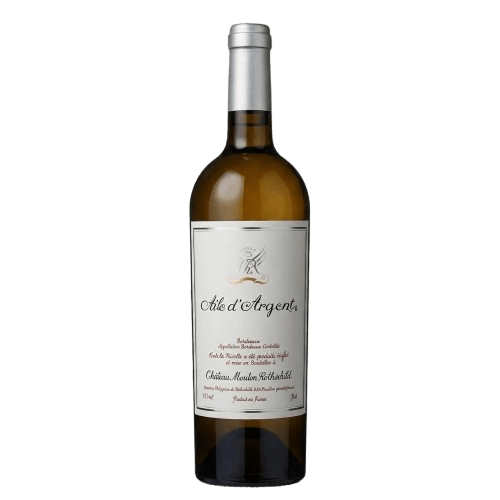
Château Mouton Rothschild
Aile d'Argent Blanc du Chateau Mouton Rothschild
2011
Aile d'Argent Blanc is the distinguished white wine of Château Mouton Rothschild, crafted from estate-grown Sauvignon Blanc, Sémillon and Muscadelle. A rare and elegant expression from one of Bordeaux's most iconic First Growth estates.
Country
France
Region
Bordeaux - Pauillac
More information
Producer
Château Mouton Rothschild is the only property ever promoted within the 1855 Classification of Bordeaux, elevated to Premier Grand Cru Classé—First Growth—status in 1973. Acquired by Baron Nathaniel de Rothschild in 1853 and profoundly shaped by his great-grandson Baron Philippe de Rothschild throughout the 20th century, the estate remains under family ownership and management. Its Cabernet Sauvignon-led wines combine power, aromatic depth and structural precision with an unmatched capacity for long-term cellaring, consistently ranking among the most collectible and sought-after bottles in the world.
Quick Facts
- Location: Pauillac, Médoc, Bordeaux, France
- Acquired: 1853, by Baron Nathaniel de Rothschild
- Classification: Premier Grand Cru Classé—First Growth, promoted 1973
- Ownership: Baron Philippe de Rothschild SA, Rothschild family
- Principal grapes: Cabernet Sauvignon, Merlot, Cabernet Franc, Petit Verdot
- Estate vineyard: Approximately 90 hectares under vine
- Soils: Deep Günzian gravel over limestone and clay subsoils
- Grand Vin: Château Mouton Rothschild
- Second wine: Le Petit Mouton de Mouton Rothschild
- White wine: Aile d'Argent (Sauvignon Blanc, Sémillon, Muscadelle)
- Style: Concentrated, aromatic, structured and built for extended ageing
- Cultural hallmark: Artist-designed labels commissioned annually since 1945
The Only Promoted First Growth
When the Bordeaux wine trade established the 1855 Classification, Château Mouton Rothschild was ranked as a Second Growth. For more than a century, the estate's wines commanded prices and critical recognition comparable to the four original First Growths, yet its official status remained unchanged.
Baron Philippe de Rothschild devoted decades to pursuing reclassification. His efforts culminated on 21 June 1973, when the French Minister of Agriculture signed the decree elevating Mouton to Premier Grand Cru Classé. The estate adopted the motto "Premier ne puis, second ne daigne, Mouton suis"—First I cannot be, second I do not deign to be, Mouton I am—to mark its unique achievement. Following promotion, the phrase was amended to "Premier je suis, second je fus, Mouton ne change"—First I am, second I was, Mouton does not change.
The Plateau of Pauillac
The château's vineyards occupy a gently elevated plateau overlooking the Gironde estuary, positioned among the finest terroirs of the Pauillac appellation. Deep beds of Günzian gravel—large, rounded pebbles deposited during the Quaternary period—provide exceptional drainage and heat retention, creating ideal conditions for Cabernet Sauvignon to ripen fully and develop its characteristic aromatic intensity.
Cabernet Sauvignon typically represents around 80 to 85 per cent of the Grand Vin's blend, supported by Merlot, Cabernet Franc and small proportions of Petit Verdot. The estate's commitment to rigorous parcel selection means that only the finest fruit enters the Grand Vin; declassified lots contribute to Le Petit Mouton or are sold as generic Pauillac.
The result is a wine distinguished by concentrated cassis and blackcurrant fruit, cedar and graphite complexity, and firm yet refined tannins that evolve gracefully over 30 to 50 years or more.
Art, Labels and Cultural Legacy
Since 1945, Château Mouton Rothschild has commissioned a different artist each year to create an original work for its label. Pablo Picasso, Joan Miró, Marc Chagall, Andy Warhol, Francis Bacon, Jeff Koons and Gerhard Richter are among those who have contributed designs, transforming each vintage into a cultural artefact as well as a collectible wine.
This tradition was initiated by Baron Philippe de Rothschild to celebrate the Liberation of France and has continued without interruption. Only the 1953 vintage—the centenary of the Rothschild acquisition—deviates, featuring the original portrait of Baron Nathaniel rather than a contemporary commission.
The estate also houses the Musée du Vin dans l'Art, a private museum displaying centuries of wine-related art and artefacts assembled by the Rothschild family. Together with the label collection, it reinforces Mouton's identity as a meeting point of wine, art and cultural heritage.
Precision Across the Portfolio
Beyond the Grand Vin, the estate produces Le Petit Mouton de Mouton Rothschild, introduced with the 1993 vintage as a more approachable expression of the property's Pauillac character. It is made from younger vines and parcels judged not quite ready for inclusion in the Grand Vin, offering earlier accessibility while retaining the estate's signature aromatic richness.
Aile d'Argent, launched in 1991, is a white Bordeaux produced from Sauvignon Blanc, Sémillon and Muscadelle planted on selected parcels within the estate. Aged partly in oak, it reflects Mouton's attention to detail and commitment to excellence across all styles.
Across every wine, Château Mouton Rothschild remains a benchmark for Pauillac and one of the defining names of the Left Bank, consistently demonstrating the longevity, complexity and profound ageing potential that define Bordeaux at its finest.
Country
Region
Bordeaux - Pauillac
Pauillac is one of the most respected appellations in Bordeaux and the only commune in the Médoc to contain three of the five First Growth estates from the historic 1855 Classification. Located on the Left Bank of the Gironde estuary in the Haut-Médoc, Pauillac combines centuries of winemaking heritage with exceptional terroir, producing powerful, structured wines that rank among the most collectible Bordeaux bottles. The appellation represents the pinnacle of Cabernet Sauvignon expression in the Médoc.
The appellation benefits from deep gravel beds mixed with sand and clay, providing excellent drainage and ideal conditions for Cabernet Sauvignon, which typically dominates blends alongside Merlot, Cabernet Franc and Petit Verdot. The moderating influence of the Gironde estuary protects vines from frost while extending the growing season, allowing grapes to achieve optimal ripeness. These geological and climatic factors contribute to wines of remarkable concentration, balance and longevity.
Pauillac is home to Château Lafite Rothschild, Château Latour and Château Mouton Rothschild, three of the world's most celebrated wine estates. Beyond the First Growths, the appellation includes distinguished producers such as Château Pichon-Longueville, Château Pichon Longueville Comtesse de Lalande and Château Lynch-Bages. Pauillac wines are renowned for their firm tannins, cassis and blackcurrant character, cedar notes and exceptional ageing potential, often reaching their peak after decades in the cellar.
Discover Pauillac wines, compare prices from trusted merchants across Europe and find the best offers with Sipfind.
Grapes
Sauvignon Blanc is one of the world’s most widely recognised white wine grapes, celebrated for its vibrant acidity, expressive aromatics and remarkable ability to reflect climate and terroir. Originating in France, the variety is historically associated with the Loire Valley and Bordeaux, while today it produces distinctive wines across many of the world’s leading wine regions.
In the Loire Valley, Sauvignon Blanc reaches some of its most celebrated expressions in Sancerre and Pouilly-Fumé. These wines are typically dry, precise and refreshing, showing flavours and aromas of citrus, green apple, gooseberry and white flowers, often accompanied by herbal and mineral notes. Differences in soil, vineyard location and winemaking can produce styles ranging from delicate and elegant to concentrated and age-worthy.
In Bordeaux, Sauvignon Blanc traditionally plays a different role. It is frequently blended with Sémillon, and sometimes Muscadelle, to produce both dry white Bordeaux and the renowned sweet wines of Sauternes and Barsac. Sauvignon Blanc contributes acidity, freshness and aromatic lift, complementing the richness and texture of Sémillon.
Beyond France, Sauvignon Blanc has become particularly important in New Zealand, where Marlborough established an internationally recognised style characterised by intense citrus, passion fruit, gooseberry and herbaceous aromas. Important expressions are also produced in California, Chile, South Africa, Australia and Italy, demonstrating the variety’s ability to develop distinctive personalities across different climates and soils.
Whether expressed as a mineral-driven Loire wine, a structured Bordeaux blend or an intensely aromatic New World Sauvignon Blanc, the grape’s combination of freshness, aromatic clarity and terroir expression has established it as one of the defining varieties of modern white wine.
Sémillon is a white wine grape originating in Bordeaux, where it is central to both dry white blends and botrytised sweet wines. Its generous texture, affinity with noble rot and ability to develop considerable complexity through bottle ageing have established Sémillon as one of the most versatile white varieties in fine wine, with benchmark expressions found in Bordeaux and Australia’s Hunter Valley.
Quick Grape Facts
- Grape Type: White wine grape
- Origin: Bordeaux, France
- Key Regions: Sauternes, Barsac, Graves, Pessac-Léognan and Hunter Valley
- Primary Styles: Dry white wines, botrytised sweet wines and white blends
- Common Blending Partners: Sauvignon Blanc and Muscadelle
- Typical Aromas: Lemon, green apple, pear, beeswax, honey, apricot, toast and nuts
- Structure: Generally medium to full-bodied, with acidity and concentration varying according to climate, harvest timing and wine style
- Botrytis Susceptibility: High, supported by the grape’s relatively thin skins
- Ageing Potential: High in leading Sauternes, Barsac and Hunter Valley expressions
- Canonical Name: Sémillon
- Alias: Semillon
- Historical Labels: Hunter River Riesling, Shepherd’s Riesling, Hock, White Burgundy and Chablis
Regional Expressions and Wine Styles
In Sauternes and Barsac, Sémillon’s thin skins make it particularly receptive to Botrytis cinerea, or noble rot. Botrytis concentrates the grapes’ sugars, acidity and flavours, producing richly textured sweet wines with notes of honey, beeswax, apricot, candied citrus and saffron. Sauvignon Blanc commonly contributes freshness and aromatic lift, while Muscadelle may add floral complexity. In the dry white wines of Graves and Pessac-Léognan, Sémillon brings body, depth and ageing potential to blends with Sauvignon Blanc, developing waxy, toasted and nutty complexity as the wines mature.
In Australia’s Hunter Valley, Sémillon is typically harvested early at relatively low sugar levels and fermented in stainless steel with little or no oak influence. Young wines can appear light-bodied, restrained and citrus-driven, yet the finest examples evolve over decades to show lemon curd, toast, lanolin, honey and nuts. Sémillon is also produced as a varietal wine in the Barossa Valley and blended with Sauvignon Blanc in Margaret River. Historical Australian labels such as Hunter River Riesling do not indicate a relationship with Riesling and should be treated as former naming conventions rather than separate grapes or modern synonyms.
Explore Sémillon Wines on Sipfind
Explore Sémillon wines, regions and current offers from selected wine retailers on Sipfind.
Muscadelle is an aromatic white wine grape originating in south-west France and traditionally associated with the white wines of Bordeaux. Usually included in small proportions, it contributes floral, musky and lightly spiced aromas to blends with Sémillon and Sauvignon Blanc. Despite its name and muscat-like character, Muscadelle is a distinct grape variety and is not a member of the Muscat family.
Quick Grape Facts
- Grape Type: Aromatic white wine grape
- Origin: South-west France
- Key Regions: Bordeaux, Sauternes, Barsac, Entre-Deux-Mers and Loupiac
- Primary Styles: Dry white blends and botrytised sweet wines
- Common Blending Partners: Sémillon, Sauvignon Blanc and Sauvignon Gris
- Typical Aromas: Acacia, honeysuckle, orange blossom, honey, musk and gentle spice
- Structure: Soft and aromatic, generally contributing roundness rather than pronounced acidity
- Typical Blend Contribution: Usually a minority component and rarely more than approximately 10%
- Botrytis Susceptibility: High, making the variety particularly suited to sweet-wine production under favourable conditions
- Canonical Name: Muscadelle
- Local and Historical Names: Issal de Tarayre, Marmésie, Bouillenc, Musquette, Raisinote, Cadillac and Muscat Fou
Regional Expressions and Wine Styles
In Sauternes, Barsac and other sweet-wine appellations of Bordeaux, Muscadelle supports the more structurally important Sémillon and Sauvignon varieties. Its susceptibility to Botrytis cinerea, or noble rot, allows it to contribute concentrated floral, honeyed and musky notes to liquoreux wines. Muscadelle’s role is generally aromatic rather than structural: Sémillon provides richness and depth, Sauvignon Blanc supplies freshness, and Muscadelle adds a distinctive layer of perfume and complexity.
In dry Bordeaux whites, particularly those from Entre-Deux-Mers and the wider Bordeaux appellation, Muscadelle is used to enhance freshness of aroma and broaden the blend’s sensory range. It can contribute white flowers, subtle musk and gentle spice alongside the citrus, herbal character and acidity of Sauvignon Blanc and the texture of Sémillon. Because Muscadelle is fragile in the vineyard and normally represents only a small part of the final blend, varietal wines are uncommon. Its importance lies instead in its ability to give both dry and sweet Bordeaux whites greater aromatic definition.
Explore Muscadelle Wines on Sipfind
Explore Muscadelle wines, regions and current offers from selected wine retailers on Sipfind.
History and Style
Aile d'Argent Blanc du Château Mouton Rothschild represents a remarkable chapter in the story of one of Bordeaux's five First Growth estates. While Château Mouton Rothschild built its legendary reputation on powerful Cabernet Sauvignon-based reds from Pauillac, this white wine showcases the estate's commitment to excellence across styles and demonstrates the versatility of its exceptional terroir.
Quick Facts
- Producer: Château Mouton Rothschild
- Classification: White wine from Premier Grand Cru Classé estate
- Region: Bordeaux
- Appellation: Bordeaux Blanc (white grapes from Pauillac estate)
- Country: France
- Style: Elegant dry white Bordeaux Blanc
- Grape Composition: Sauvignon Blanc, Sémillon, Muscadelle (proportions vary by vintage)
- Ageing Potential: 5-15 years from vintage
- Alcohol (ABV): 13-14%
- Tasting Profile: Citrus, grapefruit, white flowers, stone fruit, mineral notes, subtle oak
- Food Pairing: Seafood, shellfish, white fish, poultry, goat cheese
- Serving Temperature: 10-12°C
- Bottle Status: Estate Wine
- Vintage: Varies by vintage
Vineyard, Terroir and Style
The estate in Pauillac has cultivated white grape varieties on select parcels for decades, with Aile d'Argent serving as the white counterpart to the famous Grand Vin. The name, meaning "Silver Wing," echoes the estate's artistic heritage and the Rothschild family's dedication to producing wines of distinction. These white varietals thrive in carefully chosen plots within the estate's holdings, benefiting from the same meticulous viticulture and winemaking expertise that defines Mouton Rothschild's red wine production.
History and Reputation
The wine typically presents a refined Bordeaux Blanc profile, blending Sauvignon Blanc's vibrant citrus and herbaceous character with Sémillon's textural richness and Muscadelle's aromatic lift. Expect notes of grapefruit, white flowers, stone fruit and subtle mineral undertones, with the precision and balance characteristic of top-tier white Bordeaux. Oak maturation adds complexity without overwhelming the fruit expression, creating a wine of elegance and ageing potential.
For collectors and enthusiasts seeking to explore the full range of a First Growth estate's capabilities, Aile d'Argent offers a fascinating and rare opportunity. Compare prices across premium retailers on Sipfind to discover this distinguished white wine from Château Mouton Rothschild.