
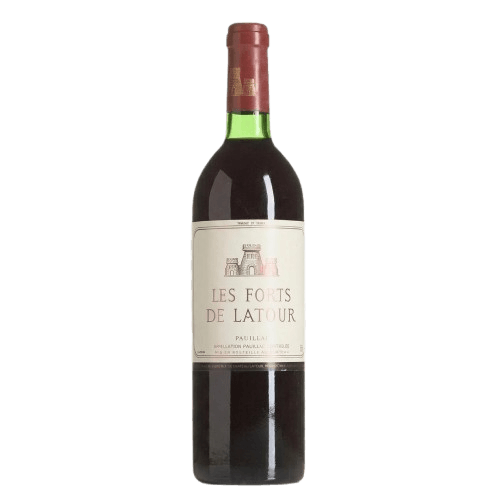
Château Latour
Les Forts de Latour
2024
Les Forts de Latour represents the second wine of the legendary Château Latour, delivering Pauillac's signature power and refinement in a more approachable format while maintaining the estate's uncompromising standards.
Country
France
Region
Bordeaux - Pauillac
More information
Producer
Château Latour is one of only five Premier Grand Cru Classé estates recognised in the historic 1855 Classification of Bordeaux, widely regarded as the pinnacle of Left Bank winemaking. Located in Pauillac and owned by François Pinault's Groupe Artémis since 1993, the estate has been documented since the 14th century and formally established in its modern form during the 17th century. Its Grand Vin is defined by extraordinary power, architectural structure and an unmatched capacity to evolve gracefully over 30 to 50 years or more.
Quick Facts
- Location: Pauillac, Médoc, Bordeaux, France
- Founded: Documented since the 1300s; modern estate established in the 17th century
- Classification: Premier Grand Cru Classé – First Growth, 1855
- Ownership: François Pinault (Groupe Artémis), since 1993
- Principal grapes: Cabernet Sauvignon, Merlot, Cabernet Franc, Petit Verdot
- Estate size: 78 hectares under vine
- Core vineyard: L'Enclos, a walled 47-hectare parcel
- Soils: Deep Günzian gravel over clay and limestone
- Grand Vin: Grand Vin de Château Latour
- Second wine: Les Forts de Latour
- Third wine: Pauillac de Latour
- Style: Concentrated, structured and built for exceptional longevity
A Premier Cru with Centuries of Provenance
Château Latour's history extends back to the Middle Ages, with records of viticulture on the site appearing as early as the 1300s. The iconic stone tower that gives the estate its name dates from the 15th century and served as a fortified position overlooking the Gironde estuary. By the 17th century, the property had evolved into a formally organised wine estate under aristocratic ownership.
Recognition of Latour's exceptional quality was formalised in 1855, when it was named a First Growth alongside Lafite Rothschild, Margaux, Haut-Brion and, later, Mouton Rothschild. The estate changed hands several times during the 20th century before being acquired by François Pinault in 1993, ushering in an era of significant investment, restored vineyard health and rigorous estate management.
L'Enclos: The Heart of Latour
The estate's reputation is inseparable from L'Enclos, a walled 47-hectare vineyard immediately surrounding the château. This historic parcel benefits from deep Günzian gravel deposits—among the finest in Pauillac—laid down during the Quaternary period and resting on substrata of clay and limestone. The proximity to the Gironde provides a moderating maritime influence, encouraging even ripening and contributing minerality and freshness to the wines.
L'Enclos is planted predominantly to Cabernet Sauvignon, with smaller proportions of Merlot, Cabernet Franc and Petit Verdot. Vines average over 40 years of age, with some parcels considerably older, and are meticulously managed to yield concentrated, phenolically ripe fruit. The Grand Vin is composed almost exclusively from L'Enclos, with only the most exceptional plots selected in each vintage.
Beyond the enclosure, the estate cultivates additional parcels on gravel plateaux and slopes that contribute to Les Forts de Latour and Pauillac de Latour, both reflecting the same exacting standards and terroir expression that define the estate's identity.
Power, Precision and Time
Château Latour's winemaking philosophy centres on patience and rigour. Extended maceration periods extract depth, colour and structure from the fruit, while maturation in French oak barrels—typically 100% new for the Grand Vin—adds complexity without overwhelming the wine's inherent character. The resulting Grand Vin is famously dense and powerful in youth, built on a framework of concentrated black fruit, graphite-like minerality and formidable but finely grained tannins.
What distinguishes Latour is not merely power but precision. The wines possess remarkable clarity and balance, with an underlying freshness that allows them to age for decades. Over time, the Grand Vin evolves from tightly coiled intensity into layered complexity, revealing secondary notes of cedar, tobacco, truffle and undergrowth while retaining extraordinary vitality and length.
Les Forts de Latour, historically regarded as one of Bordeaux's finest second wines, offers a more approachable expression of the estate's style, while Pauillac de Latour provides a gateway into the estate's identity. Across the portfolio, Château Latour remains a benchmark for structured, age-worthy Bordeaux and a reference point for collectors and connoisseurs worldwide.
Country
Region
Bordeaux - Pauillac
Pauillac is one of the most respected appellations in Bordeaux and the only commune in the Médoc to contain three of the five First Growth estates from the historic 1855 Classification. Located on the Left Bank of the Gironde estuary in the Haut-Médoc, Pauillac combines centuries of winemaking heritage with exceptional terroir, producing powerful, structured wines that rank among the most collectible Bordeaux bottles. The appellation represents the pinnacle of Cabernet Sauvignon expression in the Médoc.
The appellation benefits from deep gravel beds mixed with sand and clay, providing excellent drainage and ideal conditions for Cabernet Sauvignon, which typically dominates blends alongside Merlot, Cabernet Franc and Petit Verdot. The moderating influence of the Gironde estuary protects vines from frost while extending the growing season, allowing grapes to achieve optimal ripeness. These geological and climatic factors contribute to wines of remarkable concentration, balance and longevity.
Pauillac is home to Château Lafite Rothschild, Château Latour and Château Mouton Rothschild, three of the world's most celebrated wine estates. Beyond the First Growths, the appellation includes distinguished producers such as Château Pichon-Longueville, Château Pichon Longueville Comtesse de Lalande and Château Lynch-Bages. Pauillac wines are renowned for their firm tannins, cassis and blackcurrant character, cedar notes and exceptional ageing potential, often reaching their peak after decades in the cellar.
Discover Pauillac wines, compare prices from trusted merchants across Europe and find the best offers with Sipfind.
Grapes
Cabernet Sauvignon is one of the world’s most important and widely planted red wine grapes, renowned for its powerful structure, concentrated fruit and exceptional ageing potential. Originating in Bordeaux, France, the variety has become a defining grape of fine wine regions around the world, particularly Napa Valley, Tuscany, Chile, Australia and South Africa.
Classic Cabernet Sauvignon combines flavours and aromas of blackcurrant, cassis, blackberry and dark cherry with characteristic notes of cedar, graphite, tobacco and herbs. Naturally high tannins and fresh acidity provide structure and longevity, while maturation in oak can add layers of spice, vanilla and toast. Its character varies significantly with climate, soil and winemaking, ranging from elegant and savoury to rich, powerful and intensely concentrated.
In Bordeaux, Cabernet Sauvignon is particularly associated with the Left Bank, where it forms the foundation of many prestigious blends alongside Merlot, Cabernet Franc and other permitted varieties. In Napa Valley, it has become the region’s signature red grape, producing some of the world’s most sought-after Cabernet Sauvignon wines.
Cabernet Sauvignon’s ability to express terroir while retaining its distinctive structure and character has made it a global benchmark for premium red wine. Whether produced as the dominant variety in a blend or as a varietal wine, the finest examples combine concentration, complexity and the capacity to develop gracefully over decades
Merlot is one of the world’s most important red wine grapes, celebrated for its generous fruit, supple texture and ability to produce wines ranging from approachable and elegant to exceptionally complex and long-lived. Originating in Bordeaux, France, Merlot is particularly associated with the Right Bank, where it forms the foundation of many of the prestigious wines of Pomerol and Saint-Émilion.
Merlot typically expresses flavours and aromas of plum, black cherry, blackberry and red fruits, often developing notes of chocolate, tobacco, cedar, herbs and earthy complexity with maturation. Its naturally rounded texture and generally softer tannin profile distinguish it from Cabernet Sauvignon, although the finest examples can possess considerable structure, freshness and ageing potential.
In Pomerol, Merlot reaches some of its most celebrated expressions, particularly on the appellation’s clay-rich soils, producing wines of remarkable concentration, texture and complexity. In Saint-Émilion, it is commonly blended with Cabernet Franc and, to a lesser extent, Cabernet Sauvignon, creating wines that combine ripe fruit with structure, aromatic complexity and longevity.
Beyond Bordeaux, Merlot is widely cultivated in Italy, California, Washington State, Chile and other major wine regions. It can be produced as a varietal wine or used as a central component of blends, where its fruit and texture complement more structured grape varieties.
From the great Merlot-based wines of Bordeaux’s Right Bank to leading expressions around the world, Merlot’s combination of rich fruit, refined texture and capacity to express terroir has established it as one of the defining varieties of fine red wine.
Petit Verdot is a powerful red wine grape from south-west France, best known as a small but distinctive component of the classic red blends of Bordeaux. Its deeply coloured wines, firm tannins and concentrated aromatics allow even modest proportions to add structure, freshness and intensity alongside Cabernet Sauvignon, Merlot and Cabernet Franc.
On Bordeaux’s Left Bank, Petit Verdot is particularly associated with the gravel soils of the Médoc, including appellations such as Margaux, Saint-Julien, Pauillac and Saint-Estèphe. The variety buds relatively early but ripens late, making complete maturation challenging in cooler vintages. When fully ripe, it can retain vibrant acidity while developing considerable colour, tannin and aromatic complexity.
Typical expressions show blackberry, black cherry, blueberry and plum, accompanied by violet, liquorice, pepper, cocoa and other dark spices. In Bordeaux blends, Petit Verdot is generally used in limited quantities to reinforce colour, tannic structure and aromatic depth. Its combination of acidity and tannin can also contribute significantly to a wine’s ageing potential.
Beyond Bordeaux, warmer and more reliable growing conditions have allowed Petit Verdot to achieve greater ripeness and a more prominent role. Producers in California, Australia, Spain and South America increasingly use the variety in both Bordeaux-style blends and varietal wines. These expressions are often full-bodied and deeply coloured, with ripe dark fruit, floral character, spice and powerful tannins.
From its historic role in the Médoc to its expanding presence as a varietal wine, Petit Verdot is defined by colour, structure, freshness and aromatic intensity. Once regarded primarily as a supporting grape, it is increasingly recognised as a distinctive variety capable of producing serious, age-worthy wines in its own right.
History and Style
Les Forts de Latour stands as the distinguished second wine of Château Latour, one of Bordeaux's most iconic Premier Grand Cru Classé estates in Pauillac. Created from parcels and younger vines not ultimately selected for the Grand Vin, this second wine nonetheless carries the unmistakable hallmark of its renowned parentage, offering collectors and enthusiasts access to Latour's excellence in a format that reaches maturity earlier than the flagship bottling.
Quick Facts
- Producer: Château Latour
- Classification: Second wine of Premier Grand Cru Classé (1855)
- Region: Bordeaux
- Appellation: Pauillac
- Country: France
- Style: Full-bodied Left Bank Bordeaux, second wine
- Grape Composition: Cabernet Sauvignon-dominant blend with Merlot (typically 60-75% Cabernet Sauvignon, proportions vary by vintage)
- Ageing Potential: 15-25 years from vintage
- Alcohol (ABV): 13-14%
- Tasting Profile: Blackcurrant, cedar, graphite, dark plum, tobacco, refined tannins
- Food Pairing: Roast lamb, grilled beef, duck confit, aged hard cheeses
- Serving Temperature: 16-18°C
- Bottle Status: Second Wine
- Vintage: Varies by vintage (multi-vintage product)
Vineyard, Terroir and Style
The vineyards contributing to Les Forts de Latour benefit from the same gravelly terroir that has made Pauillac legendary, with deep gravel beds over limestone and clay providing ideal drainage and minerality. The estate's proximity to the Gironde estuary moderates temperatures and extends the growing season, allowing for optimal phenolic ripeness. Winemaking follows the same rigorous protocols as the Grand Vin, with fermentation in temperature-controlled stainless steel and ageing in French oak barriques, though with a slightly lower proportion of new wood.
History and Reputation
The wine typically displays a dense ruby-purple colour and offers generous aromatics of blackcurrant, cedar, graphite and dark plum. On the palate, it combines Pauillac's signature structure and concentration with refined tannins and impressive length. While approachable in its youth compared to the Grand Vin, Les Forts de Latour possesses considerable ageing potential.
For those seeking an introduction to Château Latour's style or a more accessible expression of Pauillac excellence, Les Forts de Latour represents exceptional value within the First Growth hierarchy, delivering serious pedigree and aging capability at a more approachable price point.