
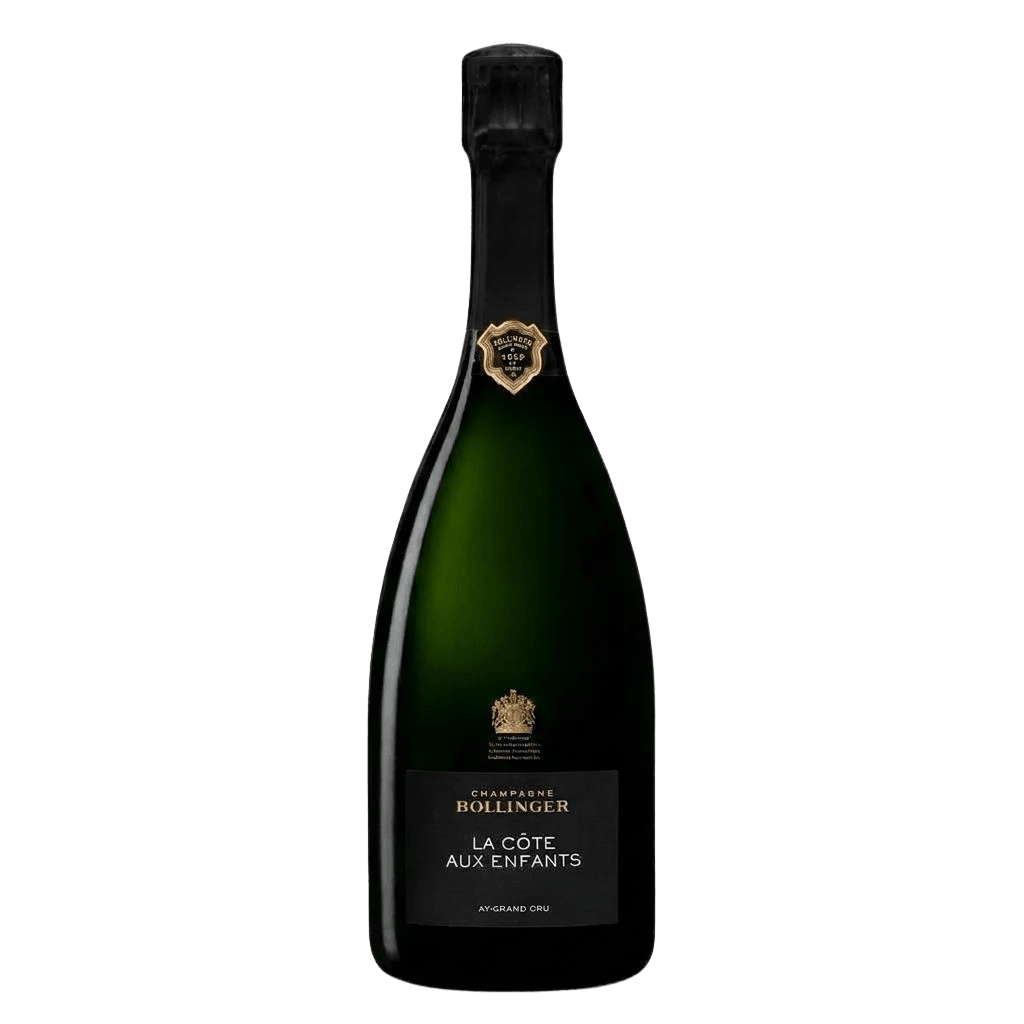
Champagne Bollinger
Bollinger La Côte aux Enfants
2015
A distinctive single-vineyard Blanc de Noirs Champagne expressing the character of Pinot Noir from Bollinger's historic La Côte aux Enfants vineyard in Aÿ Grand Cru.
Country
France
Region
Champagne
More information
Producer
Founded in 1829, Champagne Bollinger is one of the world's most celebrated Grande Marque houses and among the last significant family-owned producers in Champagne. Based in Aÿ in the heart of the Montagne de Reims and still controlled by the family, the house has remained dedicated to traditional methods for nearly two centuries. Its Champagnes are distinguished by structure, concentration and profound aromatic complexity—wines built to age gracefully for decades.
Quick Facts
- Location: Aÿ, Montagne de Reims, Champagne, France
- Founded: 1829
- Founder: Jacques Bollinger
- Ownership: Family-owned since foundation
- House identity: Pinot Noir-led Champagne with barrel fermentation
- Signature cuvée: Special Cuvée
- Prestige cuvées: La Grande Année, R.D. (Récemment Dégorgé), Vieilles Vignes Françaises
- Estate vineyards: Approximately 178 hectares, predominantly Grand Cru and Premier Cru
- Winemaking hallmark: Barrel fermentation in small oak casks
- Key styles: Brut, Vintage, Rosé, Late-release (R.D.), Blanc de Noirs from ungrafted vines
- Dosage approach: Restrained across the range
- Ageing potential: 20 to 30+ years for prestige cuvées
A Family House in Aÿ
Jacques Bollinger, a German-born merchant, and Athanase de Villermont founded the house in 1829 under the name Renaudin-Bollinger & Cie. Within a generation, the Bollinger family assumed full ownership and control of the estate. The house passed through successive family members, including the formidable Madame Élisabeth "Lily" Bollinger, who guided the house through the mid-20th century and became one of Champagne's most influential figures.
Today, the house remains independent and family-controlled, a rare position among Champagne's historic grandes marques. Its headquarters and cellars continue to occupy the original site in Aÿ, a village renowned for its Grand Cru Pinot Noir.
The Pinot Noir Foundation
Pinot Noir forms the structural backbone of every Bollinger cuvée, typically accounting for 60% or more of the blend. The house owns approximately 178 hectares of vineyards, the majority classified as Grand Cru or Premier Cru, concentrated around Aÿ, Bouzy, Verzenay and Louvois—some of Champagne's finest sites for Pinot Noir.
This emphasis on estate fruit and Pinot Noir dominance gives Bollinger its characteristic density, vinous power and ability to develop complexity with extended cellaring. Chardonnay and Pinot Meunier contribute freshness and balance, but it is Pinot Noir that defines the house style.
Barrel Fermentation and Extended Ageing
Bollinger is one of the few Champagne houses to maintain extensive barrel fermentation. A significant portion of the base wines, particularly from the estate's finest parcels, ferments in small oak casks, adding richness, texture and aromatic depth uncommon in modern Champagne production.
Extended lees ageing further distinguishes the house. Special Cuvée, the signature non-vintage cuvée, rests for a minimum of three years on the lees—well beyond the legal requirement. La Grande Année, the vintage prestige cuvée, matures for five to six years before release. R.D., or Récemment Dégorgé, takes this philosophy to its conclusion: fully mature wines disgorged only when deemed ready, often after more than a decade on the lees.
The legendary Vieilles Vignes Françaises comes entirely from ungrafted, pre-phylloxera Pinot Noir vines in the Aÿ lieu-dit of Chaudes Terres and Clos Saint-Jacques. Produced in tiny quantities and released only in exceptional vintages, it represents one of Champagne's rarest and most collectible expressions.
Structured Champagne Built for Time
Across the portfolio, Bollinger Champagnes combine vinous weight with elegance, displaying notes of toasted brioche, hazelnut, stone fruit and spice. The house's restrained dosage approach preserves clarity and allows the structure and complexity developed through barrel fermentation and long ageing to remain at the forefront.
The result is a collection of Champagnes that reward patience. Whether the multi-vintage complexity of Special Cuvée or the profound depth of R.D., Bollinger remains a benchmark for traditional craftsmanship and wines built to evolve over many years.
Country
Region
Champagne
Champagne is widely regarded as the world's most prestigious sparkling wine region and has become synonymous with celebration, luxury and uncompromising quality. Located in northeastern France, approximately 150 kilometres east of Paris, the region combines centuries of winemaking tradition with exceptional terroir to produce sparkling wines of remarkable elegance and complexity. From legendary maisons to small grower-producers, Champagne represents the benchmark against which all other sparkling wines are measured, and its influence on global wine culture remains unrivalled.
The region's vineyards stretch across five principal districts: Montagne de Reims, Vallée de la Marne, Côte des Blancs, Côte de Sézanne and Côte des Bar. The defining characteristic of Champagne terroir is its chalk-limestone subsoil, which provides excellent drainage, mineral richness and steady water supply essential for producing grapes of exceptional quality. The cool continental climate, moderated by maritime influences, ensures slow ripening and high natural acidity, while the principal grape varieties—Chardonnay, Pinot Noir and Pinot Meunier—each contribute distinct character to the final blend. The region's 17 grand cru villages and 42 premier cru villages represent the finest expression of Champagne terroir, producing grapes of outstanding concentration and finesse.
Champagne is governed by strict AOC regulations established in 1927, which define geographical boundaries, permitted grape varieties, yields and production methods. The region is home to some of the world's most celebrated houses, including Krug, Louis Roederer, Bollinger, Dom Pérignon, Veuve Clicquot, Pol Roger, Salon, Taittinger and Moët & Chandon. These maisons have upheld the art of blending and cellar ageing for generations, producing prestige cuvées and vintage expressions that rank among the most collectible wines in the world. Alongside these historic houses, a growing number of grower-producers cultivate and vinify their own grapes, offering terroir-focused expressions that reveal the diversity and depth of Champagne's varied terroirs.
Whether exploring grand cru villages, prestige cuvées or historic maisons, Champagne offers an unparalleled journey through the birthplace of the world's finest sparkling wines. Discover Champagne Champagnes, compare prices from trusted merchants across Europe and find the best offers with Sipfind.
Grapes
History and Style
Bollinger La Côte aux Enfants – The Singular Expression of Aÿ Grand Cru
Bollinger La Côte aux Enfants Champagne is a single-vineyard vintage Blanc de Noirs produced exclusively from Pinot Noir grown on the north-west-facing slope of the historic La Côte aux Enfants vineyard in Aÿ, Champagne.
The cuvée represents a particularly focused expression of Bollinger's expertise in Pinot Noir, bringing together geographical precision, vineyard heritage and extended cellar maturation.
Unlike the house's traditional Champagnes, which draw their identity from the combination of different vineyards and grape varieties, La Côte aux Enfants explores the character of one specific vineyard and one individual harvest.
The vineyard itself occupies a limestone hillside on the outskirts of Aÿ and has played an important role in Bollinger's history since Jacques Bollinger began acquiring its individual parcels in 1926.
Long associated with the production of still red wine, La Côte aux Enfants has gained a second identity through this vintage Champagne, revealing another dimension of its distinctive terroir.
Quick Wine Facts
- Producer: Champagne Bollinger
- Wine: Bollinger La Côte aux Enfants Champagne
- Country: France
- Region: Champagne
- Subregion: Grande Vallée de la Marne
- Village: Aÿ
- Appellation: Champagne AOC
- Vineyard Classification: Grand Cru
- Vineyard: La Côte aux Enfants
- Vineyard Ownership: Bollinger monopole
- Historic Vineyard Area: Approximately 4 hectares
- Champagne Vineyard Area: Approximately 2 hectares, as documented for recent releases
- Vineyard Orientation: North-west-facing slope
- Soil: Limestone-rich hillside
- Wine Style: Vintage Blanc de Noirs Champagne
- Grape Variety: 100% Pinot Noir
- Harvest: Manual
- Production Method: Traditional bottle fermentation
- Cellar Maturation: Extended maturation under natural cork
- Dosage: Vintage-dependent
- Ageing Potential: Long-term, depending on vintage and storage conditions
- Bottle Size: 750 ml
The History of La Côte aux Enfants
La Côte aux Enfants occupies a distinctive position within the history of Champagne Bollinger.
Today, the vineyard is associated with a single producer. However, its ownership was once divided among more than fifty individuals.
This fragmentation was not unusual in Champagne, where generations of inheritance and changes in land ownership created a complex mosaic of small vineyard holdings.
For Jacques Bollinger, the hillside represented an opportunity to bring an exceptional vineyard together under unified ownership.
Between 1926 and 1934, he gradually acquired its individual sections, establishing a contiguous vineyard of approximately four hectares.
The acquisition required patience, a long-term perspective and confidence in the potential of the site.
Rather than purchasing an already established estate, Jacques Bollinger assembled the vineyard through a series of individual transactions.
The result was a monopole: a vineyard under the exclusive ownership of one producer.
This historical development remains fundamental to the identity of La Côte aux Enfants.
Jacques Bollinger and the Vision of Vineyard Ownership
Champagne Bollinger has historically placed considerable importance on owning and managing its vineyards.
Direct vineyard ownership allows a producer to develop a long-term understanding of individual sites and their characteristics.
For La Côte aux Enfants, unified ownership created opportunities to study differences within the hillside and develop separate approaches to its fruit.
The significance of this ownership extends beyond the commercial value of the land.
It provides continuity in:
- Vineyard management.
- Understanding of soil characteristics.
- Monitoring of grape development.
- Evaluation of different hillside exposures.
- Long-term assessment of individual vineyard sections.
- Preservation of geographical identity.
The Champagne bearing the vineyard's name represents a continuation of the work initiated by Jacques Bollinger.
It transforms a historic vineyard acquisition into a contemporary expression of single-vineyard Champagne.
Aÿ Grand Cru – One of Champagne's Historic Pinot Noir Villages
Aÿ is situated in the Grande Vallée de la Marne, close to Épernay in the heart of Champagne.
The village has a long association with Pinot Noir and historically enjoyed a reputation for its still red wines before sparkling Champagne became the region's defining product.
Its vineyards are classified as Grand Cru within Champagne's traditional village classification.
Aÿ is particularly associated with Pinot Noir wines displaying structural depth and concentration.
However, individual vineyards within the village can produce considerably different expressions depending on their soils, elevation and exposure.
Characteristics of the Aÿ Terroir
- Limestone and chalk-influenced geological formations.
- Hillside vineyard locations.
- Cool-climate viticulture.
- Variations in slope orientation and sunlight exposure.
- Growing conditions particularly associated with Pinot Noir.
- Potential for wines combining concentration with freshness.
The Grand Cru designation provides important geographical context, but the identity of La Côte aux Enfants extends beyond its village classification.
Its defining characteristic is the origin of the grapes within one particular hillside.
The Terroir of La Côte aux Enfants
The vineyard occupies a limestone-rich slope overlooking the surroundings of Aÿ.
Its hillside position creates variations in exposure, sunlight and growing conditions.
These differences are particularly significant because Bollinger uses distinct sections of the vineyard to produce two fundamentally different wines.
Limestone-Rich Soils
Limestone is an important geological component of Champagne's vineyard landscape.
Its physical characteristics can influence the movement and availability of water within the soil, as well as the environment in which vine roots develop.
Depending on soil depth and composition, limestone-rich formations may contribute to:
- Drainage.
- Water regulation.
- Root development.
- Differences in vine vigour.
- Variations in grape maturation.
The relationship between geology and wine character is complex.
Limestone does not directly determine a wine's flavour, but it forms part of the growing environment that influences grape development.
Hillside Exposure
The orientation of a vineyard affects how sunlight reaches the vines throughout the day.
La Côte aux Enfants Champagne originates from the north-west-facing section of the hillside.
This exposure creates a different pattern of sunlight and temperature from other sections of the vineyard.
Such differences can influence the relationship between sugar accumulation, acidity and phenolic development in Pinot Noir.
The north-west-facing slope is therefore not simply a geographical detail.
It is an essential component of the Champagne's identity.
Two Expressions of One Historic Vineyard
One of the most distinctive aspects of La Côte aux Enfants is that the vineyard is associated with both sparkling white Champagne and still red wine.
Both wines are made from Pinot Noir, yet their production methods and resulting characteristics are fundamentally different.
La Côte aux Enfants Champagne
The sparkling wine originates from the north-west-facing section of the vineyard.
Its identity is based on:
- Pinot Noir vinified as a white wine.
- Single-vineyard origin.
- Individual vintage expression.
- Secondary fermentation in bottle.
- Extended cellar maturation.
- The integration of fruit, acidity, texture and effervescence.
La Côte aux Enfants Coteaux Champenois
The still red wine represents another expression of the historic vineyard.
Its production involves red-wine vinification, allowing contact between the grape juice and skins.
This develops colour, tannin and structural characteristics that differ fundamentally from those of Blanc de Noirs Champagne.
The two wines illustrate how the same grape variety and vineyard can produce markedly different results through differences in exposure, fruit selection and winemaking.
They are separate wines with distinct identities, production methods and market values.
Pinot Noir – The Foundation of La Côte aux Enfants
Pinot Noir is central to the identity of Champagne Bollinger.
Although the grape is internationally associated with the red wines of Burgundy, it also plays a fundamental role in Champagne.
Its ability to produce both structured red wines and complex white sparkling wines makes it particularly versatile.
In La Côte aux Enfants Champagne, Pinot Noir accounts for the entire grape composition.
Characteristics of Pinot Noir in Champagne
Depending on vineyard conditions, maturity and winemaking, Pinot Noir can contribute:
- Structural depth.
- Fruit concentration.
- Red-fruit and orchard-fruit characteristics.
- A broad and expressive palate.
- Textural complexity.
- Freshness.
- Capacity for extended maturation.
The variety is particularly sensitive to differences in growing conditions.
Its development can be influenced by temperature, sunlight, water availability and the timing of harvest.
These characteristics make Pinot Noir especially interesting for single-vineyard Champagne, where the objective is to preserve the individuality of a particular site.
Blanc de Noirs – White Champagne from Dark-Skinned Grapes
The term Blanc de Noirs describes a white wine produced exclusively from dark-skinned grape varieties.
In Champagne, these are principally Pinot Noir and Meunier.
Although Pinot Noir has dark skins, its juice is naturally pale.
By carefully controlling pressing and limiting colour extraction from the skins, winemakers can produce a white base wine.
The Blanc de Noirs Approach
- Dark-skinned grapes are harvested.
- The fruit is pressed carefully.
- Contact between juice and skins is restricted.
- Pale juice is collected for white-wine fermentation.
- The resulting base wine undergoes secondary fermentation in bottle.
La Côte aux Enfants is exclusively based on Pinot Noir rather than a combination of Pinot Noir and Meunier.
Its identity therefore reflects the relationship between a single grape variety, a specific vineyard and the conditions of an individual harvest.
Vineyard Management and Fruit Selection
Producing Champagne from a single vineyard requires a different approach from creating a blend sourced from numerous locations.
A multi-vineyard Champagne allows the winemaker to combine components with complementary characteristics.
A single-vineyard Champagne has a more restricted geographical foundation.
The characteristics of the selected site therefore play a particularly important role.
Important Vineyard Considerations
- Vine health and development.
- Soil and water conditions.
- Sunlight exposure.
- Grape maturity.
- Acidity levels.
- Fruit concentration.
- Weather conditions during the growing season.
- Harvest timing.
The objective is to obtain grapes capable of expressing the vineyard's identity while retaining the balance required for traditional-method sparkling wine.
Specific vineyard treatments, yields and cultivation decisions may differ between growing seasons.
Harvesting – Balancing Ripeness and Freshness
Harvest timing is particularly important when producing vintage Blanc de Noirs Champagne.
Pinot Noir must achieve sufficient maturity to provide flavour, structure and concentration while retaining the acidity required for balanced sparkling wine.
Champagne's appellation regulations require manual harvesting.
This allows grapes to be transported for pressing while limiting unnecessary damage to the fruit.
Factors Influencing Harvest Decisions
- Sugar development.
- Natural acidity.
- Aromatic maturity.
- Fruit condition.
- Weather forecasts.
- Vineyard exposure.
- Characteristics of the individual growing season.
The precise harvest dates vary between vintages.
For a Champagne originating from a single vineyard, these differences form an important part of the wine's individual vintage expression.
Vinification – Preserving the Identity of Pinot Noir
The production of La Côte aux Enfants Champagne begins with the transformation of Pinot Noir into a still white base wine.
The winemaking process must preserve the fruit's characteristics while establishing the structure required for secondary fermentation and extended maturation.
The Production Process
1. Harvesting and Fruit Selection
Pinot Noir grapes are collected from the designated vineyard section.
2. Pressing
The grapes are pressed to obtain pale juice while controlling extraction from the dark skins.
3. Primary Fermentation
The grape juice is transformed into a still base wine.
4. Preparation for Secondary Fermentation
The base wine is prepared for the traditional Champagne production process.
5. Secondary Fermentation in Bottle
Yeast and sugar initiate a further fermentation inside the sealed bottle, creating the wine's natural effervescence.
6. Extended Cellar Maturation
The Champagne develops in bottle, gaining additional texture and aromatic complexity.
7. Riddling and Disgorgement
Sediment resulting from bottle fermentation is collected and removed.
8. Dosage and Final Closure
The wine receives its final dosage, where applicable, before being sealed for further development and eventual release.
The precise technical decisions associated with primary fermentation, fermentation vessels and maturation are not necessarily identical for every vintage.
Traditional Bottle Fermentation – Creating Natural Effervescence
La Côte aux Enfants is produced using the traditional method required for Champagne.
During secondary fermentation, yeast converts sugar into alcohol and carbon dioxide.
Because fermentation takes place inside a sealed bottle, the carbon dioxide remains dissolved in the wine.
When the bottle is opened, the reduction in pressure allows the gas to emerge as bubbles.
However, secondary fermentation contributes more than effervescence.
The subsequent period of contact with the yeast sediment plays an important role in the development of the finished Champagne.
Extended Cellar Maturation and Natural Cork
Extended maturation is an important element of La Côte aux Enfants Champagne.
Bollinger's published information for several releases documents cellar ageing under natural cork for substantially longer than the minimum period required by the Champagne appellation.
This approach is consistent with the house's broader emphasis on time and bottle development.
The Role of Lees Ageing
During extended contact with the lees, the breakdown of yeast cells can contribute to changes in the wine's composition and sensory characteristics.
This process, known as autolysis, may influence:
- Palate texture.
- Creaminess.
- Aromatic complexity.
- Integration of effervescence.
- Pastry and toasted characteristics.
- Overall structural development.
These effects depend on several factors, including the original base wine, cellar conditions and the duration of maturation.
Maturation Under Natural Cork
Natural cork is a distinctive element documented in Bollinger's production information for La Côte aux Enfants.
It forms part of the house's approach to extended bottle maturation.
The closure, storage environment and length of ageing all contribute to the conditions under which the wine develops.
The precise maturation period should be considered individually for each release rather than presented as a fixed specification for the entire cuvée.
Dosage – The Final Balance
Dosage is one of the final decisions in the production of Champagne.
Following disgorgement, a finishing liquid may be added to adjust the wine's balance.
The quantity of sugar introduced through dosage can influence the perception of acidity, texture and fruit.
For La Côte aux Enfants, Bollinger adjusts this element according to the characteristics of each vintage.
Published releases illustrate this variation:
- 2012: 8 grams per litre.
- 2013: 4 grams per litre.
- 2014: 6 grams per litre.
- 2015: 4 grams per litre.
- 2016: 6 grams per litre.
These differences demonstrate that dosage is not a permanent specification of the cuvée.
It is part of the producer's interpretation of the individual harvest.
A lower dosage does not automatically indicate higher quality. Its significance lies in the balance of the finished wine.
Style and Tasting Profile
Bollinger La Côte aux Enfants Champagne is associated with the structural character of Pinot Noir, extended maturation and the individuality of its vineyard origin.
Its precise sensory profile varies according to vintage, bottle maturity and storage conditions.
Appearance
Depending on the release and its stage of development, the Champagne may display:
- Golden-yellow colour.
- Deeper golden reflections with maturity.
- Fine effervescence.
- Increasing colour intensity during extended bottle development.
Aromas
Published vintage descriptions reveal a broad aromatic spectrum that can include:
- Citrus and orchard fruits.
- Ripe quince and stone fruits.
- Dried flowers.
- Honey.
- Toasted nuts.
- Brioche and pastry.
- Sweet spices.
- Dried fruits.
- Subtle smoky characteristics.
These aromas should be understood as possible expressions across different vintages rather than a fixed tasting profile.
Palate
The wine's structure may combine:
- Concentrated fruit.
- Pronounced texture.
- Fresh acidity.
- Creamy effervescence.
- Savoury complexity.
- Subtle bitterness.
- Saline nuances.
- A persistent finish.
The relationship between concentration and freshness is particularly important to understanding the character of La Côte aux Enfants.
Extended maturation can add complexity without necessarily diminishing the individuality of Pinot Noir.
Ageing Potential – The Development of Single-Vineyard Champagne
La Côte aux Enfants is produced with extended maturation as an important part of its identity.
Further development can continue after disgorgement and release.
During bottle ageing, the relationship between fruit, acidity and maturation-derived aromas may gradually change.
Factors Influencing Ageing Potential
- Vintage conditions.
- Natural acidity.
- Fruit concentration.
- Base-wine structure.
- Duration of cellar maturation.
- Disgorgement date.
- Dosage.
- Storage temperature.
- Bottle condition.
Younger bottles may emphasise fruit, freshness and structural precision.
With maturity, additional characteristics associated with dried fruits, nuts, honey, pastry and savoury complexity may become more prominent.
There is no universal drinking window applicable to every release.
The individual vintage and the bottle's storage history remain essential considerations.
Serving and Food Pairing
The structure and texture associated with Pinot Noir-based Champagne make La Côte aux Enfants suitable for a range of gastronomic combinations.
Its character can extend beyond the lighter dishes traditionally associated with sparkling wine.
Recommended Food Pairings
Lobster and Langoustine
The wine's acidity and texture can complement the richness and delicate sweetness of shellfish.
Roasted Poultry
Chicken and other poultry dishes, particularly those prepared with herbs or subtle sauces, can complement its structural character.
Veal
Selected veal preparations can provide a suitable combination with the depth and texture of mature Blanc de Noirs.
Mushrooms
Mushroom-based dishes may complement the savoury characteristics that develop during bottle maturation.
Mature Hard Cheeses
Comté, Mimolette and other selected mature cheeses can provide combinations based on texture, nuttiness and complexity.
Serving Recommendations
- Serving Temperature: Approximately 8–12°C, depending on vintage and maturity.
- Glassware: A fine tulip-shaped Champagne glass or a suitable white-wine glass.
- Decanting: Generally unnecessary.
- Bottle Storage: Cool, dark and stable conditions.
- Cellaring Potential: Vintage-dependent.
A glass with sufficient bowl volume can allow the Champagne's aromatic characteristics to develop more fully than a particularly narrow flute.
La Côte aux Enfants Within the Bollinger Collection
Bollinger produces several Champagnes that explore different aspects of Pinot Noir.
Although they share the house's expertise in the grape variety, their individual identities differ considerably.
Bollinger PN
The PN collection explores Pinot Noir through different geographical origins, base years and blending decisions.
Each edition highlights a particular interpretation of the grape.
Bollinger Vieilles Vignes Françaises
Vieilles Vignes Françaises is associated with Bollinger's historic ungrafted Pinot Noir vines and their distinctive cultivation heritage.
Its identity is closely connected to the preservation of these unusual vineyard conditions.
Bollinger La Côte aux Enfants Champagne
La Côte aux Enfants focuses on the expression of Pinot Noir from a defined hillside section in Aÿ.
Its defining elements are:
- One grape variety.
- One vineyard.
- One designated hillside exposure.
- One individual harvest.
- Extended bottle maturation.
Together, these wines illustrate the diversity of Pinot Noir within Bollinger's portfolio.
They should not be treated as interchangeable expressions of the same Champagne.
Understanding Vintage Variation
La Côte aux Enfants is a vintage Champagne.
Each release reflects the conditions of an individual growing season and the producer's subsequent winemaking decisions.
The restricted geographical origin makes these annual differences particularly relevant.
A warmer growing season may encourage greater fruit concentration, while cooler or later-ripening conditions may produce a different balance of acidity, aromatic development and structure.
Vintage-Specific Characteristics
The following elements should be assessed individually for each release:
- Growing-season conditions.
- Harvest dates.
- Grape maturity.
- Alcohol content.
- Fermentation details.
- Cellar maturation period.
- Disgorgement date.
- Dosage.
- Tasting profile.
- Production volume.
- Drinking window.
The permanent identity of La Côte aux Enfants remains rooted in its vineyard, Pinot Noir composition, vintage character and production philosophy.
The individual releases provide different interpretations of that identity.
Discover Bollinger La Côte aux Enfants on Sipfind
Explore Bollinger La Côte aux Enfants Champagne, a single-vineyard vintage Blanc de Noirs originating from the historic limestone hillside of Aÿ Grand Cru.
Discover the relationship between Pinot Noir, vineyard exposure, extended cellar maturation and the distinctive characteristics of individual harvests.
Compare available offers from European wine retailers on Sipfind, with producer, cuvée, vintage and bottle format clearly identified.