
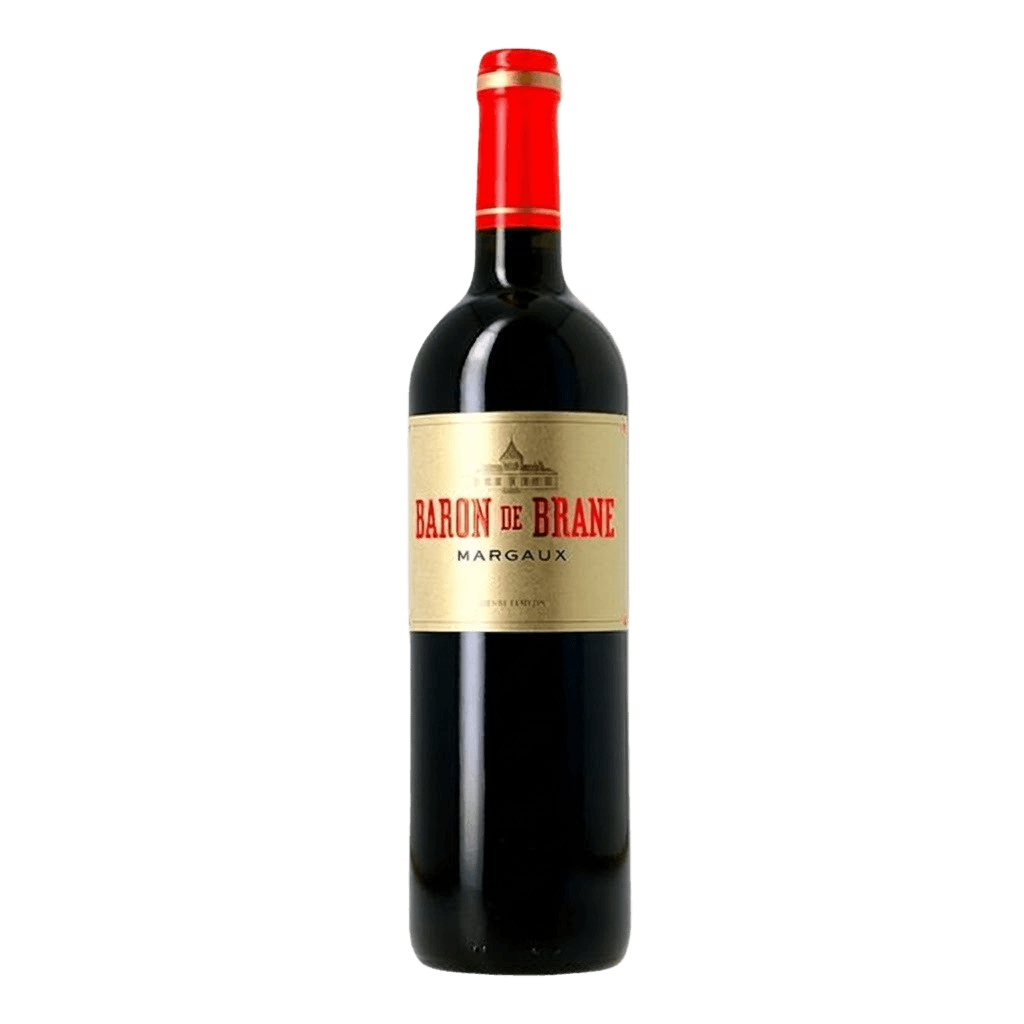
Château Brane-Cantenac
Baron de Brane
2020
From 34 EUR from 1 retailers
Baron de Brane represents the accessible side of Château Brane-Cantenac, offering Margaux's signature elegance and finesse in a second wine crafted from younger vines and carefully selected parcels.
Country
France
Region
Bordeaux - Margaux
Number of retailers: 1
bordeauxwines.se
Sweden
Baron de Brane
2020
Standard delivery 1-3 business days
More information
Producer
Château Brane-Cantenac is a Deuxième Cru Classé—Second Growth—in the 1855 Classification, positioned among the historic leading estates of the Margaux appellation. Located in the commune of Cantenac and under the ownership of the Lurton family, the property comprises approximately 75 hectares of vineyards planted predominantly to Cabernet Sauvignon. Its Grand Vin is recognised for finesse, aromatic precision and the silky, perfumed character that defines Margaux at its most elegant.
Quick Facts
- Location: Cantenac, Margaux, Bordeaux, France
- Classification: Deuxième Cru Classé (Second Growth), 1855 Classification
- Estate history: Dates to the 18th century
- Notable historical figure: Baron Hector de Brane, owner in the early 19th century
- Ownership: Lurton family
- Estate size: Approximately 75 hectares under vine
- Principal grapes: Cabernet Sauvignon, Merlot, Cabernet Franc, Petit Verdot
- Soils: Deep Günzian gravel over clay and limestone subsoils
- Grand Vin: Château Brane-Cantenac
- Second wine: Baron de Brane
- Style: Elegant, aromatic, structured Margaux with notable ageing potential
- Typical ageing potential: 15–30+ years for the Grand Vin
The Estate of Baron de Brane
The origins of Château Brane-Cantenac reach back to the 18th century, but its modern identity was shaped in the early 1800s under Baron Hector de Brane. Known as the "Napoléon des Vignes" for his skill and influence in Bordeaux viticulture, Baron de Brane established a reputation for quality that secured the estate's place in the 1855 Classification as a Second Growth. His legacy remains central to the château's identity, with the second wine carrying his name in recognition of his contribution to the property's standing.
Following changes of ownership through the 19th and 20th centuries, the estate came into the hands of the Lurton family, whose extensive experience across Bordeaux has supported continued investment in vineyard management and winemaking precision.
Günzian Gravel and the Margaux Expression
Brane-Cantenac's vineyards rest on some of the finest terroir in Margaux: deep beds of Günzian gravel deposited during the Quaternary period. These well-drained soils overlay clay and limestone subsoils, creating ideal conditions for Cabernet Sauvignon to ripen slowly and evenly while retaining freshness and aromatic complexity.
The estate's 75 hectares are planted primarily to Cabernet Sauvignon, which typically forms the majority of the Grand Vin's blend. Merlot adds roundness and richness, while smaller proportions of Cabernet Franc and Petit Verdot contribute aromatic lift and structural refinement. Parcel selection and meticulous vineyard work ensure that only the most expressive fruit reaches the cellar.
Silky Tannins and Floral Precision
The Grand Vin of Château Brane-Cantenac is crafted to embody the hallmark characteristics of Margaux: elegance, balance and perfumed complexity. Careful vinification and ageing in French oak barrels allow the wine to develop layers of black fruit, violet, graphite and subtle spice, framed by fine-grained tannins and a graceful structure.
While accessible in its youth, the wine is built for patient cellaring. Over 15 to 30 years or more, it evolves into a more seamless and nuanced expression, revealing the depth and refinement that distinguished Second Growth Margaux can offer. Baron de Brane, the estate's second wine, provides an earlier-drinking expression of the property's terroir and style, offering approachable elegance with the signature silkiness of Margaux.
Country
Region
Bordeaux - Margaux
Margaux is one of the most respected wine appellations in Bordeaux and represents the pinnacle of Left Bank elegance. Located in the Haut-Médoc, the appellation combines centuries of winemaking heritage with exceptional terroir, producing refined red wines that are widely recognised for their perfume, finesse and remarkable ageing potential. Margaux has long been synonymous with graceful, sophisticated Bordeaux that balances structure with silky texture.
The appellation benefits from distinctive gravel soils with varying proportions of sand and clay, creating ideal drainage and warmth retention for Cabernet Sauvignon, Merlot, Cabernet Franc and Petit Verdot. These deep gravel beds, combined with the moderating influence of the Gironde estuary, produce wines of exceptional aromatic complexity, with characteristic notes of violets, black fruit, cedar and spice. The terroir allows for elegant tannins and refined structure that distinguishes Margaux from neighbouring appellations.
Margaux is home to twenty-one classified estates from the 1855 Classification, including the renowned First Growth Château Margaux, along with distinguished properties such as Château Palmer, Château Rauzan-Ségla, Château Brane-Cantenac and Château Giscours. These estates represent benchmark expressions of the appellation's signature style: wines of exceptional balance, aromatic intensity and graceful power that reward careful cellaring.
Discover Margaux wines, compare prices from trusted merchants across Europe and find the best offers with Sipfind.
Grapes
Cabernet Sauvignon is one of the world’s most important and widely planted red wine grapes, renowned for its powerful structure, concentrated fruit and exceptional ageing potential. Originating in Bordeaux, France, the variety has become a defining grape of fine wine regions around the world, particularly Napa Valley, Tuscany, Chile, Australia and South Africa.
Classic Cabernet Sauvignon combines flavours and aromas of blackcurrant, cassis, blackberry and dark cherry with characteristic notes of cedar, graphite, tobacco and herbs. Naturally high tannins and fresh acidity provide structure and longevity, while maturation in oak can add layers of spice, vanilla and toast. Its character varies significantly with climate, soil and winemaking, ranging from elegant and savoury to rich, powerful and intensely concentrated.
In Bordeaux, Cabernet Sauvignon is particularly associated with the Left Bank, where it forms the foundation of many prestigious blends alongside Merlot, Cabernet Franc and other permitted varieties. In Napa Valley, it has become the region’s signature red grape, producing some of the world’s most sought-after Cabernet Sauvignon wines.
Cabernet Sauvignon’s ability to express terroir while retaining its distinctive structure and character has made it a global benchmark for premium red wine. Whether produced as the dominant variety in a blend or as a varietal wine, the finest examples combine concentration, complexity and the capacity to develop gracefully over decades
Merlot is one of the world’s most important red wine grapes, celebrated for its generous fruit, supple texture and ability to produce wines ranging from approachable and elegant to exceptionally complex and long-lived. Originating in Bordeaux, France, Merlot is particularly associated with the Right Bank, where it forms the foundation of many of the prestigious wines of Pomerol and Saint-Émilion.
Merlot typically expresses flavours and aromas of plum, black cherry, blackberry and red fruits, often developing notes of chocolate, tobacco, cedar, herbs and earthy complexity with maturation. Its naturally rounded texture and generally softer tannin profile distinguish it from Cabernet Sauvignon, although the finest examples can possess considerable structure, freshness and ageing potential.
In Pomerol, Merlot reaches some of its most celebrated expressions, particularly on the appellation’s clay-rich soils, producing wines of remarkable concentration, texture and complexity. In Saint-Émilion, it is commonly blended with Cabernet Franc and, to a lesser extent, Cabernet Sauvignon, creating wines that combine ripe fruit with structure, aromatic complexity and longevity.
Beyond Bordeaux, Merlot is widely cultivated in Italy, California, Washington State, Chile and other major wine regions. It can be produced as a varietal wine or used as a central component of blends, where its fruit and texture complement more structured grape varieties.
From the great Merlot-based wines of Bordeaux’s Right Bank to leading expressions around the world, Merlot’s combination of rich fruit, refined texture and capacity to express terroir has established it as one of the defining varieties of fine red wine.
Cabernet Franc is one of France’s most historic red wine grapes, valued for its aromatic intensity, vibrant acidity and ability to express both climate and soil with remarkable clarity. It produces elegant single-varietal wines and plays an essential role in some of Bordeaux’s most distinguished blends. Earlier ripening than Cabernet Sauvignon allows Cabernet Franc to perform particularly well in cooler wine regions.
In the Loire Valley, Cabernet Franc reaches its clearest expression as a varietal wine. Typical aromas include redcurrant, raspberry, red cherry and violet, often accompanied by graphite, dried herbs, tobacco and subtle peppery notes. Naturally fresh acidity and finely structured tannins can produce approachable, fruit-driven wines as well as complex examples capable of developing for many years.
The variety is especially important in Chinon, Bourgueil and Saumur-Champigny. Chinon can range from fragrant and supple to deeply structured and age-worthy, depending on vineyard site and soil. Bourgueil often combines dark red fruit with firm structure, while Saumur-Champigny is renowned for freshness, aromatic purity and refined texture. Limestone-rich tuffeau, gravel, sand and clay all contribute to the diversity of Cabernet Franc across these Loire appellations.
In Bordeaux, Cabernet Franc is principally associated with the Right Bank, particularly Saint-Émilion and Pomerol. Usually blended with Merlot and sometimes Cabernet Sauvignon, it contributes perfume, freshness, savoury complexity and structural precision. On suitable limestone and clay terroirs, Cabernet Franc can become a dominant component of exceptionally refined and long-lived wines.
Beyond France, Cabernet Franc is cultivated in regions including Tuscany, Bolgheri, Napa Valley, Washington State, Canada, Argentina and Chile, producing styles shaped by local climate and terroir. Traditionally known as Breton in the Loire and Bouchet in parts of Bordeaux, Cabernet Franc’s combination of aromatic elegance, freshness and ageing potential establishes it as one of the world’s great red wine varieties.
Petit Verdot is a powerful red wine grape from south-west France, best known as a small but distinctive component of the classic red blends of Bordeaux. Its deeply coloured wines, firm tannins and concentrated aromatics allow even modest proportions to add structure, freshness and intensity alongside Cabernet Sauvignon, Merlot and Cabernet Franc.
On Bordeaux’s Left Bank, Petit Verdot is particularly associated with the gravel soils of the Médoc, including appellations such as Margaux, Saint-Julien, Pauillac and Saint-Estèphe. The variety buds relatively early but ripens late, making complete maturation challenging in cooler vintages. When fully ripe, it can retain vibrant acidity while developing considerable colour, tannin and aromatic complexity.
Typical expressions show blackberry, black cherry, blueberry and plum, accompanied by violet, liquorice, pepper, cocoa and other dark spices. In Bordeaux blends, Petit Verdot is generally used in limited quantities to reinforce colour, tannic structure and aromatic depth. Its combination of acidity and tannin can also contribute significantly to a wine’s ageing potential.
Beyond Bordeaux, warmer and more reliable growing conditions have allowed Petit Verdot to achieve greater ripeness and a more prominent role. Producers in California, Australia, Spain and South America increasingly use the variety in both Bordeaux-style blends and varietal wines. These expressions are often full-bodied and deeply coloured, with ripe dark fruit, floral character, spice and powerful tannins.
From its historic role in the Médoc to its expanding presence as a varietal wine, Petit Verdot is defined by colour, structure, freshness and aromatic intensity. Once regarded primarily as a supporting grape, it is increasingly recognised as a distinctive variety capable of producing serious, age-worthy wines in its own right.
History and Style
Baron de Brane is the second wine of Château Brane-Cantenac, one of Margaux's most distinguished Deuxième Grand Cru Classé estates. Created from younger vines and parcels that do not make the final selection for the estate's Grand Vin, Baron de Brane offers wine enthusiasts an opportunity to experience the property's hallmark elegance and refinement at a more accessible level. It embodies the classic Margaux character while maintaining approachability in its youth.
Quick Facts
- Producer: Château Brane-Cantenac
- Classification: Second wine of Deuxième Grand Cru Classé (1855)
- Region: Bordeaux
- Appellation: Margaux
- Country: France
- Style: Medium to full-bodied Left Bank Bordeaux
- Grape Composition: Cabernet Sauvignon-dominant blend with Merlot, exact proportions vary by vintage
- Ageing Potential: 5-12 years from vintage
- Alcohol (ABV): 13-14%
- Tasting Profile: Blackcurrant, raspberry, cherry, floral notes, subtle oak, supple tannins
- Food Pairing: Roasted poultry, grilled lamb, beef, soft cheeses, charcuterie
- Serving Temperature: 16-18°C
- Bottle Status: Second Wine
- Vintage: Varies by release
Vineyard, Terroir and Style
Château Brane-Cantenac's 75-hectare estate benefits from exceptional gravelly soils in the heart of the Margaux appellation, terroir that imparts both aromatic complexity and structural finesse. The property has been producing wine since the 18th century and earned its Deuxième Cru status in the legendary 1855 Classification. Baron de Brane reflects this heritage, drawing from the same meticulous viticulture and winemaking traditions that define the Grand Vin.
History and Reputation
Typically Cabernet Sauvignon-dominant with supporting Merlot, Baron de Brane showcases red and black fruit characteristics—blackcurrant, raspberry, and cherry—alongside subtle floral notes and integrated oak influence. The wine displays medium body with supple tannins and balanced acidity, making it more approachable in its youth than the Grand Vin while still offering genuine Margaux elegance. It pairs beautifully with roasted poultry, grilled lamb, and soft cheeses.
For those seeking to explore Left Bank Bordeaux without the investment required for classified Grand Vins, Baron de Brane delivers authentic estate character and proven Margaux pedigree. Compare prices across merchants on Sipfind to find the best value for this distinguished second wine.