
Château Gruaud Larose
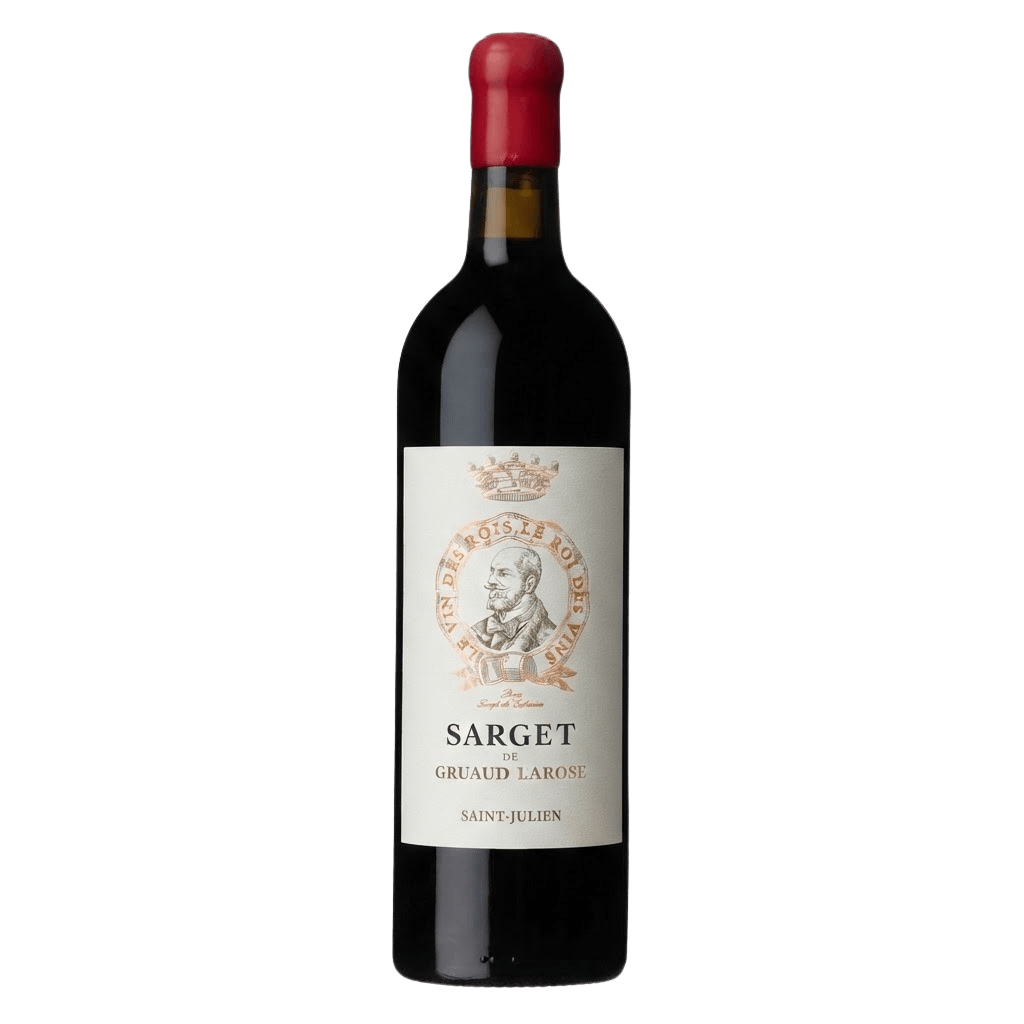
Sarget de Gruaud Larose
2019
From 38 EUR from 2 retailers
The second wine of Château Gruaud Larose, expressing its Saint-Julien gravel terroir through Cabernet-led structure, freshness, dark fruit and an accessible Médoc character.
Country
France
Region
Bordeaux - Saint-Julien
Number of retailers: 2
Bottle Hero
European Union
Sarget de Gruaud Larose
2019
bordeauxwines.se
Sweden
Sarget de Gruaud Larose
2019
Standard delivery 1-3 business days
You save up to 2 EUR, where 2 EUR is the difference between the highest price and the lowest price
More information
Producer
Château Gruaud Larose is one of the most distinguished Second Growths classified in 1855, with a reputation for producing robust, long-lived wines that exemplify the character of Saint-Julien. Located in the centre of the appellation and owned by the Merlaut family, the estate has maintained consistent quality across generations. Its Grand Vin is recognised for remarkable concentration, structured tannins and the ability to evolve gracefully over decades.
Quick Facts
- Location: Beychevelle, Saint-Julien, Bordeaux, France
- Classification: Deuxième Cru Classé – Second Growth, 1855
- Estate history: Dates to the early 18th century
- Current ownership: Merlaut family, since 1997
- Estate size: Approximately 82 hectares of contiguous vineyards
- Principal grapes: Cabernet Sauvignon, Merlot, Cabernet Franc, Petit Verdot
- Soils: Deep Gunzian gravel beds over clay and sand
- Grand Vin: Château Gruaud Larose
- Second wine: Sarget de Gruaud Larose
- Style: Powerful, structured and age-worthy
- Production: Traditional Médocain winemaking with extended barrel maturation
The Wines of the King
The estate's name and reputation were established by Joseph Stanislas Gruaud, an abbot and influential figure who acquired the property in 1757. Under his stewardship, the vineyard expanded significantly and its wines gained recognition at the highest levels, earning the title "the wine of kings, the king of wines" during the 18th century.
Following Gruaud's death in 1778, the estate passed to his heirs and was eventually divided between two branches of the family. The property was reunited in 1935 under a single ownership, restoring the estate's historic unity and allowing it to build on its classified status with renewed focus and ambition.
A Single Expanse of Gravel
The estate's 82 hectares form one of the largest contiguous vineyard holdings in Saint-Julien. This single, unbroken expanse sits on a plateau of deep Gunzian gravel, the oldest and most prized geological formation in the Médoc, laid down during the Quaternary period.
The gravel beds provide exceptional drainage and heat retention, encouraging gradual ripening and concentration in Cabernet Sauvignon, which typically represents around 60 to 65 per cent of the blend. Merlot, Cabernet Franc and small quantities of Petit Verdot complete the composition, contributing roundness, complexity and aromatic depth.
The vineyard's proximity to the Gironde estuary moderates temperature extremes and protects against spring frost, creating conditions suited to producing wines of power and structure without sacrificing balance or freshness.
Depth Built to Last
Gruaud Larose is made in a deliberately traditional style. Fermentation occurs in temperature-controlled stainless steel and concrete vats, with extraction managed to preserve structure and intensity. The Grand Vin is matured in French oak barrels for 18 to 24 months, with a proportion of new oak that varies according to vintage character.
The result is a wine distinguished by dense black fruit, graphite, tobacco and dark spice, supported by firm, fine-grained tannins and remarkable length. In youth, Château Gruaud Larose can appear compact and muscular. With cellaring, it develops tertiary complexity, aromatic refinement and a more seamless integration of fruit, oak and acidity.
Sarget de Gruaud Larose, produced from younger vines and selected parcels, offers earlier approachability while retaining the estate's signature depth and structure. It provides an accessible introduction to the house style and the character of Saint-Julien's gravel terroirs.
Country
Region
Bordeaux - Saint-Julien
Saint-Julien is one of the most respected wine appellations in the Médoc and has earned a distinguished reputation for producing some of Bordeaux's most refined and balanced wines. Located between Pauillac and Margaux along the left bank of the Gironde estuary, the appellation combines exceptional terroir with centuries of winemaking tradition. Despite being one of the smallest communal appellations in the Médoc, Saint-Julien boasts an extraordinary concentration of classified growth estates.
The appellation benefits from deep gravel soils mixed with clay and sand, providing excellent drainage while retaining sufficient moisture for the vines. This terroir creates ideal conditions for Cabernet Sauvignon, which dominates most blends, supported by Merlot, Cabernet Franc and Petit Verdot. The maritime influence from the Gironde moderates temperatures, allowing for slow, even ripening that contributes to the appellation's signature balance and refinement.
Saint-Julien is home to eleven classified growths from the 1855 Classification, including five distinguished Second Growths: Château Léoville Las Cases, Château Léoville Poyferré, Château Léoville Barton, Château Ducru-Beaucaillou and Château Gruaud-Larose. These estates produce wines renowned for their harmonious structure, combining concentration and power with remarkable elegance and finesse. The consistent quality across the appellation has made Saint-Julien a benchmark for classic Médoc winemaking.
Discover Saint-Julien wines, compare prices from trusted merchants across Europe and find the best offers with Sipfind.
Grapes
Cabernet Sauvignon is one of the world’s most important and widely planted red wine grapes, renowned for its powerful structure, concentrated fruit and exceptional ageing potential. Originating in Bordeaux, France, the variety has become a defining grape of fine wine regions around the world, particularly Napa Valley, Tuscany, Chile, Australia and South Africa.
Classic Cabernet Sauvignon combines flavours and aromas of blackcurrant, cassis, blackberry and dark cherry with characteristic notes of cedar, graphite, tobacco and herbs. Naturally high tannins and fresh acidity provide structure and longevity, while maturation in oak can add layers of spice, vanilla and toast. Its character varies significantly with climate, soil and winemaking, ranging from elegant and savoury to rich, powerful and intensely concentrated.
In Bordeaux, Cabernet Sauvignon is particularly associated with the Left Bank, where it forms the foundation of many prestigious blends alongside Merlot, Cabernet Franc and other permitted varieties. In Napa Valley, it has become the region’s signature red grape, producing some of the world’s most sought-after Cabernet Sauvignon wines.
Cabernet Sauvignon’s ability to express terroir while retaining its distinctive structure and character has made it a global benchmark for premium red wine. Whether produced as the dominant variety in a blend or as a varietal wine, the finest examples combine concentration, complexity and the capacity to develop gracefully over decades
Merlot is one of the world’s most important red wine grapes, celebrated for its generous fruit, supple texture and ability to produce wines ranging from approachable and elegant to exceptionally complex and long-lived. Originating in Bordeaux, France, Merlot is particularly associated with the Right Bank, where it forms the foundation of many of the prestigious wines of Pomerol and Saint-Émilion.
Merlot typically expresses flavours and aromas of plum, black cherry, blackberry and red fruits, often developing notes of chocolate, tobacco, cedar, herbs and earthy complexity with maturation. Its naturally rounded texture and generally softer tannin profile distinguish it from Cabernet Sauvignon, although the finest examples can possess considerable structure, freshness and ageing potential.
In Pomerol, Merlot reaches some of its most celebrated expressions, particularly on the appellation’s clay-rich soils, producing wines of remarkable concentration, texture and complexity. In Saint-Émilion, it is commonly blended with Cabernet Franc and, to a lesser extent, Cabernet Sauvignon, creating wines that combine ripe fruit with structure, aromatic complexity and longevity.
Beyond Bordeaux, Merlot is widely cultivated in Italy, California, Washington State, Chile and other major wine regions. It can be produced as a varietal wine or used as a central component of blends, where its fruit and texture complement more structured grape varieties.
From the great Merlot-based wines of Bordeaux’s Right Bank to leading expressions around the world, Merlot’s combination of rich fruit, refined texture and capacity to express terroir has established it as one of the defining varieties of fine red wine.
Cabernet Franc is one of France’s most historic red wine grapes, valued for its aromatic intensity, vibrant acidity and ability to express both climate and soil with remarkable clarity. It produces elegant single-varietal wines and plays an essential role in some of Bordeaux’s most distinguished blends. Earlier ripening than Cabernet Sauvignon allows Cabernet Franc to perform particularly well in cooler wine regions.
In the Loire Valley, Cabernet Franc reaches its clearest expression as a varietal wine. Typical aromas include redcurrant, raspberry, red cherry and violet, often accompanied by graphite, dried herbs, tobacco and subtle peppery notes. Naturally fresh acidity and finely structured tannins can produce approachable, fruit-driven wines as well as complex examples capable of developing for many years.
The variety is especially important in Chinon, Bourgueil and Saumur-Champigny. Chinon can range from fragrant and supple to deeply structured and age-worthy, depending on vineyard site and soil. Bourgueil often combines dark red fruit with firm structure, while Saumur-Champigny is renowned for freshness, aromatic purity and refined texture. Limestone-rich tuffeau, gravel, sand and clay all contribute to the diversity of Cabernet Franc across these Loire appellations.
In Bordeaux, Cabernet Franc is principally associated with the Right Bank, particularly Saint-Émilion and Pomerol. Usually blended with Merlot and sometimes Cabernet Sauvignon, it contributes perfume, freshness, savoury complexity and structural precision. On suitable limestone and clay terroirs, Cabernet Franc can become a dominant component of exceptionally refined and long-lived wines.
Beyond France, Cabernet Franc is cultivated in regions including Tuscany, Bolgheri, Napa Valley, Washington State, Canada, Argentina and Chile, producing styles shaped by local climate and terroir. Traditionally known as Breton in the Loire and Bouchet in parts of Bordeaux, Cabernet Franc’s combination of aromatic elegance, freshness and ageing potential establishes it as one of the world’s great red wine varieties.
Petit Verdot is a powerful red wine grape from south-west France, best known as a small but distinctive component of the classic red blends of Bordeaux. Its deeply coloured wines, firm tannins and concentrated aromatics allow even modest proportions to add structure, freshness and intensity alongside Cabernet Sauvignon, Merlot and Cabernet Franc.
On Bordeaux’s Left Bank, Petit Verdot is particularly associated with the gravel soils of the Médoc, including appellations such as Margaux, Saint-Julien, Pauillac and Saint-Estèphe. The variety buds relatively early but ripens late, making complete maturation challenging in cooler vintages. When fully ripe, it can retain vibrant acidity while developing considerable colour, tannin and aromatic complexity.
Typical expressions show blackberry, black cherry, blueberry and plum, accompanied by violet, liquorice, pepper, cocoa and other dark spices. In Bordeaux blends, Petit Verdot is generally used in limited quantities to reinforce colour, tannic structure and aromatic depth. Its combination of acidity and tannin can also contribute significantly to a wine’s ageing potential.
Beyond Bordeaux, warmer and more reliable growing conditions have allowed Petit Verdot to achieve greater ripeness and a more prominent role. Producers in California, Australia, Spain and South America increasingly use the variety in both Bordeaux-style blends and varietal wines. These expressions are often full-bodied and deeply coloured, with ripe dark fruit, floral character, spice and powerful tannins.
From its historic role in the Médoc to its expanding presence as a varietal wine, Petit Verdot is defined by colour, structure, freshness and aromatic intensity. Once regarded primarily as a supporting grape, it is increasingly recognised as a distinctive variety capable of producing serious, age-worthy wines in its own right.
History and Style
Sarget de Gruaud Larose
Sarget de Gruaud Larose is the second wine of Château Gruaud Larose, the historic Second Growth estate of Saint-Julien on Bordeaux's Left Bank.
The wine draws on the same estate environment that defines Château Gruaud Larose, whose vineyards lie on ancient Garonne gravel. Cabernet Sauvignon typically provides the structural foundation, accompanied by Merlot, Cabernet Franc and Petit Verdot in proportions that change according to the vintage.
Sarget is designed as its own expression of the property: recognisably Saint-Julien and connected to the character of Gruaud Larose, while generally offering greater accessibility than the Grand Vin.
Quick Facts
- Producer: Château Gruaud Larose
- Wine: Sarget de Gruaud Larose
- Category: Second wine
- Appellation: Saint-Julien AOC
- Region: Bordeaux, France
- Principal varieties: Cabernet Sauvignon, Merlot, Cabernet Franc and Petit Verdot
History and Identity
Sarget de Gruaud Larose occupies the second-wine position within the Château Gruaud Larose portfolio.
Its identity is directly connected to the estate's historic Saint-Julien vineyard, but selection provides a distinction between Sarget and Château Gruaud Larose, the Grand Vin.
This relationship is important for Sipfind. Sarget should not be described merely as a simplified version of Château Gruaud Larose. It is a separate product entity with its own vintages, blends, technical specifications and merchant offers.
The estate's official archive currently provides individual Sarget vintages extending back to 1994, demonstrating its established history as a distinct wine within the portfolio.
For SCI, its identity is therefore:
Château Gruaud Larose → Second Wine → Sarget de Gruaud Larose → Vintage
Vineyards and Terroir
Sarget shares the viticultural environment of the Gruaud Larose estate in Saint-Julien.
The château's vineyard extends over approximately 82 hectares, with its principal geological foundation formed by Garonne gravel deposited during the Quaternary period. The estate's official material describes these gravel deposits as more than 600,000 years old.
These well-drained gravel soils are particularly important for Cabernet Sauvignon, the variety that forms the structural backbone of both the estate and many vintages of Sarget.
The vineyard itself contains Cabernet Sauvignon, Merlot, Cabernet Franc and Petit Verdot. Historical technical sheets also document small amounts of Malbec in the estate vineyard, although this should not automatically be attached to the contemporary Sarget master product.
The correct hierarchy is therefore:
Bordeaux → Médoc → Saint-Julien → Château Gruaud Larose → estate selection → Sarget de Gruaud Larose
Estate planting percentages must never be confused with the blend of an individual Sarget vintage.
Blend
Sarget de Gruaud Larose has no fixed numerical master blend.
Cabernet Sauvignon, Merlot, Cabernet Franc and Petit Verdot can all contribute, with the precise proportions determined according to vintage and selection.
The producer's technical sheets demonstrate this clearly.
For example, Sarget 2009 was:
54% Cabernet Sauvignon
26% Merlot
13% Cabernet Franc
7% Petit Verdot.
By comparison, Sarget 2019 was:
48% Cabernet Sauvignon
37% Merlot
8% Cabernet Franc
7% Petit Verdot.
The generic bottle page should therefore describe the wine as a Cabernet-oriented Saint-Julien Bordeaux blend, without hard-coding one numerical composition.
For SCI:
Master product → principal grape varieties
Vintage entity → exact verified blend
Production and Maturation
Château Gruaud Larose uses detailed parcel selection in its winemaking. The producer's technical records describe selection according to factors including grape variety, terroir and vine age, allowing individual lots to be managed separately.
Historical Sarget technical sheets document vinification in temperature-controlled wooden and cement vats, with fermentation and maceration decisions adapted through tasting.
The exact production regime, however, has changed over time.
This is particularly evident in maturation. The official technical sheet for Sarget 2002, for example, records 14 months in French oak with 10% new barrels, whereas 2019 records 18–24 months in French fine-grained oak, with 80% new barrels.
That variation makes it especially important that Sipfind does not hard-code one maturation regime into the master bottle.
The master product should therefore retain:
Parcel selection → controlled vinification → French oak maturation
while:
Fermentation → maceration → maturation period → new oak → alcohol
remain vintage-specific.
Style and Tasting Profile
Sarget de Gruaud Larose retains the structural DNA of Saint-Julien and Château Gruaud Larose, while generally presenting it in a more immediately accessible form than the Grand Vin.
Cabernet Sauvignon provides structure and definition, while Merlot can contribute flesh and roundness. Cabernet Franc and Petit Verdot provide additional aromatic and structural dimensions depending on the vintage.
Rather than attaching tasting descriptors from one particular year to every Sarget bottle, the master product should focus on the wine's broader structural identity.
For SCI, I would lock:
Saint-Julien gravel → Cabernet structure → dark fruit → freshness → texture → balance → accessibility.
Specific aromas such as cassis, blackberry, cedar, tobacco, graphite, spice or floral notes should be attached to individual vintage tasting profiles when supported by reliable sources.
Position within the Gruaud Larose Portfolio
The distinction is straightforward:
Château Gruaud Larose is the estate's Grand Vin and carries its status as a Second Growth in the 1855 Classification.
Sarget de Gruaud Larose is the estate's second wine.
This creates the clean SCI hierarchy:
Château Gruaud Larose
→ Sarget de Gruaud Larose
→ Vintage
→ Blend / Alcohol / Harvest / Vinification / Maturation / Tasting / Scores / Offers
One important semantic point: the 1855 Second Growth classification belongs to Château Gruaud Larose and the estate's Grand Vin identity. Sipfind should not describe Sarget itself as though it were independently classified as a Second Growth merely because producer technical sheets carry the château's classification alongside the wine. The official Sarget pages identify the wine under the Saint-Julien estate and display the estate's classification context.
Ageing and Serving
Sarget de Gruaud Larose possesses the structure expected from a Cabernet-based Saint-Julien, while its position as the second wine generally makes accessibility an important part of its identity.
However, ageing potential can differ substantially according to vintage, blend, ripeness and élevage.
Sipfind should therefore not assign one universal drinking window to the master Sarget product.
Drinking window → serving temperature → decanting → ageing recommendation
should remain vintage-specific whenever reliable information is available.
Explore Sarget de Gruaud Larose on Sipfind
Compare vintages, critic scores, availability and current prices for Sarget de Gruaud Larose from trusted wine merchants.