
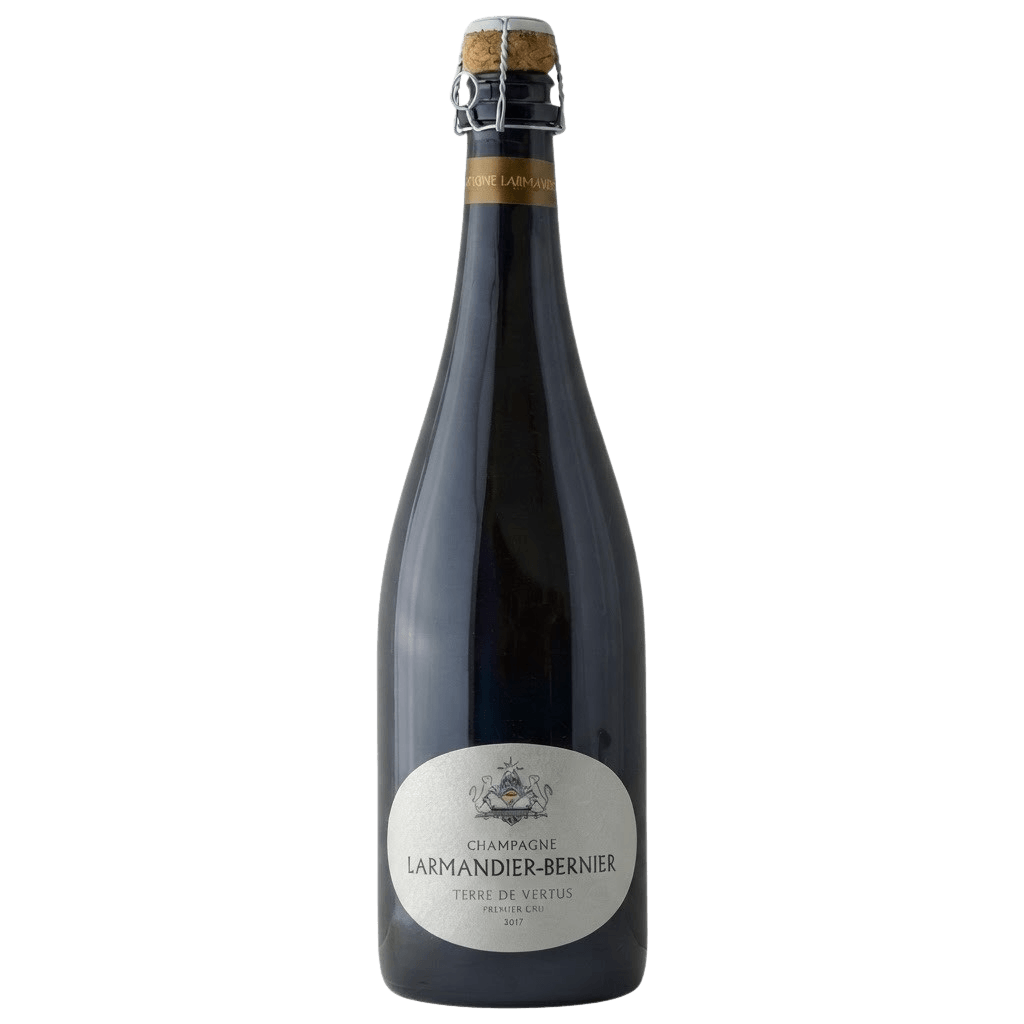
Larmandier-Bernier
Larmandier-Bernier Terre de Vertus
2018
From 121 EUR from 2 retailers
A vintage Premier Cru Blanc de Blancs from a single Chardonnay parcel in Vertus, combining remarkable purity, mineral tension, salinity and terroir-driven complexity.
Country
France
Region
Champagne
Number of retailers: 2
Philipson Wine ApS
Sweden
Larmandier-Bernier Terre de Vertus
2018
Standard delivery 1-3 business days
XtraWine
European Union
Larmandier-Bernier Terre de Vertus
2018
Standard delivery 1-3 business days
You save up to 29 EUR, where 29 EUR is the difference between the highest price and the lowest price
Scoring
More information
Producer
Larmandier-Bernier
Larmandier-Bernier is a family-owned Champagne grower based in Vertus, at the southern end of the Côte des Blancs. Its vineyards extend across Premier and Grand Cru terroirs including Vertus, Cramant, Avize, Oger and Chouilly, with Chardonnay forming more than 90% of the estate's plantings.
The domaine's identity is built around allowing individual terroirs to determine the character of its wines. Biodynamic viticulture, mature fruit, indigenous yeasts, maturation in wood and minimal intervention in the cellar form a coherent philosophy centred on purity, minerality and the expression of Champagne's chalk soils.
Quick Facts
- Producer: Champagne Larmandier-Bernier
- Location: Vertus, Côte des Blancs, Champagne
- Family winegrowing roots: 1765
- Estate: 19 hectares
- Principal grape: Chardonnay — more than 90% of the vineyard
- Viticulture: Biodynamic since 1999; organic certification since 2003
History and Identity
The histories of the Larmandier and Bernier families as winegrowers extend back to 1765, and the Larmandiers have cultivated vineyards in the Premier and Grand Cru villages of the Côte des Blancs since the nineteenth century.
The modern estate took shape in 1971, when Philippe Larmandier and his wife Elisabeth Bernier, herself the owner of vineyards in Vertus, created Champagne Larmandier-Bernier and built their cellar in Vertus.
Their son Pierre Larmandier returned to the family estate in 1988 together with his wife Sophie. Pierre progressively changed the viticultural direction of the domaine, abandoning herbicides completely in 1992 before converting the entire estate to biodynamic farming in 1999. Indigenous yeasts were introduced for fermentation at the same time, while maturation increasingly moved from stainless steel towards barrels and larger wooden vats.
The next generation is now involved. Arthur Larmandier joined in 2017, followed by his brother Georges in 2021, continuing the family's involvement into another generation.
Estate, Vineyards and Terroir
Larmandier-Bernier farms approximately 19 hectares in the Côte des Blancs.
The estate identifies holdings in:
Vertus – Premier Cru
Cramant – Grand Cru
Avize – Grand Cru
Oger – Grand Cru
Chouilly – Grand Cru
Importantly, Larmandier-Bernier states that it does not purchase grapes. The wines are produced from fruit originating from its own vineyard holdings, with the estate expanding through the acquisition of vineyards rather than bought-in fruit.
The geological foundation of the domaine is the Campanian chalk of the Côte des Blancs. Larmandier-Bernier explicitly identifies this chalk as central to the mineral character of its Champagnes.
More than 90% of the vineyard is planted to Chardonnay, and the vines average approximately 35 years of age.
These percentages describe the estate plantings, not the blend of every Larmandier-Bernier Champagne.
Viticulture
Viticulture is one of the defining elements of Larmandier-Bernier.
Pierre Larmandier abandoned herbicides completely in 1992, and the entire estate has been farmed biodynamically since 1999. The vineyards have been certified organic since 2003.
The domaine works its soils to encourage deeper rooting and preserve soil life. It emphasises mature fruit, controlled yields, old vines and massal selections originating from earlier generations of the Larmandier and Bernier families. Harvesting is carried out manually once the desired maturity has been achieved.
The objective is not biodynamics as an end in itself, but to produce grapes capable of transmitting differences between individual vineyards and terroirs.
Production and Winemaking
The same low-intervention philosophy continues in the cellar.
Fruit is gently pressed and fermentation takes place spontaneously using indigenous yeasts, a practice used by the estate since 1999. Fermentation and maturation take place in wooden vessels, including casks and Stockinger foudres.
The wines undergo prolonged maturation on their lees — the estate describes approximately 11 months in casks and wooden vats — before bottling. They are bottled without filtration or fining.
Bottle ageing then continues for several years in the domaine's chalk cellars.
Dosage is generally restrained, but we should not hard-code one dosage level at producer level. Individual wines range across Brut Nature, Extra Brut and other specific expressions, and exact dosage belongs to the individual bottle or release.
Style and Identity
Larmandier-Bernier's stylistic identity is closely connected to Chardonnay and the chalk terroirs of the Côte des Blancs.
Rather than creating a dominant house style through cellar intervention, the domaine aims to preserve distinctions between sites. The producer itself repeatedly uses purity, minerality and terroir expression to describe the objective of its wines.
For Sipfind, I would define the producer's stylistic DNA as:
Chalk → Chardonnay → maturity → purity → minerality → precision → low intervention.
That is more useful than assigning one universal tasting profile to the entire range, particularly because Larmandier-Bernier produces everything from Chardonnay-led blends to single-terroir Blanc de Blancs and Rosé de Saignée.
Portfolio
Larmandier-Bernier's current portfolio demonstrates the domaine's increasingly terroir-specific approach.
Latitude provides a Chardonnay-based expression centred on the southern Côte des Blancs.
Longitude follows the north-south axis of the Côte des Blancs and is a Premier Cru Blanc de Blancs.
Terre de Vertus is a single-terroir Premier Cru Blanc de Blancs from Vertus.
Les Chemins d'Avize is produced from two old-vine parcels in Avize and represents a singular Grand Cru expression.
Vieille Vigne du Levant is another of the estate's important terroir-specific Grand Cru Blanc de Blancs.
The range also includes Rosé de Saignée, Cramant Nature and Vertus Rouge.
Each should exist as an independent bottle entity within Sipfind, with vintage, dosage, blend, disgorgement and maturation information attached at the appropriate product or release level.
Explore Larmandier-Bernier Champagnes
Discover Larmandier-Bernier Champagnes from the Côte des Blancs. Compare cuvées, vintages, critic scores, availability and current prices from trusted wine merchants.
Country
Region
Champagne
Champagne is widely regarded as the world's most prestigious sparkling wine region and has become synonymous with celebration, luxury and uncompromising quality. Located in northeastern France, approximately 150 kilometres east of Paris, the region combines centuries of winemaking tradition with exceptional terroir to produce sparkling wines of remarkable elegance and complexity. From legendary maisons to small grower-producers, Champagne represents the benchmark against which all other sparkling wines are measured, and its influence on global wine culture remains unrivalled.
The region's vineyards stretch across five principal districts: Montagne de Reims, Vallée de la Marne, Côte des Blancs, Côte de Sézanne and Côte des Bar. The defining characteristic of Champagne terroir is its chalk-limestone subsoil, which provides excellent drainage, mineral richness and steady water supply essential for producing grapes of exceptional quality. The cool continental climate, moderated by maritime influences, ensures slow ripening and high natural acidity, while the principal grape varieties—Chardonnay, Pinot Noir and Pinot Meunier—each contribute distinct character to the final blend. The region's 17 grand cru villages and 42 premier cru villages represent the finest expression of Champagne terroir, producing grapes of outstanding concentration and finesse.
Champagne is governed by strict AOC regulations established in 1927, which define geographical boundaries, permitted grape varieties, yields and production methods. The region is home to some of the world's most celebrated houses, including Krug, Louis Roederer, Bollinger, Dom Pérignon, Veuve Clicquot, Pol Roger, Salon, Taittinger and Moët & Chandon. These maisons have upheld the art of blending and cellar ageing for generations, producing prestige cuvées and vintage expressions that rank among the most collectible wines in the world. Alongside these historic houses, a growing number of grower-producers cultivate and vinify their own grapes, offering terroir-focused expressions that reveal the diversity and depth of Champagne's varied terroirs.
Whether exploring grand cru villages, prestige cuvées or historic maisons, Champagne offers an unparalleled journey through the birthplace of the world's finest sparkling wines. Discover Champagne Champagnes, compare prices from trusted merchants across Europe and find the best offers with Sipfind.
Grapes
Chardonnay is one of the world’s most important and prestigious white wine grapes, renowned for its remarkable versatility and ability to reflect both terroir and winemaking style. Most famously associated with Burgundy and Champagne in France, Chardonnay is cultivated across virtually every major wine-producing country and can produce everything from precise, mineral-driven whites to rich, complex wines with exceptional ageing potential.
In Burgundy, Chardonnay reaches some of its most celebrated expressions. The limestone-rich vineyards of Chablis are known for wines combining vibrant acidity, citrus character and mineral precision, while the Côte de Beaune, particularly appellations such as Meursault, Puligny-Montrachet and Chassagne-Montrachet, produces some of the world’s most sought-after and age-worthy white wines.
Chardonnay also plays a fundamental role in Champagne, where it contributes freshness, finesse and acidity to blends alongside Pinot Noir and Meunier. When produced exclusively from Chardonnay, the resulting Champagne is known as Blanc de Blancs, a style prized for its elegance, precision and capacity to develop considerable complexity with extended ageing.
The grape’s character varies significantly according to climate, terroir and winemaking. Cooler regions can produce wines showing citrus, green apple, white flowers and mineral notes, while warmer conditions can bring peach, melon and tropical-fruit character. Oak fermentation, barrel ageing and malolactic fermentation can introduce additional layers of toast, vanilla, butter and hazelnut, demonstrating Chardonnay’s exceptional stylistic range.
Beyond France, Chardonnay has established important expressions in California, Australia, New Zealand, South Africa and numerous other wine regions. From the mineral whites of Chablis and the great vineyards of Burgundy to Blanc de Blancs Champagne and modern New World interpretations, Chardonnay’s combination of versatility, complexity and terroir expression has established it as one of the defining grape varieties of fine wine.
History and Style
Larmandier-Bernier Terre de Vertus
Terre de Vertus is a vintage Premier Cru Blanc de Blancs Champagne created to express one specific Chardonnay terroir in Vertus, at the southern end of the Côte des Blancs.
Unlike Larmandier-Bernier's multi-terroir cuvées, Terre de Vertus comes from a single mid-slope parcel known as Les Barillers. It is produced from 100% Chardonnay, one terroir and one vintage, with no dosage added after disgorgement.
Quick Facts
- Producer: Larmandier-Bernier
- Wine: Terre de Vertus
- Classification: Premier Cru
- Style: Vintage Brut Nature Blanc de Blancs
- Origin: Les Barillers, Vertus, Côte des Blancs
- Grape: 100% Chardonnay
History and Identity
The Chardonnay from Les Barillers has been vinified separately by Larmandier-Bernier since 1995, making Terre de Vertus one of the producer's established single-terroir Champagnes.
Its concept is deliberately simple: rather than constructing complexity through an assemblage of villages, parcels or vintages, Larmandier-Bernier allows one vineyard and one growing season to define the wine.
The producer describes this approach as recognising when an individual parcel already possesses sufficient balance and character to stand alone. Terre de Vertus therefore occupies a fundamentally different position from Latitude and Longitude, which rely on blending to create their respective identities.
Vineyards and Terroir
Terre de Vertus originates from Les Barillers, a Chardonnay parcel situated mid-slope in Vertus.
Larmandier-Bernier identifies the site as a particularly distinctive terroir, combining delicacy with pronounced salinity and complexity. The mid-slope position is central to the identity of the wine and is sufficiently individual that the parcel has been vinified independently for more than three decades.
For Sipfind, its geographical hierarchy should be explicit:
Champagne → Côte des Blancs → Vertus Premier Cru → Les Barillers → Terre de Vertus
This is considerably more useful semantically than storing only Vertus as the wine's origin.
Production and Maturation
The Chardonnay is gently pressed and the juice only lightly clarified before being transferred directly into wood.
Natural alcoholic fermentation with indigenous yeasts and spontaneous malolactic fermentation take place in barrels and Stockinger foudres. The wine remains on its natural lees throughout its first year, without fining or filtration.
Tirage takes place at the end of July. Crucially, there is no blending with other vintages and no blending with other terroirs.
The bottles then undergo secondary fermentation and mature in the estate's cellars for at least six additional years. Each bottle is disgorged by hand approximately one year before release.
Because Terre de Vertus is vintage Champagne, exact harvest information, disgorgement date, alcohol and other release-specific technical details belong to the individual vintage page.
Non Dosé / Brut Nature
Terre de Vertus is bottled without dosage.
Larmandier-Bernier adds no sugar at disgorgement, relying instead on grape maturity and the natural balance of the wine. The producer notes that approximately 1 g/l of natural residual sugar may remain, but the added dosage itself is 0 g/l.
This is not simply a stylistic label. It forms part of the underlying concept of Terre de Vertus: as little as possible is added between vineyard and finished Champagne so that the identity of Les Barillers remains clear.
For SCI:
Dosage classification: Brut Nature / Non Dosé
Added dosage: 0 g/l
Natural residual sugar: not equivalent to dosage
That distinction is worth preserving.
Style and Tasting Profile
Larmandier-Bernier defines Terre de Vertus primarily through tension, minerality, salinity and complexity.
Those characteristics provide a strong vintage-neutral identity without borrowing tasting notes from any particular year.
For the master product, I would define its stylistic DNA as:
Purity → tension → minerality → salinity → depth → complexity.
Fruit, floral, autolytic or spice descriptors should remain on the relevant vintage pages. For example, current critical descriptions of the 2017 and 2018 releases differ, reinforcing why those tasting notes should not be treated as permanent characteristics of the master wine.
Position within the Larmandier-Bernier Portfolio
Terre de Vertus belongs to Larmandier-Bernier's group of single-terroir Champagnes, where one parcel or tightly defined origin is allowed to express itself independently rather than becoming part of a broader blend.
This gives the portfolio a useful semantic structure:
Latitude → multi-year → southern Vertus → generosity and roundness
Longitude → multi-year → multiple Côte des Blancs terroirs → minerality and linearity
Terre de Vertus → single vintage → Les Barillers, Vertus → purity, salinity and tension
Les Chemins d'Avize → single vintage → two old-vine Avize parcels → mineral density and elegance
Terre de Vertus should therefore be treated in SCI as both a wine entity and an expression of the Les Barillers vineyard entity.
Ageing and Serving
Larmandier-Bernier gives Terre de Vertus substantial cellar maturation before release: approximately one year of initial élevage is followed by at least six additional years in bottle, with hand disgorgement approximately one year before commercial release.
The producer describes the wine as suitable for drinking on release or ageing for approximately five to ten years, and highlights its purity as particularly suited to the beginning of a meal.
For Sipfind, however, the most precise drinking windows should still belong to the individual vintage pages.
Explore Larmandier-Bernier Terre de Vertus on Sipfind
Compare Terre de Vertus vintages, critic scores, availability and current prices from trusted wine merchants.