
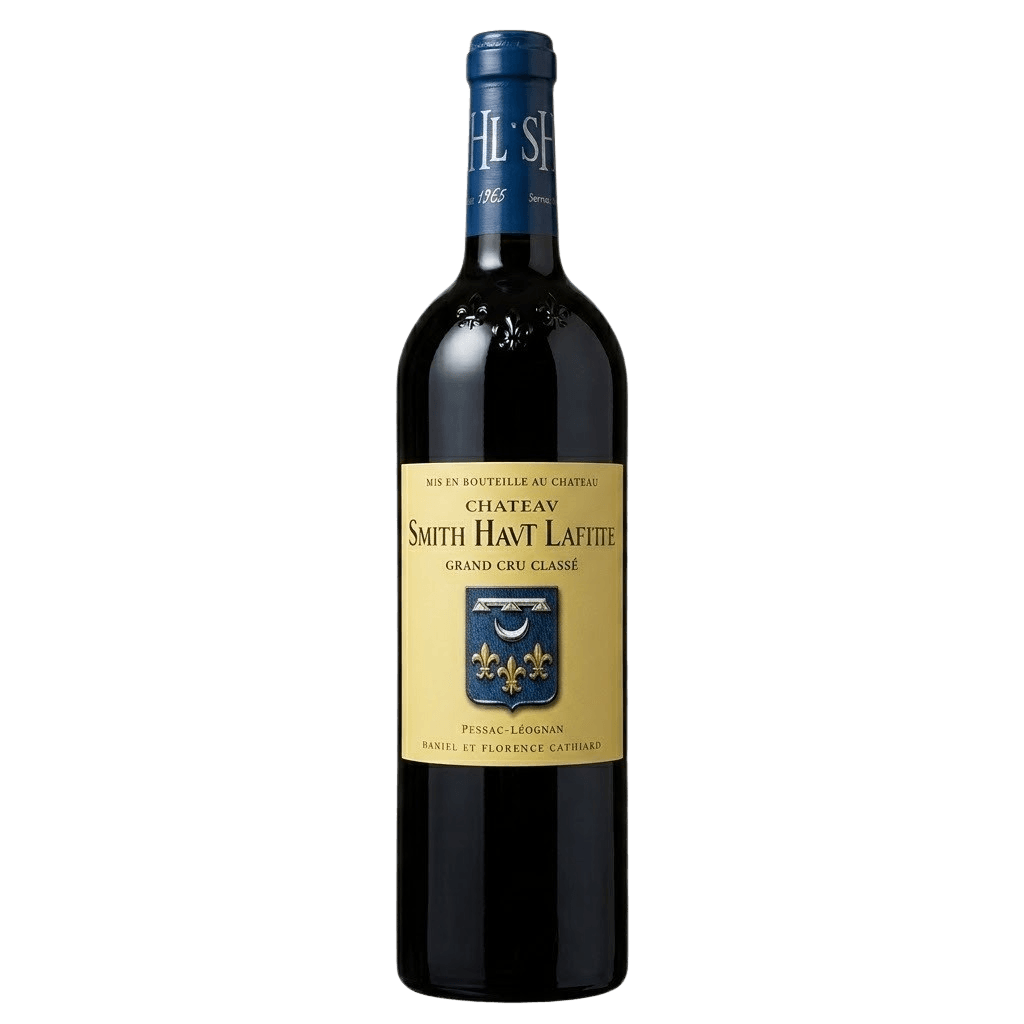
Château Smith Haut Lafitte
Château Smith Haut Lafitte
2025
From 92 EUR from 1 retailers
Château Smith Haut Lafitte represents the pinnacle of this distinguished Pessac-Léognan Grand Cru Classé estate, combining gravelly terroir expression with traditional Bordeaux craftsmanship and remarkable aging potential.
Country
France
Region
Bordeaux - Pessac-Leognan
Number of retailers: 1
Lobenbergs Gute Weine GmbH & Co. KG
Germany
Château Smith Haut Lafitte
2025
Standard delivery 1-3 business days
More information
Producer
Château Smith Haut Lafitte is a Grand Cru Classé estate in the Pessac-Léognan appellation, one of only six properties classified for both red and white wines in the 1959 Graves Classification. Situated south of Bordeaux and acquired by the Cathiard family in 1990, the estate has established itself as a leading proponent of organic and biodynamic viticulture in the region. Its wines are distinguished by refined structure, aromatic complexity and exceptional ageing potential, reflecting both historic terroir and a long-term commitment to sustainable winemaking.
Quick Facts
- Location: Martillac, Pessac-Léognan, Bordeaux, France
- Historical origins: Dating to the 14th century
- Ownership: Cathiard family since 1990
- Classification: Grand Cru Classé, 1959 Graves Classification (red and white)
- Estate size: 78 hectares of vineyards
- Principal grapes (red): Cabernet Sauvignon, Merlot, Cabernet Franc, Petit Verdot
- Principal grapes (white): Sauvignon Blanc, Sauvignon Gris, Sémillon
- Soils: Deep Günzian gravel over gravelly-clay subsoils
- Grand Vin (red): Château Smith Haut Lafitte Rouge
- Grand Vin (white): Château Smith Haut Lafitte Blanc
- Second wine: Les Hauts de Smith
- Viticulture: Organic certification achieved 2019, biodynamic practices ongoing
- Style: Elegant, terroir-focused Left Bank Bordeaux with extended ageing potential
The Cathiard Vision for a Historic Estate
The property's roots extend to the 14th century, when it formed part of the noble Du Bosq estate. By the 18th century, it had passed to Scotsman George Smith, whose name became attached to the property. Following classification in 1959, the estate changed hands several times before being acquired by Daniel and Florence Cathiard in 1990.
The Cathiards undertook extensive vineyard replanting, cellar modernisation and a decisive shift toward environmentally conscious viticulture. Organic certification was achieved in 2019, formalising practices developed over nearly three decades. This commitment has reshaped Smith Haut Lafitte into a model for quality-driven, sustainable estate management in Bordeaux.
Günzian Gravel and the Graves Identity
The estate's 78 hectares occupy a gently elevated plateau formed from deep Günzian gravel deposited during the Quaternary period. These warm, well-drained soils are characteristic of the finest sites in Pessac-Léognan and are particularly well suited to Cabernet Sauvignon, which typically dominates the red wine blend.
The red wine vineyards are planted predominantly to Cabernet Sauvignon, complemented by Merlot, Cabernet Franc and a small proportion of Petit Verdot. White wine parcels, accounting for approximately 11 hectares, feature Sauvignon Blanc and the rarer Sauvignon Gris, along with Sémillon. Hand-harvesting, meticulous parcel selection and precise vinification allow the estate to express the distinct character of its terroir across both red and white wines.
Elegance Built Through Precision and Time
Château Smith Haut Lafitte Rouge is crafted for structure, freshness and longevity. The wine combines concentrated dark fruit, graphite-like minerality and fine-grained tannins with a characteristic elegance that distinguishes it from more opulent Left Bank expressions. Extended ageing in French oak, typically around 60% new, refines rather than dominates the wine's expression.
The white Grand Vin ranks among the most celebrated in Bordeaux. Fermented and matured in barrel, it offers citrus peel, white flowers, mineral tension and remarkable depth. Both wines are built to evolve gracefully over decades, developing layered complexity and aromatic refinement with time.
Les Hauts de Smith, the estate's second wine, provides earlier accessibility while maintaining the precise, terroir-focused style that defines the property. Across its portfolio, Smith Haut Lafitte continues to reflect the Cathiard family's vision of Pessac-Léognan: a balance of historic terroir, environmental stewardship and uncompromising attention to quality.
Country
Region
Bordeaux - Pessac-Leognan
Pessac-Léognan is an AOC/AOP wine appellation in northern Graves, immediately south and south-west of the city of Bordeaux, France. Recognised as a separate appellation in 1987, it produces both red and dry white wines across ten communes. Its gravel-dominated terroir is home to all 14 estates in the current Graves Great Growth classification, including Château Haut-Brion, which also appears in the 1855 Bordeaux Classification.
Pessac-Léognan occupies the northern part of the Graves wine area. Its vineyards extend across Cadaujac, Canéjan, Gradignan, Léognan, Martillac, Mérignac, Pessac, Saint-Médard-d’Eyrans, Talence and Villenave-d’Ornon.
The appellation’s soils combine river pebbles, fine gravel, flint, sand and limestone-rich clay. Ancient gravel deposits form gently undulating outcrops with effective natural drainage. The nearby Garonne, the city of Bordeaux and the Landes Forest also influence local growing conditions.
Red Pessac-Léognan is principally associated with Cabernet Sauvignon and Merlot. Cabernet Franc, Malbec and Petit Verdot may also contribute to the blend.
The appellation’s red wines are generally structured and complex, combining ripe fruit with firm but polished tannins. Their balance, concentration and capacity for bottle ageing vary by estate, vineyard site and vintage.
Pessac-Léognan also produces dry white Bordeaux from Sauvignon Blanc, Sauvignon Gris, Sémillon and Muscadelle. These wines can combine citrus and white-fruit character with freshness, texture and mineral or gently toasted notes.
The exact blend and ageing approach differ between producers. Sauvignon commonly contributes freshness and aromatic definition, while Sémillon can add breadth and texture.
All 14 estates in the current Graves Great Growth classification are situated within Pessac-Léognan. Estates may be classified for their red wine, their dry white wine or both.
Château Haut-Brion has a unique position: it belongs to the Graves classification and is also a Premier Grand Cru Classé in the 1855 Bordeaux Classification. Other recognised estates in the appellation include Château La Mission Haut-Brion, Domaine de Chevalier, Château Haut-Bailly, Château Pape Clément and Château Smith Haut Lafitte.
Compare prices for Pessac-Léognan wines across retailers on Sipfind. Explore red and dry white wines by estate, vintage, bottle size and available offer.
Grapes
Cabernet Sauvignon is one of the world’s most important and widely planted red wine grapes, renowned for its powerful structure, concentrated fruit and exceptional ageing potential. Originating in Bordeaux, France, the variety has become a defining grape of fine wine regions around the world, particularly Napa Valley, Tuscany, Chile, Australia and South Africa.
Classic Cabernet Sauvignon combines flavours and aromas of blackcurrant, cassis, blackberry and dark cherry with characteristic notes of cedar, graphite, tobacco and herbs. Naturally high tannins and fresh acidity provide structure and longevity, while maturation in oak can add layers of spice, vanilla and toast. Its character varies significantly with climate, soil and winemaking, ranging from elegant and savoury to rich, powerful and intensely concentrated.
In Bordeaux, Cabernet Sauvignon is particularly associated with the Left Bank, where it forms the foundation of many prestigious blends alongside Merlot, Cabernet Franc and other permitted varieties. In Napa Valley, it has become the region’s signature red grape, producing some of the world’s most sought-after Cabernet Sauvignon wines.
Cabernet Sauvignon’s ability to express terroir while retaining its distinctive structure and character has made it a global benchmark for premium red wine. Whether produced as the dominant variety in a blend or as a varietal wine, the finest examples combine concentration, complexity and the capacity to develop gracefully over decades
Merlot is one of the world’s most important red wine grapes, celebrated for its generous fruit, supple texture and ability to produce wines ranging from approachable and elegant to exceptionally complex and long-lived. Originating in Bordeaux, France, Merlot is particularly associated with the Right Bank, where it forms the foundation of many of the prestigious wines of Pomerol and Saint-Émilion.
Merlot typically expresses flavours and aromas of plum, black cherry, blackberry and red fruits, often developing notes of chocolate, tobacco, cedar, herbs and earthy complexity with maturation. Its naturally rounded texture and generally softer tannin profile distinguish it from Cabernet Sauvignon, although the finest examples can possess considerable structure, freshness and ageing potential.
In Pomerol, Merlot reaches some of its most celebrated expressions, particularly on the appellation’s clay-rich soils, producing wines of remarkable concentration, texture and complexity. In Saint-Émilion, it is commonly blended with Cabernet Franc and, to a lesser extent, Cabernet Sauvignon, creating wines that combine ripe fruit with structure, aromatic complexity and longevity.
Beyond Bordeaux, Merlot is widely cultivated in Italy, California, Washington State, Chile and other major wine regions. It can be produced as a varietal wine or used as a central component of blends, where its fruit and texture complement more structured grape varieties.
From the great Merlot-based wines of Bordeaux’s Right Bank to leading expressions around the world, Merlot’s combination of rich fruit, refined texture and capacity to express terroir has established it as one of the defining varieties of fine red wine.
Cabernet Franc is one of France’s most historic red wine grapes, valued for its aromatic intensity, vibrant acidity and ability to express both climate and soil with remarkable clarity. It produces elegant single-varietal wines and plays an essential role in some of Bordeaux’s most distinguished blends. Earlier ripening than Cabernet Sauvignon allows Cabernet Franc to perform particularly well in cooler wine regions.
In the Loire Valley, Cabernet Franc reaches its clearest expression as a varietal wine. Typical aromas include redcurrant, raspberry, red cherry and violet, often accompanied by graphite, dried herbs, tobacco and subtle peppery notes. Naturally fresh acidity and finely structured tannins can produce approachable, fruit-driven wines as well as complex examples capable of developing for many years.
The variety is especially important in Chinon, Bourgueil and Saumur-Champigny. Chinon can range from fragrant and supple to deeply structured and age-worthy, depending on vineyard site and soil. Bourgueil often combines dark red fruit with firm structure, while Saumur-Champigny is renowned for freshness, aromatic purity and refined texture. Limestone-rich tuffeau, gravel, sand and clay all contribute to the diversity of Cabernet Franc across these Loire appellations.
In Bordeaux, Cabernet Franc is principally associated with the Right Bank, particularly Saint-Émilion and Pomerol. Usually blended with Merlot and sometimes Cabernet Sauvignon, it contributes perfume, freshness, savoury complexity and structural precision. On suitable limestone and clay terroirs, Cabernet Franc can become a dominant component of exceptionally refined and long-lived wines.
Beyond France, Cabernet Franc is cultivated in regions including Tuscany, Bolgheri, Napa Valley, Washington State, Canada, Argentina and Chile, producing styles shaped by local climate and terroir. Traditionally known as Breton in the Loire and Bouchet in parts of Bordeaux, Cabernet Franc’s combination of aromatic elegance, freshness and ageing potential establishes it as one of the world’s great red wine varieties.
Petit Verdot is a powerful red wine grape from south-west France, best known as a small but distinctive component of the classic red blends of Bordeaux. Its deeply coloured wines, firm tannins and concentrated aromatics allow even modest proportions to add structure, freshness and intensity alongside Cabernet Sauvignon, Merlot and Cabernet Franc.
On Bordeaux’s Left Bank, Petit Verdot is particularly associated with the gravel soils of the Médoc, including appellations such as Margaux, Saint-Julien, Pauillac and Saint-Estèphe. The variety buds relatively early but ripens late, making complete maturation challenging in cooler vintages. When fully ripe, it can retain vibrant acidity while developing considerable colour, tannin and aromatic complexity.
Typical expressions show blackberry, black cherry, blueberry and plum, accompanied by violet, liquorice, pepper, cocoa and other dark spices. In Bordeaux blends, Petit Verdot is generally used in limited quantities to reinforce colour, tannic structure and aromatic depth. Its combination of acidity and tannin can also contribute significantly to a wine’s ageing potential.
Beyond Bordeaux, warmer and more reliable growing conditions have allowed Petit Verdot to achieve greater ripeness and a more prominent role. Producers in California, Australia, Spain and South America increasingly use the variety in both Bordeaux-style blends and varietal wines. These expressions are often full-bodied and deeply coloured, with ripe dark fruit, floral character, spice and powerful tannins.
From its historic role in the Médoc to its expanding presence as a varietal wine, Petit Verdot is defined by colour, structure, freshness and aromatic intensity. Once regarded primarily as a supporting grape, it is increasingly recognised as a distinctive variety capable of producing serious, age-worthy wines in its own right.
History and Style
Château Smith Haut Lafitte is the flagship Grand Vin of one of Pessac-Léognan's most prestigious estates, a property classified as Grand Cru Classé de Graves. This Cabernet Sauvignon-dominant blend showcases the exceptional gravelly terroir that defines the appellation, producing wines of remarkable structure, elegance, and longevity.
Quick Facts
- Producer: Château Smith Haut Lafitte
- Classification: Grand Cru Classé de Graves
- Region: Bordeaux
- Appellation: Pessac-Léognan
- Country: France
- Style: Full-bodied Left Bank Bordeaux with gravelly terroir expression
- Grape Composition: Cabernet Sauvignon-dominant blend (typically 55-65%), Merlot (30-40%), with Cabernet Franc and Petit Verdot
- Ageing Potential: 15-30+ years from vintage
- Alcohol (ABV): 13-14%
- Tasting Profile: Blackcurrant, dark cherry, cedar, tobacco, graphite, mineral, subtle smoke
- Food Pairing: Grilled lamb, beef tenderloin, game birds, aged Comté, mushroom-based dishes
- Serving Temperature: 16-18°C
- Bottle Status: Flagship
- Consumer Profile: Fine wine collectors, Bordeaux enthusiasts, special occasion dining, investment buyers
Vineyard, Terroir and Style
The estate's history dates to the 14th century, with the modern era defined by meticulous viticulture and sustainable practices across 67 hectares of prime vineyard land. The gravelly soils, deposited by ancient Garonne River flows, provide exceptional drainage and stress the vines, concentrating flavours and creating the mineral backbone characteristic of great Pessac-Léognan. The blend typically features Cabernet Sauvignon as the dominant variety, supported by Merlot, with occasional contributions from Cabernet Franc and Petit Verdot, though exact proportions vary by vintage to reflect each year's unique conditions.
History and Reputation
Aged in French oak barrels, the wine develops layers of complexity—blackcurrant and dark cherry fruit interweave with cedar, tobacco, graphite, and subtle smoky notes. The palate offers refined tannins, impressive depth, and the signature freshness that distinguishes Pessac-Léognan from the Médoc. Built for the cellar, Château Smith Haut Lafitte rewards patience with decades of evolution.
Whether you're a seasoned collector or exploring Bordeaux's Left Bank, Sipfind helps you compare prices across trusted merchants to secure this benchmark Pessac-Léognan at the best value.