
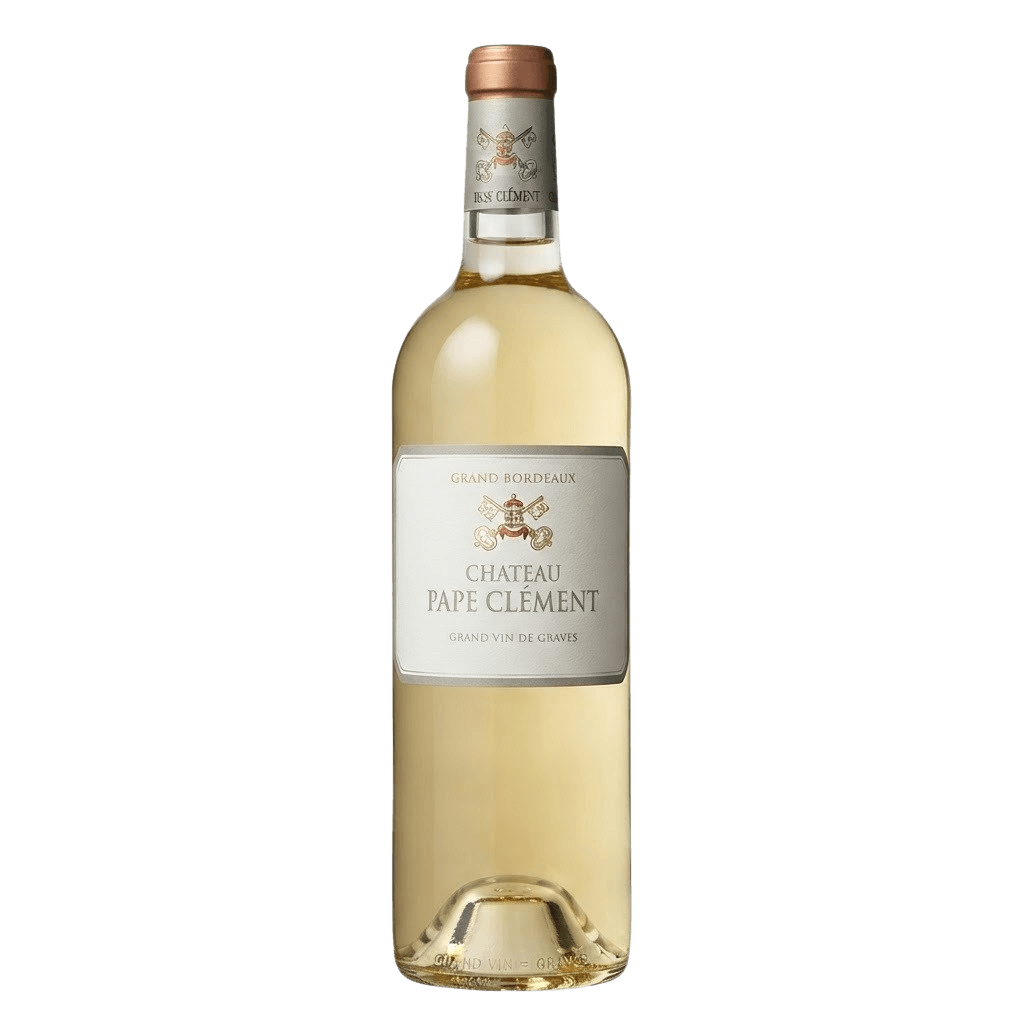
Château Pape Clément
Château Pape Clément Blanc
2023
From 161 EUR from 1 retailers
The white Grand Vin of Château Pape Clément, combining Sauvignon Blanc and Sémillon with Graves freshness, concentration, fine texture and aromatic precision.
Country
France
Region
Bordeaux - Pessac-Leognan
Number of retailers: 1
Bottle Hero
European Union
Château Pape Clément Blanc
2023
More information
Producer
Château Pape Clément
Château Pape Clément is one of Bordeaux's oldest wine estates, situated in Pessac, immediately southwest of the city of Bordeaux. Its first recorded harvest dates to 1252, giving the property more than seven centuries of viticultural history.
The château takes its name from Bertrand de Goth, who became Archbishop of Bordeaux before being elected Pope in 1305 as Clement V. Today, Château Pape Clément is owned by Bernard Magrez and produces both red and white wines from its Pessac-Léognan terroir. Its red Grand Vin is recognised as a Grand Cru Classé de Graves.
Quick Facts
- Producer: Château Pape Clément
- Location: Pessac, Bordeaux, France
- Appellation: Pessac-Léognan
- First recorded harvest: 1252
- Classification: Grand Cru Classé de Graves
- Owner: Bernard Magrez
History and Identity
The history of Château Pape Clément reaches back to the 13th century. The estate records its first harvest in 1252 and traces its origins to the de Goth family.
Bertrand de Goth became Archbishop of Bordeaux and, in 1305, was elected Pope under the name Clement V. His association with the vineyard ultimately gave Château Pape Clément the name it carries today.
The property continued through centuries of Bordeaux history and became one of the estates included in the 1959 Classification of Graves.
A major modern chapter began during the 1980s when Bernard Magrez acquired Château Pape Clément. It was his first vineyard and became the foundation of what subsequently developed into a much broader international wine portfolio.
This combination of medieval origins and continuing technical development is central to the producer's identity.
Estate, Vineyards and Terroir
Château Pape Clément lies within Pessac-Léognan, part of the historic Graves area south of Bordeaux.
Its terroir belongs to the gravel-dominated landscape from which Graves takes its name. The estate manages individual vineyard parcels according to their particular characteristics rather than treating the vineyard as a single homogeneous unit.
The red vineyards are associated principally with the traditional Bordeaux varieties Cabernet Sauvignon and Merlot, alongside smaller contributions from other varieties depending on vineyard composition and vintage.
White wine production centres on Bordeaux's principal white varieties, particularly Sauvignon Blanc and Sémillon, with other varieties appearing in individual wines or vintages.
For SCI, estate plantings and individual wine blends must remain completely separate:
Estate vineyard composition ≠ Château Pape Clément Rouge blend ≠ Château Pape Clément Blanc blend.
Exact bottle blends belong at product and vintage level.
Viticulture
Viticulture at Château Pape Clément is highly parcel-focused.
The estate describes vineyard management that includes natural or managed grass cover, soil cultivation, integrated pest management, vigour control, debudding, removal of lateral shoots and green harvesting. Manual harvesting is used for the principal wines, with grapes collected in small crates.
Animal traction is also used for certain vineyard work, reducing soil compaction around the vines.
The estate's official material identifies both Terra Vitis and HVE Level 3 environmental certification.
For Sipfind, the key producer-level concept is:
micro-terroir → parcel management → precision viticulture → selective harvesting.
Production and Winemaking
The same parcel philosophy continues inside the winery.
Château Pape Clément's wooden vat room was redesigned in 2007 and contains 28 vats corresponding to vineyard parcels of different ages and grape varieties. The estate describes this approach as parcellisation: reproducing the structure of the vineyard inside the winery so individual micro-terroirs can be separated or combined as required.
For the red Grand Vin, official material describes manual sorting, gravity-fed transfer into wooden vats, pre-fermentation cold maceration, manual punching down and malolactic fermentation in French oak barrels.
White winemaking follows a different process, including whole-berry pressing, protection from oxidation, fermentation in French oak and lees ageing.
Exact fermentation, oak and maturation specifications should nevertheless remain attached to the relevant wine and vintage, rather than being hard-coded across the producer entity.
Style and Identity
Château Pape Clément produces both red and white expressions of Pessac-Léognan, and these need separate stylistic identities within SCI.
The red wines combine Cabernet and Merlot structure with the depth, texture and aromatic complexity associated with the gravel terroirs of Pessac-Léognan.
The white wines place greater emphasis on freshness, concentration, texture and aromatic definition, primarily through Sauvignon Blanc and Sémillon.
At producer level, however, the strongest identity is broader:
Historic Graves terroir → parcel precision → red and white Bordeaux → concentration → structure → freshness → refinement.
Specific aromas and tasting notes should remain attached to individual wines and vintages.
Portfolio
The portfolio must be separated carefully because Château Pape Clément produces both red and white wines.
Château Pape Clément Rouge is the estate's principal red wine and carries its Grand Cru Classé de Graves identity.
Château Pape Clément Blanc is the estate's principal white wine.
Le Clémentin de Pape Clément Rouge and Le Clémentin de Pape Clément Blanc form separate product entities associated with the estate and must not be merged with their respective Grand Vins.
The estate also produces additional cuvées, which should remain separate product entities in SCI rather than being folded into the core Château Pape Clément record.
This gives us the basic hierarchy:
Château Pape Clément → Rouge / Blanc → individual wine → vintage
with each product maintaining its own blends, technical specifications, scores and merchant offers.
Explore Château Pape Clément Wines
Discover the red and white wines of Château Pape Clément. Compare vintages, critic scores, availability and current prices from trusted wine merchants.
Country
Region
Bordeaux - Pessac-Leognan
Pessac-Léognan is an AOC/AOP wine appellation in northern Graves, immediately south and south-west of the city of Bordeaux, France. Recognised as a separate appellation in 1987, it produces both red and dry white wines across ten communes. Its gravel-dominated terroir is home to all 14 estates in the current Graves Great Growth classification, including Château Haut-Brion, which also appears in the 1855 Bordeaux Classification.
Pessac-Léognan occupies the northern part of the Graves wine area. Its vineyards extend across Cadaujac, Canéjan, Gradignan, Léognan, Martillac, Mérignac, Pessac, Saint-Médard-d’Eyrans, Talence and Villenave-d’Ornon.
The appellation’s soils combine river pebbles, fine gravel, flint, sand and limestone-rich clay. Ancient gravel deposits form gently undulating outcrops with effective natural drainage. The nearby Garonne, the city of Bordeaux and the Landes Forest also influence local growing conditions.
Red Pessac-Léognan is principally associated with Cabernet Sauvignon and Merlot. Cabernet Franc, Malbec and Petit Verdot may also contribute to the blend.
The appellation’s red wines are generally structured and complex, combining ripe fruit with firm but polished tannins. Their balance, concentration and capacity for bottle ageing vary by estate, vineyard site and vintage.
Pessac-Léognan also produces dry white Bordeaux from Sauvignon Blanc, Sauvignon Gris, Sémillon and Muscadelle. These wines can combine citrus and white-fruit character with freshness, texture and mineral or gently toasted notes.
The exact blend and ageing approach differ between producers. Sauvignon commonly contributes freshness and aromatic definition, while Sémillon can add breadth and texture.
All 14 estates in the current Graves Great Growth classification are situated within Pessac-Léognan. Estates may be classified for their red wine, their dry white wine or both.
Château Haut-Brion has a unique position: it belongs to the Graves classification and is also a Premier Grand Cru Classé in the 1855 Bordeaux Classification. Other recognised estates in the appellation include Château La Mission Haut-Brion, Domaine de Chevalier, Château Haut-Bailly, Château Pape Clément and Château Smith Haut Lafitte.
Compare prices for Pessac-Léognan wines across retailers on Sipfind. Explore red and dry white wines by estate, vintage, bottle size and available offer.
Grapes
Sauvignon Blanc is one of the world’s most widely recognised white wine grapes, celebrated for its vibrant acidity, expressive aromatics and remarkable ability to reflect climate and terroir. Originating in France, the variety is historically associated with the Loire Valley and Bordeaux, while today it produces distinctive wines across many of the world’s leading wine regions.
In the Loire Valley, Sauvignon Blanc reaches some of its most celebrated expressions in Sancerre and Pouilly-Fumé. These wines are typically dry, precise and refreshing, showing flavours and aromas of citrus, green apple, gooseberry and white flowers, often accompanied by herbal and mineral notes. Differences in soil, vineyard location and winemaking can produce styles ranging from delicate and elegant to concentrated and age-worthy.
In Bordeaux, Sauvignon Blanc traditionally plays a different role. It is frequently blended with Sémillon, and sometimes Muscadelle, to produce both dry white Bordeaux and the renowned sweet wines of Sauternes and Barsac. Sauvignon Blanc contributes acidity, freshness and aromatic lift, complementing the richness and texture of Sémillon.
Beyond France, Sauvignon Blanc has become particularly important in New Zealand, where Marlborough established an internationally recognised style characterised by intense citrus, passion fruit, gooseberry and herbaceous aromas. Important expressions are also produced in California, Chile, South Africa, Australia and Italy, demonstrating the variety’s ability to develop distinctive personalities across different climates and soils.
Whether expressed as a mineral-driven Loire wine, a structured Bordeaux blend or an intensely aromatic New World Sauvignon Blanc, the grape’s combination of freshness, aromatic clarity and terroir expression has established it as one of the defining varieties of modern white wine.
Sémillon is a white wine grape originating in Bordeaux, where it is central to both dry white blends and botrytised sweet wines. Its generous texture, affinity with noble rot and ability to develop considerable complexity through bottle ageing have established Sémillon as one of the most versatile white varieties in fine wine, with benchmark expressions found in Bordeaux and Australia’s Hunter Valley.
Quick Grape Facts
- Grape Type: White wine grape
- Origin: Bordeaux, France
- Key Regions: Sauternes, Barsac, Graves, Pessac-Léognan and Hunter Valley
- Primary Styles: Dry white wines, botrytised sweet wines and white blends
- Common Blending Partners: Sauvignon Blanc and Muscadelle
- Typical Aromas: Lemon, green apple, pear, beeswax, honey, apricot, toast and nuts
- Structure: Generally medium to full-bodied, with acidity and concentration varying according to climate, harvest timing and wine style
- Botrytis Susceptibility: High, supported by the grape’s relatively thin skins
- Ageing Potential: High in leading Sauternes, Barsac and Hunter Valley expressions
- Canonical Name: Sémillon
- Alias: Semillon
- Historical Labels: Hunter River Riesling, Shepherd’s Riesling, Hock, White Burgundy and Chablis
Regional Expressions and Wine Styles
In Sauternes and Barsac, Sémillon’s thin skins make it particularly receptive to Botrytis cinerea, or noble rot. Botrytis concentrates the grapes’ sugars, acidity and flavours, producing richly textured sweet wines with notes of honey, beeswax, apricot, candied citrus and saffron. Sauvignon Blanc commonly contributes freshness and aromatic lift, while Muscadelle may add floral complexity. In the dry white wines of Graves and Pessac-Léognan, Sémillon brings body, depth and ageing potential to blends with Sauvignon Blanc, developing waxy, toasted and nutty complexity as the wines mature.
In Australia’s Hunter Valley, Sémillon is typically harvested early at relatively low sugar levels and fermented in stainless steel with little or no oak influence. Young wines can appear light-bodied, restrained and citrus-driven, yet the finest examples evolve over decades to show lemon curd, toast, lanolin, honey and nuts. Sémillon is also produced as a varietal wine in the Barossa Valley and blended with Sauvignon Blanc in Margaret River. Historical Australian labels such as Hunter River Riesling do not indicate a relationship with Riesling and should be treated as former naming conventions rather than separate grapes or modern synonyms.
Explore Sémillon Wines on Sipfind
Explore Sémillon wines, regions and current offers from selected wine retailers on Sipfind.
History and Style
Château Pape Clément Blanc
Château Pape Clément Blanc is the principal white wine of the historic Château Pape Clément estate in Pessac-Léognan, Bordeaux.
Produced principally from Sauvignon Blanc and Sémillon, with Sauvignon Gris also represented in the château's current published composition, the wine combines the richness and concentration expected of serious white Bordeaux with freshness, aromatic definition and long ageing potential.
It is important to distinguish the white wine from Château Pape Clément Rouge. The château officially presents the white as Grand Vin de Graves, while the red carries the estate's Grand Cru Classé de Graves designation.
Quick Facts
- Producer: Château Pape Clément
- Wine: Château Pape Clément Blanc
- Category: White Grand Vin
- Appellation: Pessac-Léognan AOC
- Region: Bordeaux, France
- Principal varieties: Sauvignon Blanc and Sémillon, with Sauvignon Gris also used
History and Identity
Château Pape Clément Blanc forms the white counterpart to the estate's historic red Grand Vin.
Rather than being treated simply as a white extension of Château Pape Clément Rouge, it should exist within Sipfind as an independent product entity. Its grape composition, vinification, maturation, tasting profile and vintage history differ fundamentally from those of the red wine.
The château itself gives considerable prominence to the wine. Its current visitor material describes Château Pape Clément Blanc as a “cuvée confidentielle”, reflecting its more limited place within the estate's production.
For SCI:
Château Pape Clément → Château Pape Clément Blanc → Vintage
This must remain separate from:
Château Pape Clément → Château Pape Clément Rouge → Vintage
Vineyards and Terroir
The wine originates from Château Pape Clément's vineyards in Pessac, within the Pessac-Léognan appellation and the historic Graves area of Bordeaux.
The château applies parcel-based vineyard management, allowing different parts of the estate to be managed according to their individual characteristics. For its white vineyards, the estate also describes natural grass cover, integrated pest management, debudding, removal of lateral shoots and green harvesting.
Harvesting for the white wine is conducted manually in two passes, allowing selection according to grape maturity.
As with the red Grand Vin, SCI must keep vineyard composition separate from the final bottled wine:
Estate plantings ≠ Château Pape Clément Blanc blend.
Blend
The principal varieties associated with Château Pape Clément Blanc are:
Sauvignon Blanc · Sémillon · Sauvignon Gris
The château's current generic wine page gives a composition of:
50% Sauvignon Blanc
40% Sémillon
10% Sauvignon Gris.
However, for Sipfind we should not lock 50/40/10 as the permanent blend of every Château Pape Clément Blanc.
The precise composition belongs to the relevant vintage whenever vintage-specific technical information is available.
Therefore:
Master Bottle → Sauvignon Blanc + Sémillon + Sauvignon Gris
Vintage Entity → exact verified percentages
This protects SCI from applying one published blend retrospectively to every historical vintage.
Production and Maturation
The production method of Château Pape Clément Blanc is substantially different from that of the red Grand Vin.
The château describes manual filling of pneumatic presses, followed by slow pressing of whole berries under an inert atmosphere to protect aromatic freshness.
The juice moves by gravity into barrels. Settling and alcoholic fermentation then take place in French oak barrels.
The wine is subsequently matured on its fine lees with bâtonnage, building texture and complexity.
The château's current technical presentation also states that 15% is handled in egg-shaped concrete tanks and gives a maturation period of approximately 16 months.
These are valuable technical reference points, but under the Sipfind Gold Standard the exact maturation regime belongs at vintage level whenever it can vary.
We therefore lock at master level:
Whole-berry pressing → protection from oxidation → French oak fermentation → fine-lees ageing → bâtonnage → oak/concrete maturation
while:
exact percentages → maturation duration → oak regime → alcohol
remain vintage-specific.
Style and Tasting Profile
Château Pape Clément Blanc is characterised by the combination of richness and concentration with freshness and aromatic precision.
The château's current presentation identifies citrus and green-fruit characteristics alongside minerality and integrated oak, while emphasising concentration and length.
Rather than transferring those exact descriptors automatically to every vintage, the master product should capture the wine's structural identity.
For SCI:
Graves terroir → Sauvignon freshness → Sémillon texture → concentration → aromatic precision → minerality → length.
This gives us a strong generic identity while leaving vintage-specific citrus, floral, mineral, oak and fruit descriptors to their correct vintage pages.
Position within the Château Pape Clément Portfolio
The hierarchy needs to be especially clean here.
Château Pape Clément Rouge
→ Red Grand Vin
→ Grand Cru Classé de Graves
Château Pape Clément Blanc
→ White Grand Vin
→ Grand Vin de Graves
Clémentin Rouge
→ Separate red product
Clémentin Blanc
→ Separate white product
The château currently lists all four as separate wines.
This means Château Pape Clément Blanc must never inherit technical information, classification or blend data from either Château Pape Clément Rouge or Clémentin Blanc.
Ageing and Serving
Château Pape Clément Blanc is produced with the concentration, structure and maturation regime necessary for bottle development. The château's current presentation specifically notes its long ageing potential.
However, we should not attach one universal drinking window to every vintage.
Vintage conditions, acidity, concentration, blend and maturation all influence development.
Therefore:
Drinking window → serving temperature → decanting → ageing recommendation
should remain vintage-specific whenever reliable information is available.
Explore Château Pape Clément Blanc on Sipfind
Compare vintages, critic scores, availability and current prices for Château Pape Clément Blanc from trusted wine merchants.