
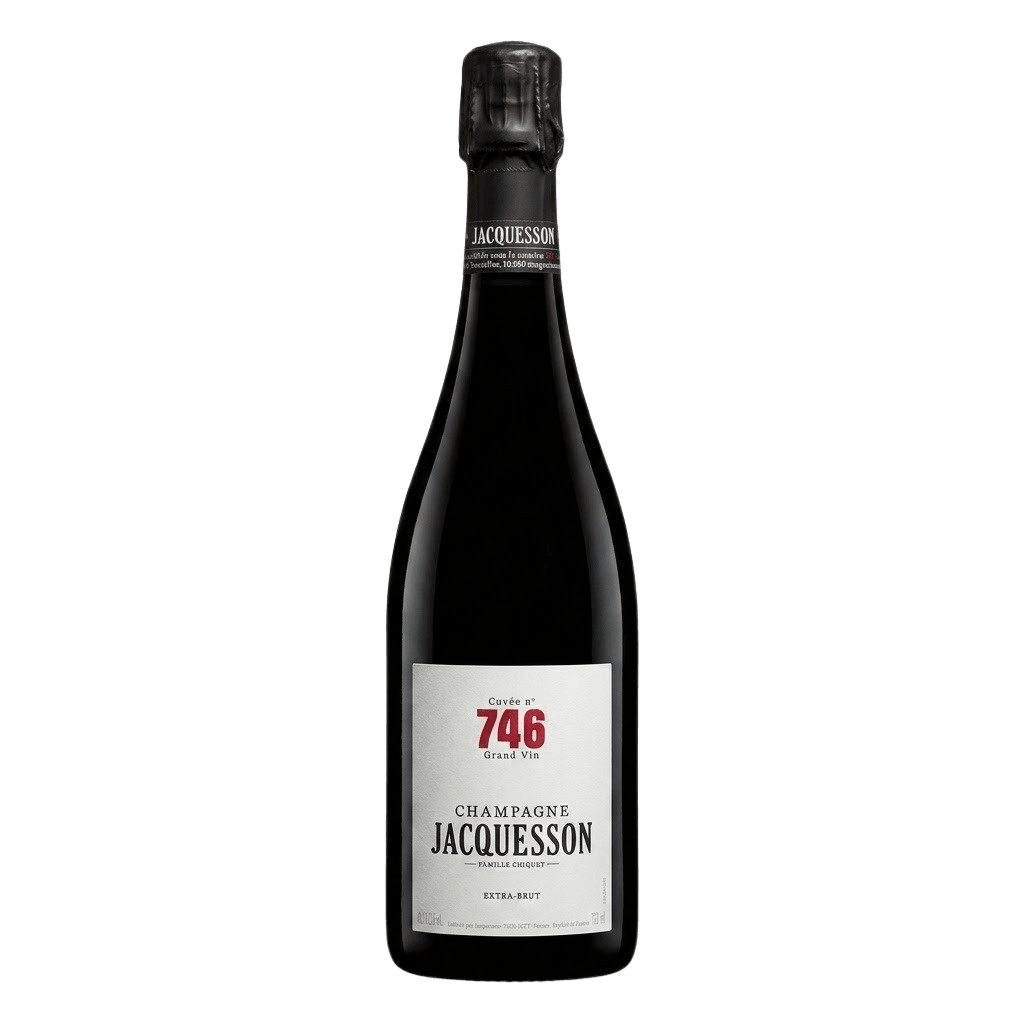
Champagne Jacquesson & Fils
Jacquesson Cuvée n° 746
From 82 EUR from 1 retailers
Jacquesson Cuvée n° 746 represents a singular approach to non-vintage champagne, where Champagne Jacquesson crafts a terroir-driven, vintage-based blend that prioritizes harvest expression over house consistency.
Country
France
Region
Champagne
Number of retailers: 1
XtraWine
European Union
Jacquesson Cuvée n° 746
Standard delivery 1-3 business days
More information
Producer
Champagne Jacquesson & Fils is a family-owned Champagne house in Dizy founded in 1798, recognised as one of the region's most terroir-focused and quality-driven producers. Now led by brothers Jean-Hervé and Laurent Chiquet, the house cultivates approximately 30 hectares of estate vineyards across Grand Cru and Premier Cru villages including Aÿ, Avize and Dizy. Jacquesson is distinguished by its pioneering decision to replace traditional non-vintage Champagne with a numbered cuvée series that transparently reflects the character of each harvest.
Quick Facts
- Location: Dizy, Champagne, France
- Founded: 1798
- Founder: Memmie Jacquesson
- Ownership: Chiquet family (since 1974)
- House identity: Terroir-driven Champagne with single-vineyard focus
- Signature cuvée: Cuvée 700-series (annually numbered)
- Prestige cuvées: Avize Champ Caïn, Dizy Corne Bautray, Aÿ Vauzelle Terme
- Estate holdings: Approximately 30 hectares across Grand Cru and Premier Cru sites
- Key villages: Aÿ, Avize, Dizy, Hautvillers
- Soils: Deep Campanian chalk
- Vinification: Small oak barrels and stainless steel tanks, parcel-by-parcel
- Key styles: Numbered vintage-reflective Cuvée, single-vineyard Champagnes, extended lees ageing
A Heritage of Quality and Royal Favour
Established in 1798 by Memmie Jacquesson, the house rose to prominence in the early 19th century and earned distinction as one of Champagne's most prestigious names. In 1810, Jacquesson was appointed official supplier to Napoleon Bonaparte, a testament to its standing during the Empire.
The house was acquired by the Chiquet family in 1974. Jean-Hervé and Laurent Chiquet, who assumed leadership in the 1980s, transformed Jacquesson's direction by deepening the focus on vineyard expression and challenging the conventions of Champagne blending and labelling.
The Numbered Cuvée and the End of Non-Vintage
In 2000, Jacquesson took the radical step of discontinuing its non-vintage Brut Perfection in favour of a numbered cuvée that changes with each harvest. The Cuvée 700-series—beginning with Cuvée 728—represents a blend of the year's harvest with limited reserve wines, creating a vintage-reflective Champagne that varies in composition, style and personality.
Each release is numbered sequentially rather than by vintage year, emphasising the house's commitment to transparency and the belief that every harvest deserves recognition. This approach has positioned Jacquesson as an innovator willing to redefine the traditional structure of Champagne.
Estate Vineyards and Parcel-by-Parcel Vinification
Jacquesson's approximately 30 hectares are dispersed across some of Champagne's most esteemed sites, including Grand Cru parcels in Aÿ and Avize and Premier Cru holdings in Dizy and Hautvillers. The deep Campanian chalk soils provide exceptional drainage, minerality and conditions suited to extended vine maturation.
Each parcel is vinified separately in a combination of small oak barrels and stainless steel tanks, preserving the distinct character of individual sites. This meticulous approach allows the Chiquets to blend with precision or bottle site-specific expressions as single-vineyard Champagnes.
The estate's single-vineyard cuvées—Avize Champ Caïn, Dizy Corne Bautray and Aÿ Vauzelle Terme—represent the pinnacle of Jacquesson's terroir philosophy, offering concentrated, mineral-driven wines built for decades of evolution.
Craftsmanship, Balance and Time
Jacquesson's winemaking emphasises low yields, minimal intervention and extended lees ageing to develop complexity and texture. The house typically allows wines to rest for several years before disgorgement, building depth while retaining freshness and precision.
The result is a portfolio of Champagnes that balance power with elegance, richness with minerality and structure with aromatic clarity. Whether in the vintage-reflective Cuvée 700-series or the age-worthy single-vineyard bottlings, Jacquesson produces Champagnes that reward patience and reflect the Chiquet family's unwavering commitment to terroir, transparency and time.
Country
Region
Champagne
Champagne is widely regarded as the world's most prestigious sparkling wine region and has become synonymous with celebration, luxury and uncompromising quality. Located in northeastern France, approximately 150 kilometres east of Paris, the region combines centuries of winemaking tradition with exceptional terroir to produce sparkling wines of remarkable elegance and complexity. From legendary maisons to small grower-producers, Champagne represents the benchmark against which all other sparkling wines are measured, and its influence on global wine culture remains unrivalled.
The region's vineyards stretch across five principal districts: Montagne de Reims, Vallée de la Marne, Côte des Blancs, Côte de Sézanne and Côte des Bar. The defining characteristic of Champagne terroir is its chalk-limestone subsoil, which provides excellent drainage, mineral richness and steady water supply essential for producing grapes of exceptional quality. The cool continental climate, moderated by maritime influences, ensures slow ripening and high natural acidity, while the principal grape varieties—Chardonnay, Pinot Noir and Pinot Meunier—each contribute distinct character to the final blend. The region's 17 grand cru villages and 42 premier cru villages represent the finest expression of Champagne terroir, producing grapes of outstanding concentration and finesse.
Champagne is governed by strict AOC regulations established in 1927, which define geographical boundaries, permitted grape varieties, yields and production methods. The region is home to some of the world's most celebrated houses, including Krug, Louis Roederer, Bollinger, Dom Pérignon, Veuve Clicquot, Pol Roger, Salon, Taittinger and Moët & Chandon. These maisons have upheld the art of blending and cellar ageing for generations, producing prestige cuvées and vintage expressions that rank among the most collectible wines in the world. Alongside these historic houses, a growing number of grower-producers cultivate and vinify their own grapes, offering terroir-focused expressions that reveal the diversity and depth of Champagne's varied terroirs.
Whether exploring grand cru villages, prestige cuvées or historic maisons, Champagne offers an unparalleled journey through the birthplace of the world's finest sparkling wines. Discover Champagne Champagnes, compare prices from trusted merchants across Europe and find the best offers with Sipfind.
Grapes
Chardonnay is one of the world’s most important and prestigious white wine grapes, renowned for its remarkable versatility and ability to reflect both terroir and winemaking style. Most famously associated with Burgundy and Champagne in France, Chardonnay is cultivated across virtually every major wine-producing country and can produce everything from precise, mineral-driven whites to rich, complex wines with exceptional ageing potential.
In Burgundy, Chardonnay reaches some of its most celebrated expressions. The limestone-rich vineyards of Chablis are known for wines combining vibrant acidity, citrus character and mineral precision, while the Côte de Beaune, particularly appellations such as Meursault, Puligny-Montrachet and Chassagne-Montrachet, produces some of the world’s most sought-after and age-worthy white wines.
Chardonnay also plays a fundamental role in Champagne, where it contributes freshness, finesse and acidity to blends alongside Pinot Noir and Meunier. When produced exclusively from Chardonnay, the resulting Champagne is known as Blanc de Blancs, a style prized for its elegance, precision and capacity to develop considerable complexity with extended ageing.
The grape’s character varies significantly according to climate, terroir and winemaking. Cooler regions can produce wines showing citrus, green apple, white flowers and mineral notes, while warmer conditions can bring peach, melon and tropical-fruit character. Oak fermentation, barrel ageing and malolactic fermentation can introduce additional layers of toast, vanilla, butter and hazelnut, demonstrating Chardonnay’s exceptional stylistic range.
Beyond France, Chardonnay has established important expressions in California, Australia, New Zealand, South Africa and numerous other wine regions. From the mineral whites of Chablis and the great vineyards of Burgundy to Blanc de Blancs Champagne and modern New World interpretations, Chardonnay’s combination of versatility, complexity and terroir expression has established it as one of the defining grape varieties of fine wine.
Meunier, historically known as Pinot Meunier, is one of the three principal grape varieties of Champagne, alongside Chardonnay and Pinot Noir. Valued for its fresh fruit character, reliable ripening and adaptability to cooler vineyard sites, Meunier plays an essential role in many Champagne blends, contributing aromatic expression, roundness and approachability.
The grape is particularly important in the Vallée de la Marne, where it thrives across vineyards that can be more challenging for Chardonnay and Pinot Noir. Meunier buds later and ripens relatively early, helping reduce its exposure to damaging spring frosts while allowing it to reach maturity reliably in Champagne’s cool climate. These characteristics have made it an important component of the region’s viticultural identity.
In Champagne, Meunier typically contributes flavours and aromas of red apple, pear, plum, citrus and fresh red fruits, depending on terroir, ripeness and winemaking. Its naturally generous fruit profile can provide softness and accessibility to blends, complementing the finesse and acidity of Chardonnay and the structure and depth associated with Pinot Noir.
Although best known as a blending variety, Meunier can also produce distinctive single-variety Champagnes, demonstrating greater complexity and terroir expression than its historical reputation sometimes suggests. A growing number of producers highlight individual Meunier vineyards and parcels, bringing renewed attention to the grape as an important expression of Champagne in its own right.
From classic non-vintage blends to increasingly sought-after single-variety bottlings, Meunier’s combination of fresh fruit, adaptability and aromatic character makes it one of Champagne’s defining grape varieties.
History and Style
Jacquesson Cuvée n° 746 is the flagship non-vintage champagne of Champagne Jacquesson & Fils, a distinguished grower-producer estate with roots dating to 1798. Based on the 2018 harvest and blended with reserve wines from earlier vintages, this cuvée embodies the house's philosophy of allowing each year's terroir and climate to shape the wine's character rather than conforming to a standardized taste profile.
Quick Facts
- Producer: Champagne Jacquesson & Fils
- Classification: Grower-Producer Champagne (Récoltant-Manipulant)
- Region: Champagne
- Appellation: Champagne AOC
- Country: France
- Style: Terroir-driven non-vintage champagne, vintage-based assemblage
- Grape Composition: Chardonnay, Pinot Noir, Pinot Meunier blend (proportions vary by release)
- Ageing Potential: 5-10+ years from release
- Alcohol (ABV): 12-12.5%
- Tasting Profile: Citrus, white flowers, brioche, chalky minerality, vibrant acidity
- Food Pairing: Shellfish, white fish, poultry, soft cheeses, caviar
- Serving Temperature: 8-10°C
- Bottle Status: Flagship
- Vintage: Non-Vintage (based on 2018 harvest)
House Style and Blending Philosophy
Champagne Jacquesson farms premier and grand cru parcels across Aÿ, Dizy, and Avize, producing wines of exceptional purity and precision. The numbered cuvée system, introduced in the early 2000s, revolutionized the approach to non-vintage champagne by treating each release as a unique vintage-dated assemblage. The base wine typically comprises Chardonnay, Pinot Noir, and Pinot Meunier sourced from the estate's top vineyards, with extended lees ageing and minimal dosage ensuring the wine's integrity and ageability.
Character and Ageing
On the palate, Cuvée n° 746 reveals crystalline fruit, vibrant acidity, and remarkable depth for a non-vintage champagne. Expect flavors of citrus, white flowers, brioche, and chalky minerality, with a structure and complexity that rival many vintage champagnes. The wine's tension and precision make it versatile at table yet compelling enough for contemplative drinking.
For collectors and champagne enthusiasts seeking authenticity and terroir expression over brand uniformity, Jacquesson Cuvée n° 746 represents a benchmark in artisanal champagne production. Compare prices across premium retailers on Sipfind to discover this exceptional bottling.