
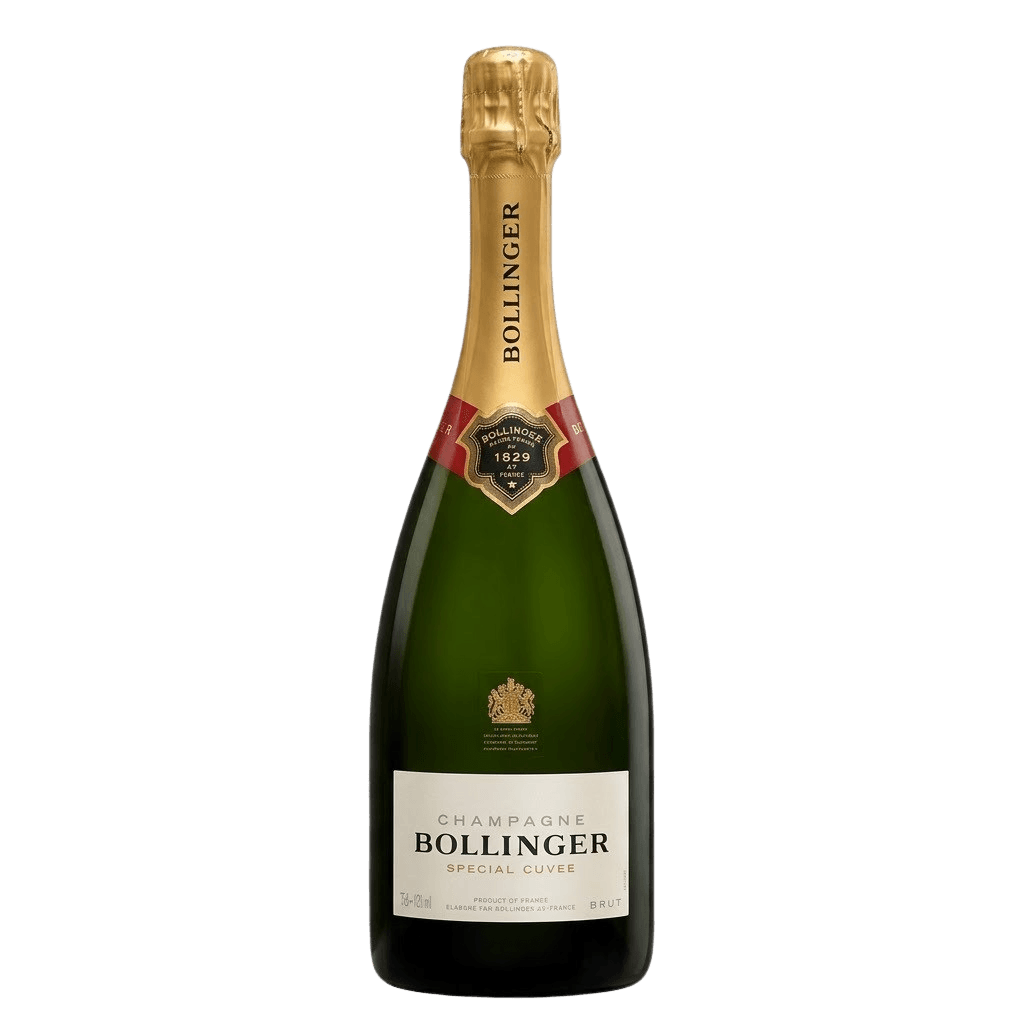
Champagne Bollinger
Bollinger – Special Cuvée
From 50 EUR from 4 retailers
Bollinger Special Cuvée represents the signature style of Champagne Bollinger—a powerful, complex non-vintage Champagne crafted primarily from Pinot Noir and aged extensively for exceptional depth and character.
Country
France
Region
Champagne
Number of retailers: 4
Chateaunet
France
Bollinger – Special Cuvée
Standard delivery 1-3 business days
Philipson Wine ApS
Sweden
Bollinger – Special Cuvée
Standard delivery 1-3 business days
You save up to 10 EUR, where 10 EUR is the difference between the highest price and the lowest price
XtraWine
European Union
Bollinger – Special Cuvée
Standard delivery 1-3 business days
Lobenbergs Gute Weine GmbH & Co. KG
Germany
Bollinger – Special Cuvée
Standard delivery 1-3 business days
More information
Producer
Founded in 1829, Champagne Bollinger is one of the world's most celebrated Grande Marque houses and among the last significant family-owned producers in Champagne. Based in Aÿ in the heart of the Montagne de Reims and still controlled by the family, the house has remained dedicated to traditional methods for nearly two centuries. Its Champagnes are distinguished by structure, concentration and profound aromatic complexity—wines built to age gracefully for decades.
Quick Facts
- Location: Aÿ, Montagne de Reims, Champagne, France
- Founded: 1829
- Founder: Jacques Bollinger
- Ownership: Family-owned since foundation
- House identity: Pinot Noir-led Champagne with barrel fermentation
- Signature cuvée: Special Cuvée
- Prestige cuvées: La Grande Année, R.D. (Récemment Dégorgé), Vieilles Vignes Françaises
- Estate vineyards: Approximately 178 hectares, predominantly Grand Cru and Premier Cru
- Winemaking hallmark: Barrel fermentation in small oak casks
- Key styles: Brut, Vintage, Rosé, Late-release (R.D.), Blanc de Noirs from ungrafted vines
- Dosage approach: Restrained across the range
- Ageing potential: 20 to 30+ years for prestige cuvées
A Family House in Aÿ
Jacques Bollinger, a German-born merchant, and Athanase de Villermont founded the house in 1829 under the name Renaudin-Bollinger & Cie. Within a generation, the Bollinger family assumed full ownership and control of the estate. The house passed through successive family members, including the formidable Madame Élisabeth "Lily" Bollinger, who guided the house through the mid-20th century and became one of Champagne's most influential figures.
Today, the house remains independent and family-controlled, a rare position among Champagne's historic grandes marques. Its headquarters and cellars continue to occupy the original site in Aÿ, a village renowned for its Grand Cru Pinot Noir.
The Pinot Noir Foundation
Pinot Noir forms the structural backbone of every Bollinger cuvée, typically accounting for 60% or more of the blend. The house owns approximately 178 hectares of vineyards, the majority classified as Grand Cru or Premier Cru, concentrated around Aÿ, Bouzy, Verzenay and Louvois—some of Champagne's finest sites for Pinot Noir.
This emphasis on estate fruit and Pinot Noir dominance gives Bollinger its characteristic density, vinous power and ability to develop complexity with extended cellaring. Chardonnay and Pinot Meunier contribute freshness and balance, but it is Pinot Noir that defines the house style.
Barrel Fermentation and Extended Ageing
Bollinger is one of the few Champagne houses to maintain extensive barrel fermentation. A significant portion of the base wines, particularly from the estate's finest parcels, ferments in small oak casks, adding richness, texture and aromatic depth uncommon in modern Champagne production.
Extended lees ageing further distinguishes the house. Special Cuvée, the signature non-vintage cuvée, rests for a minimum of three years on the lees—well beyond the legal requirement. La Grande Année, the vintage prestige cuvée, matures for five to six years before release. R.D., or Récemment Dégorgé, takes this philosophy to its conclusion: fully mature wines disgorged only when deemed ready, often after more than a decade on the lees.
The legendary Vieilles Vignes Françaises comes entirely from ungrafted, pre-phylloxera Pinot Noir vines in the Aÿ lieu-dit of Chaudes Terres and Clos Saint-Jacques. Produced in tiny quantities and released only in exceptional vintages, it represents one of Champagne's rarest and most collectible expressions.
Structured Champagne Built for Time
Across the portfolio, Bollinger Champagnes combine vinous weight with elegance, displaying notes of toasted brioche, hazelnut, stone fruit and spice. The house's restrained dosage approach preserves clarity and allows the structure and complexity developed through barrel fermentation and long ageing to remain at the forefront.
The result is a collection of Champagnes that reward patience. Whether the multi-vintage complexity of Special Cuvée or the profound depth of R.D., Bollinger remains a benchmark for traditional craftsmanship and wines built to evolve over many years.
Country
Region
Champagne
Champagne is widely regarded as the world's most prestigious sparkling wine region and has become synonymous with celebration, luxury and uncompromising quality. Located in northeastern France, approximately 150 kilometres east of Paris, the region combines centuries of winemaking tradition with exceptional terroir to produce sparkling wines of remarkable elegance and complexity. From legendary maisons to small grower-producers, Champagne represents the benchmark against which all other sparkling wines are measured, and its influence on global wine culture remains unrivalled.
The region's vineyards stretch across five principal districts: Montagne de Reims, Vallée de la Marne, Côte des Blancs, Côte de Sézanne and Côte des Bar. The defining characteristic of Champagne terroir is its chalk-limestone subsoil, which provides excellent drainage, mineral richness and steady water supply essential for producing grapes of exceptional quality. The cool continental climate, moderated by maritime influences, ensures slow ripening and high natural acidity, while the principal grape varieties—Chardonnay, Pinot Noir and Pinot Meunier—each contribute distinct character to the final blend. The region's 17 grand cru villages and 42 premier cru villages represent the finest expression of Champagne terroir, producing grapes of outstanding concentration and finesse.
Champagne is governed by strict AOC regulations established in 1927, which define geographical boundaries, permitted grape varieties, yields and production methods. The region is home to some of the world's most celebrated houses, including Krug, Louis Roederer, Bollinger, Dom Pérignon, Veuve Clicquot, Pol Roger, Salon, Taittinger and Moët & Chandon. These maisons have upheld the art of blending and cellar ageing for generations, producing prestige cuvées and vintage expressions that rank among the most collectible wines in the world. Alongside these historic houses, a growing number of grower-producers cultivate and vinify their own grapes, offering terroir-focused expressions that reveal the diversity and depth of Champagne's varied terroirs.
Whether exploring grand cru villages, prestige cuvées or historic maisons, Champagne offers an unparalleled journey through the birthplace of the world's finest sparkling wines. Discover Champagne Champagnes, compare prices from trusted merchants across Europe and find the best offers with Sipfind.
Grapes
Chardonnay is one of the world’s most important and prestigious white wine grapes, renowned for its remarkable versatility and ability to reflect both terroir and winemaking style. Most famously associated with Burgundy and Champagne in France, Chardonnay is cultivated across virtually every major wine-producing country and can produce everything from precise, mineral-driven whites to rich, complex wines with exceptional ageing potential.
In Burgundy, Chardonnay reaches some of its most celebrated expressions. The limestone-rich vineyards of Chablis are known for wines combining vibrant acidity, citrus character and mineral precision, while the Côte de Beaune, particularly appellations such as Meursault, Puligny-Montrachet and Chassagne-Montrachet, produces some of the world’s most sought-after and age-worthy white wines.
Chardonnay also plays a fundamental role in Champagne, where it contributes freshness, finesse and acidity to blends alongside Pinot Noir and Meunier. When produced exclusively from Chardonnay, the resulting Champagne is known as Blanc de Blancs, a style prized for its elegance, precision and capacity to develop considerable complexity with extended ageing.
The grape’s character varies significantly according to climate, terroir and winemaking. Cooler regions can produce wines showing citrus, green apple, white flowers and mineral notes, while warmer conditions can bring peach, melon and tropical-fruit character. Oak fermentation, barrel ageing and malolactic fermentation can introduce additional layers of toast, vanilla, butter and hazelnut, demonstrating Chardonnay’s exceptional stylistic range.
Beyond France, Chardonnay has established important expressions in California, Australia, New Zealand, South Africa and numerous other wine regions. From the mineral whites of Chablis and the great vineyards of Burgundy to Blanc de Blancs Champagne and modern New World interpretations, Chardonnay’s combination of versatility, complexity and terroir expression has established it as one of the defining grape varieties of fine wine.
Meunier, historically known as Pinot Meunier, is one of the three principal grape varieties of Champagne, alongside Chardonnay and Pinot Noir. Valued for its fresh fruit character, reliable ripening and adaptability to cooler vineyard sites, Meunier plays an essential role in many Champagne blends, contributing aromatic expression, roundness and approachability.
The grape is particularly important in the Vallée de la Marne, where it thrives across vineyards that can be more challenging for Chardonnay and Pinot Noir. Meunier buds later and ripens relatively early, helping reduce its exposure to damaging spring frosts while allowing it to reach maturity reliably in Champagne’s cool climate. These characteristics have made it an important component of the region’s viticultural identity.
In Champagne, Meunier typically contributes flavours and aromas of red apple, pear, plum, citrus and fresh red fruits, depending on terroir, ripeness and winemaking. Its naturally generous fruit profile can provide softness and accessibility to blends, complementing the finesse and acidity of Chardonnay and the structure and depth associated with Pinot Noir.
Although best known as a blending variety, Meunier can also produce distinctive single-variety Champagnes, demonstrating greater complexity and terroir expression than its historical reputation sometimes suggests. A growing number of producers highlight individual Meunier vineyards and parcels, bringing renewed attention to the grape as an important expression of Champagne in its own right.
From classic non-vintage blends to increasingly sought-after single-variety bottlings, Meunier’s combination of fresh fruit, adaptability and aromatic character makes it one of Champagne’s defining grape varieties.
History and Style
Bollinger Special Cuvée is the flagship non-vintage Champagne of Champagne Bollinger, one of the most esteemed Grande Marque houses in the region. This core range offering embodies the house's distinctive philosophy of power, structure, and complexity, setting the benchmark for what a non-vintage prestige Champagne can achieve.
Quick Facts
- Producer: Champagne Bollinger
- Classification: Grande Marque
- Region: Champagne
- Appellation: Champagne AOC
- Country: France
- Style: Non-vintage Champagne, full-bodied and vinous
- Grape Composition: Pinot Noir-dominant blend (typically 60%), Chardonnay, Pinot Meunier
- Ageing Potential: 5-10 years from purchase
- Alcohol (ABV): 12%
- Tasting Profile: Baked apple, hazelnut, brioche, honey, citrus, mineral, fine mousse
- Food Pairing: Oysters, seafood, poultry, soft cheeses, aperitif
- Serving Temperature: 8-10°C
- Bottle Status: Flagship
- Vintage: Non-Vintage
House Style and Blending Philosophy
Champagne Bollinger's holdings span premier and grand cru vineyards across Aÿ, Bouzy, and Verzenay, providing exceptional Pinot Noir that forms the backbone of Special Cuvée. The house maintains traditional practices including fermentation in small oak barrels and extended ageing on lees—typically five to ten years before release, far exceeding standard non-vintage requirements. This dedication to time and terroir creates remarkable consistency and depth.
Character and Ageing
The resulting Champagne displays a powerful, vinous character with rich fruit intensity balanced by brioche complexity and mineral precision. The palate reveals layers of baked apple, hazelnut, honey, and subtle spice, supported by fine mousse and persistent length. The high proportion of Pinot Noir—typically 60% or more—gives Special Cuvée its signature structure and ageing potential uncommon in non-vintage Champagne.
Bollinger Special Cuvée pairs beautifully with oysters, seafood, poultry, and soft cheeses, while its complexity allows it to stand alone as an aperitif. Compare prices across premium retailers on Sipfind to discover the best value for this iconic Champagne.